Introduction
In 2026, freelancers and solo entrepreneurs face an unprecedented challenge: the demand for high-quality visual content has never been higher, yet budgets and time remain painfully constrained. Social media algorithms favor eye-catching graphics, product listings require professional photography, and marketing campaigns demand consistent brand imagery. For the overwhelmed entrepreneur juggling client work, administrative tasks, and creative output, traditional design workflows—hiring freelance designers, learning complex software like Photoshop, or settling for generic stock photos—consume hours that could be spent on revenue-generating activities.
This is where the paradigm shift from manual creative work to AI-powered visual production becomes transformative. Enter MidJourney V7, the latest iteration of the groundbreaking image generation platform that’s redefining what’s possible for small businesses operating with lean resources. Unlike previous versions, MidJourney V7 introduces unprecedented text rendering capabilities, enhanced coherence across style transfers, and intuitive prompt understanding that dramatically reduces the learning curve for non-designers.
For freelancers and solo entrepreneurs overwhelmed with administrative tasks, MidJourney V7 represents more than just a design tool—it’s a strategic implementation of ai efficiency for small business. By automating the visual content creation pipeline, entrepreneurs can reclaim 10 to 15 hours weekly, redirect resources toward client acquisition, and maintain a professional brand presence without the traditional overhead of design agencies or expensive software subscriptions. This article explores how MidJourney V7 specifically addresses the efficiency bottlenecks that plague small business operations in 2026.
Key Concepts of AI Efficiency
Understanding how ai efficiency for small business actually works requires examining three foundational concepts that determine whether AI adoption saves time or creates new complications.
Cognitive Offloading
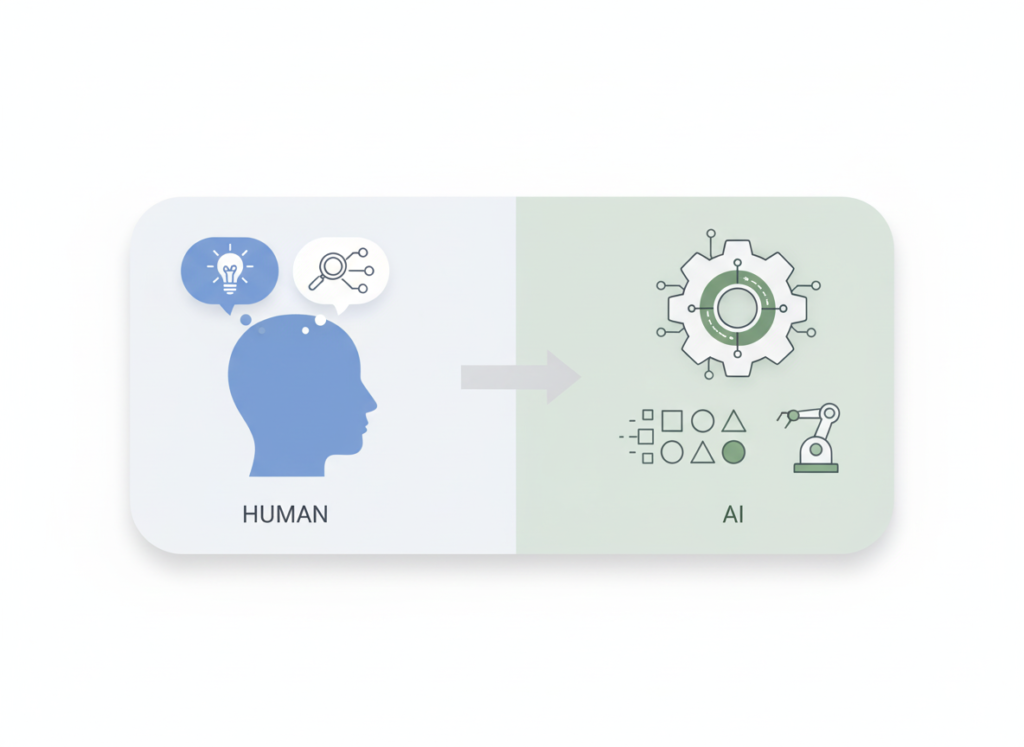
Cognitive offloading refers to the strategic transfer of mentally demanding tasks from human decision-makers to AI systems. For small business owners, every creative decision carries a cognitive cost. When a freelance marketing consultant needs to create five social media graphics for a client campaign, the traditional workflow involves brainstorming concepts, sketching layouts, choosing color palettes, sourcing images, and executing the design in tools like Canva or Adobe Creative Suite. Each decision point—from font selection to image composition—drains mental energy that could be allocated to strategic thinking or client relationship management.
MidJourney V7 enables cognitive offloading by accepting natural language descriptions and producing publication-ready visuals. Instead of micromanaging design elements, the entrepreneur describes the desired outcome: “a minimalist product mockup featuring organic skincare bottles on marble, soft morning light, Instagram aesthetic.” The AI handles composition, lighting, color harmony, and style consistency. This isn’t laziness—it’s strategic resource allocation. The entrepreneur’s expertise remains in understanding brand messaging and campaign strategy, while the AI handles execution-level creative decisions.
In practical business scenarios, cognitive offloading through MidJourney V7 means a solo consultant can generate client presentation visuals during a 15-minute coffee break rather than blocking out three hours for design work. The mental bandwidth freed up allows for higher-value activities like refining service offerings or networking with potential clients.
Context Switching Cost
Context switching—the productivity penalty incurred when shifting between different types of work—represents one of the most insidious efficiency killers for freelancers and solo entrepreneurs. Research in cognitive psychology demonstrates that transitioning from analytical work (writing a proposal) to creative work (designing a logo) to administrative work (invoicing) creates a compounding time loss of 20 to 40 percent as the brain reorients to each task’s unique demands.
For small businesses relying on traditional design workflows, visual content creation forces a particularly expensive context switch. A freelance writer working on client articles must exit their writing flow, open design software, navigate unfamiliar interfaces, make aesthetic decisions using a completely different skill set, and then attempt to return to analytical writing. The cognitive transition alone can consume 30 minutes, even before actual design work begins.
MidJourney V7 minimizes context switching cost by integrating into natural workflow patterns. Because the tool operates through conversational prompts rather than complex software interfaces, entrepreneurs can generate needed visuals without leaving their primary work environment. A freelance business coach writing a workshop workbook can describe needed diagrams in plain English, receive AI-generated options, select the best fit, and immediately return to writing—all within the same focused work session. The ai efficiency for small business here isn’t just about faster image creation; it’s about preserving the deep focus states that drive meaningful productivity.
Workflow Orchestration
Workflow orchestration describes the systematic coordination of multiple tasks, tools, and processes into coherent, repeatable systems. For small businesses, effective workflow orchestration transforms chaotic reactivity into predictable productivity. However, traditional creative workflows resist systematization because design quality depends heavily on subjective judgment and iterative refinement.
MidJourney V7’s style transfer capabilities and parameter controls enable workflow orchestration for visual content in ways previously impossible for non-designers. A freelance e-commerce consultant can establish a repeatable system: upload client brand guidelines as reference images, define core style parameters once, then generate unlimited product mockups, social media graphics, and advertising visuals maintaining perfect brand consistency. The orchestration happens through saved prompts, style references, and parameter templates that ensure every generated image aligns with established brand standards.
This orchestration capability directly impacts small business efficiency by eliminating the need for extensive revision cycles. When a solo entrepreneur uses generic design tools, achieving brand consistency across multiple graphics requires manual effort to match colors, fonts, and visual styles. With MidJourney V7’s style transfer and reference systems, brand consistency becomes automatic. A freelance consultant managing five client brands can switch between visual identities simply by loading different reference sets—no manual style matching required.
The business result of effective workflow orchestration through AI image generation is predictable, scalable visual content production. What previously required outsourcing to designers at $50 to $150 per graphic now becomes an internal, on-demand capability with fixed monthly costs and unlimited output potential.
How MidJourney V7 Helps Efficiency

MidJourney V7 introduces specific features engineered to address the efficiency challenges facing freelancers and solo entrepreneurs overwhelmed with administrative tasks. Understanding how each capability translates to tangible business results enables strategic implementation.
Advanced Text Rendering and Typography Control
What It Is: MidJourney V7 represents a breakthrough in AI-generated typography, allowing users to specify text content directly within image prompts with unprecedented accuracy. Unlike earlier versions that struggled with legible text, V7 can produce crisp, professional lettering across diverse fonts, sizes, and compositional placements.
How It Works: Users incorporate desired text within quotation marks in their prompts, along with style specifications. For example: “modern coffee shop logo, the words ‘Daily Grind Cafe’ in elegant serif font, minimalist design, earth tones.” The AI generates multiple options with accurately rendered text, eliminating the need for post-production typography work in separate design software.
Business Result: This capability directly reduces the design workflow for freelancers creating marketing materials, social media posts, and branding elements. What traditionally required designing the visual in MidJourney, exporting to Photoshop or Canva, adding text layers, adjusting positioning, and exporting final files now happens in a single generation step.
Realistic Usage Scenario: A freelance social media manager handling three client accounts needs to produce 15 branded quote graphics weekly. Previously, this meant generating background images in MidJourney, importing to Canva, manually adding text with appropriate formatting, and adjusting layouts—consuming roughly six hours weekly. With V7’s text rendering, the manager generates complete graphics directly: “inspirational quote ‘Success is built daily’ in modern sans-serif, gradient sunset background, minimalist composition.” The same 15 graphics now require two hours, reclaiming four hours for client strategy work or business development.
Illustration and Drawing Assistant Capabilities
What It Is: MidJourney V7’s enhanced illustration capabilities transform rough sketches, hand-drawn concepts, or verbal descriptions into polished, professional illustrations across multiple artistic styles—from technical diagrams to whimsical watercolors to precise vector-style graphics.
How It Works: Users can upload rough sketches as reference images or describe needed illustrations in natural language. The AI interprets the concept and produces refined versions maintaining the original idea while applying professional artistic execution. Style parameters allow specification of illustration types: “convert this sketch to clean line art suitable for technical documentation” or “transform into whimsical watercolor illustration for children’s content.”
Business Result: Solo entrepreneurs gain access to custom illustration capabilities previously requiring $200 to $800 per commissioned piece from professional illustrators. This democratizes visual communication for businesses that rely on explainer graphics, infographics, custom icons, or branded illustrations but lack design budgets.
Realistic Usage Scenario: A freelance business consultant developing a workshop on productivity frameworks needs visual diagrams explaining time management concepts. Previously, this required either hiring an illustrator (costly and time-consuming) or creating amateur diagrams in PowerPoint (unprofessional appearance). Using V7’s illustration capabilities, the consultant sketches rough flowcharts by hand, photographs them, uploads as references, and prompts: “convert to clean, professional business diagram, corporate color palette, suitable for presentation slides.” Within minutes, publication-quality diagrams emerge, elevating the consultant’s perceived expertise and allowing them to focus on content development rather than design execution.
Image Generation with Style Transfer Consistency
What It Is: MidJourney V7’s refined style transfer allows users to establish a visual signature and apply it consistently across unlimited image generations. By providing reference images that define preferred aesthetic qualities, users ensure every generated image maintains cohesive brand identity.
How It Works: Users upload one to five reference images representing their desired visual style—whether that’s moody film photography, bright flat-lay product shots, or minimalist line art. MidJourney analyzes these references and applies their aesthetic qualities to new image generations. Parameters allow control over how strongly the style influences results, enabling flexibility while maintaining consistency.
Business Result: This feature solves the brand consistency challenge that plagues small businesses attempting to maintain professional visual identity across marketing channels. When every social media post, website graphic, and marketing material shares cohesive visual language, businesses project competence and professionalism that builds customer trust.
Realistic Usage Scenario: A freelance e-commerce consultant helping clients launch Shopify stores needs to create product lifestyle images for 20 different SKUs. Traditionally, this required either expensive product photography sessions or mismatched stock photos that undermine brand cohesion. The consultant photographs one set of on-brand product shots featuring specific lighting, composition style, and color grading. These become style references. For each subsequent product, the consultant prompts: “organic skincare serum bottle on minimalist marble surface, morning light” while applying the style reference. Every generated image maintains perfect visual consistency, creating a cohesive brand presence across the entire product catalog. Time investment drops from two days coordinating photoshoots to three hours of AI-guided generation.
Natural Language Prompt Refinement and Iteration
What It Is: MidJourney V7 introduces conversational prompt understanding that interprets vague descriptions, understands context, and allows iterative refinement through natural dialogue rather than technical parameter syntax.
How It Works: Instead of mastering complex prompt engineering with specific keywords and parameter codes, users describe what they want in plain language. “I need something like the first image but with warmer tones and the subject positioned more to the left” produces appropriate adjustments. The system maintains context across iterations, learning user preferences and refining outputs through natural conversation.
Business Result: This dramatically reduces the learning curve barrier that prevents many overwhelmed entrepreneurs from adopting AI tools. When tools require extensive technical training, they create new administrative burdens rather than reducing them. Natural language interaction means entrepreneurs can achieve professional results from their first session rather than investing weeks in skill development.
Realistic Usage Scenario: A solo entrepreneur launching a coaching practice needs a professional headshot for their website and LinkedIn profile but cannot afford $300 for professional photography. They describe to MidJourney V7: “professional headshot of a confident business coach, warm smile, modern office background, corporate but approachable.” The first generation is close but slightly too formal. Rather than struggling with technical parameters, they simply state: “same concept but more casual, maybe outdoors, natural lighting.” The refinement happens conversationally, producing a polished professional image within 10 minutes—saving hundreds of dollars and hours of scheduling professional photography sessions.
Ready to cut admin time in half? Try MidJourney V7 ?https://www.midjourney.com/
Use Cases: Small Business & Freelancer Efficiency
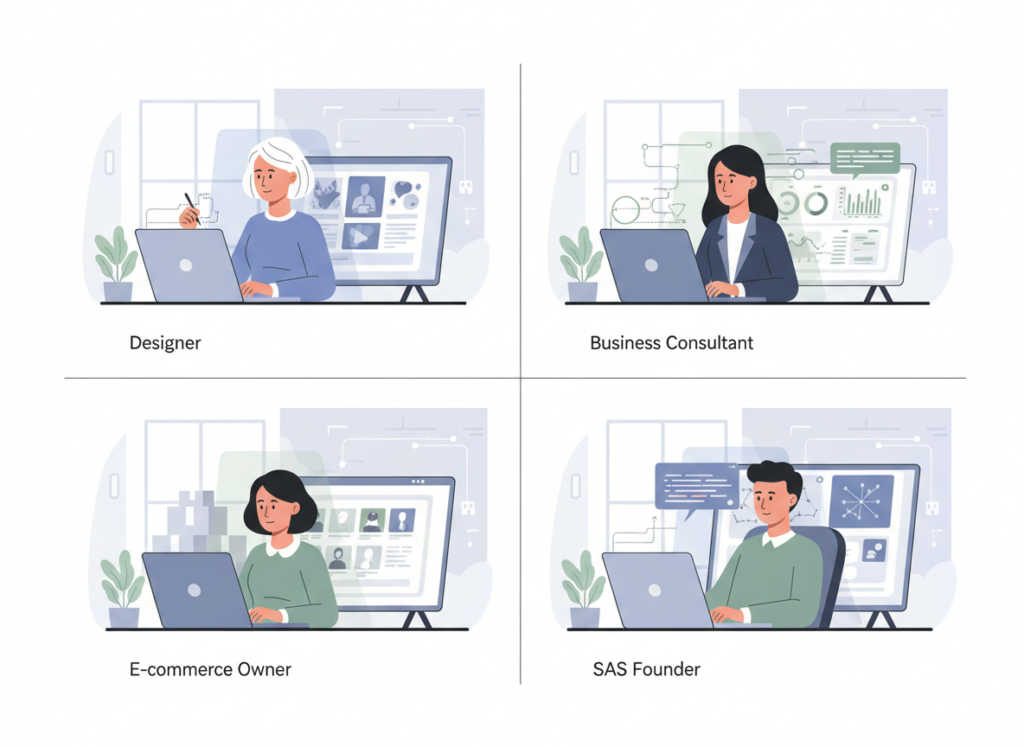
Real-world implementation of ai efficiency for small business through MidJourney V7 varies significantly based on business model and workflow demands. These four personas illustrate how specific freelancer and entrepreneur archetypes achieve measurable efficiency gains.
Creative Freelancer: Brand Designer and Content Creator
Old Workflow Reality: Maya runs a freelance branding studio serving small business clients. Her typical branding package includes logo concepts, brand style guides, social media templates, and marketing collateral. For each client project, she spent:
- 4 hours on mood board research and concept development
- 6 hours creating logo variations in Adobe Illustrator
- 5 hours designing social media templates
- 3 hours producing marketing mockups (business cards, packaging concepts)
Total: 18 hours per branding package, limiting her to roughly six clients monthly while leaving no time for business development or personal creative projects. Client revisions added another 4 to 6 hours per project. Her effective hourly rate suffered because design execution consumed time better spent on creative strategy.
New AI-Enhanced Workflow: Maya now uses MidJourney V7 for conceptualization and mockup production:
- 1 hour defining client brand strategy and style direction
- 2 hours generating 50+ logo concepts using illustration and drawing assistant capabilities, presenting top 10 to clients
- 1.5 hours creating social media templates by generating branded graphics with text rendering
- 1 hour producing realistic marketing mockups using style transfer to maintain brand consistency
Total: 5.5 hours per branding package for initial delivery. Revision cycles drop to 1 to 2 hours because clients choose from abundant AI-generated options rather than requesting modifications to single concepts. Maya now serves 12 clients monthly, doubling revenue while reclaiming 15 hours weekly for strategic consulting services that command premium rates.
Time Saved, Clarity Gained, Stress Reduced: By offloading execution-level design work to AI, Maya experiences reduced decision fatigue. She focuses energy on understanding client vision and brand positioning—the strategic work she enjoys and excels at—while AI handles the technical production. Client satisfaction improves because they see more options and achieve results faster.
“With MidJourney V7, I automated what felt like 70 percent of my production work. I’m not designing less—I’m designing smarter. My clients get better results because I can explore 20 concept directions instead of three, and I actually have time to grow my business now instead of just executing projects.” — Maya Chen, Brand Designer
Solo Consultant: Business Strategy and Workshop Facilitator
Old Workflow Reality: James provides business strategy consulting and runs corporate workshops on leadership and productivity. His challenge wasn’t generating ideas but creating professional supporting materials. Each workshop required:
- 8 hours developing PowerPoint presentations with custom diagrams
- 3 hours sourcing appropriate stock photography for slides
- 4 hours creating participant workbooks with visual elements
- 2 hours designing promotional materials for workshop marketing
Total: 17 hours of design work for each workshop offering, work he found frustrating because it pulled him from his expertise in business strategy. He frequently settled for generic PowerPoint templates that undermined his premium positioning.
New AI-Enhanced Workflow: James leverages MidJourney V7’s illustration and image generation:
- 2 hours creating presentation slides using AI-generated diagrams from rough sketches and concept descriptions
- 30 minutes generating cohesive slide imagery using style transfer to maintain visual consistency
- 1 hour producing workbook visuals and infographics
- 30 minutes creating workshop promotional graphics with professional photography-quality images
Total: 4 hours design work per workshop. More importantly, the visual quality now matches his premium pricing, strengthening his brand positioning. He uses reclaimed time to develop new workshop offerings, expanding his service catalog from three to seven distinct programs.
Time Saved, Clarity Gained, Stress Reduced: James reports decreased anxiety about visual presentation. Previously, the gap between his strategic expertise and amateur design skills created impostor syndrome—he worried clients judged his capabilities by his PowerPoint aesthetics. AI-generated professional visuals align his materials with his expertise, increasing confidence and client conversion rates.
“I spent a decade avoiding design work because I wasn’t good at it. MidJourney V7 doesn’t just save time—it eliminates a source of professional insecurity. My workshop materials now look like they came from a major consulting firm, which they should, given my experience. That visual credibility translates directly to higher fees and more bookings.” — James Peterson, Business Consultant
E-Commerce Owner: Online Retailer and Product Developer
Old Workflow Reality: Tasha operates a Shopify store selling sustainable home goods. Visual content creation represented her largest operational bottleneck:
- Product photography: $400 per photoshoot covering 5 to 8 products
- Social media content: 10 hours weekly creating posts, stories, and promotional graphics
- Seasonal campaign visuals: hiring designers at $75/hour for 8 to 12 hours per campaign
- Email marketing graphics: 2 hours weekly using Canva templates
Total: Roughly $2,000 monthly on visual content plus 18 hours of her personal time. The cost prevented her from testing new product lines (which required upfront photography investment) and limited her social media posting frequency, directly impacting organic reach.
New AI-Enhanced Workflow: Tasha uses MidJourney V7 for comprehensive visual content:
- Product lifestyle images: Generates unlimited variations of products in styled environments using one reference photo per item
- Social media content: 2 hours weekly generating scroll-stopping posts with text rendering for promotional copy
- Seasonal campaigns: Creates complete visual libraries in 3 hours using style transfer for brand consistency
- Email marketing: 20 minutes weekly producing on-brand header graphics and product features
Total: $10 monthly MidJourney subscription plus 6 hours personal time. This represents 99 percent cost reduction and 67 percent time savings. More significantly, she now tests new product photography concepts risk-free, validates product ideas with AI-generated mockups before ordering inventory, and posts daily instead of three times weekly—tripling organic social media traffic.
Time Saved, Clarity Gained, Stress Reduced: The financial relief transformed Tasha’s business model from constrained cash flow to strategic reinvestment. Money previously spent on photography now funds inventory expansion. The ability to generate unlimited visual content removed the psychological burden of “wasting” expensive photos on low-performing posts.
“MidJourney V7 completely changed my unit economics. I was spending $40 in photography costs for every product before I sold a single unit. Now I can test product concepts with AI-generated mockups, validate demand, and only invest in physical inventory once I know it’ll sell. This isn’t just efficiency—it’s a fundamentally better business model.” — Tasha Williams, E-Commerce Owner
Technical Founder: SaaS Startup and Product Development
Old Workflow Reality: Marcus founded a project management SaaS tool but lacked design resources for marketing materials:
- Landing page graphics: Hired designers at $150/graphic for 5 to 8 hero images
- Feature explanation visuals: $400 for illustration packages showing product capabilities
- Social proof and testimonial graphics: 3 hours weekly creating customer story visuals
- Product update announcements: Generic screenshots that failed to generate excitement
Total: $1,500 to $2,000 monthly design costs plus opportunity cost of delayed launches waiting for designer availability. His technical background made him hesitant to create visual content himself, creating dependencies on external contractors.
New AI-Enhanced Workflow: Marcus uses MidJourney V7 to internalize visual content production:
- Landing page graphics: Generates modern, professional hero images showcasing product benefits in compelling environments
- Feature illustrations: Creates clear, attractive diagrams using drawing assistant capabilities from rough sketches
- Social proof graphics: 30 minutes weekly producing polished customer testimonial visuals with appropriate branding
- Product updates: Generates exciting announcement graphics that drive user engagement
Total: $10 monthly subscription plus 2 hours weekly. He achieves design independence, accelerates launch timelines, and tests marketing messages through rapid visual iteration rather than committing to single expensive designs.
Time Saved, Clarity Gained, Stress Reduced: Marcus values control and iteration speed over absolute time savings. Previously, communicating vision to designers consumed significant mental energy and often resulted in misalignment requiring expensive revisions. AI generation allows him to explore concepts himself, iterate instantly, and maintain creative control while achieving professional results.
“As a technical founder, my instinct is to build rather than explain. MidJourney V7 gives me the visual communication capability I lacked. I can now show potential customers what our product does, not just tell them. That visual storytelling improved our conversion rate by 34 percent in three months.” — Marcus Rodriguez, SaaS Founder
? Streamline your workflow with smart automation. Start free with MidJourney V7 ? https://www.midjourney.com/
Best Practices for Implementing AI Efficiency
Strategic implementation determines whether AI tools like MidJourney V7 deliver promised efficiency gains or create new complexity. These practices optimize adoption for freelancers and solo entrepreneurs overwhelmed with administrative tasks.
Start Small: Target One to Two High-Impact Tasks
The efficiency trap many entrepreneurs fall into is attempting comprehensive AI transformation simultaneously across all business functions. This creates learning curve overwhelm that paradoxically reduces productivity during transition periods. Instead, identify the one or two visual content tasks that consume disproportionate time or money and dedicate initial AI implementation exclusively to those workflows.
For a freelance consultant, this might mean using MidJourney V7 solely for workshop presentation diagrams initially, maintaining existing workflows for other design needs. For an e-commerce owner, focus might center on product lifestyle photography replacement while continuing to use traditional methods for logo design or packaging mockups. This focused approach allows skill development, workflow refinement, and confidence building before expanding AI usage.
The implementation timeline for each targeted task should span two to four weeks of deliberate practice, exploring prompt techniques and building a library of successful approaches before adding additional use cases. This measured progression prevents the scattered adoption that leads entrepreneurs to abandon AI tools before achieving proficiency.
Maintain Human-in-the-Loop Quality Control
AI efficiency for small business does not mean abdicating creative judgment to algorithms. MidJourney V7 excels at execution and exploration but lacks the strategic business context that determines which visuals effectively communicate brand values or resonate with target audiences. Effective implementation treats AI as a powerful assistant producing options for human curation rather than a replacement for strategic decision-making.
Establish a review protocol where every AI-generated visual undergoes intentional evaluation before publication. Ask: Does this align with brand identity? Will my target audience connect with this aesthetic? Does this communicate the intended message clearly? This human-in-the-loop approach ensures quality while capturing efficiency gains. The consultant reviews 20 AI-generated diagram options and selects the three best rather than spending hours creating a single diagram manually—capturing both speed and quality advantages.
Additionally, maintain version control and experimentation documentation. When particular prompts produce exceptional results, save them for future reference. When outputs miss the mark, note what failed and why. This learning system accelerates proficiency and builds institutional knowledge that compounds over time.
Avoid Overloading with Multiple AI Tools Simultaneously
The AI tool landscape in 2026 offers overwhelming options: ChatGPT for writing, MidJourney for images, various automation platforms, scheduling tools, and specialized industry solutions. Enthusiastic entrepreneurs often adopt five to ten AI tools simultaneously, believing more tools equal more efficiency. The reality is tool overload creates integration complexity, subscription cost accumulation, and context-switching penalties that negate efficiency gains.
Focus on mastering one or two core AI capabilities that address your largest bottlenecks before expanding. For most freelancers and solo entrepreneurs overwhelmed with administrative tasks, combining a conversational AI assistant (for writing, analysis, planning) with MidJourney V7 (for visual content) addresses 70 to 80 percent of efficiency opportunities. Additional tools should only be adopted after achieving fluency with core systems and identifying specific gaps those core tools cannot address.
This focused approach also prevents subscription cost creep. Five AI tools at $20 to $50 monthly each rapidly accumulate to $100 to $250 in recurring expenses. Verify return on investment for each tool individually before adding to your technology stack.
Track What AI Is Actually Replacing
Implement simple measurement to verify AI adoption delivers promised efficiency. Before implementing MidJourney V7, track one week of actual time spent on visual content creation tasks: hours devoted to design work, money spent on contractors or stock photography, emotional stress levels associated with creative production. After one month of AI implementation, measure again using identical metrics.
Concrete data prevents self-deception about efficiency gains and identifies where AI adoption succeeds versus where traditional methods remain superior. Many entrepreneurs discover AI excels for certain visual content types (social media graphics, presentation diagrams, product mockups) while traditional methods still prove faster for others (detailed logo design requiring brand committee approval, highly technical illustrations with precise specifications).
This measurement also reveals unexpected benefits. Beyond direct time savings, users often discover AI adoption reduces decision fatigue, lowers anxiety about visual quality, or enables content strategies previously considered impossible due to resource constraints. Tracking these qualitative impacts justifies continued investment even when quantitative time savings prove modest.
Limitations and Considerations
Honest assessment of MidJourney V7’s limitations enables strategic deployment while avoiding common pitfalls that undermine efficiency gains.
Where AI Image Generation Is NOT Ideal
Despite remarkable capabilities, MidJourney V7 remains inappropriate for several business scenarios. Legal and regulatory contexts requiring precise factual accuracy in visual representations should avoid AI generation. Product assembly instructions, safety documentation, medical diagrams, or technical schematics benefit from human-created visuals where accuracy literally saves lives or prevents liability exposure.
Similarly, visual content requiring extensive stakeholder approval processes often proves more time-consuming with AI iteration than traditional design. When brand committees, legal teams, or multiple decision-makers must approve visuals, the iterative nature of AI generation can create revision spirals. A single designer-created concept may navigate approval faster than presenting numerous AI options that invite endless “what about this variation?” discussions.
Finally, contexts demanding absolute originality for intellectual property purposes require caution. While MidJourney’s terms of service grant commercial usage rights, businesses building brand identities around specific visual trademarks should consult legal counsel about AI-generated logos or signature imagery that may face trademark challenges.
Risks: Hallucination, Privacy, and Over-Reliance
AI image generation occasionally produces unintended artifacts, anatomical impossibilities, or nonsensical elements—visual “hallucinations” analogous to text-based AI errors. Small businesses must implement quality control to catch these issues before publication. A product mockup showing physically impossible perspectives or marketing graphics containing subtle inappropriate elements can damage brand reputation if published without review.
Privacy considerations arise when using reference images. Uploading client-confidential materials, proprietary product designs, or sensitive business information to cloud-based AI platforms creates potential data exposure. Review MidJourney’s data handling policies and avoid uploading confidential materials unless explicitly permitted by data security agreements.
Over-reliance risk emerges when businesses lose in-house creative capabilities entirely. If your entire visual content strategy depends on a single AI platform, service disruptions, pricing changes, or policy shifts create business continuity vulnerabilities. Maintain basic design skills or backup resources to ensure operations continue if AI access becomes unavailable.
Mitigation Tips
Establish output review checklists that catch common AI generation issues: anatomical accuracy for human figures, physical plausibility for product mockups, text legibility and accuracy, appropriate brand alignment, and absence of unintended elements. Assign this review responsibility explicitly rather than assuming it happens automatically.
For privacy protection, create internal guidelines defining what materials may be uploaded to AI platforms. When handling client work, obtain explicit permission before using AI tools that process client data. Consider contractual language addressing AI tool usage in client agreements to prevent disputes.
Maintain skill diversity by periodically creating visual content through traditional methods, ensuring team members (even if that’s just you) retain baseline capabilities. This prevents complete dependency while allowing AI tools to handle the majority of routine production work.
FAQs
1. What is AI efficiency for small business?
AI efficiency for small business refers to the strategic deployment of artificial intelligence tools to automate, accelerate, or enhance routine business operations that traditionally consumed disproportionate time, money, or mental energy relative to their strategic value. For small businesses and freelancers, this specifically means using AI to handle execution-level tasks—like visual content creation, data analysis, writing assistance, or administrative coordination—freeing human operators to focus on strategic decision-making, client relationships, and creative innovation that directly generates revenue. The goal is not eliminating human involvement but optimizing where human expertise creates most value.
2. Can AI replace admin work entirely?
AI cannot entirely replace administrative work but can reduce administrative burden by 40 to 70 percent depending on business model and workflow complexity. Tasks involving routine pattern recognition, content generation, data organization, and format conversion are highly suitable for AI automation. However, administrative work requiring nuanced human judgment, stakeholder relationship management, or contextual decision-making still benefits from human oversight. The most effective approach treats AI as an intelligent assistant that handles repetitive execution while humans provide strategic direction, quality control, and relationship management. Complete automation attempts often fail because they underestimate the contextual complexity embedded in seemingly simple administrative tasks.
3. How do freelancers use AI to save time?
Freelancers achieve time savings through AI by offloading three specific work categories: content creation (generating first drafts, visual assets, or research summaries), format conversion (transforming meeting notes to client emails, converting rough sketches to polished graphics), and idea exploration (producing multiple concept variations quickly for client selection). The most successful freelancers use AI to compress the exploration and execution phases of creative work, allowing them to present clients with abundant high-quality options rather than investing extensive time developing single concepts that may require revision. This shifts time investment from production to strategic consultation, often enabling freelancers to serve more clients simultaneously while improving service quality through expanded creative exploration.
4. What’s the best AI tool for reducing workload?
The best AI tool depends on your specific workload bottleneck. For visual content creation—social media graphics, marketing materials, product mockups, presentation visuals—MidJourney V7 offers the most accessible power-to-ease ratio for non-designers. For writing tasks, conversational AI assistants like Claude or ChatGPT excel. For workflow automation connecting multiple business systems, tools like Zapier with AI features prove valuable. Most freelancers and small business owners benefit most from mastering one conversational AI for text-based work and one image generation AI for visual work, as these two capabilities address the majority of administrative bottlenecks. Resist accumulating numerous specialized tools until you’ve maximized value from core platforms.
5. Do I need technical skills to use AI for efficiency?
No extensive technical skills are required to achieve meaningful efficiency gains from modern AI tools like MidJourney V7. Unlike earlier generations of automation requiring coding knowledge or complex configuration, contemporary AI platforms emphasize natural language interaction. If you can describe what you want in conversational English, you can operate these tools effectively. The learning curve centers on understanding how to communicate clearly and specifically rather than mastering technical syntax. Most users achieve competent results within their first week of experimentation and reach advanced proficiency within one to two months of regular use. The primary skill required is willingness to experiment iteratively rather than expecting perfect results from initial attempts.
Conclusion
The landscape of small business operations in 2026 demands new approaches to efficiency. Freelancers and solo entrepreneurs can no longer compete effectively by simply working harder or longer hours—sustainable success requires working differently. MidJourney V7 represents a transformative capability in the ai efficiency for small business toolkit, specifically addressing the visual content creation bottleneck that constrains so many resource-limited operations.
By democratizing access to professional-grade image generation, illustration capabilities, and style transfer consistency, MidJourney V7 enables one-person businesses to project the visual sophistication previously reserved for companies with dedicated creative departments. The time savings—measured in hours reclaimed weekly—matter less than the strategic reorientation those hours enable. When entrepreneurs spend less time struggling with design execution and more time refining service offerings, nurturing client relationships, and developing business strategy, the compounding effects transform business trajectories.
However, success with AI efficiency tools requires realistic expectations and thoughtful implementation. AI augments human capability rather than replacing it. The most effective small business operators treat MidJourney V7 as a powerful assistant that expands what’s possible, not a magic solution that eliminates effort. They maintain creative judgment, implement quality control, and focus AI deployment on specific, high-impact use cases rather than attempting wholesale workflow transformation overnight.
The shift toward AI-powered daily operations represents opportunity rather than threat for freelancers willing to adapt. Those who master these tools gain competitive advantages in speed, cost efficiency, and creative output quality. Those who resist adoption increasingly struggle against competitors who can deliver superior results more quickly at lower costs. The choice facing overwhelmed entrepreneurs in 2026 isn’t whether to adopt AI tools but how quickly and strategically to integrate them into sustainable, human-centered workflows that preserve the creative judgment and strategic insight that make small businesses valuable to their clients in the first place.
Next Steps
? Compare AI — Evaluate different AI tools to find the best fit for your specific workflow needs ? AI Revenue Boost — Discover strategies for converting efficiency gains into increased revenue ? Solo DX — Learn how solo entrepreneurs are digitally transforming their one-person operations ?? AI Workflows — Explore proven workflow templates for integrating AI into daily business operations
Leave a Reply