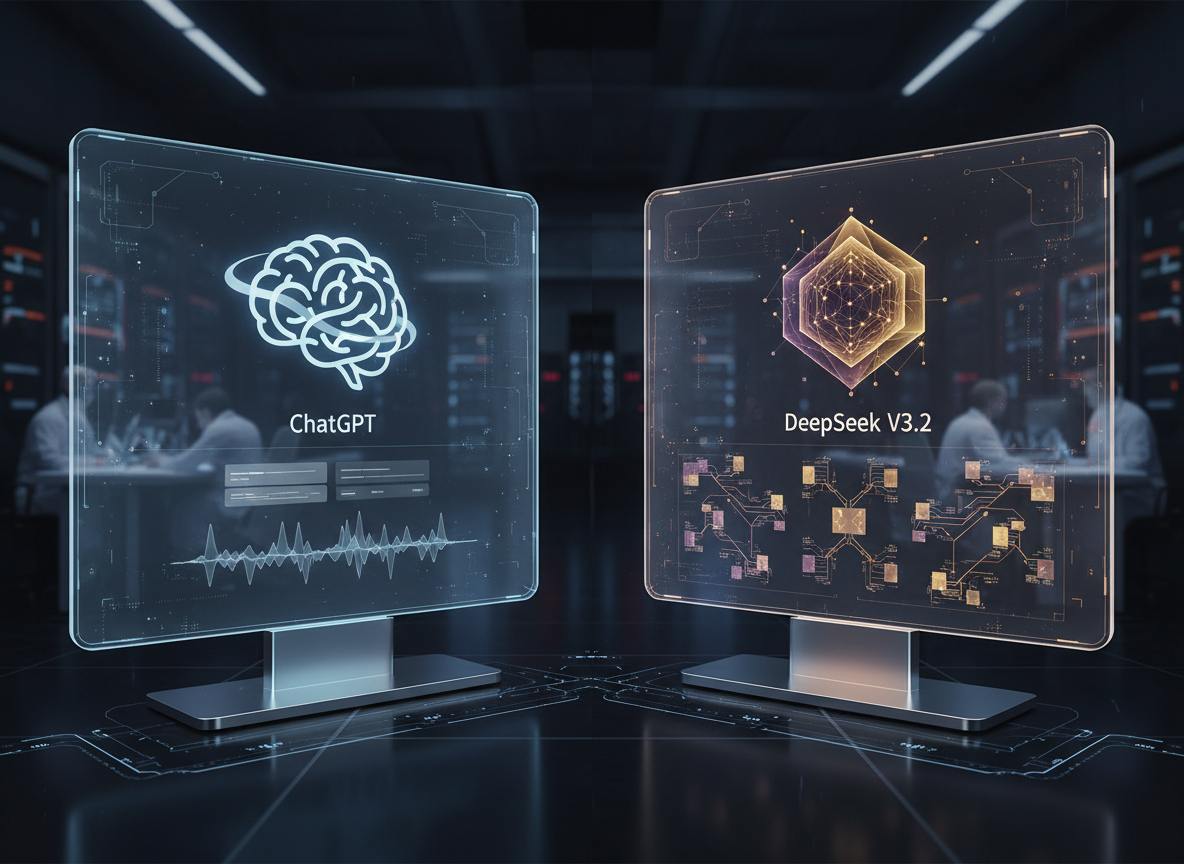
If you’re a solo developer, bootstrapped founder, or small team evaluating AI coding assistants with cost as a serious constraint, this comparison addresses the core trade-off: ChatGPT offers mature tooling, extensive community knowledge, and reliable performance across diverse coding tasks, while DeepSeek V3.2 delivers surprisingly competitive coding capabilities at a fraction of the cost—especially through API access. ChatGPT excels for developers who need consistent, well-documented solutions and can justify $20/month subscriptions, making it ideal for client work where reliability matters more than cost. DeepSeek V3.2 suits budget-conscious developers comfortable with newer tooling, particularly those building automated workflows via API where per-token pricing creates significant savings. Neither tool eliminates the need for code review or fundamental programming knowledge, and DeepSeek’s relative newness means less community troubleshooting resources. Your decision hinges on whether you prioritize ecosystem maturity and support (ChatGPT) or cost efficiency with strong technical performance (DeepSeek V3.2).
Introduction: Why This Comparison Matters
Choosing between ChatGPT and DeepSeek V3.2 for programming creates confusion because surface-level feature comparisons miss the practical business decision: cost versus ecosystem maturity. Most developers evaluating these tools already know both can generate code, explain syntax, and assist with debugging. The meaningful question isn’t “which is smarter” but “which delivers better value given my specific constraints”—whether those constraints are budget limitations, need for community support, integration with existing workflows, or tolerance for bleeding-edge tooling.
This comparison matters because DeepSeek V3.2 represents a genuine shift in AI economics. Previously, budget-conscious developers accepted that cheaper AI meant inferior coding performance. DeepSeek disrupts this assumption by offering competitive technical capabilities at dramatically lower API costs, forcing a recalibration: when does ChatGPT’s established ecosystem justify its price premium, and when does DeepSeek’s cost efficiency outweigh its newer, less-documented status?

The chatgpt vs deepseek for solo developers decision particularly matters for bootstrapped businesses where $20 monthly subscriptions accumulate quickly across tools. A freelancer using AI for code generation, documentation, and client communication faces different economics than an enterprise team with centralized budgets. Similarly, chatgpt vs deepseek api for developers building automated code review, documentation generation, or testing workflows confronts different cost structures: ChatGPT’s per-token API pricing versus DeepSeek’s lower rates creates 5-10x cost differences at scale.
By the end, you’ll understand not just feature parity but decision triggers: the specific business situations where ChatGPT’s maturity justifies its cost, where DeepSeek’s pricing enables use cases previously too expensive, and where both tools share the same fundamental limitations that no pricing advantage can overcome.
Who This Comparison Is Best For

This comparison serves developers and technical decision-makers navigating a specific tension: wanting AI coding assistance but facing budget constraints that make tool proliferation unsustainable. You’re likely in one of these situations:
Bootstrapped founders writing code outside their core expertise face the classic build-vs-buy calculation compressed into monthly subscriptions. You need AI help implementing features—authentication systems, payment processing, API integrations—but you’re already paying for hosting, domain registration, email services, and design tools. Adding another $20/month subscription requires justification: will this AI measurably accelerate development enough to offset costs, or are you subscribing to feel productive while actual progress remains marginal?
Freelance developers managing multiple client projects encounter a different constraint: each client’s codebase presents unique debugging challenges, framework quirks, and legacy decisions that require quick context reconstruction. You need an AI that handles diverse technical stacks without requiring extensive per-project configuration, but you’re also tracking monthly expenses against variable client income. The value proposition isn’t abstract “productivity”—it’s whether AI assistance lets you complete two additional client projects monthly, directly converting subscription costs into billable hours.
Small development teams without dedicated DevOps or infrastructure specialists inherit operational complexity: maintaining CI/CD pipelines, debugging deployment issues, optimizing database queries, and managing cloud infrastructure. Team members have varying coding proficiency, and projects span multiple languages and frameworks. You need AI that serves as a force multiplier across skill levels, but team leads also evaluate total cost of ownership: three developers at $20/month each versus a single API account with usage-based pricing presents different budget dynamics.

Common mistake: Evaluating AI tools solely on benchmark performance or feature checklists. A model that scores highest on HumanEval (a coding benchmark) may underperform for your specific needs—explaining legacy PHP code, debugging React state management, or generating SQL queries against your particular database schema. Benchmark performance measures potential; actual value emerges from how well the AI integrates into your existing workflow and knowledge gaps.
Real-world example: A WordPress agency developer builds custom plugins for 15 clients monthly. Each plugin requires similar patterns—custom post types, meta boxes, REST API endpoints—but with unique business logic. Using ChatGPT’s web interface, the developer asks coding questions interactively, paying $20/month. Alternatively, building a local tool that sends code snippets to DeepSeek’s API for explanation and refactoring costs $3-5/month based on actual token usage. The business outcome isn’t which AI writes “better” code—it’s whether the $15 monthly savings across twelve months ($180 annually) justifies accepting DeepSeek’s smaller ecosystem and potentially solving integration challenges independently.
Why Each AI Fits That Need
ChatGPT for Ecosystem Maturity and Reliable Support

ChatGPT’s primary advantage isn’t coding capability in isolation—it’s the surrounding ecosystem that reduces friction when you encounter problems. When ChatGPT generates code that doesn’t work as expected, you can search Stack Overflow, Reddit, or developer forums for “ChatGPT [specific error]” and find community discussions of common issues, workarounds, and effective prompting strategies. This meta-layer of community knowledge accelerates problem-solving beyond the AI’s direct capabilities.
General-purpose usefulness extends across the full development lifecycle: initial exploration and prototyping, implementation and debugging, documentation writing, and explaining technical decisions to non-technical stakeholders. ChatGPT handles context-switching between these activities fluidly. A developer can paste error logs, request debugging help, then immediately shift to asking for user-facing documentation of the same feature without changing tools or re-establishing context.
Learning curve remains minimal for developers already comfortable with conversational interfaces. The web interface requires no API integration, authentication setup, or local configuration. You create an account and start asking questions. This accessibility matters for occasional users who need AI assistance sporadically—configuring API keys and writing integration code for infrequent use represents overhead that diminishes value.
Thinking support manifests through ChatGPT’s ability to discuss architectural trade-offs, not just generate implementations. When evaluating whether to use serverless functions versus traditional servers, ChatGPT can outline considerations around cost, scalability, cold start latency, and vendor lock-in in the context of your specific project constraints. This advisory capacity extends beyond “write code that does X” to “help me think through whether X is the right approach.”
Integration and tool compatibility benefits from OpenAI’s established position. Third-party tools—IDE plugins, browser extensions, workflow automation platforms—prioritize ChatGPT integration because of its user base. A developer using VS Code, Raycast, or Slack can find well-maintained plugins that embed ChatGPT functionality directly into existing workflows, reducing context-switching overhead.
Supporting example: A developer debugging a complex React state management issue spends thirty minutes refining their question through ChatGPT’s conversational interface—sharing component code, explaining expected versus actual behavior, and testing suggested solutions iteratively. When a suggested fix introduces a new error, they paste the error message and continue the conversation. The session’s value isn’t that ChatGPT solved the problem instantly; it’s that the conversational flow matches natural debugging processes, and when the developer encounters similar issues later, searching “ChatGPT React useState closure problem” surfaces relevant community discussions.
Business result: Reduced cognitive load for context-switching and problem-solving, particularly valuable when juggling multiple projects or working under tight deadlines where research friction compounds into significant time loss.
DeepSeek V3.2 for Cost-Effective Performance

DeepSeek V3.2’s defining characteristic is price-to-performance ratio. Based on publicly available information as of early 2025, DeepSeek demonstrates competitive coding capabilities on standard benchmarks while offering API pricing significantly below ChatGPT’s rates. This economic advantage creates different use case possibilities.
General-purpose usefulness focuses specifically on coding tasks rather than general conversation or creative writing. DeepSeek’s training emphasizes mathematical reasoning and code generation, making it particularly effective for algorithmic problems, data structure implementations, and logic-heavy programming. Where ChatGPT tries to be conversationally helpful across all domains, DeepSeek optimizes for technical accuracy in narrower scope.
Learning curve presents a steeper initial climb, primarily around API integration. DeepSeek’s web interface exists but receives less development attention than API access, reflecting its positioning toward developers comfortable with programmatic integration. Using DeepSeek effectively often means writing wrapper scripts, setting up local environments, or integrating into existing development tooling—activities that require upfront technical investment but enable customization.
Thinking support operates differently than ChatGPT’s conversational approach. DeepSeek tends toward direct, technically dense responses rather than explaining concepts from first principles. For experienced developers who want quick answers without pedagogical framing, this efficiency is valuable. For junior developers or those learning new domains, the terseness can feel less supportive.
Tool compatibility remains limited compared to ChatGPT’s ecosystem. Fewer third-party integrations exist, and documentation skews toward API usage rather than point-and-click interfaces. This creates opportunities for developers who build custom tooling: you can create precisely the integration you need without fighting against opinionated defaults, but you’re responsible for building and maintaining that integration.
Who Should Choose Another AI

Neither ChatGPT nor DeepSeek V3.2 serves situations requiring guaranteed code correctness, regulatory compliance, or domain-specific vertical optimization. Understanding these boundaries prevents misallocating resources.
Mission-critical systems where bugs have severe consequences—medical device software, financial trading systems, aviation control systems—cannot rely on AI-generated code without extensive validation that eliminates time savings. Both tools occasionally generate subtle logical errors, security vulnerabilities, or edge case failures. A banking system processing millions of transactions cannot deploy AI-written transaction logic without security audits and formal testing that cost more than writing code manually with established safety practices.
Highly regulated industries with code compliance requirements need deterministic verification tools. Healthcare applications subject to HIPAA, payment processors requiring PCI-DSS compliance, or government contractors working under specific security clearances cannot use general-purpose AI outputs directly. The code may function correctly but violate regulatory requirements in ways neither ChatGPT nor DeepSeek reliably identifies. These scenarios benefit from specialized compliance tools, formal verification systems, or consultants with regulatory expertise.

Teams requiring consistent code style across large codebases may find AI assistance creates more problems than it solves. When maintaining a mature application with established patterns, conventions, and architectural decisions, AI tools suggest solutions optimized for immediate functionality rather than long-term consistency. A developer using ChatGPT might receive React solutions using class components when the team has standardized on hooks, or DeepSeek might suggest database queries that work but don’t match the project’s existing ORM patterns. The cleanup cost of AI-generated code that “works but doesn’t fit” can exceed manual implementation time.
Projects requiring cutting-edge framework features or very recent language updates expose both tools’ training data limitations. If you’re using features introduced in the last six months—new TypeScript capabilities, recent React APIs, or just-released library versions—both ChatGPT and DeepSeek generate solutions based on outdated patterns. The AI confidently suggests approaches that were superseded, requiring you to recognize and correct these mismatches.
Use Cases by Business Goal
Productivity
Internal tool development and automation scripts represent ideal AI coding assistance use cases because they balance technical complexity with tolerance for imperfection. A small business owner building an admin dashboard to track inventory doesn’t need enterprise-grade polish—they need functional data display quickly. ChatGPT handles this through conversational iteration: describe desired features, refine generated code, add functionality incrementally. DeepSeek serves the same goal more cost-effectively for developers comfortable working programmatically: write a script that sends dashboard requirements to DeepSeek’s API, generates components, and automatically creates project files.
ChatGPT pros: Web interface enables quick experimentation without local setup. Conversational refinement feels natural for exploring different approaches.
ChatGPT cons: $20/month subscription cost adds up across team members. Rate limits on free tier disrupt workflow during intensive coding sessions.
DeepSeek V3.2 pros: API pricing makes high-volume automation economically feasible. Lower cost enables experimental features that might not justify ChatGPT expenses.
DeepSeek V3.2 cons: Requires upfront investment building API integration tools. Less helpful for one-off questions that don’t justify API setup overhead.

Data processing and transformation scripts—converting file formats, cleaning datasets, generating reports from databases—benefit from AI assistance because logic is straightforward but syntax varies across languages and libraries. A freelancer receiving client data in inconsistent CSV formats can describe transformation requirements and get working Python scripts handling edge cases like missing values, encoding issues, or malformed rows.
Cost consideration: ChatGPT’s subscription makes sense if you’re writing these scripts conversationally multiple times weekly. DeepSeek’s API pricing wins if you’re building reusable tools that generate transformation scripts programmatically—the per-use cost drops to cents rather than fixed monthly fees.
Business outcome: Internal productivity improvements that would take days of research and trial-and-error get built in hours, and the “good enough” threshold is lower because humans previously did these tasks manually. Explore more productivity strategies at AI Efficiency.
Revenue / Marketing

Technical documentation and API reference generation directly impacts revenue for SaaS products where quality documentation reduces support burden and improves conversion. A developer can feed existing code to either AI and request documentation, but the economic models differ. ChatGPT’s conversational interface suits writing one-off documentation where you’re iteratively refining tone and technical depth. DeepSeek’s API enables automated documentation pipelines: commit code, trigger documentation generation, update docs automatically.
ChatGPT pros: Strong at explaining complex concepts to different audience levels. Can adjust technical depth based on target reader expertise.
ChatGPT cons: Manual process doesn’t scale well for maintaining docs across large codebases. Subscription cost doesn’t decrease with efficient use.
DeepSeek V3.2 pros: API integration enables automated documentation workflows. Cost scales with actual usage—generating docs for small projects costs pennies.
DeepSeek V3.2 cons: Less nuanced at adjusting explanation depth for non-technical audiences. Requires building automation infrastructure.
Code example generation for developer-facing products matters for companies selling APIs, SDKs, or developer tools. Providing examples in multiple languages (Python, JavaScript, Ruby, Go) increases adoption but multiplies documentation burden. A solo founder can use AI to generate equivalent examples across languages rather than writing each manually.
Trade-off consideration: ChatGPT handles cross-language consistency through conversation—you describe desired functionality once and request implementations in different languages. DeepSeek’s API lets you programmatically generate examples in batch, potentially faster and cheaper for large example libraries.
Business outcome: Shipping revenue-enabling features (better docs, more code examples, clearer onboarding) faster than hiring technical writers, with quality sufficient for early customer validation. Find more revenue-focused strategies at AI Revenue Boost.
AI Comparison Table + Explanation
| Axis | ChatGPT | DeepSeek V3.2 |
|---|---|---|
| Ease of Use | Conversational web interface requires zero technical setup; accessible for immediate use by developers of all skill levels | API-first design requires integration effort; steeper initial learning curve but enables customization and automation |
| Best For | Interactive debugging, explaining code to non-technical stakeholders, exploring multiple approaches conversationally, occasional ad-hoc coding questions | High-volume automated workflows, cost-sensitive projects, developers building custom AI-integrated tooling, batch processing coding tasks |
| Strengths | Mature ecosystem with extensive community knowledge; reliable performance across diverse coding tasks; strong at explaining “why” behind solutions; well-integrated with third-party tools | Exceptional price-to-performance ratio enables previously uneconomical use cases; strong mathematical and algorithmic reasoning; lower API costs enable experimentation without budget anxiety |
| Limitations | $20/month subscription cost accumulates across team members; rate limits can disrupt intensive usage; API pricing higher than DeepSeek for equivalent tasks | Smaller community means less troubleshooting resources; newer tool with less battle-tested integration patterns; documentation focuses on API usage over conversational interaction |
| Pricing Perception | Established paid tier ($20/month) viewed as justified for professional use but creates budget pressure for bootstrapped projects; API costs limit high-volume automation | Disruptively low API pricing (5-10x cheaper than ChatGPT) enables new use cases but requires technical sophistication to access; perceived as “budget option” despite competitive performance |
Why choice depends on business maturity and goals: Early-stage bootstrapped founders prioritize cost efficiency over ecosystem maturity. When $20 monthly represents meaningful budget allocation, DeepSeek’s lower costs enable AI assistance that might otherwise feel unjustifiable. The technical overhead of API integration matters less when you’re already writing code daily.
Established freelancers managing client work prioritize reliability and support resources. When client deadlines approach and AI-generated code fails mysteriously, searching “ChatGPT [error]” and finding community solutions matters more than saving $15 monthly. The subscription cost is business overhead justified by reduced troubleshooting time.

Small teams balance both considerations. Team leads might use ChatGPT for interactive problem-solving and architectural discussions where conversational depth adds value, while automating routine tasks through DeepSeek’s API for cost efficiency. The combined approach costs less than putting entire team on ChatGPT subscriptions while maintaining access to both tools’ strengths.
Business goal alignment determines optimal choice. If your primary bottleneck is “we can’t afford AI assistance at all,” DeepSeek’s pricing removes that barrier entirely. If your bottleneck is “AI assistance sometimes wastes more time than it saves because we can’t troubleshoot issues,” ChatGPT’s ecosystem reduces that friction. Neither tool eliminates the fundamental requirement that someone on your team understands code well enough to evaluate AI outputs critically.
How to Choose the Right AI
Decision checkpoints for selecting between ChatGPT and DeepSeek V3.2:
Budget constraints and cost sensitivity: If $20/month feels like meaningful expense requiring justification, start with DeepSeek. The lower cost enables trying AI assistance without commitment. Track actual usage: if you’re using AI multiple hours daily and hitting DeepSeek’s API heavily, total costs may approach ChatGPT’s subscription anyway—at which point, ChatGPT’s ecosystem benefits justify switching. If monthly API costs remain under $10, DeepSeek’s cost advantage persists indefinitely.
Technical sophistication and integration comfort: ChatGPT’s web interface serves developers who want zero-friction access—create account, start asking questions. DeepSeek requires API integration competence: setting up authentication, handling rate limits, parsing responses, managing errors. If you’re comfortable writing integration code and see value in customization, DeepSeek’s API-first approach enables powerful workflows. If you want to avoid infrastructure overhead, ChatGPT’s managed interface removes that burden.
Usage patterns and volume characteristics: For occasional questions (5-10 weekly), ChatGPT’s free tier may suffice indefinitely. For intensive interactive use (multiple sessions daily), ChatGPT’s $20 subscription provides unlimited access without usage anxiety. For high-volume automated processing (thousands of API calls monthly), DeepSeek’s per-token pricing creates 5-10x savings. Analyze your actual workflow: are you having conversations with AI or programmatically processing coding tasks?
Team size and collaboration requirements: Solo developers optimize differently than teams. Individual subscriptions accumulate linearly ($20/developer/month), making ChatGPT expensive for larger teams. DeepSeek’s API usage pools across team members—total costs depend on collective volume rather than headcount. However, ChatGPT’s shared conversation history and better documentation support benefits teams with varying skill levels who need to reference and learn from each other’s AI interactions.
Explore structured decision frameworks for AI tool selection at AI Workflows.
FAQs

Is ChatGPT better than DeepSeek V3.2 for coding beginners?
ChatGPT generally serves beginners better due to ecosystem maturity and conversational interface accessibility. When you’re learning programming, getting stuck is frequent and frustrating—ChatGPT’s ability to explain concepts at different depth levels, provide analogies, and iteratively refine explanations through conversation reduces learning friction. The extensive community resources (Stack Overflow answers, Reddit discussions, tutorial content) mean that when ChatGPT’s explanation doesn’t click, you can search for alternative explanations of the same concept from other users’ conversations. DeepSeek’s API-first design and more technical response style assume baseline comfort with programming concepts and command-line tools. However, cost matters for students or career-changers learning on personal budgets: DeepSeek’s lower cost enables AI assistance for people who can’t justify $20 monthly. The optimal choice depends on whether you value educational support (ChatGPT) or cost accessibility (DeepSeek), but neither tool replaces structured learning through courses, documentation, and hands-on practice.
How does DeepSeek V3.2 coding accuracy compare to ChatGPT in practice?
Based on publicly available information as of early 2025, deepseek v3.2 coding accuracy comparison shows competitive performance on standard benchmarks, but practical accuracy depends heavily on task type and prompting quality. For algorithmic problems, mathematical reasoning, and data structure implementations, DeepSeek demonstrates strong accuracy that often matches or exceeds ChatGPT. For tasks requiring broader context—understanding legacy codebases, debugging complex framework interactions, or generating code that follows project-specific patterns—ChatGPT’s larger training corpus and more extensive fine-tuning may provide advantages. The accuracy difference matters less than reliability and debuggability: when AI-generated code fails, can you understand why and fix it? Both tools occasionally generate plausible-looking code with subtle bugs. The critical skill is recognizing when to trust AI outputs versus when to verify carefully. For production code, treat both tools equally: assume generated code requires review regardless of which AI provided it.
Can I use DeepSeek’s API affordably for a small development team?
Yes, DeepSeek’s pricing model specifically benefits small teams and bootstrapped projects. Based on current API pricing, a small team generating 100,000 tokens monthly (roughly equivalent to reviewing 50 medium-sized pull requests, generating documentation for 20 API endpoints, or processing 100 code explanation requests) costs approximately $5-15 monthly with DeepSeek versus $50-150 with ChatGPT’s API. The savings scale linearly: higher usage maintains the cost ratio advantage. However, “affordable” requires qualification: you need someone technically capable of building and maintaining API integration infrastructure. If integration effort costs three developer-days ($2,400 at $100/hour rate), you need sustained usage where monthly savings ($100-150 vs ChatGPT) recoup that investment within months. For teams already comfortable with API integration and building internal tools, DeepSeek’s pricing enables AI features that are economically infeasible at ChatGPT rates. For teams without that technical capacity, ChatGPT’s managed interface may deliver better total cost of ownership despite higher subscription prices.
Which tool is better for API integration and automated workflows?
DeepSeek’s API-first design and lower costs create structural advantages for automated workflows and chatgpt vs deepseek api for developers scenarios. Automated code review, documentation generation, test case creation, and batch code transformation all benefit from DeepSeek’s per-token pricing because costs scale directly with usage. ChatGPT can certainly handle these use cases via API, but economics favor DeepSeek for high-volume automation. However, ChatGPT’s more extensive API documentation, established integration patterns, and larger community of developers building similar automations reduce implementation risk. If you’re building your first automated workflow and need reference examples to avoid common pitfalls, ChatGPT’s ecosystem provides more guidance. If you’re experienced with API integration and confident in building custom tooling, DeepSeek’s cost efficiency enables experimentation without budget anxiety. The “better” choice depends on whether you’re optimizing for implementation safety (ChatGPT) or operational costs (DeepSeek).
Next Steps

Choose your next area of focus based on where AI can deliver the most immediate business value:
- Compare AI — Explore detailed comparisons across other AI tools and use cases
- AI Efficiency — Discover workflows and strategies for maximizing AI productivity gains
- AI Revenue Boost — Learn how to apply AI to revenue-generating activities and marketing
- Solo DX — Find approaches for solo developers and small teams building sustainable systems
- AI Workflows — Access structured frameworks for integrating AI into existing development processes
Leave a Reply