
Introduction
In 2026, freelance developers and solo entrepreneurs face an unprecedented challenge: the complexity of modern software development has exploded while resources remain limited. A freelance web developer managing three client projects simultaneously must juggle frontend frameworks, backend APIs, database queries, DevOps configurations, and testing—all while billing by the hour. Every minute spent searching Stack Overflow, debugging syntax errors, or rewriting boilerplate code is a minute not spent delivering value to clients.
This is where AI coding efficiency for small business becomes not just a competitive advantage, but a survival necessity. The shift from manual coding workflows to AI-augmented development represents one of the most significant productivity leaps since the introduction of integrated development environments. For small teams operating without the luxury of specialized engineers for every technology stack, AI-powered coding assistance levels the playing field.
Enter GitHub Copilot AI—a tool that has evolved from a simple autocomplete feature into a comprehensive development partner. Unlike traditional code editors that merely highlight syntax, GitHub Copilot AI understands context across your entire codebase, suggests entire functions based on natural language comments, and can explain complex code in plain English. For the overwhelmed entrepreneur writing code at 11 PM after a day of client meetings, this isn’t just about typing faster—it’s about thinking clearer, working smarter, and reclaiming time for strategic growth.
Key Concepts of AI Efficiency
Understanding how AI transforms coding efficiency requires grasping three foundational concepts that explain why traditional development workflows drain so much mental energy and time.
Cognitive Offloading
Cognitive offloading refers to the practice of delegating mental tasks to external tools, freeing up working memory for higher-level problem-solving. In coding, this manifests in two critical ways. First, remembering syntax across multiple programming languages consumes significant cognitive bandwidth. A freelancer building a full-stack application must recall Python syntax for backend logic, JavaScript conventions for frontend interactivity, SQL query structures for databases, and YAML formatting for configuration files. Each context switch requires retrieving stored knowledge from long-term memory—a process that introduces friction and errors.
Second, maintaining mental models of code structure becomes increasingly difficult as projects scale. When you’re debugging a function that interacts with five other modules, your brain must simultaneously hold the call stack, variable states, and data flow patterns in working memory. GitHub Copilot AI for freelancers excels at cognitive offloading by serving as an external memory system. Instead of mentally juggling syntax rules, developers can focus on architectural decisions and business logic while Copilot handles the mechanical translation of intent into code.
For small businesses operating in competitive markets, this cognitive offloading translates directly to ai coding efficiency for small business. A solo developer building an e-commerce platform no longer needs to pause development to research “how to implement JWT authentication in Node.js”—Copilot suggests the implementation pattern instantly, allowing the developer to evaluate the approach rather than construct it from scratch.
Context Switching Cost
The context switching cost describes the productivity loss that occurs when transitioning between different tasks, tools, or mental frameworks. Research in cognitive psychology demonstrates that it takes an average of 23 minutes to fully regain focus after an interruption. For developers, context switches happen constantly: moving from writing business logic to configuring deployment pipelines, switching from Python to JavaScript, or toggling between coding and searching documentation.
Each context switch involves two hidden taxes. The cognitive tax requires your brain to dump the current mental model and load a new one—remembering different syntax rules, design patterns, and project constraints. The temporal tax is the time spent reorienting yourself within the new context: “Where was I in this file? What was I trying to accomplish? What variables are in scope?”
AI developer tools for startups minimize context switching by providing contextual assistance without requiring developers to leave their IDE. Rather than opening a browser to search for “React hook dependency array best practices,” then reading through five articles, then returning to the code editor and reconstructing your mental model—Copilot suggests the correct pattern inline. The developer remains in flow state, making decisions rather than gathering information.
For a technical founder building an MVP with limited runway, eliminating ten 5-minute context switches per day recovers nearly an hour of focused development time. Compounded over weeks and months, this represents the difference between launching on schedule and burning through capital while still in development.
Workflow Orchestration
Workflow orchestration describes how individual tasks are sequenced, parallelized, and automated within a broader process. In traditional development workflows, orchestration is largely manual. A freelancer building a feature must: write the code, write tests, run the tests, fix failing tests, commit changes, write commit messages, create pull requests, and document the changes. Each step requires conscious decision-making and tool switching.
Modern AI coding assistants transform workflow orchestration by understanding the broader context of development activities. GitHub Copilot AI doesn’t just suggest the next line of code—it can generate entire test suites based on implementation code, draft documentation from function signatures, and even suggest appropriate commit messages based on code changes. This orchestration reduces the administrative overhead of development, allowing small teams to maintain professional engineering practices without dedicated DevOps personnel.
When we speak about ai coding efficiency for small business, workflow orchestration represents perhaps the most undervalued dimension. A solo consultant can now implement enterprise-grade testing coverage and documentation standards—traditionally only feasible for large teams—because AI handles the mechanical execution while the developer provides strategic direction.
How GitHub Copilot AI Helps Efficiency

GitHub Copilot AI has evolved into a comprehensive development assistant that addresses efficiency challenges at multiple levels. Understanding its core capabilities reveals how it transforms the daily experience of coding for small teams.
Intelligent Code Completion with Multi-File Context
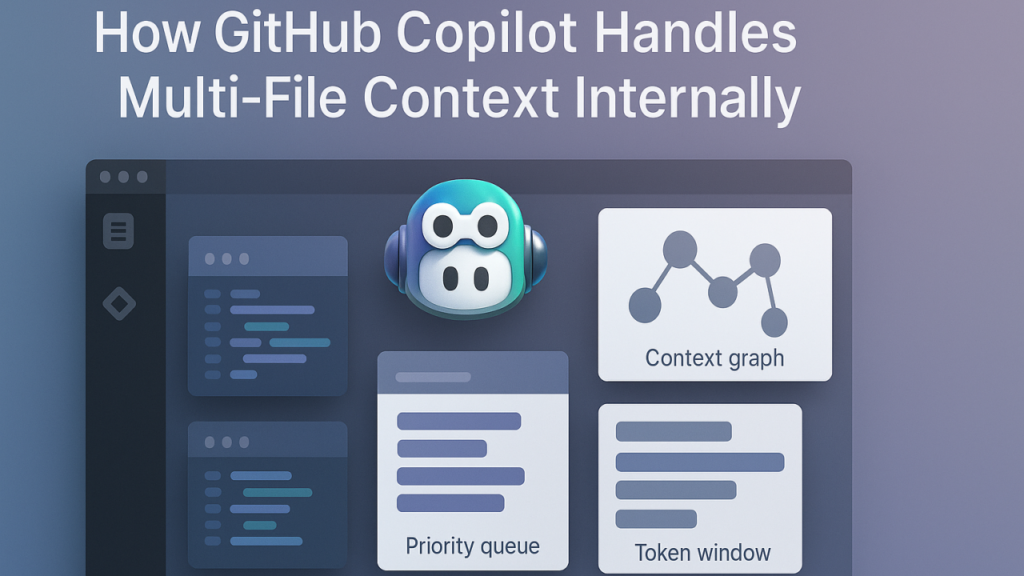
Unlike traditional autocomplete that suggests variable names and keywords, GitHub Copilot AI analyzes your entire project structure to provide contextually relevant suggestions. When you begin writing a function, Copilot examines imported libraries, existing utility functions, and coding patterns used elsewhere in your project to generate suggestions that align with your established conventions.
How It Works: Copilot uses a large language model trained on billions of lines of public code. When you type a function signature or comment describing intent, the model predicts the implementation based on patterns it has learned. Crucially, it maintains awareness of your current file’s imports, the broader project structure, and even coding style preferences inferred from your existing code.
Realistic Scenario: You’re building a payment processing module. You write a comment: // Process refund and update inventory. Copilot suggests a complete function that calls your payment gateway API, handles error cases, updates the database, and logs the transaction—all consistent with patterns used in your existing payment processing code. You review the suggestion, make minor adjustments for your specific business rules, and move on. What would have been a 45-minute implementation task becomes a 10-minute review and refinement task.
Natural Language to Code Translation
Perhaps Copilot’s most transformative feature is its ability to convert plain English descriptions into working code. This capability is particularly valuable for small business owners who understand what they need to build but may not recall the exact syntax or library methods required.
How It Works: By writing comments that describe functionality in natural language, developers can prompt Copilot to generate corresponding implementations. The model understands not just syntax but semantic meaning—it knows that “validate email address” implies regex pattern matching, error handling, and potentially logging invalid attempts.
Business Result: This feature dramatically accelerates development in unfamiliar technology areas. A Python developer who occasionally needs to write SQL queries can describe the desired data transformation in a comment, and Copilot generates optimized SQL. This eliminates the friction of switching mental contexts and searching documentation, enabling small teams to work effectively across full technology stacks without specialized expertise in every domain.
Realistic Scenario: You need to implement rate limiting for your API but have never configured Redis before. You write: // Implement rate limiting using Redis: 100 requests per hour per user. Copilot generates the Redis connection code, the rate limiting middleware, and error handling for Redis connection failures. You spend your time understanding the approach and tuning parameters rather than researching implementation details.
Code Explanation and Documentation Generation
Understanding unfamiliar code—whether legacy code you inherited or complex algorithms—traditionally requires significant time investment. GitHub Copilot AI can explain code functionality in plain English and automatically generate documentation.
How It Works: Copilot analyzes code structure, variable names, control flow, and external dependencies to produce human-readable explanations. For documentation generation, it examines function signatures, parameters, return types, and implementation logic to create appropriate docstrings and inline comments.
Business Result: This capability is invaluable when freelancers inherit client codebases or need to onboard collaborators quickly. Instead of spending hours tracing execution paths to understand how a module works, developers can request explanations and immediately grasp high-level functionality. For code they write, auto-generated documentation ensures future maintainability without the tedious work of manual documentation.
Realistic Scenario: A client asks you to extend functionality in their existing Node.js application. You encounter a complex data transformation pipeline with nested map/reduce operations and no comments. You select the code and ask Copilot to explain it. Within seconds, you receive a paragraph explaining that the code processes user activity logs, aggregates them by session, calculates engagement metrics, and formats the output for a analytics dashboard. Armed with this understanding, you can confidently make modifications without hours of manual code tracing.
Use Cases: Small Business & Freelancer Efficiency

Real-world adoption stories illustrate how GitHub Copilot AI transforms daily workflows across different business contexts. These personas represent common scenarios where ai developer tools for startups deliver measurable efficiency gains.
Creative Freelancer: Web Developer Building Portfolio Sites

Old Workflow: Maria is a freelance web developer specializing in custom portfolio sites for creative professionals. Each project requires building responsive layouts, implementing contact forms, integrating content management systems, and deploying to web hosts. Maria spends approximately 12 hours per site on coding, with additional time on revisions and bug fixes. Her workflow involves:
- Referencing previous projects to copy and modify boilerplate code
- Searching documentation for CSS framework syntax (Tailwind, Bootstrap)
- Testing responsiveness across devices manually
- Debugging JavaScript issues by adding console.log statements throughout code
- Writing deployment scripts for different hosting providers
New AI-Enhanced Workflow: With GitHub Copilot for freelancers, Maria’s process has transformed. She begins each project by describing the layout requirements in comments: // Create a three-column portfolio grid that's responsive with masonry layout on desktop and single column on mobile. Copilot generates the HTML structure and Tailwind classes. When implementing the contact form, she describes: // Add form validation and send email via SendGrid API with rate limiting, and Copilot produces the complete implementation including error handling.
For deployment, Maria maintains configuration templates and lets Copilot adapt them for each hosting environment. When bugs emerge, she selects the problematic code and asks Copilot to identify issues—it points out a missing async keyword causing promise rejection errors.

Time Saved: Maria now completes sites in 7-8 hours instead of 12, a 33% efficiency gain. This allows her to take on an additional project per month, increasing revenue by $2,500 monthly without working longer hours. The reduced context switching means she maintains creative energy for design decisions rather than exhausting it on syntax lookup.
“With GitHub Copilot AI, I automated 3 hours of weekly boilerplate work and reduced debugging time by half. I’m now accepting more clients without burnout because the tedious parts of coding are handled.”
Solo Consultant: Building Custom CRM Tools

Old Workflow: James is a business consultant who builds lightweight CRM tools for small B2B companies. His stack includes Python (Flask), PostgreSQL, and vanilla JavaScript. Each CRM requires custom data models, reporting dashboards, and email integration. James faces constant context switching between:
- Backend Python development for business logic
- Frontend JavaScript for interactive dashboards
- SQL query optimization for reports
- API documentation for third-party integrations (email providers, calendar services)
A typical CRM project spans 6 weeks, with James spending roughly 30 hours on development and 10 hours debugging integration issues and optimizing database queries.
New AI-Enhanced Workflow: James now describes desired functionality at a high level, and Copilot handles implementation details. For database models, he writes: // Create User model with company relationship, activity tracking, and deal pipeline fields. Copilot generates the SQLAlchemy model class with appropriate field types, relationships, and indexes.
When building the dashboard, James sketches the layout in HTML comments, and Copilot generates responsive chart implementations using Chart.js, including data fetching and error states. For third-party integrations, James specifies: // Integrate with Google Calendar API: sync meetings bidirectionally with error handling, and Copilot produces the OAuth flow, API calls, and webhook handlers.
Technical Founder: Building MVP for SaaS Startup

Old Workflow: Alex is a technical founder building a project management SaaS for creative agencies. With a runway of 12 months, speed is critical. Alex handles full-stack development alone: React frontend, Node.js backend, PostgreSQL database, AWS deployment, and stripe integration for payments. The challenge is breadth—Alex must maintain expertise across multiple domains simultaneously.
Before adopting AI tools, Alex spent:
- 15 hours/week on feature development
- 8 hours/week on infrastructure and DevOps
- 5 hours/week debugging and fixing issues
- 4 hours/week writing documentation and tests
This 32-hour development schedule left minimal time for customer development and strategic planning, creating a dangerous situation where the product was being built without adequate market validation.
New AI-Enhanced Workflow: Alex uses GitHub Copilot AI as a force multiplier across all development activities. For frontend components, Alex describes the UX in comments: // Create a kanban board with drag-and-drop, real-time updates via websockets, and optimistic UI updates. Copilot generates the React component with proper state management and edge case handling.
For backend APIs, Alex focuses on business logic and lets Copilot handle boilerplate: authentication middleware, request validation, database transactions, and error responses. When setting up AWS infrastructure, Alex describes the desired architecture in comments within terraform files, and Copilot generates the infrastructure-as-code configurations.
Most critically, Copilot enables Alex to implement features outside his core expertise. The real-time collaboration features required WebSocket implementation—a technology Alex had never used. By describing the desired behavior and letting Copilot suggest implementation patterns, Alex built production-ready real-time features in two days rather than the week he had budgeted for research and experimentation.
Time Saved: Alex’s development time drops from 32 hours/week to 20 hours/week—a 37% reduction. The reclaimed 12 hours per week are redirected to customer interviews, sales calls, and strategic planning. This balance allows Alex to build features that customers actually want, rather than technically impressive features nobody uses. The faster development pace also means reaching key product milestones 30% faster, stretching runway and improving the probability of raising the next funding round before capital runs out.
“Copilot lets me punch above my weight class. I’m shipping features at a pace that makes investors think I have a full engineering team. The reality is I’m one person with an AI pair programmer who never sleeps.”
? Streamline your workflow with smart automation. Start free with GitHub Copilot AI ? https://github.com/features/copilot
Start Small with High-Impact Tasks

The temptation when adopting new technology is to revolutionize everything simultaneously. This approach typically leads to overwhelm and abandonment. Instead, identify 1-2 repetitive coding tasks that currently consume disproportionate time and introduce AI assistance specifically for those tasks.
For example, if you spend 30 minutes per day writing boilerplate CRUD operations for database models, use Copilot exclusively for that task during the first week. Master the pattern of describing the model in comments and reviewing the generated code. Once this workflow feels natural, expand to another task like test generation or API endpoint creation.
This phased approach builds confidence and competence without disrupting your entire development flow. You learn to evaluate AI-generated code quality in low-stakes scenarios before relying on it for mission-critical features. As you internalize how to prompt effectively and what types of suggestions to accept versus modify, you naturally expand AI assistance to more complex tasks.
Track and Measure What AI Replaces
To justify continued investment in AI tools and optimize your workflow, maintain simple metrics about AI impact. Track:
- Time saved per task type: How long did creating an API endpoint take before AI vs. after?
- Bugs prevented: How many times did Copilot catch a mistake during code review that would have become a production bug?
- Learning acceleration: How many times did AI-generated code teach you a new pattern or library you didn’t know existed?
- Context switches avoided: How many trips to Stack Overflow or documentation did AI eliminate?
This data serves multiple purposes. It quantifies ROI for business planning, helps you identify which tasks benefit most from AI assistance (doubling down on those), and reveals areas where AI isn’t helping (allowing you to revert to manual workflows where appropriate).
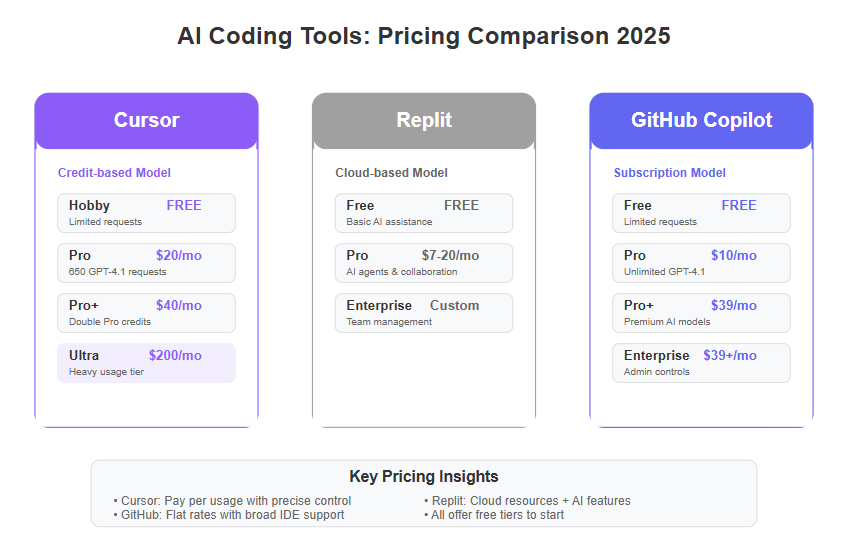
For teams considering whether to upgrade from free to paid AI tool tiers, these metrics provide concrete decision-making data. If you can demonstrate that Copilot saves 10 hours per month and generates $500 in additional revenue through faster delivery, the $10/month subscription cost becomes obviously justifiable.
Where AI Coding Assistance Falls Short

AI coding tools excel at pattern recognition and mechanical code generation but struggle with several critical development dimensions. Architectural decision-making requires understanding long-term maintainability, scalability constraints, and team capabilities—factors AI cannot assess without deep business context. When deciding between microservices and monolithic architecture for your startup, Copilot cannot evaluate your team’s DevOps skills, runway length, or scaling timeline.
Domain-specific business logic often involves nuanced rules that don’t appear in training data. If you’re building specialized financial calculations for a unique business model, Copilot may suggest general-purpose implementations that miss critical compliance requirements or edge cases specific to your industry. Always implement and review business logic manually, using AI only for surrounding boilerplate.
Creative problem-solving for novel challenges remains distinctly human. When you encounter a unique technical challenge without established patterns—like optimizing a custom algorithm for your specific data characteristics—AI suggestions based on generic patterns may be suboptimal. Use AI to accelerate implementation of your creative solution, not to generate the solution itself.
Risks: Hallucination, Privacy, and Over-Reliance

Code hallucination occurs when AI generates syntactically correct code that doesn’t function as intended or introduces subtle bugs. Copilot might suggest a database query that works for small datasets but has quadratic time complexity, creating performance disasters at scale. Or it might generate error handling that silently swallows exceptions, hiding bugs instead of surfacing them. Mitigate this through code review, testing, and never accepting code you don’t understand.
Privacy considerations are critical for businesses handling sensitive data. While GitHub has implemented privacy controls, any code sent to Copilot for analysis technically leaves your local environment. Review your client contracts and compliance requirements before using AI tools on proprietary or regulated codebases. For highly sensitive projects, consider GitHub Copilot Business which offers additional privacy guarantees, or restrict AI assistance to non-sensitive portions of your codebase.
Over-reliance degrades skill development. Junior developers who lean heavily on AI without understanding underlying principles may struggle when AI suggestions are incorrect or when working in environments without AI tools. Balance AI assistance with deliberate practice of fundamental skills. Use Copilot to accelerate work, but regularly implement features manually to maintain core competencies.
Mitigation Strategies
Implement safeguards to maximize benefits while minimizing risks:
- Code review protocols: Treat AI-generated code with the same scrutiny as code from junior developers—careful review, testing, and validation before production deployment.
- Testing requirements: Never skip tests for AI-generated code. Comprehensive test coverage catches hallucinations and ensures generated code meets specifications.
- Privacy boundaries: Maintain clear policies about which codebases and data can be processed by AI tools, especially when working with client projects or regulated industries.
- Continuous learning: Dedicate time to understanding technologies even when AI can generate implementations. Read the code Copilot produces, research unfamiliar patterns, and ensure you could recreate the solution manually if needed.
- Fallback plans: Maintain development workflows that don’t depend on AI tools. When Copilot experiences outages or generates poor suggestions for a particular task, you should seamlessly switch to manual development without productivity collapse.
FAQs

What is AI coding efficiency for small business?
AI coding efficiency for small business refers to using artificial intelligence tools to accelerate software development workflows for teams with limited resources. Instead of spending hours on repetitive coding tasks, debugging syntax errors, or searching documentation, small teams use AI assistants like GitHub Copilot to generate boilerplate code, suggest implementations based on natural language descriptions, and automate routine development tasks. This allows lean teams to deliver more features faster, compete with larger organizations, and focus human creativity on strategic problems rather than mechanical coding work.
Can AI replace admin work in software development?
AI can automate significant portions of administrative development work but doesn’t eliminate it entirely. Tasks like generating boilerplate code, writing tests, creating documentation, and formatting commit messages can be largely automated with tools like GitHub Copilot. However, strategic decisions about what to build, code review for business logic correctness, architectural planning, and final quality assurance still require human judgment. Think of AI as eliminating 60-80% of mechanical coding work, freeing developers to focus on the 20-40% that requires creativity, domain expertise, and strategic thinking.
How do freelancers use AI to save time on coding projects?
Freelancers leverage AI coding tools to compress development timelines and increase project throughput. Common time-saving applications include: using natural language comments to generate function implementations instead of writing code from scratch, asking AI to explain unfamiliar client code rather than spending hours tracing execution, generating comprehensive test suites automatically, and receiving inline documentation suggestions. Many freelancers report reducing project completion time by 30-40%, which translates to either taking on more clients for increased revenue or maintaining the same income while working fewer hours and avoiding burnout.
Conclusion

In 2026, the competitive landscape for small businesses and freelancers in software development has fundamentally shifted. The teams that thrive are those that strategically integrate AI coding efficiency for small business into their workflows—not as a replacement for human expertise, but as a powerful multiplier of existing capabilities. GitHub Copilot AI represents this shift, transforming how solo developers and lean teams approach the entire development lifecycle.
The evidence is compelling: freelancers reducing project completion time by 30-40%, technical founders stretching runway by shipping features faster, and solo consultants delivering enterprise-quality solutions previously requiring full teams. These aren’t hypothetical benefits—they’re the reality of AI-augmented development in 2026. The efficiency gains compound over time, as developers learn to prompt more effectively, trust the tool’s suggestions in appropriate contexts, and redirect saved time toward strategic activities that directly drive business growth.
Yet the transition requires intentionality. AI coding assistants are powerful tools, not magic solutions. Success comes from maintaining human judgment, starting with focused use cases, and building competence gradually. The goal isn’t to code faster at all costs—it’s to code smarter, focusing creative energy on problems that matter while offloading mechanical work to AI.
For the overwhelmed entrepreneur managing client demands while building technical solutions, GitHub Copilot AI offers a path forward. It won’t eliminate the need for technical skill, strategic thinking, or hard work. But it will eliminate much of the friction, tedium, and context-switching that currently drains energy and limits what’s possible for small teams. In an environment where every hour counts and every dollar matters, that’s not just an efficiency improvement—it’s a competitive necessity.
Next Steps

Ready to transform your development workflow? Explore these resources to deepen your AI efficiency journey:
- Compare AI – Evaluate GitHub Copilot against other AI coding tools to find the best fit for your stack and budget
- AI Revenue Boost – Discover how AI efficiency translates to measurable revenue growth for small businesses
- Solo DX – Learn developer experience optimization strategies specifically designed for solo founders and freelancers
- AI Workflows – Access detailed workflow templates for implementing AI tools across different development scenarios
Leave a Reply