Introduction: Why This Comparison Matters
Choosing the right AI email copywriting tool is harder than it should be. Most comparison articles list features without explaining what those features actually mean for someone who’s writing five emails a week, managing a small list, or trying to launch a product without a marketing team. The real question isn’t “which tool has more templates”—it’s “which tool helps me get campaigns out the door faster without sacrificing conversion or brand consistency?”
This comparison focuses on HoppyCopy vs Jasper for email marketing copy and campaign writing from a business decision lens. Both tools use large language models to generate marketing copy, but they approach email differently. HoppyCopy is purpose-built for email marketers, with workflows designed around campaign types, sequence logic, and deliverability-aware copy. Jasper is a general-purpose AI copywriting platform that handles email alongside blog posts, ads, and social content, which makes it more versatile but less opinionated about email best practices.
The confusion often comes from comparing feature lists instead of workflow fit. A tool with 100 templates sounds better than one with 20, until you realize you only use three templates repeatedly and need faster iteration, not more variety. This article helps you understand which AI fits your actual email marketing situation—whether that’s automating newsletter writing, building complex drip sequences, or generating campaign ideas when you’re stuck on messaging.
Who This Comparison Is Best For
This comparison is most useful if you recognize yourself in one of these situations: you’re handling email marketing as part of a broader workload (not as a full-time email strategist), you’re working solo or with a small team where everyone wears multiple hats, or you’re responsible for growing a business through email without deep copywriting training. You might be a freelance consultant who sends monthly newsletters but also writes client proposals, a small business owner managing a product launch email sequence while also running operations, or a marketing generalist who needs to produce email campaigns, social posts, and landing page copy without hiring specialists for each format.
The common pain point is decision fatigue around content creation. You know email marketing works, but writing from scratch every time is slow, and you’re not sure if your copy follows best practices for open rates, click-through, or conversions. You might be stuck choosing between spending three hours crafting one email or using a template that feels generic. AI tools promise to solve this, but the real challenge is figuring out which tool reduces cognitive load without creating new problems like over-editing AI output or struggling with tools that don’t match your workflow.
A typical mistake: choosing an AI tool based on how impressive the demo looks, then realizing the tool assumes you already know what a “nurture sequence” or “re-engagement campaign” should contain. Another common error is picking the cheapest option without considering how much time you’ll spend fighting the tool’s limitations. If you’re spending 30 minutes editing AI-generated copy that should have taken 10 minutes to produce, the tool isn’t saving you time—it’s shifting where the work happens.
You’ll benefit from this comparison if you need practical answers to questions like: “Can I use this tool to write a five-email product launch sequence without starting from scratch?” or “Will this AI help me write better subject lines, or will I still need to A/B test everything manually?” or “Does this tool understand email-specific constraints like preview text, mobile readability, and CTA placement?” These are execution questions, not theoretical ones, and they matter more than feature checklists.
This comparison is not for full-time email marketing teams with dedicated copywriters, compliance review processes, or enterprise-level automation platforms. If you’re managing 50+ email campaigns a month with complex segmentation and legal review, you likely need tools with governance features, API integrations, and team collaboration workflows that go beyond what either HoppyCopy or Jasper offer. Similarly, if your email marketing is entirely transactional (order confirmations, password resets, system notifications), you need templating systems with variable logic, not AI copywriting tools.
Why Each AI Fits That Need
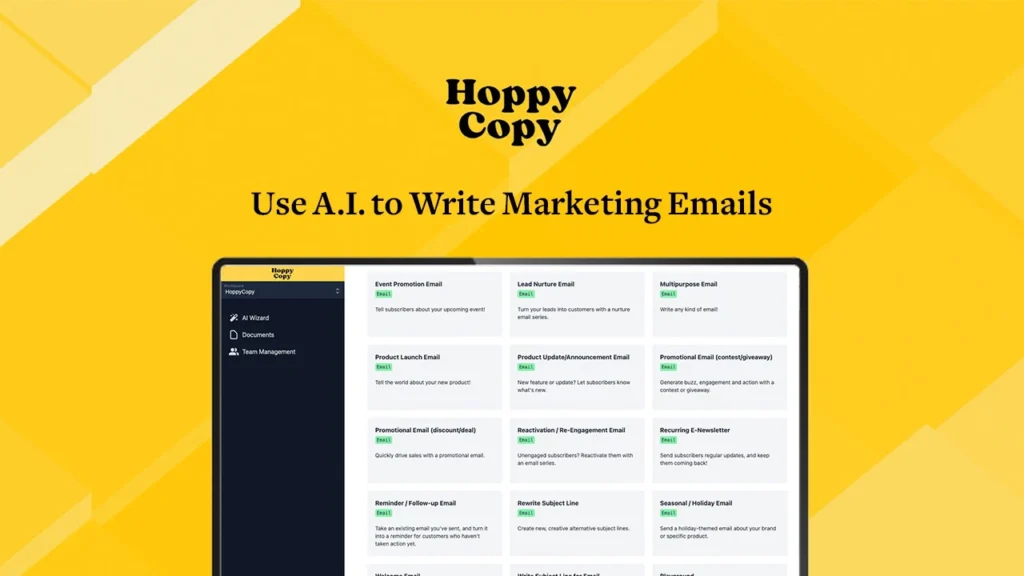
HoppyCopy is designed with a single job in mind: help email marketers produce campaign-ready copy faster. The interface organizes workflows around campaign types—welcome sequences, product launches, newsletters, abandoned cart emails—rather than generic “write something” prompts. This structure reduces decision paralysis because the tool already knows the typical format and goals of each email type. For example, if you select “welcome email sequence,” HoppyCopy generates a series of emails with logical progression (introduce brand ? provide value ? soft sell ? ask for engagement) instead of just generating one email and leaving you to figure out the rest.
The practical advantage is less manual sequencing work. If you’re building a five-email onboarding series, HoppyCopy understands that email one should be different from email five in tone, content focus, and call-to-action urgency. You’re not prompting the AI separately for each email; you’re working within a framework that already anticipates email marketing logic. This matters most when you’re not an email specialist—the tool compensates for knowledge gaps by building best practices into the workflow.
HoppyCopy also includes deliverability-focused features like spam score checking and subject line analysis, which are specific to email marketing constraints. These features don’t guarantee your emails land in the inbox, but they flag common mistakes (excessive capitalization, spam trigger words, poor formatting) before you send. For solo business owners or small teams without a dedicated deliverability specialist, this reduces the risk of accidentally damaging sender reputation or wasting campaigns on poorly optimized copy.
The learning curve is relatively shallow if your primary need is email. You’re not navigating a general-purpose content platform trying to figure out which template applies to your specific use case. The trade-off is reduced flexibility: HoppyCopy is less useful if you also need to write blog posts, ad copy, or landing pages. It’s a specialist tool, which means you gain speed and structure for email but lose versatility for other content formats.
Jasper takes the opposite approach: it’s a general-purpose AI copywriting platform that handles email as one of many content types. The core strength is format flexibility. If your marketing mix includes email newsletters, Facebook ads, product descriptions, blog outlines, and landing page headlines, Jasper lets you handle all of it in one tool instead of subscribing to multiple platforms. This reduces tool sprawl and makes it easier to maintain a consistent brand voice across channels because you’re training one AI system, not managing separate tools with different outputs.
For email specifically, Jasper provides templates for common formats (promotional emails, newsletters, cold outreach) and lets you build custom workflows using its “Recipes” feature, which chains multiple AI prompts together. This is useful when your email campaigns don’t fit standard templates—for example, if you’re writing educational email series that mix storytelling, technical explanation, and product mentions. Jasper’s flexibility means you can guide the output more precisely, but it also requires more active direction. You’re not working within a pre-built email sequence framework; you’re assembling the sequence yourself using AI-generated components.
Jasper’s integration with tools like Surfer SEO and Grammarly (through browser extensions) adds quality-checking layers that HoppyCopy doesn’t offer natively. If you’re writing newsletters that double as blog content or need to optimize email copy for search intent (for archived newsletter pages), Jasper’s broader ecosystem is more compatible with cross-channel content strategies.
The learning curve is steeper because Jasper assumes you understand content strategy. It won’t automatically suggest that your welcome email sequence should have a specific structure; you need to know that structure and prompt accordingly. This makes Jasper better suited for users who already have email marketing experience and want an AI assistant to speed up execution, rather than users who need the AI to guide campaign structure.
In business terms, HoppyCopy fits best when email is your primary marketing channel and you need to produce campaigns consistently without deep copywriting expertise. It supports faster output for email-specific tasks but doesn’t help with non-email content. Jasper fits best when email is part of a broader content operation and you have enough marketing knowledge to direct the AI toward the right campaign structures. It supports more varied content types but requires more manual assembly for email sequences.
Who Should Choose Another AI

If your email marketing needs are highly vertical-specific with strict regulatory or compliance requirements, neither HoppyCopy nor Jasper may be the right fit. For example, financial services email (investment advice, loan offers, insurance products) often requires legal disclaimers, compliance review, and specific language to meet regulatory standards. AI-generated copy in these contexts needs extensive editing and legal vetting, which can negate the time-saving benefits. Similarly, healthcare or pharmaceutical email marketing involves HIPAA compliance, FDA guidelines, and patient privacy constraints that general-purpose AI tools don’t account for. In these cases, you likely need template-based systems with built-in compliance checks or human copywriters with domain expertise.
If your email campaigns are entirely transactional or automated based on user behavior triggers (order confirmations, shipping updates, account notifications), you don’t need AI copywriting tools—you need email service platforms (ESPs) with conditional logic and dynamic content blocks. Tools like Klaviyo, ActiveCampaign, or HubSpot handle these use cases better because they integrate directly with your e-commerce or CRM data and automate sending based on rules, not creative copy generation.
Finally, if your business model relies on extremely niche or technical content where accuracy is critical and factual errors are costly (legal analysis, medical research summaries, technical documentation), AI copywriting tools carry too much risk. These tools can generate plausible-sounding but factually incorrect content (“hallucinations”), and the cost of fact-checking every AI-generated claim often exceeds the time savings. In these cases, human subject matter experts remain the better option, potentially supported by AI tools for research or outlining rather than final copy generation.
Use Cases by Business Goal
Productivity
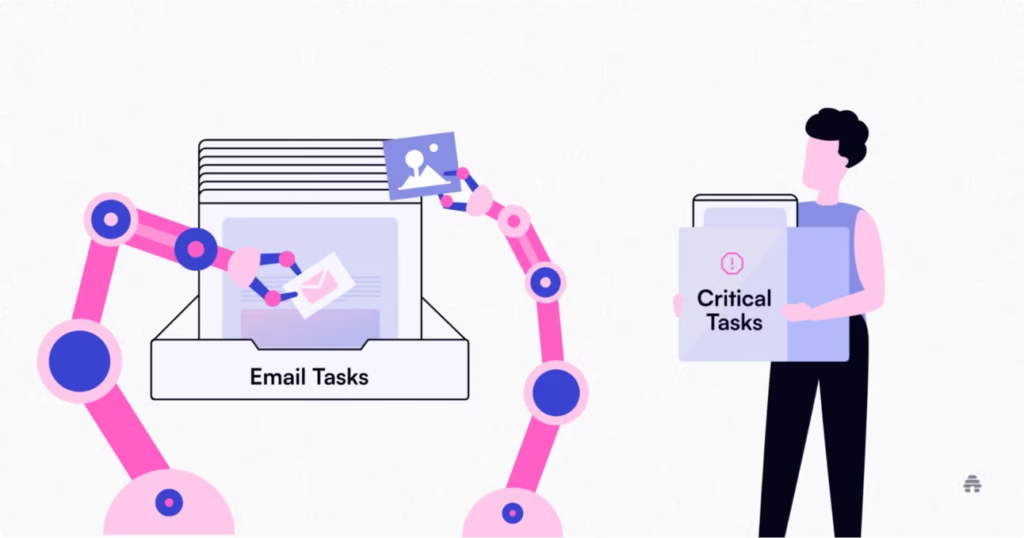
For internal efficiency, email marketing AI tools primarily save time on repetitive writing tasks: weekly newsletters, team update emails, or recurring campaign formats that follow predictable structures. HoppyCopy’s strength here is reducing the time spent on campaign planning and sequencing. If you run a monthly product update email series, HoppyCopy can generate the entire sequence in one session, maintaining logical flow between emails without requiring you to manually prompt for each message. This is useful for solo marketers or small teams where one person handles multiple campaigns simultaneously.
Jasper’s productivity advantage is cross-format efficiency. If your workday involves writing a newsletter, drafting social posts to promote it, and updating a landing page with the same messaging, Jasper lets you generate all three from a single content brief. The “Commands” feature (freeform AI prompting) also speeds up ad-hoc tasks like rewriting subject lines, shortening copy for mobile readability, or generating alternative CTAs for A/B testing.
The limitation for both tools is editing overhead. AI-generated email copy typically needs 20-40% revision to match brand voice, fix awkward phrasing, or add specific details the AI couldn’t infer. For productivity gains to materialize, you need a clear editing process: knowing which parts of AI output to trust (structure, formatting, general messaging) versus which parts require human judgment (tone nuances, product-specific claims, storytelling elements). Without this, you risk spending as much time editing AI copy as you would have spent writing from scratch.
Neither tool eliminates the need for campaign strategy. AI can execute a welcome email sequence, but it can’t decide whether your business needs a welcome sequence or a different onboarding approach. The productivity gain comes from faster execution once you know what to build, not from outsourcing strategic decisions to the AI.
For practical productivity improvements, explore how AI fits into broader operational workflows: AI Efficiency.
Revenue / Marketing

For direct revenue impact, email marketing AI tools help with two primary challenges: volume and testing velocity. More campaigns and faster iteration generally lead to better results, assuming baseline quality. HoppyCopy accelerates campaign volume by reducing the time to build promotional sequences, product launch emails, or seasonal campaigns. If you’re a solo business owner who currently sends one email per month because writing takes too long, using HoppyCopy to maintain a weekly cadence can directly increase revenue by keeping your brand visible and driving more traffic to offers.
Jasper’s revenue advantage is messaging experimentation. Because it handles multiple content formats, you can quickly test different value propositions across email, ads, and landing pages to see which messaging resonates. For example, if you’re launching a new product, you can use Jasper to generate five different email angles (problem-focused, benefit-focused, social proof-focused, urgency-focused, educational-focused) and A/B test them faster than writing each variant manually.
The trade-off is conversion quality versus speed. AI-generated email copy tends to be serviceable but rarely exceptional. It follows proven formulas (problem-agitation-solution, attention-interest-desire-action) without the creative edge that makes emails memorable or emotionally compelling. For low-ticket offers or high-frequency campaigns where volume matters more than perfect copy, this trade-off works. For high-ticket products, launches with significant revenue dependency, or brand-building campaigns where tone and voice are critical, AI-generated copy needs substantial refinement.
Neither tool provides performance analytics or revenue attribution. They generate copy, but they don’t tell you which email drove sales, what subject lines had the highest open rates, or how your campaigns perform over time. You still need an email service platform (Mailchimp, ConvertKit, Klaviyo) to send, track, and optimize campaigns. The AI tool saves time on writing; your ESP provides the data to improve results.
For revenue-focused email strategies and how to measure AI’s contribution to growth, see: AI Revenue Boost.
AI Comparison Table + Explanation
| Axis | HoppyCopy | Jasper |
|---|---|---|
| Ease of Use | Easier for email-only workflows; pre-built campaign structures reduce setup time | Steeper learning curve; requires more active direction and content strategy knowledge |
| Best For | Solo marketers or small businesses focused primarily on email campaigns; users who need campaign structure guidance | Marketing generalists handling email alongside other content types; users with existing email marketing experience |
| Strengths | Email-specific workflows, deliverability features (spam checking, subject line scoring), faster email sequence generation | Format flexibility (email, ads, social, blog), brand voice training, broader template library, API access |
| Limitations | Limited use outside email marketing; less flexible for non-standard campaign structures | Requires more manual sequencing for email campaigns; higher cognitive load for email-specific tasks |
| Pricing Perception | Mid-tier pricing focused on email specialists; value depends on email campaign volume | Higher pricing tier; value increases if you use it for multiple content types beyond email |
The choice between these tools depends on business maturity and content scope. If you’re in the early stages of building an email list (under 5,000 subscribers) and email is your primary marketing channel, HoppyCopy’s focused workflow will likely produce faster results with less friction. The tool’s opinionated structure compensates for gaps in email marketing knowledge, which is valuable when you’re learning as you grow.
If your business has evolved past email-only marketing and you’re managing a content mix (social media, paid ads, blog content, email), Jasper’s versatility becomes more cost-effective. Subscribing to one tool that handles multiple content types reduces software costs and simplifies workflow management compared to using separate tools for each format.
The pricing decision isn’t just about monthly costs—it’s about time ROI. A cheaper tool that requires 30% more editing time isn’t actually cheaper if your hourly rate (or opportunity cost) makes that extra editing time expensive. Similarly, a more expensive tool that sits unused because it’s too complex for your current needs is a poor investment regardless of features.
Both tools require active quality control. AI-generated email copy can sound generic, miss brand-specific nuances, or include factual errors if the AI makes assumptions about your product or audience. The time savings come from faster first drafts, not from eliminating editing entirely. Expect to spend 10-20 minutes refining AI output for a single email, or 30-60 minutes for a multi-email sequence, depending on how closely the initial output matches your needs.
How to Choose the Right AI

The practical decision framework involves four checkpoints: budget constraints, time-to-output needs, team technical skills, and review requirements.
Budget: If you’re operating on a tight marketing budget (under $100/month for all marketing tools), choosing an AI email copywriting tool means evaluating whether it displaces other costs. Can you replace a freelance copywriter’s monthly retainer with an AI tool plus your own editing time? Does the tool reduce email marketing time enough to justify reallocating budget from other areas? Neither HoppyCopy nor Jasper is free, so the decision isn’t “AI or no AI”—it’s “AI tool cost versus current alternative cost.” If you’re currently spending nothing on email copywriting because you write everything yourself, the question is whether your time is worth more than the tool’s subscription fee.
Time-to-output: If you need to launch campaigns quickly (product launch next week, seasonal promotion starting in three days), HoppyCopy’s email-specific workflows will likely get you to a sendable draft faster. If you have more time and need to coordinate email campaigns with other marketing channels, Jasper’s cross-format capability helps maintain messaging consistency across all materials, which can be more important than speed for any single piece of content.
Team tech skills: Neither tool requires coding or technical expertise, but they do require different types of content skills. HoppyCopy assumes you know what type of email campaign you need but not necessarily how to structure it. Jasper assumes you know how to structure campaigns and just need help generating the actual copy. If your team is weak on email marketing fundamentals (campaign types, sequence logic, copywriting frameworks), HoppyCopy’s guided approach is more forgiving. If your team understands marketing strategy but lacks copywriting speed, Jasper’s flexibility will be more valuable.
Common mistakes to avoid: choosing based on hype or influencer recommendations without testing the tool against your actual workflow. Most AI copywriting tools offer free trials; use them to generate real campaigns you need to send, not just to explore features. If you can’t produce a usable email in the trial period, the tool likely won’t work better after you subscribe. Another mistake is treating AI as a replacement for understanding your audience. AI can generate copy based on prompts, but it can’t replace knowing what your subscribers care about, what messaging has worked historically, or what product positioning resonates. The tool executes; you still need to provide strategic direction.
For building AI into your decision-making and operational processes: AI Workflows.
FAQs
Which AI email copywriting tool is better for small businesses with no marketing team?
HoppyCopy is generally better for small businesses where one person handles all email marketing without dedicated copywriting support. The tool’s email-specific templates and campaign structures provide guidance on what types of emails to send and how to sequence them, which reduces the learning curve. If your challenge is “I know I should be sending more emails but I don’t know what to write,” HoppyCopy’s frameworks help you get started faster. Jasper works better if you already have marketing experience and just need to speed up execution across multiple content types.
Can I use either tool to write automated email sequences that send based on user actions?
Both tools can generate the copy for automated email sequences (welcome series, abandoned cart emails, post-purchase follow-ups), but neither tool actually sends the emails or manages the automation logic. You’ll need to copy the AI-generated content into your email service platform (Mailchimp, Klaviyo, ConvertKit, etc.) and set up the behavioral triggers there. The AI tool writes the content; your ESP handles the automation, segmentation, and sending infrastructure. Think of these tools as copywriting assistants, not marketing automation platforms.
How much editing do AI-generated emails typically need before sending?
Expect to spend 30-50% of the time you would have spent writing from scratch on editing AI output. For a simple promotional email, that might mean 10-15 minutes of editing. For a complex multi-email sequence, plan for 45-60 minutes of refinement across all emails. The editing typically focuses on brand voice adjustments, fact-checking product claims, personalizing generic sections, and ensuring CTAs align with your specific goals. AI provides structure and drafts; you provide accuracy and brand authenticity.
Next Steps
- Compare AI — Explore more AI tool comparisons for different business use cases
- AI Efficiency — Learn how to integrate AI into daily operations for productivity gains
- AI Revenue Boost — Discover AI strategies for driving revenue through content and marketing
- Solo DX — Build systems and workflows that scale your solo business with AI
- AI Workflows — Step-by-step guides for implementing AI in your existing processes
Leave a Reply