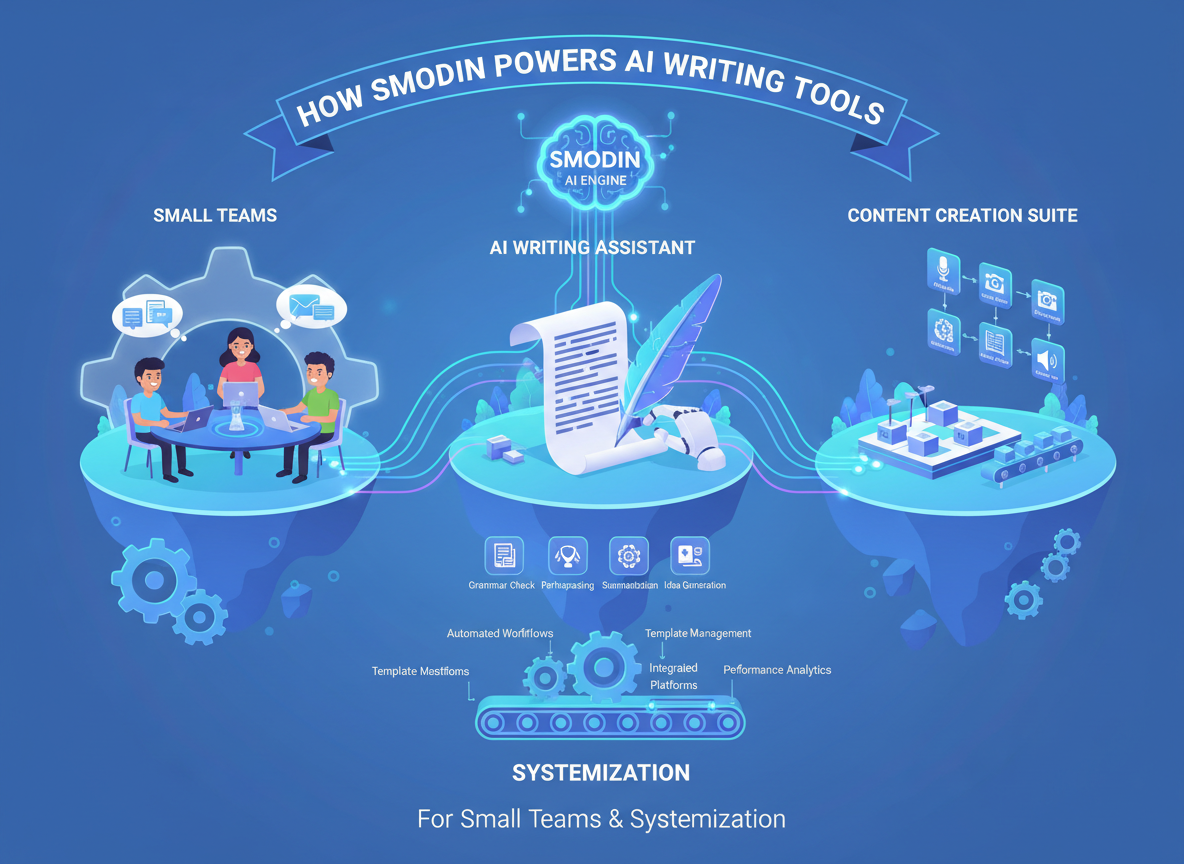
Small teams that master AI writing tools gain an unfair operational advantage — and Smodin is the platform quietly helping US founders claim it.
If you’ve grown your business from a solo operation to a team of three, five, or ten people, you already know the chaos that follows. Knowledge lives in Slack threads. New hires take weeks to onboard because nobody wrote anything down. Your best employee’s output looks nothing like your newest hire’s — and your clients notice. Welcome to 2026, where the scaling gap between what small US teams can do and what they’re actually doing has never been wider.
The promise of growth is real. But so is the operational debt that accumulates when founders scale headcount without scaling systems. In the US, where average employee turnover sits at 47% annually according to Bureau of Labor Statistics data, the cost of undocumented processes isn’t theoretical — it’s a recurring $4,000–$7,000 per new hire just in ramp-up time and lost productivity.
That’s where AI writing tools for small teams stop being a productivity luxury and start being a business survival tool.
Smodin has emerged as one of the most versatile platforms for exactly this challenge. It combines AI research assistance, automated content generation, paraphrasing, plagiarism checking, and document automation in one system — making it unusually well-suited for the specific chaos of US small teams who need to produce more, document better, and train faster without hiring a full-time operations manager.
Unlike traditional documentation approaches that can run $5,000 or more in US labor just to build a basic SOP library, Smodin lets teams get the same output in hours, not weeks, at a fraction of the cost. That’s not a feature — it’s a structural shift in how small businesses can operate.
This guide walks through exactly how Smodin enables small team systemization in 2026, including real-world use cases, ROI breakdowns in USD, and the most common mistakes teams make when they first start automating their operations.
What is Solo DX?

Solo DX — short for Solo Digital Transformation — describes a specific phase that many US small business founders find themselves in without a name for it. You’ve moved past the solo hustle. You have a team. But you don’t yet have the systems, documentation culture, or operational infrastructure that larger companies take for granted.
Corporate SOP methodologies don’t work for you. Those frameworks were built for companies with dedicated operations managers, HR departments, and multi-month implementation timelines. A five-person design studio in Austin doesn’t have six weeks to build a knowledge management system from scratch.
Solo DX sits in a distinct space between individual productivity tools and enterprise operations platforms:
| Category | Scale | Focus | Tooling |
|---|---|---|---|
| Personal Productivity | 1 person | Individual output | Notion, Obsidian, Todoist |
| AI Efficiency | 1–5 people | Speed and task automation | ChatGPT, Jasper, Copy.ai |
| Solo DX | 3–10 people | Systems and repeatability | Smodin, multi-feature AI platforms |
| Enterprise Operations | 50+ people | Process governance | Confluence, ServiceNow |
The defining characteristic of Solo DX is systemization intent. Teams in this phase are no longer just trying to get things done — they’re trying to get things done the same way, every time, by anyone on the team.
Consider a three-person branding studio in Austin: a founder handling client strategy, a designer producing deliverables, and a junior hire learning the ropes. Before Solo DX, every client onboarding looks slightly different depending on who’s handling it. Proposals vary. Revision processes are negotiated case-by-case. When the designer quits, three months of undocumented workflow walks out the door with them.
Solo DX means turning that institutional knowledge into documented, AI-generated systems that any team member can follow — and that any new hire can learn in days, not months.
This is where discover Smodin becomes relevant not just as a writing tool, but as a systemization engine. Its AI research assistant, essay and content generation, and document automation features give small teams the ability to create the operational infrastructure they need without the labor cost or timeline that traditional documentation requires.
The key insight is this: most US small teams don’t have a talent problem or even a time problem. They have a documentation problem. And in 2026, that’s a problem AI can actually solve.
Join 10,000+ US small teams using Smodin to eliminate operational chaos. See How It Works | Used by teams from Silicon Valley to New York
Why AI is Key for Mini-Team Systemization in the US
The economics of small team operations in the United States make manual systemization economically painful. US knowledge workers cost between $50 and $150 per hour fully loaded. Building documentation from scratch — writing SOPs, creating training materials, standardizing output templates — can easily consume 40 to 100 hours of founder or senior staff time. At $75/hour average, that’s a $3,000–$7,500 investment just to document what your team already knows how to do.
Three core operational problems drive the systemization crisis for US small teams, and AI addresses each one differently.
Problem 1: Knowledge Lives Only in the Founder’s Head
In the earliest stages of a business, the founder is the system. They know the clients, the processes, the workarounds, the standards. But as teams grow, this becomes a bottleneck and a liability. When the founder is traveling or unavailable, decisions stall. When the founder eventually wants to step back from day-to-day operations, there’s nothing to hand off.
AI writing tools for small teams solve this by transforming tacit knowledge into explicit documentation. A founder can dictate a process in rough notes or bullet points, and an AI research assistant can expand that into a complete, structured SOP in minutes. What would have taken a documentation specialist two days takes thirty minutes.
Problem 2: New Hires Slow Down Operations

US employee turnover averages 47% annually across industries. For small teams, that means you’re re-onboarding someone almost every year — and every time you do, you’re paying a productivity tax. Studies from SHRM suggest average replacement costs run 50–200% of annual salary depending on role complexity.
Without documented workflows, every new hire requires intensive shadowing, informal coaching, and repeated Q&A with senior team members. With AI-generated training documents and standardized workflows, onboarding time drops dramatically. Teams that have systematized their onboarding report reducing ramp-up time from four to six weeks down to one to two weeks.
Problem 3: Quality Varies Across Team Members
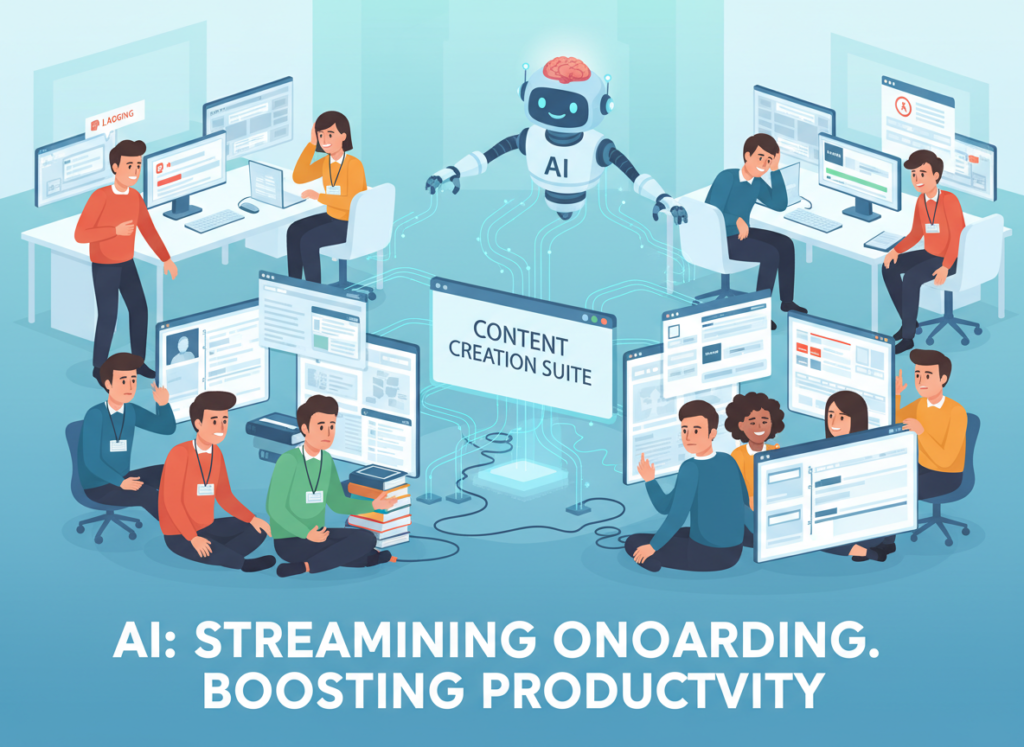
Inconsistent output is the silent revenue killer for small teams. When client deliverables, internal reports, or customer communications vary in quality depending on who produced them, you lose client trust and create rework cycles. The problem isn’t usually competence — it’s the absence of standards.
AI-powered document automation and template systems solve this structurally. When everyone works from the same AI-generated templates and follows the same documented process, quality variance decreases because the standard is embedded in the workflow, not in individual judgment.
The Cost Reality in 2026
As noted in this analysis of AI writing platforms and their role in content operations, manual documentation approaches remain the dominant choice for small businesses — but they carry real costs that founders often underestimate. The opportunity cost of using senior staff time for documentation work rather than revenue-generating activities alone justifies the shift to AI-assisted workflows.
The math is straightforward: manual documentation runs $5,000–$10,000 in US labor per major process library. AI-assisted documentation with a tool like Smodin runs $0–$10 per month in subscription costs and a fraction of the time.
How Smodin Enables Solo DX
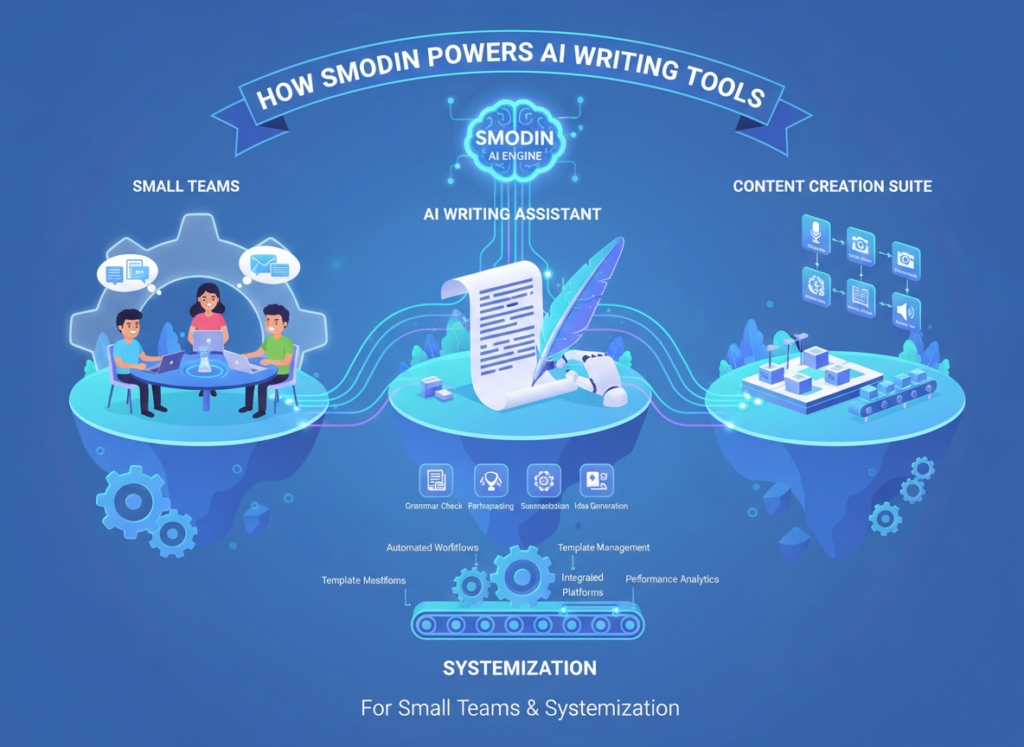
Smodin’s architecture makes it particularly well-suited for Solo DX because it combines four capabilities that small teams need in a single platform: content generation, research assistance, paraphrasing and rewriting, and plagiarism verification. Rather than stitching together three or four separate tools, teams get an integrated system.
Here’s how each core feature creates measurable ROI for US small teams.
Feature 1: AI Content Generation ? $2,000+ Saved Per Documentation Cycle

Smodin’s AI essay and content generator isn’t just for student essays — it’s a powerful engine for generating structured business documentation from prompts. A founder can describe a process in two to three sentences, and Smodin generates a full draft SOP, training guide, or client-facing document in minutes.
For a team that runs two major documentation cycles per year — updating their client onboarding playbook and their internal operations manual — this represents roughly 26 hours of senior staff time saved per cycle. At $75/hour average US knowledge worker cost, that’s $1,950 per cycle, or nearly $4,000 annually.
Feature 2: AI Research Assistant ? $78,000–$124,800 Annual Savings
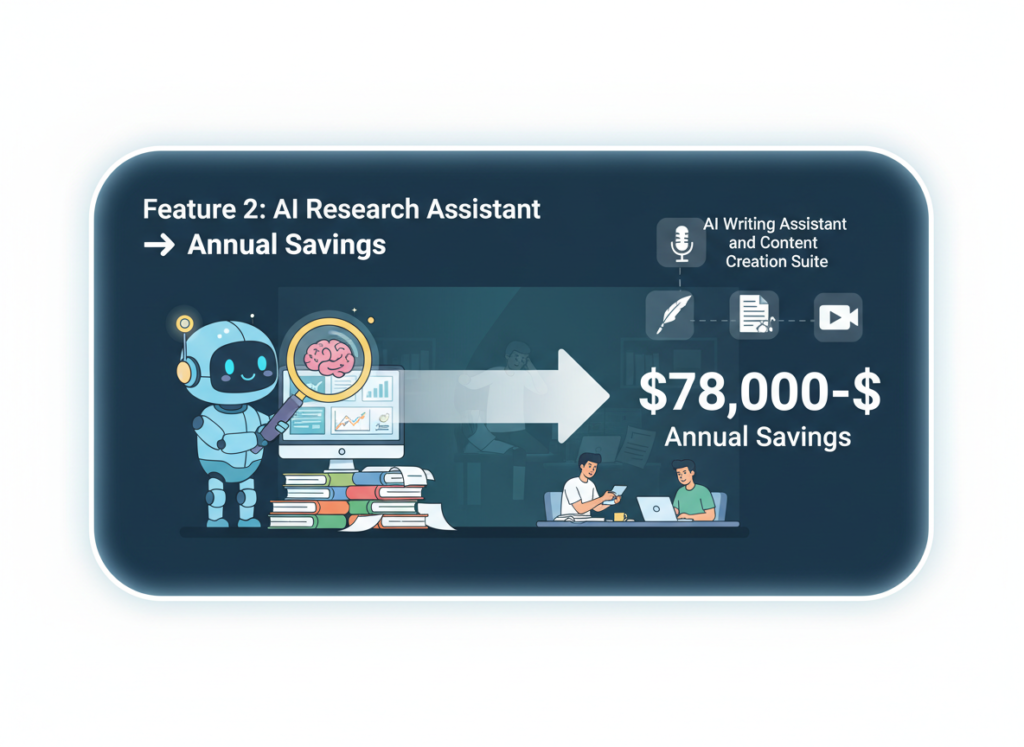
For teams that regularly produce research-heavy content — market analyses, client proposals, industry reports, grant applications — Smodin’s AI research assistant dramatically reduces the time-to-first-draft. Instead of spending six to eight hours researching and outlining a 2,000-word analysis, a team member can produce a solid first draft in under two hours.
If your team produces research-intensive documents weekly, the time savings compound rapidly. At $60/hour average and 4–6 hours saved per document, 50 documents per year yields $12,000–$18,000 in recovered labor. For teams producing multiple documents weekly, annual savings in this range are realistic.
Feature 3: Plagiarism Checker with AI ? $6,000+/Year Saved

For teams producing client content, thought leadership, or academic work, plagiarism verification is non-negotiable. Integrating Smodin’s plagiarism checker with AI into the content workflow eliminates the need for separate subscription tools and the manual step of running every piece through external checkers. The cost savings on redundant tools alone can justify the subscription.
More importantly, the integrated workflow — generate, paraphrase, check, publish — creates a repeatable quality assurance process that scales with team growth without adding headcount.
See how Smodin works for a detailed breakdown of these features and how they integrate into team workflows.
Ready to systemize your US team operations in under a week? Try Smodin Free | No credit card required | Trusted by 10,000+ US teams
Use Cases by Team Role
Persona 1: US Startup Founder Juggling 3 Departments
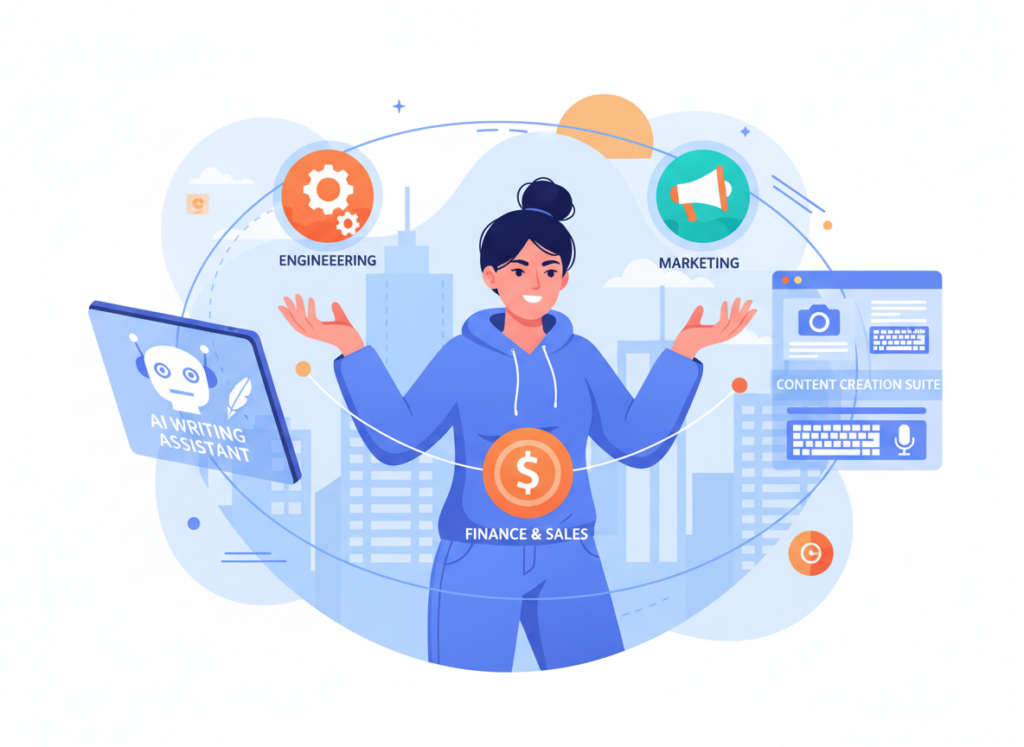
Maria, 34 — Founder, Product-Led SaaS Startup, San Francisco
Old Workflow: Maria spent three to four hours every week writing internal update emails, re-explaining the same processes to new contractors, and manually adapting pitch deck narratives for different investor audiences. Every document she produced was started from a blank page.
AI-Powered Workflow: Maria now uses Smodin’s content generator to draft weekly team updates from bullet-point notes in under 20 minutes. She created a master pitch narrative once, and uses the AI paraphrasing tool to adapt it for different investor contexts in minutes. New contractor onboarding documents are generated from a prompt library she built over two weeks.
Quantified Results: Maria recovered approximately 3 hours per week of senior founder time — worth $225/week at conservative $75/hour valuation — or $11,700 annually in recaptured strategic capacity.
“I used to feel like I was constantly writing the same things. Now I describe what I need and Smodin produces the first draft. I edit, I don’t originate.”
Persona 2: Executive Assistant Onboarding Remote Staff

James, 29 — Executive Assistant, 8-Person Remote Consulting Firm, Miami
Old Workflow: Every time a new remote team member joined, James spent two full days compiling onboarding documents, writing role-specific guides from scratch, and scheduling 1:1 training calls to fill gaps in written documentation.
AI-Powered Workflow: James used Smodin to build a complete onboarding document library in one week. Each role has a generated guide, FAQ document, and first-30-days checklist. New hires now complete 80% of onboarding self-serve, with James spending under half a day on each new hire’s process rather than two full days.
Quantified Results: At three new hires per year, James saves roughly 4.5 days of work annually. At $45/hour, that’s $1,620 in direct labor savings — plus the downstream productivity benefit of faster-ramping new hires.
“The first time I used Smodin to generate an onboarding guide, I had a 15-page document ready for review in 40 minutes. That would have been a full day of work before.”
Persona 3: Marketing Lead Standardizing Client Reporting

Aisha, 31 — Marketing Lead, 6-Person Agency, Chicago
Old Workflow: Aisha’s team produced monthly client reports that varied significantly in format, depth, and tone depending on who wrote them. Clients frequently asked for revisions or clarifications. Senior staff spent 30–45 minutes per report on quality review and editing.
AI-Powered Workflow: Aisha built a report template using Smodin’s document automation features, with standardized sections and AI-generated narrative prompts that guide junior staff through consistent analysis. She uses the plagiarism checker with AI to ensure all client-facing content is original before delivery.
Quantified Results: Report production time dropped by 40% across the team. Senior review time per report fell from 35 minutes to under 12 minutes. Across 48 client reports per year, that’s 18.4 hours of senior time recovered — worth approximately $1,840 at $100/hour. Client revision requests dropped by over half.
As noted in this breakdown of Smodin’s practical applications, the combination of AI generation with paraphrasing and plagiarism checking creates a content workflow that maintains voice while dramatically reducing production time.
“Smodin didn’t replace our writing — it standardized it. Now every report looks like our best work, not just whoever happened to write it that week.”
Join 10,000+ US small teams using Smodin to eliminate operational chaos. See How It Works | Used by teams from Silicon Valley to New York
Common Pitfalls & How to Avoid Them
Even with the right tool, small US teams frequently make implementation mistakes that undermine their Solo DX efforts. Here are the four most common pitfalls and how to avoid them.
Pitfall 1: Using Too Many Disconnected Tools
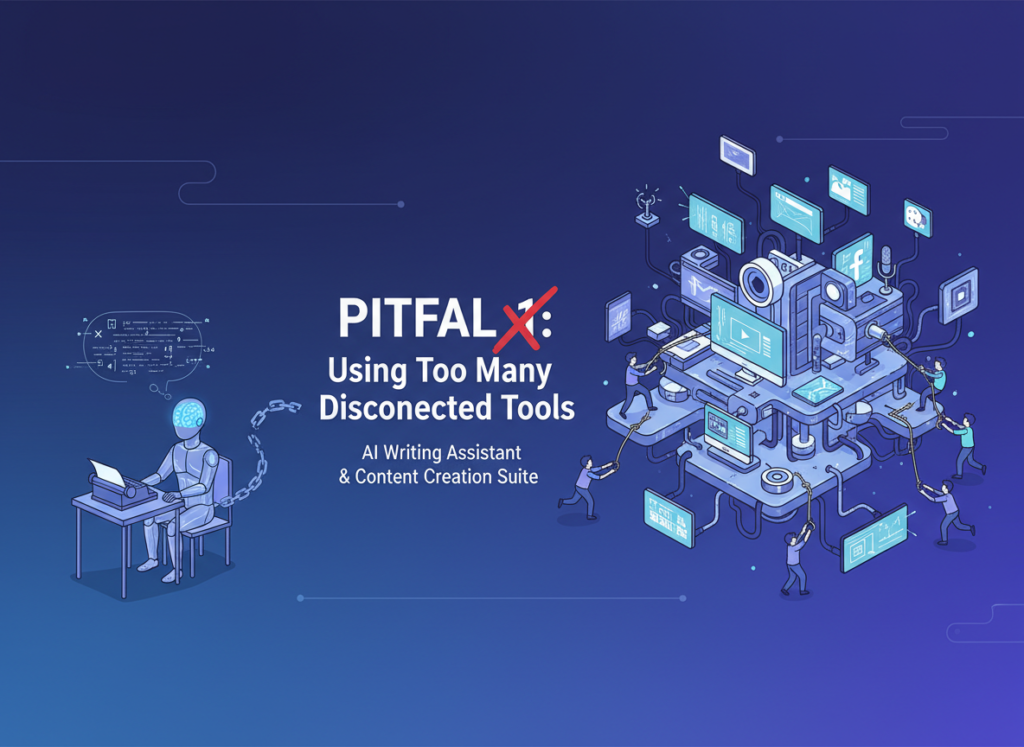
The most common mistake is assembling a stack of five or six point solutions — a separate content generator, a separate paraphrasing tool, a separate plagiarism checker — and expecting them to function as a coherent system. The result is tool fragmentation, inconsistent outputs, and team members defaulting back to manual processes because the multi-step workflow is too cumbersome.
The fix is consolidation. Smodin’s integrated approach — combining essay and content generation, AI paraphrasing, plagiarism checking, and research assistance in one platform — eliminates the tool-switching friction that kills adoption. As discussed in this practical guide to AI writing workflow integration, the ability to move through research, drafting, paraphrasing, and verification within a single environment is a significant operational advantage.
Pitfall 2: Delegating Without Documentation
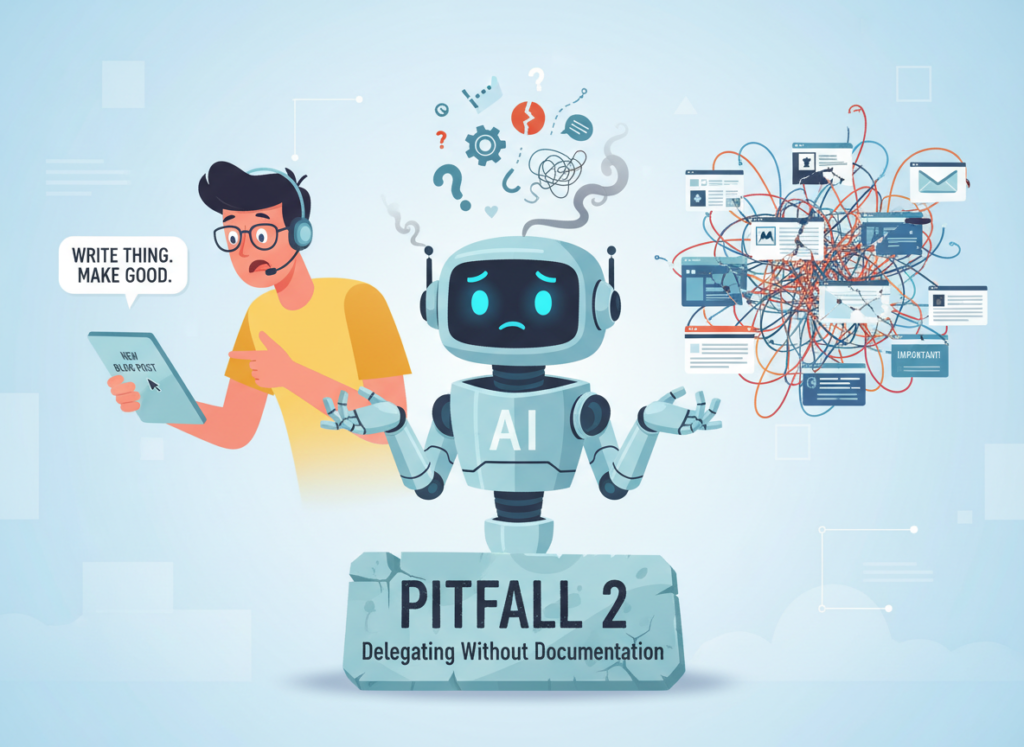
Many founders adopt AI writing tools for their own productivity, then delegate tasks to team members without documenting the AI-assisted workflow. The result is that the efficiency gains stay with the founder rather than scaling across the team.
The fix is to treat AI workflow documentation as a first-order priority. When you find a prompt or process that works, document it immediately as a team standard.
Pitfall 3: Over-Relying on Slack and Email for Knowledge
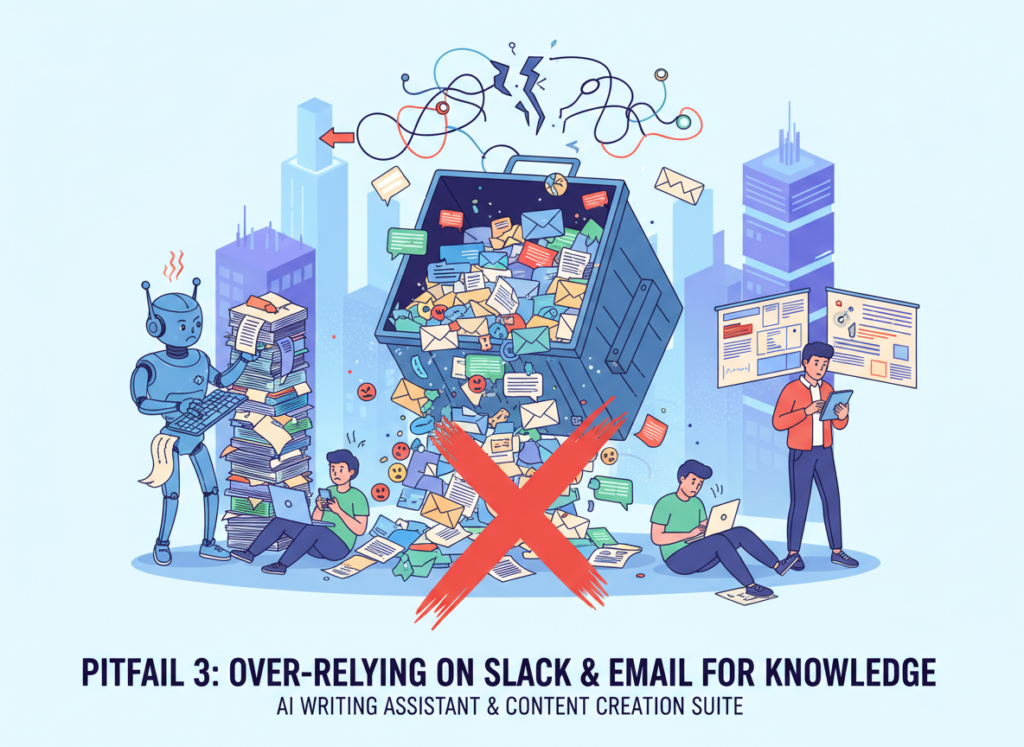
Slack and email are communication tools, not knowledge management systems. Important processes, decisions, and standards that live only in message threads are effectively invisible to anyone who wasn’t part of the original conversation — and completely inaccessible to future team members.
The fix is a deliberate practice of converting Slack threads and email chains into documented knowledge using Smodin’s content generation features. When an important process gets explained in a Slack thread, that thread becomes raw material for a Smodin-generated SOP.
Compare Smodin options to find the right plan for your team size and documentation volume.
FAQs
What is Solo DX?
Solo DX (Solo Digital Transformation) describes the operational phase where US small teams — typically 3 to 10 people — transition from founder-dependent processes to documented, repeatable systems. It’s the gap between “we figure it out as we go” and “we have a playbook for that.”
Can small teams afford to use AI?
Yes — in fact, the ROI case for small teams is stronger than for large ones. Enterprise software costs are fixed regardless of usage. AI writing tools for small teams like Smodin are priced for SMB scale, often $10–$30/month, while the labor costs they offset run $50–$150/hour. The payback period is typically measured in days, not months.
Is Smodin hard to set up?
No. Smodin is designed for non-technical users and requires no integration work or IT support. Most small teams are generating useful output within an hour of signing up. The learning curve is primarily in developing good prompt habits — which typically takes one to two weeks of regular use to develop.
Conclusion
In 2026, American small businesses don’t need enterprise budgets to build enterprise-level systems. The tools that used to require a full operations team and six-figure implementation costs are now accessible at SMB price points, through platforms designed for teams that don’t have IT departments or documentation specialists.
AI writing tools for small teams have crossed a threshold: they’re no longer primarily useful for content marketing or academic work. They’re infrastructure for operational systemization. Smodin’s combination of content generation, AI research assistance, paraphrasing, and plagiarism verification makes it one of the most complete platforms available for US teams in the Solo DX phase.
The opportunity cost of not systemizing is real and growing. Every week your processes live only in people’s heads, you’re paying a tax — in ramp-up time, in quality variance, in founder bottlenecks, in turnover risk. Smodin doesn’t eliminate that tax automatically. But it gives you the tools to eliminate it faster and more cheaply than any previous approach.
Start with one process. Pick the one that causes the most friction — the one you’ve re-explained five times in the last month — and use Smodin to document it this week. That’s the beginning of Solo DX.
For a full Smodin review including feature comparisons, pricing, and implementation guidance, visit the AI Plaza tool page.
Join 10,000+ US small teams using Smodin to eliminate operational chaos. See How It Works | Used by teams from Silicon Valley to New York
Leave a Reply