
Small teams that still rely on Canva exports and scattered Google Slides are spending 6+ hours per week on visual content that Visme AI can produce in under 20 minutes.
There’s a specific kind of chaos that hits American small teams somewhere between three and ten people. You’ve grown past the stage where one person handles everything, but you haven’t yet built the systems to keep quality consistent. A new hire asks for the client pitch deck. It’s buried in someone’s Google Drive. The last infographic your marketing lead created looks nothing like the one the operations manager put together last week. The sales deck hasn’t been updated since Q2, and no one can quite remember which version is “current.”
This is the visual content bottleneck — and it’s quietly draining US small teams of productivity, credibility, and conversion opportunities in 2026.
Unlike text-heavy documentation tools, visual content sits at the intersection of communication and brand. When your slide decks look inconsistent, prospects notice. When your internal reports are plain and hard to parse, decision-making slows down. When your team spends hours wrestling with design tools instead of doing their actual jobs, you’re burning $50–$150/hour in US labor on tasks that shouldn’t require a designer at all.
Visme AI is an ai presentation maker and visual content platform built specifically for non-designers who still need professional output. It combines AI-generated layouts, brand-consistent templates, smart infographic generation, and collaborative workflows into a single workspace. For US small teams navigating the shift from founder-driven visual content to team-wide visual systems, it offers something that traditional design tools don’t: a repeatable, scalable process.
Unlike hiring a freelance designer ($75–$150/hour in most US markets) or subscribing to a separate tool for every content type, Visme AI centralizes your entire visual workflow. The cost difference is stark — teams that document their visual workflows in Visme AI typically save $12,000–$18,000 annually compared to outsourced design or fragmented SaaS stacks.
This review covers exactly how Visme AI enables Solo DX for US small teams: what it does, where it delivers real ROI, who benefits most, and where teams hit pitfalls.
Get the full Visme AI review and feature comparison to see exactly how it fits your team’s visual content workflow.
What is Solo DX?
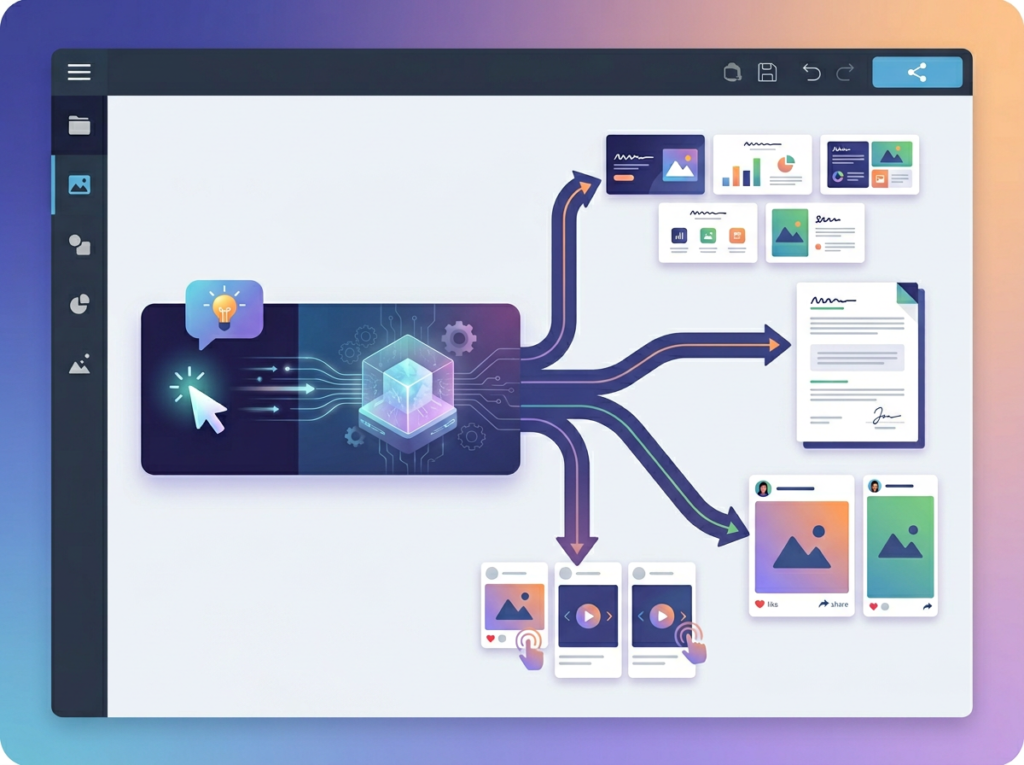
Solo DX — short for Small-scale Digital Transformation — describes the operational shift that happens when US founders stop doing everything themselves and start building repeatable systems that work without them. It’s not about enterprise software or six-figure IT projects. It’s about building the infrastructure a 3–10 person team needs to function consistently, onboard new hires quickly, and maintain quality without the founder being in every decision.
Most corporate SOP frameworks fail US small teams for a simple reason: they were designed for organizations with dedicated operations managers, compliance teams, and weeks of runway for internal projects. When a five-person Austin-based marketing agency tries to implement an enterprise documentation system, they spend three weeks building something no one uses. Solo DX is different. It’s founder-led, pragmatic, and tool-driven — and AI is what makes it achievable in days rather than months.
Solo DX vs. Other Operational Frameworks
| Framework | Who It’s For | Complexity | Timeline |
|---|---|---|---|
| Solo DX | 3–10 person US teams | Low | Days–weeks |
| Enterprise Ops | 100+ employee orgs | Very High | Months–years |
| AI Efficiency | Individual contributors | Low | Hours–days |
| Lean Startup | Product-focused teams | Medium | Ongoing |
For visual content specifically, Solo DX means moving from “whoever is available makes the slide deck” to “everyone on the team can produce on-brand, professional visual content using a shared system.” That’s where an ai presentation maker like Visme AI enters the picture.
Consider a three-person design studio in Austin. Before implementing a visual content system, every client presentation was built from scratch by the founder. Onboarding a new junior designer meant two weeks of back-and-forth over brand guidelines, template versions, and acceptable layout choices. With Visme AI, the studio loaded brand colors, fonts, and approved layout styles into a shared workspace. New hires now produce client-ready decks on their first week.
To see the full feature set that makes this possible, explore Visme AI’s features.
Solo DX doesn’t require a operations manager. It requires the right tools and the discipline to build a system once and enforce it through automation rather than oversight.
Get the full Visme AI review and feature comparison to see exactly how it fits your team’s visual content workflow.
Why AI is Key for Mini-Team Visual Systemization
Problem 1: Visual quality depends entirely on who’s available

In most US small teams, one or two people handle visual content because they happen to be better at design than everyone else. When they’re unavailable — traveling, on deadline, or simply overwhelmed — quality drops immediately. There’s no system, only people. The moment that person leaves or the team scales, the bottleneck becomes a crisis.
AI-powered visual tools solve this by encoding quality into the system itself. Brand guidelines, approved layouts, and content frameworks live in the tool — not in someone’s head. Any team member can produce professional output because the AI enforces the standards automatically.
Problem 2: New hires slow everything down

US labor turnover runs at roughly 47% annually in industries like marketing, services, and tech support. Every new hire is a drain on team velocity for weeks — sometimes months — if visual content workflows aren’t documented. A new marketing coordinator at a Denver-based SaaS startup shouldn’t need three weeks to figure out how to build a client report. With a shared Visme AI workspace, they can produce brand-consistent output on day one.
The cost of poor onboarding is quantifiable. At $65/hour average loaded labor cost for a US marketing role, three weeks of reduced productivity represents roughly $7,800 per new hire. Eliminating that drag through visual workflow documentation pays for a Visme AI subscription several times over.
Problem 3: Fragmented tools create inconsistent output
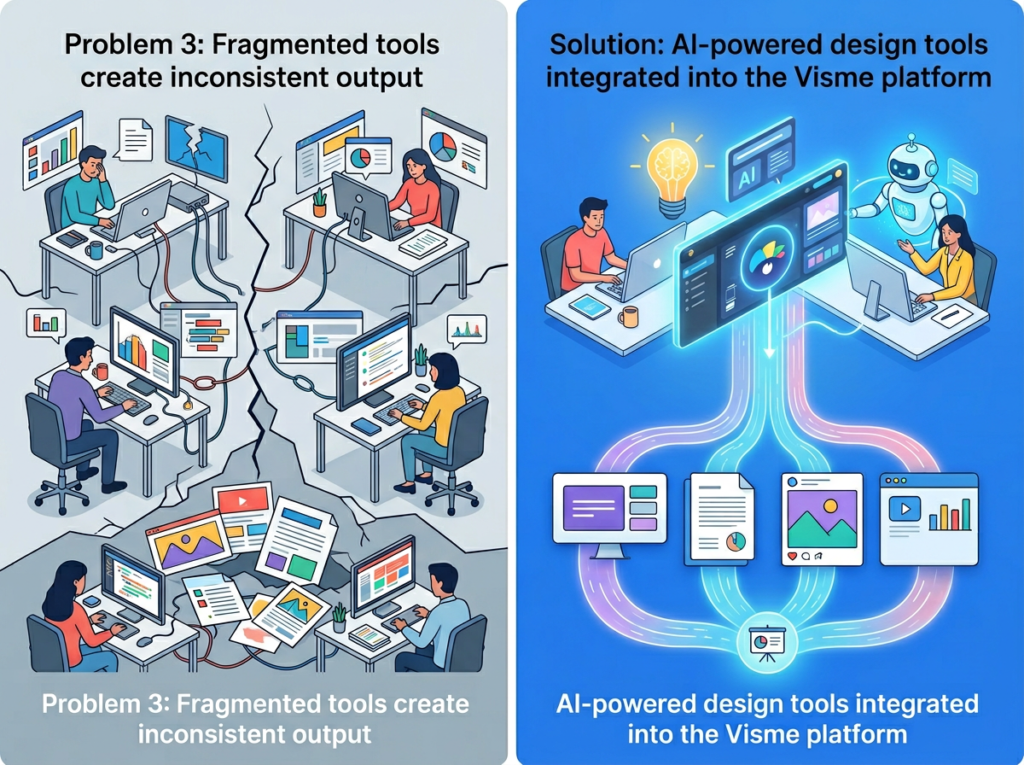
The average US small team uses 4–6 separate tools for visual content: Canva for social graphics, PowerPoint for presentations, Google Slides for internal decks, Piktochart or Venngage for infographics. Each tool has different templates, different export standards, and different quality levels. The result is a visual identity that looks different depending on which tool was used last.
The Cost Reality
| Approach | Annual Cost (US) | Time Investment |
|---|---|---|
| Freelance designer | $18,000–$36,000 | 2–3 weeks/project |
| Fragmented SaaS stack | $2,400–$4,800 | High coordination cost |
| Visme AI team plan | $480–$1,200 | Hours per project |
| In-house designer hire | $55,000–$85,000 salary | Full-time overhead |
How Visme AI Enables Solo DX

1. AI Presentation Maker — $3,200 Saved Per Pitch Cycle
Visme AI’s core AI presentation generator takes a text prompt, topic description, or document and converts it into a fully formatted, on-brand presentation in under two minutes. For a Chicago-based consulting firm that produces four client pitch decks per month, this eliminates roughly 8 hours of layout work per deck — at $100/hour in US consulting labor, that’s $3,200 saved per monthly cycle, or roughly $38,400 annually.
The AI doesn’t just populate slides. It selects layout types appropriate to the content — data-heavy sections get chart slides, narrative sections get text-with-image layouts, and introductions get bold visual openers. The result is a deck that feels intentionally designed, not assembled.
2. AI Infographic Generator — $6,000/Year in Design Labor Saved
Infographics are among the most labor-intensive visual assets for US small teams to produce without a dedicated designer. Visme AI’s infographic generator converts raw data, process descriptions, or structured text into visual formats — timelines, comparison charts, process flows, statistical summaries — in minutes.
For a Miami-based health and wellness company publishing two infographics per month for content marketing, this replaces approximately $500/month in freelance design fees. Annual savings: $6,000. As noted in this breakdown of Visme’s AI Designer capabilities, the platform’s ability to go from prompt to polished design in under two minutes is a meaningful differentiator for teams without in-house design support.
Ready to systemize your US team’s visual content in under a week? Try Visme AI Free | No credit card required | Trusted by 10,000+ US teams
See how Visme AI works for teams that need professional visual output without a full-time designer on staff.
Use Cases by Team Role
Maria — US Startup Founder Juggling 3 Departments (San Francisco)

Maria runs a 7-person B2B SaaS startup in San Francisco. She handles sales, is loosely involved in product, and signs off on every marketing deliverable. Her problem: every investor update, client deck, and internal report looks different because different team members built them in different tools.
Old workflow: Maria reviews every visual deliverable before it goes out. Average review time: 45 minutes per asset. With 12+ assets per month, she’s spending 9 hours on design review — at her effective hourly rate of $200+, that’s $1,800/month in founder time lost to low-leverage work.
AI-powered workflow: Maria sets up a Visme AI workspace with her brand kit and approved templates. Team members generate presentations and reports using the AI presentation maker within those guardrails. Maria reviews only the final content, not the design.
Results: Review time drops from 9 hours to 2 hours per month. Monthly savings: $1,400 in founder time. Quarterly pitch decks now take 45 minutes to produce instead of a full day.
“I used to spend Sunday afternoons fixing slide decks. Now the team sends me things that actually look right on the first pass.” — Composite persona based on SF-based SaaS founders
James — Executive Assistant Onboarding Remote Staff (Miami)

James supports the CEO of a 9-person financial services firm in Miami. He’s responsible for onboarding new remote hires, which includes producing welcome decks, process guides, and compliance overview materials.
Old workflow: James builds every onboarding asset from a mix of old PowerPoint files, Google Docs screenshots, and manually formatted slides. Each onboarding package takes 6–8 hours to assemble and always looks inconsistent.
AI-powered workflow: James builds a master onboarding template in Visme AI. When a new hire joins, he uses the AI to populate role-specific content into the template in under 30 minutes. The result is a professional, branded onboarding deck every time.
Results: Onboarding package production time drops from 7 hours to 30 minutes. At James’s loaded cost of $45/hour, that’s $292 saved per new hire. For a team that hires 8–10 people per year, annual savings exceed $2,500 — plus the qualitative benefit of a more professional first impression for new employees.
“New hires tell me our onboarding materials look more polished than what they saw at companies three times our size.” — Composite persona based on Miami-area EA roles
Aisha — Marketing Lead Standardizing Client Reporting (Austin)

Aisha leads marketing for a 6-person digital agency in Austin. Each month, she produces performance reports for 12 active clients. Previously, each report was a unique Google Slides document assembled by whoever had bandwidth.
Old workflow: Reports took 2–3 hours each to build and format. Inconsistent layouts meant clients occasionally questioned data presented in unfamiliar formats. Total monthly time: 30+ hours across the team.
AI-powered workflow: Aisha builds a master report template in Visme AI with locked brand elements and flexible data sections. The ai infographic generator converts raw analytics data into charts automatically. Monthly reports now take 35 minutes each.
Results: Monthly report production time drops from 30 hours to 7 hours. At $75/hour blended labor cost, that’s $1,725 saved per month — $20,700 annually. As this external analysis of Visme’s editing capabilities shows, the Edit with AI feature enables rapid iteration on existing content, which Aisha’s team uses to adapt the base template for each client’s specific metrics.
“Our clients actually look forward to their monthly reports now. The presentation quality went from ‘it gets the job done’ to ‘this looks like it came from a top-tier agency.’” — Composite persona based on Austin-area agency marketing leads
Join 10,000+ US small teams using Visme AI to eliminate visual content chaos. Discover Visme AI | Used by teams from Silicon Valley to New York
Common Pitfalls & How to Avoid Them
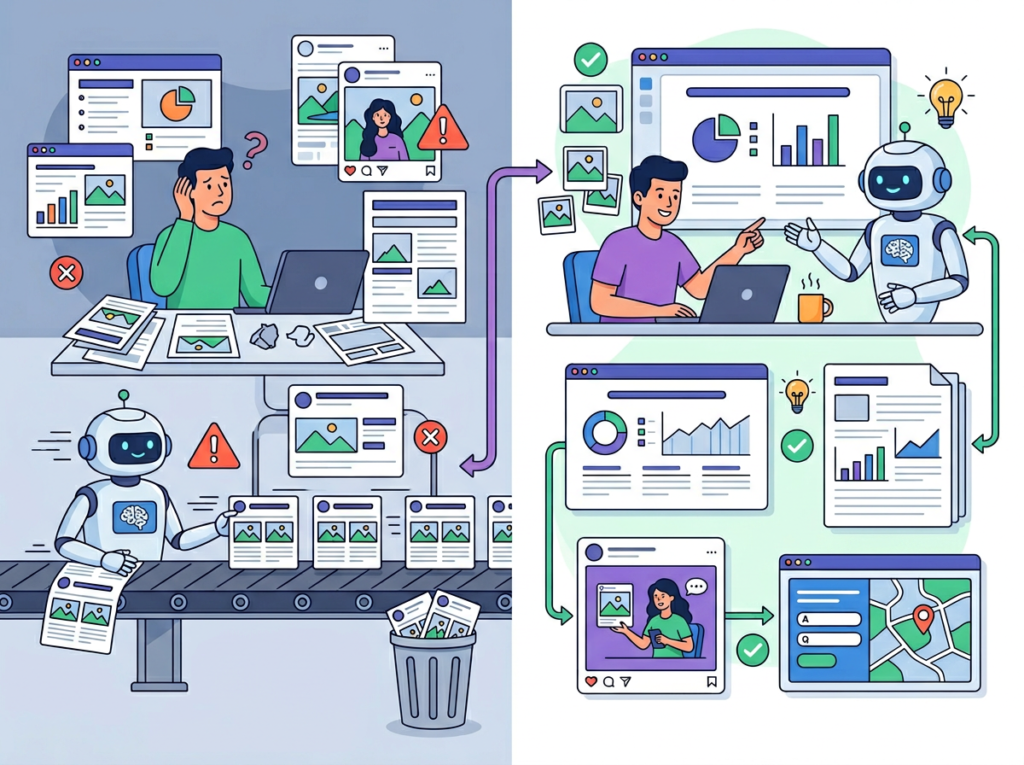
Mistake 1: Skipping the Brand Kit setup
The fastest way to undermine Visme AI’s value is to use it without configuring your brand kit first. Teams that skip this step end up with AI-generated presentations that look polished but off-brand. The fix takes 30 minutes: upload your logo, enter your brand colors (hex codes), select your approved fonts, and save. Every AI-generated asset will apply these standards automatically from that point forward.
Mistake 2: Letting team members use personal accounts instead of a shared workspace
When individual team members use separate Visme accounts, brand consistency breaks immediately. Templates don’t sync. Brand kits aren’t shared. Design choices diverge. US small teams should use Visme AI’s team plan and configure a shared workspace from day one. This is the operational infrastructure that makes the ROI possible.
Mistake 3: Keeping visual content workflows siloed from other operations systems
The full review of Visme AI’s capabilities covers how Visme AI integrates with tools like Salesforce, HubSpot, Google Analytics, and Slack. US small teams that don’t leverage these integrations miss the compounding ROI available when visual content generation is triggered by data events — for example, automatically generating a client performance report when monthly analytics are ready.
Avoiding these four pitfalls is the difference between Visme AI as a nice-to-have tool and Visme AI as genuine operational infrastructure for your US team.
Get the full Visme AI review and feature comparison to see exactly how it fits your team’s visual content workflow.
FAQs

What is Solo DX?
Solo DX stands for Small-scale Digital Transformation. It describes the process US founders go through when they shift from doing everything manually to building AI-powered systems that let their small teams operate consistently without constant oversight. Unlike enterprise digital transformation, Solo DX is pragmatic and fast — most teams can implement meaningful systems in days to weeks, not months.
How can AI write my SOPs and visual content templates?
Tools like Visme AI let you input a content description, topic, or existing document, and the AI generates a structured visual template, presentation, or infographic. You provide the content context and brand standards; the AI handles layout, visual hierarchy, and formatting. The result is a professional asset that a non-designer can produce in 15–30 minutes instead of 3–6 hours.
What’s the difference between AI Efficiency and Solo DX?
AI Efficiency describes tools and workflows that make individual contributors faster at their existing tasks. Solo DX goes further — it’s about building systems that work across a team, survive employee turnover, and scale without the founder in the loop. A marketer using AI to write faster is AI Efficiency. A marketing team with a shared Visme AI workspace, locked templates, and a documented visual content process is Solo DX.
Is Visme AI hard to set up for a non-technical team?
Setup is genuinely approachable for non-technical teams. The brand kit configuration takes 30 minutes. The AI presentation maker requires no design knowledge — you describe what you need, and the AI generates it. Most US small teams reach productive use within one business day of signing up, with full team rollout typically complete within a week.
Get the full Visme AI review and feature comparison to see exactly how it fits your team’s visual content workflow.
Conclusion

In 2026, American small businesses don’t need enterprise budgets to build enterprise-level visual systems. They need the right tool, a 30-minute setup session, and the discipline to enforce a shared process across the team.
Visme AI delivers on the core promise of an ai presentation maker: professional, on-brand visual content without a designer, without hours of layout work, and without the inconsistency that plagues small teams using five different tools for five different content types.
The ROI is quantifiable. Teams that implement Visme AI as their unified visual content platform consistently report $12,000–$25,000 in annual savings from reduced design labor, faster content production, and eliminated freelance fees. More importantly, they report a shift in how they operate — from reactive content creation to systematic visual output that scales with the team.
Start with one process. Pick your monthly client report, your onboarding deck, or your standard pitch presentation. Build a Visme AI template for it this week. Measure the time savings. Then expand.
Get the full Visme AI review and feature comparison to see exactly how it fits your team’s visual content workflow.
Leave a Reply