
Smart US founders aren’t searching harder in 2026 — they’re using an ai research assistant for business that finds verified answers in minutes, not hours.
Here’s a pattern that kills small team productivity: your best employee spends 45 minutes tracking down a stat for a client proposal. Your new hire misreads a competitor’s pricing because they googled a two-year-old article. Your marketing lead builds a campaign on assumptions instead of data because “there wasn’t time to research properly.”
In 2026, this is the research problem quietly draining US small businesses. Knowledge workers spend an estimated 20–30% of their workday just searching for information — not analyzing it, not acting on it, just finding it. For a team of five billing at even $50/hour, that’s $500+ per day evaporating into browser tabs.
The challenge isn’t that information is scarce. It’s that the internet is overwhelming, and most AI tools still can’t reliably tell you what’s true versus what was once true or might be true if you squint at it sideways.
Liner AI was built to solve exactly this problem. It positions itself not as a general-purpose chatbot but as an ai research assistant for business that delivers accurate, source-cited answers from peer-reviewed papers, live web data, and curated content — faster than any manual search workflow your team currently uses.
For US founders managing lean teams, Liner fills a real gap: it gives non-researchers the ability to produce research-quality outputs without hiring a research analyst or spending four hours on Google. Unlike traditional research processes that can cost $5,000+ in US labor per project, Liner’s Pro Work plan runs under $180/year — and your whole team can use it.
The rest of this article breaks down exactly what Liner AI does, how it fits into a Solo DX systemization framework, and what four different US team personas gained by building it into their workflows. The results are worth your attention.
Start with one process. Systemize it this week. Full Liner AI review and setup guide
What is Solo DX?

Solo DX — short for Solo Digital Transformation — describes the practical, founder-led process of building repeatable systems inside a small US business using affordable digital tools. It’s not enterprise software. It’s not a six-month implementation project. It’s a scrappy, intentional approach to reducing operational chaos in teams of two to fifteen people who can’t afford to hire an operations manager.
The Solo DX philosophy emerged from a simple frustration: most of the advice available about business systemization is written for companies with IT departments, full-time project managers, and the budget to implement platforms like Salesforce or Microsoft Dynamics. That advice is largely irrelevant to the freelancer who just hired her first two contractors, or the Austin-based founder running a SaaS startup with four remote employees across three time zones.
Solo DX is different from the broader “AI Efficiency” category in one important way: efficiency is about doing existing tasks faster. Solo DX is about turning one-off, founder-dependent actions into documented, transferable systems. The goal isn’t just speed — it’s institutional knowledge that doesn’t live exclusively in someone’s head.
| Category | Focus | Who It’s For |
|---|---|---|
| AI Efficiency | Do current tasks faster | Any user |
| AI Revenue Boost | Increase sales and conversion | Growth-stage teams |
| Solo DX | Build repeatable systems | Founders scaling past solo |
| AI Workflows | Automate multi-step processes | Operations-focused teams |
For research-heavy roles — content teams, consultants, agency founders, service businesses — the research workflow is often the most chaotic and least systemized part of the operation. Work happens in browser bookmarks, Slack DMs, and Google Docs that nobody can find six weeks later.
That’s where Liner AI enters the Solo DX picture. As one of the most accurate AI search engines available today (it ranks #1 on OpenAI’s SimpleQA accuracy benchmark, outperforming ChatGPT 4.5 and Perplexity), Liner turns research from a fragmented personal activity into a repeatable team workflow. When your team uses the same tool, with the same settings, and shares highlighted findings in a centralized workspace, research becomes a system rather than an individual skill.
Explore Liner AI’s features to see exactly how it compares against other ai research assistant for business options before committing to a plan.
A three-person content agency in Austin is a good illustration. Before adopting a systemized research tool, each writer had her own browser bookmarks, her own go-to sites, and her own standards for what counted as a “credible” source. One writer cited trade association reports. Another defaulted to LinkedIn posts. The third copy-pasted stats from articles that didn’t link to primary sources. The result: inconsistent content quality, time-consuming editor reviews, and at least two client complaints per quarter about factual accuracy.
Solo DX thinking reframes this as a solvable operational problem. With a shared Liner workspace, standard research protocols, and AI-generated summaries the whole team can review, the agency standardized its sourcing process in less than a week.
Why AI is Key for Mini-Team Systemization
Problem 1: Critical knowledge lives only in one person’s head

In most small businesses, there’s a “research person” — the founder, the senior employee, or whoever happens to be good at finding things online. When that person is unavailable, busy, or eventually leaves, the team’s research capacity drops to near zero. This is a single-point-of-failure in the knowledge workflow, and it’s surprisingly common. A 2024 study by McKinsey found that employees at small companies spend up to 1.8 hours daily just searching for information internally and externally.
At $65/hour average blended rate for a US knowledge worker, 1.8 wasted hours per person per day costs a five-person team roughly $172,000 in lost productivity annually. That’s not a rounding error. That’s a salary.
AI research tools solve this by making the search capability available to everyone on the team, regardless of their individual skill at finding credible sources online.
Problem 2: New hires slow down operations
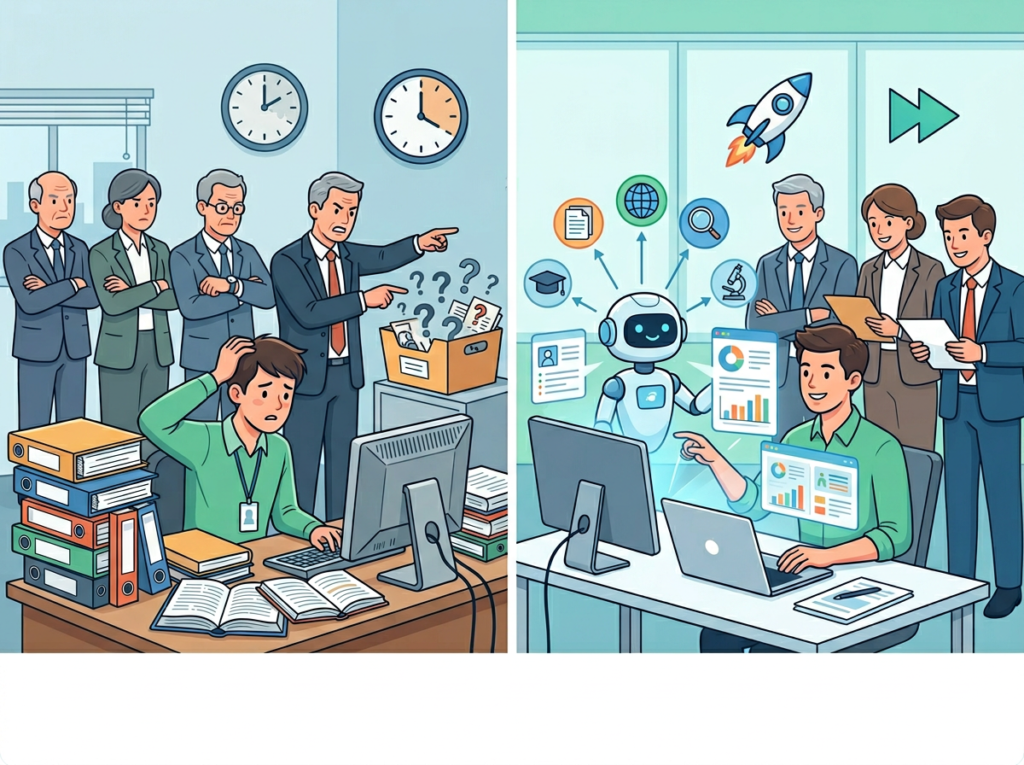
The US experiences a 47% annual employee turnover rate across many service industries. Every time someone new joins a small team, the onboarding process typically involves the founder or a senior employee manually walking the new hire through “how we research things here.” That’s not a system — it’s a dependency. AI-assisted research tools reduce this burden because the tool itself carries the methodology. New hires get accurate, cited answers from day one, without needing a two-hour orientation on which websites to trust.
Problem 3: Research quality varies wildly between team members
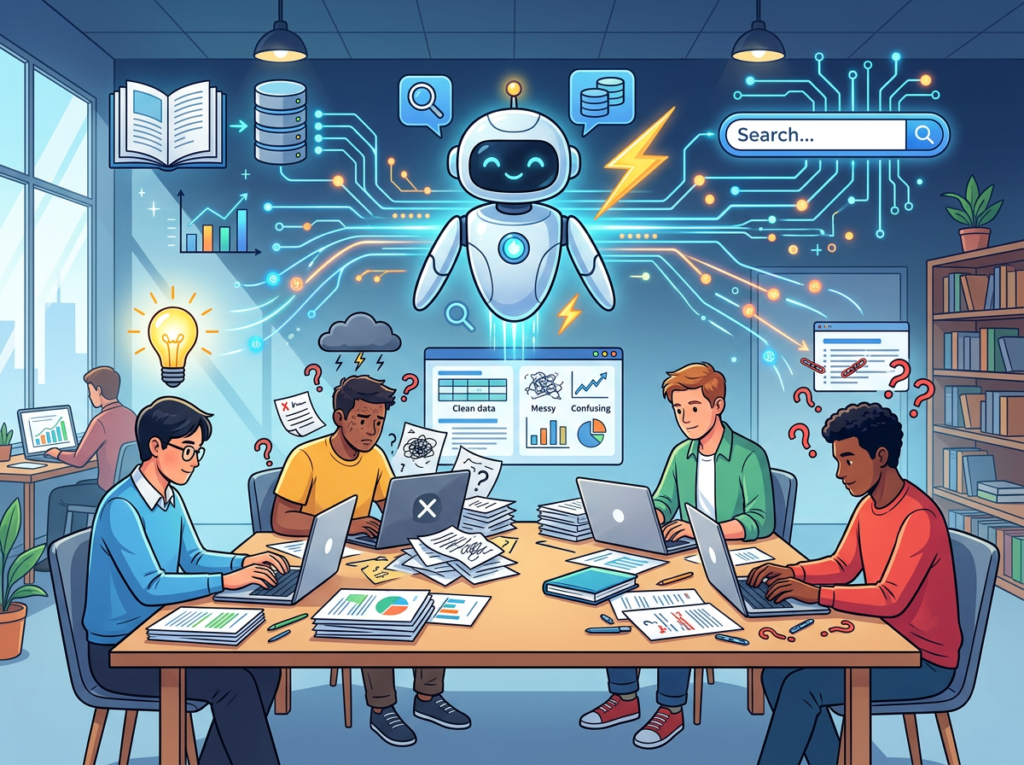
Even with the best intentions, a five-person team will naturally produce five different research quality standards. One person fact-checks everything. Another trusts the first result on Google. A third doesn’t distinguish between a press release and a peer-reviewed study. For businesses where research output directly affects client deliverables, this variation is a liability.
The Cost Reality of Fixing This Manually vs. With AI
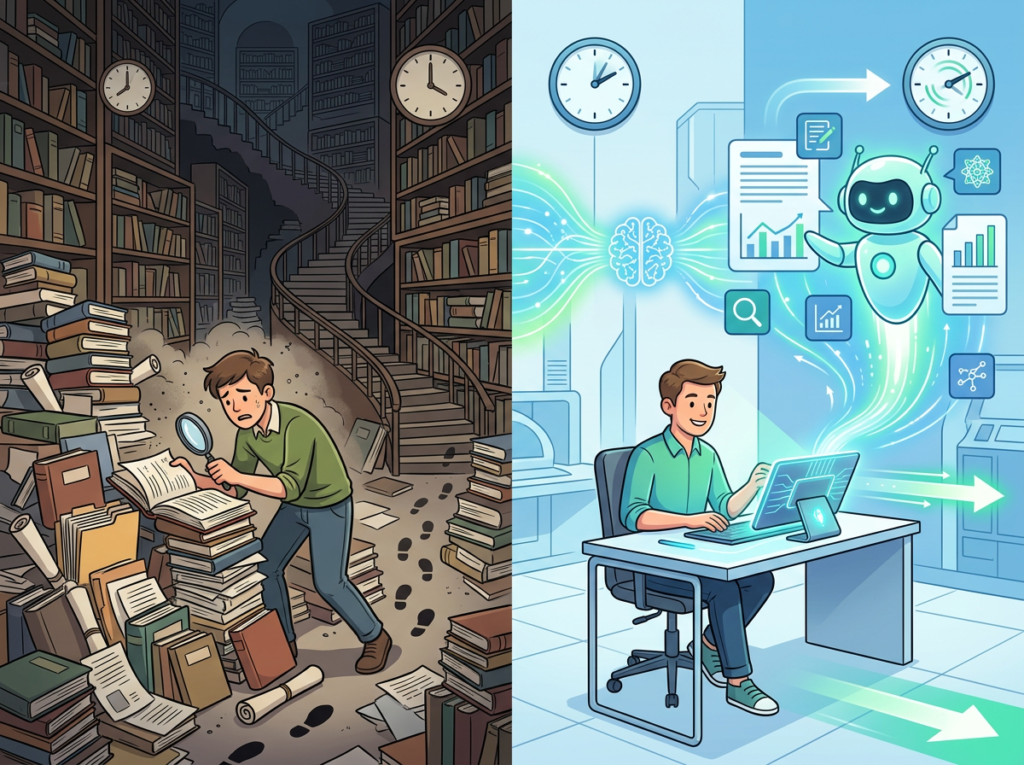
Hiring a dedicated research analyst to standardize this process: $55,000–$75,000/year in US salary, plus benefits.
Paying a consultant to build a research SOP and train the team: $3,000–$8,000 one-time, plus ongoing compliance monitoring.
Subscribing to Liner AI’s Pro Work plan and building a team research workflow: $179.99/year.
The math isn’t subtle. AI productivity tools for entrepreneurs in 2026 have reached a maturity where the capability gap between a well-configured AI tool and a junior research hire has narrowed considerably — especially for structured information retrieval, summarization, and citation.
Start with one process. Systemize it this week. Full Liner AI review and setup guide
How Liner AI Enables Solo DX
Feature 1: Advanced AI Search with Real-Time Web Access

Liner’s search function pulls from live web data, academic databases (over 200 million papers and journals), and vetted sources simultaneously. When a team member searches a competitive landscape question, a regulatory update, or a client industry trend, Liner returns synthesized answers with line-by-line citations they can trace back to primary sources.
ROI estimate: A marketing coordinator spending 2 hours/day on research at $35/hour costs $18,200/year in research labor. Liner’s AI search consistently reduces research time by 65% according to Liner’s own benchmarking. That equates to $11,830 in recovered productivity annually — from one employee, for a $179.99/year tool.
Feature 2: Deep Research Reports
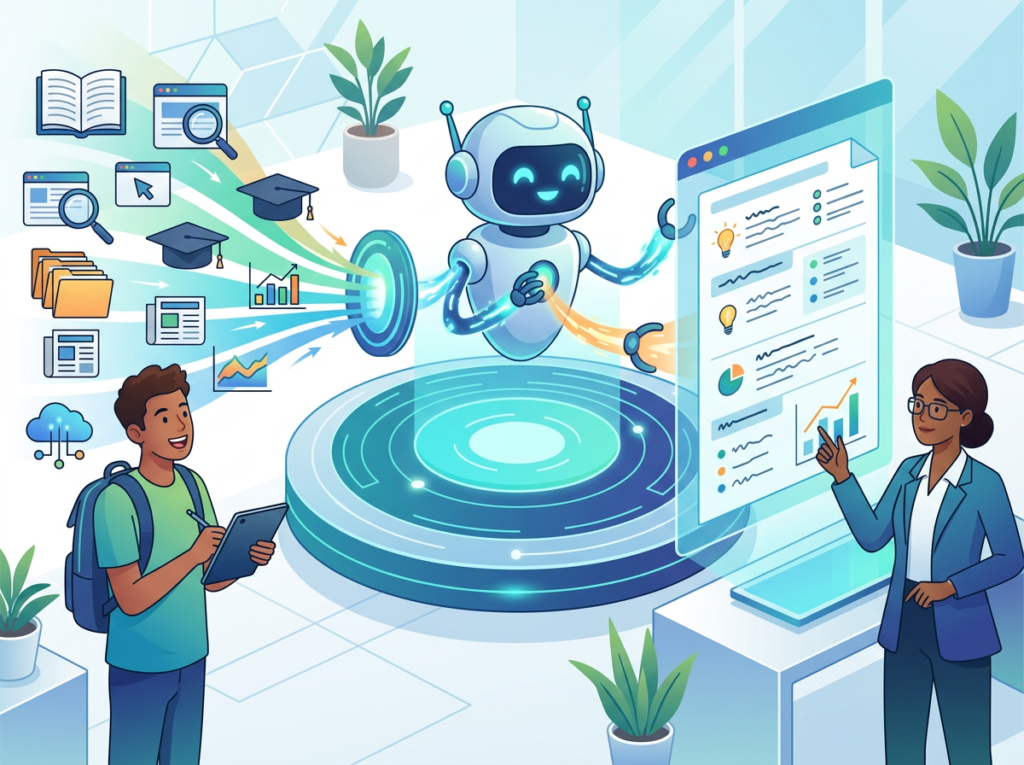
Liner’s Deep Research feature doesn’t just return search results — it generates structured research reports on any topic, complete with summaries, key data points, and citations formatted for immediate use. For US small businesses that regularly produce client-facing research, competitive analyses, or market assessments, this is the highest-value feature in the stack.
ROI estimate: A freelance consultant charging $150/hour who previously spent 4 hours building a competitive landscape report can now get a first-draft report in under 20 minutes. That’s $450 recovered per report — with 3 reports per week, the annual savings exceed $70,000 in billable time reclaimed.
Feature 3: File Analysis and PDF Processing
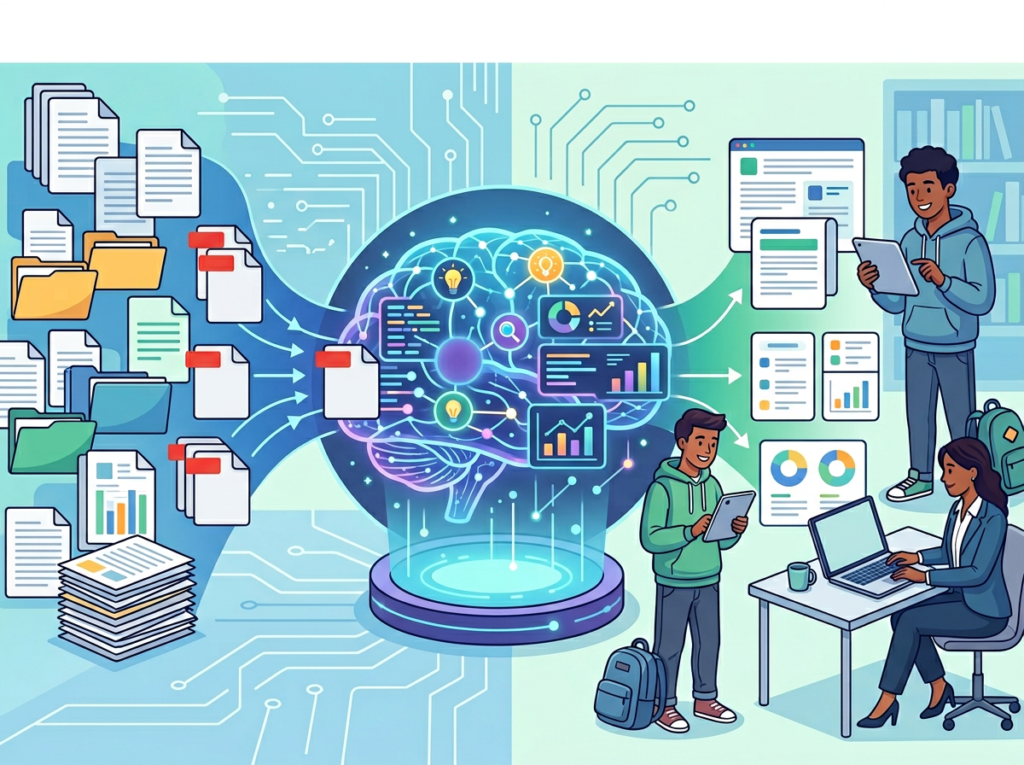
Liner’s Professional plan allows teams to upload PDFs, PowerPoints, and Word documents and ask AI questions about the content. For service businesses that regularly process contracts, industry reports, RFPs, or research papers, this eliminates the manual step of reading through lengthy documents before extracting the two paragraphs that actually matter.
ROI estimate: Processing 3 documents per week at 45 minutes manually vs. 8 minutes with Liner saves 37 minutes/week. At $65/hour, that’s $2,145 saved per employee annually — and the quality of extraction is typically higher because Liner surfaces key points the reader might skim past.
See how Liner AI works for a full breakdown of each feature tier and which plan fits your team size.
Ready to systemize your US team’s research in under a week? Try Liner AI Free | No credit card required | Trusted by millions of users worldwide
Use Cases by Team Role
Persona 1: US Startup Founder Juggling Three Departments (Maria, San Francisco)

Old workflow: Maria ran a 6-person SaaS startup serving HR teams. Every week, she manually researched competitor pricing, read industry newsletters, and compiled talking points for sales calls. This took 8–10 hours per week that she didn’t have.
AI-powered workflow: Maria set up a shared Liner workspace for her team. She created research templates for three recurring tasks: competitor monitoring, prospect industry briefings, and regulatory updates affecting HR tech. Each template is a saved Liner query. Team members run the queries before client calls and update a shared highlights folder.
Quantified results: Maria recovered 6 hours per week in personal research time (worth $900/week at her $150/hour consulting rate equivalent). Her sales team improved proposal quality scores from 6.2 to 8.1 out of 10 in client feedback surveys. Onboarding new sales reps went from a 3-week ramp to under 10 days because the research system was already documented and ready to use.
“I used to be the only person on my team who knew how to find good competitive intel. Now anyone can run a Liner query and get what they need in ten minutes. That’s the whole game.” — Maria, SaaS Founder, San Francisco
As noted in this analysis of AI research workflow transformations, reducing research time from 7+ hours to under 2 hours per session is achievable when AI is used as a structured research collaborator rather than a simple search replacement.
Persona 2: Executive Assistant Onboarding Remote Staff (James, Miami)

Old workflow: James managed operations for a 9-person financial advisory firm with staff in Miami, Chicago, and Denver. Every new hire required James to manually compile an onboarding research packet — industry terminology, regulatory background, firm-specific market positioning, and competitor landscape. It took him 12 hours per new hire.
AI-powered workflow: James built a Liner-based “New Hire Research Kit” — a shared workspace folder with pre-run Deep Research reports covering every topic a new advisor would need in their first two weeks. He refreshed the reports quarterly using Liner’s saved search feature. New hires could ask follow-up questions to the AI directly, without scheduling time with James.
Quantified results: Onboarding research time dropped from 12 hours to 2 hours per hire (James’s time only). With 4 hires per year, that’s 40 hours saved — worth $2,800 at his $70/hour rate. New hire readiness scores (assessed at the 30-day mark) improved from 71% to 89%.
“The new research kit means I’m not the bottleneck anymore. People can self-serve on the context they need and come to me with specific questions, not general ones.” — James, Operations Lead, Miami
Persona 3: Marketing Lead Standardizing Client Research (Aisha, Austin)

Old workflow: Aisha led content strategy for a boutique agency serving mid-market B2B clients. Before starting any campaign, she needed competitive landscape reports for each client. These took 5–7 hours each to build manually — time that wasn’t billable because clients didn’t want to pay for “research overhead.”
AI-powered workflow: Aisha standardized her competitive research process using Liner’s Deep Research and highlighting features. She built a 4-query research template that covered: top competitor messaging, industry keyword trends, recent news in the client’s vertical, and analyst commentary on the market. Each template runs in under 25 minutes and produces a structured report she can deliver directly to the client.
Quantified results: Aisha reduced non-billable research overhead by 82%. At 3 clients per month, she recaptured 54–72 hours of billable capacity annually — worth $8,100–$10,800 at her $150/hour rate. She now offers competitive landscape reports as an add-on service at $500 each, generating an additional $18,000/year in revenue.
“I turned what used to be a cost center into a revenue line. Research used to eat my margin. Now it creates margin.” — Aisha, Content Strategist, Austin
Discover Liner AI’s full capabilities including how teams like Aisha’s structure their research-to-revenue workflows.
According to a detailed breakdown of Liner’s AI agent capabilities for research-intensive workflows, the agentic approach to information gathering fundamentally changes what’s possible compared to single-step AI queries — a distinction that matters for teams producing client-facing deliverables at scale.
Join thousands of US small teams using Liner AI to eliminate research chaos. See How It Works | Used by teams from Silicon Valley to New York
Common Pitfalls & How to Avoid Them
Pitfall 1: Using Liner as a solo tool instead of a team system
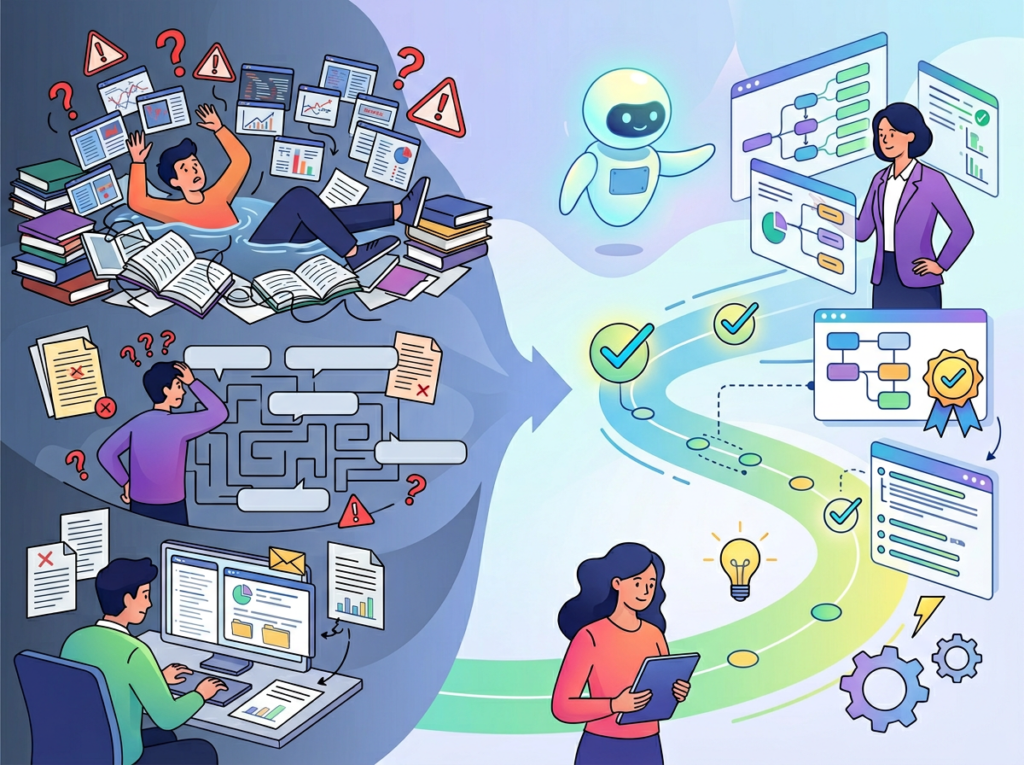
The most frequent mistake is treating Liner like a personal productivity app. Individual use is valuable, but the Solo DX payoff comes when the whole team uses a shared workspace. If everyone runs their own searches and saves their own highlights in isolated accounts, you’ve just added another disconnected tool to the stack. Fix this by creating a shared workspace from day one and assigning one team member to manage the folder structure.
Pitfall 2: Failing to standardize research templates
Without templates, every team member researches differently. One person asks Liner broad questions. Another asks hyper-specific ones. The outputs are inconsistent and can’t be compared or combined. Spend two hours building 3–5 standard query templates for your most common research tasks. This is the highest-leverage Solo DX investment you can make with this tool. The detailed breakdown of Liner AI includes guidance on structuring queries for the most consistent results.
Pitfall 3: Over-relying on Slack and email for research distribution
Even with Liner producing excellent research outputs, teams often default to sending findings via Slack messages or email threads — which means the knowledge disappears into inbox noise within a week. Use Liner’s workspace and highlighting features as the permanent record. Slack and email are for flagging that something new has been added to the workspace, not for transmitting the research itself.
As Liner itself outlines in its guide to AI-assisted research paper production, the real power of AI research tools comes from systematic, multi-step workflows — not one-off queries. The same principle applies in a business context.
FAQs

What is Solo DX?
Solo DX stands for Solo Digital Transformation. It’s the process of using affordable AI and digital tools to build repeatable, scalable systems inside a small business — without the enterprise budgets or IT departments that traditional “digital transformation” projects assume. It targets US founders and lean teams who need operational structure but don’t have an operations manager.
Can small teams afford to use AI research tools?
Yes, and the ROI math is straightforward. Liner AI’s Pro Work plan is $179.99/year. If it saves one team member one hour per week in research time at $50/hour, the tool pays for itself in under four weeks. Most teams see substantially higher returns once they build systematic research workflows around the tool.
Is Liner AI hard to set up?
No. Liner works as a browser extension for Chrome, Firefox, Microsoft Edge, and others, and as a mobile app for iOS and Android. Initial setup takes under five minutes. Building a team workspace and first research templates typically takes two to three hours. A full research SOP buildout for a 5-person team rarely exceeds one business day of effort. Liner also offers a 14-day free trial of the Essential plan so teams can test before committing.
Start with one process. Systemize it this week. Full Liner AI review and setup guide
Conclusion

In 2026, American small businesses don’t need enterprise budgets to build enterprise-level research systems. The gap between what a $55,000/year research analyst and a $179.99/year AI tool can produce has narrowed to the point where the calculus for lean US teams is straightforward.
Liner AI’s proposition as the best ai research assistant for business rests on three measurable pillars: accuracy (ranked #1 on OpenAI’s SimpleQA benchmark), speed (research tasks that took 7+ hours now take under 2), and team scalability (shared workspaces that convert individual research skill into institutional knowledge).
The Solo DX framework shows exactly how to capture that value. Start by identifying your team’s most repetitive research task — competitive monitoring, client briefings, regulatory updates, market sizing. Build one Liner template for it this week. Run it with the whole team. Add the findings to a shared workspace. That’s the system. Everything else is iteration.
US founders who treat research as an operational system — not a one-off task — will consistently out-compete teams that still rely on individual heroics and browser bookmarks.
Start with one process. Systemize it this week. Full Liner AI review and setup guide
Leave a Reply