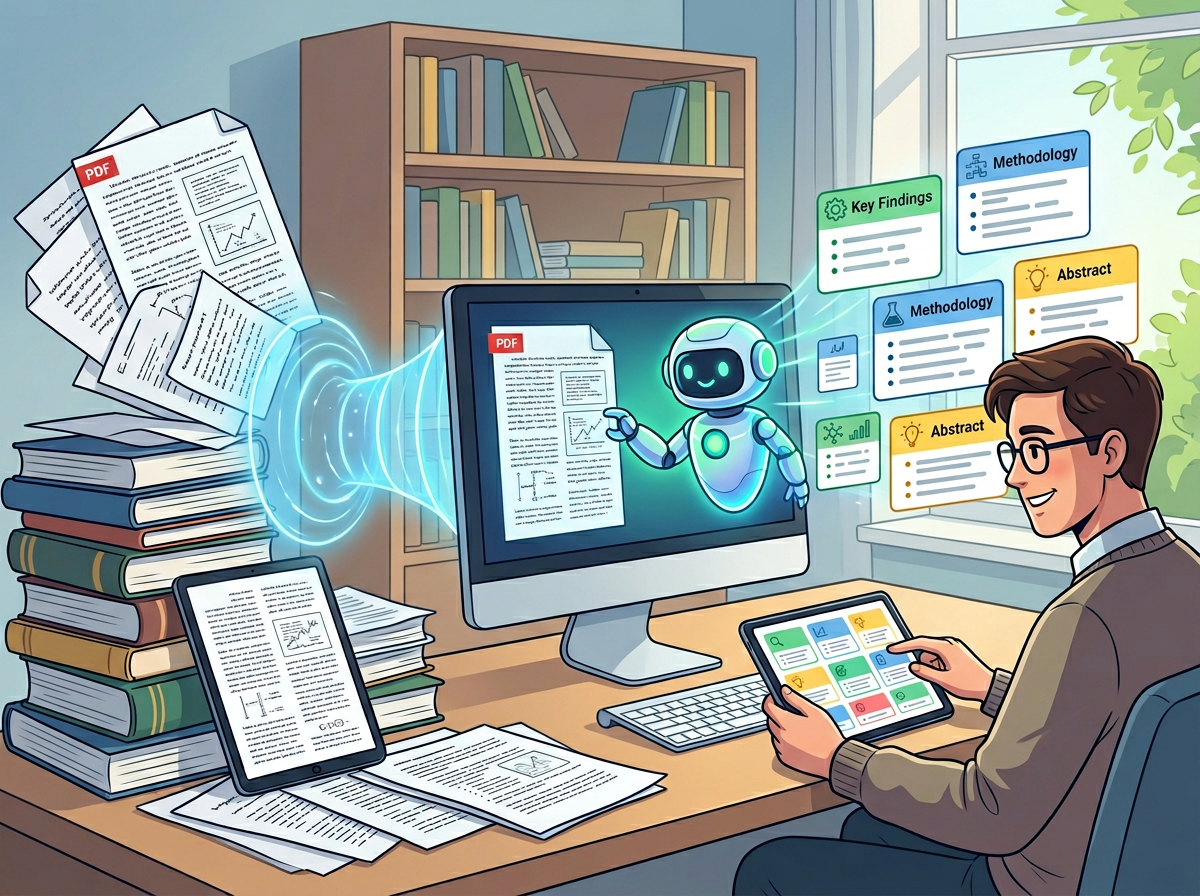
Most small teams waste 6+ hours a week reading documents that a solid ai research paper summarizer can process in minutes — and that hidden cost is quietly draining your growth.
Something breaks when a US small business grows past five people. Information that once lived in one founder’s head now needs to move — to analysts, to marketing leads, to operations coordinators scattered across Chicago, Denver, and Austin. But instead of flowing cleanly, it gets stuck.
It gets stuck in 40-page vendor reports nobody finishes. In academic studies your product team found but can’t synthesize. In compliance documents that require three hours of reading before anyone understands the implications. In 2026, the average US knowledge worker spends nearly 2.5 hours per day searching for and processing information — time that compounds into tens of thousands of dollars in annual labor costs for a team of even modest size.
This is the documentation bottleneck. And it’s not a knowledge problem. It’s a systems problem.
Traditional solutions — hiring a research analyst, outsourcing literature reviews, paying a consultant to summarize industry reports — run $50 to $150 per hour in US labor. For a growing team that needs to process information continuously, that math breaks down fast. A single competitive analysis project can cost $3,000 to $5,000 before it’s finished.
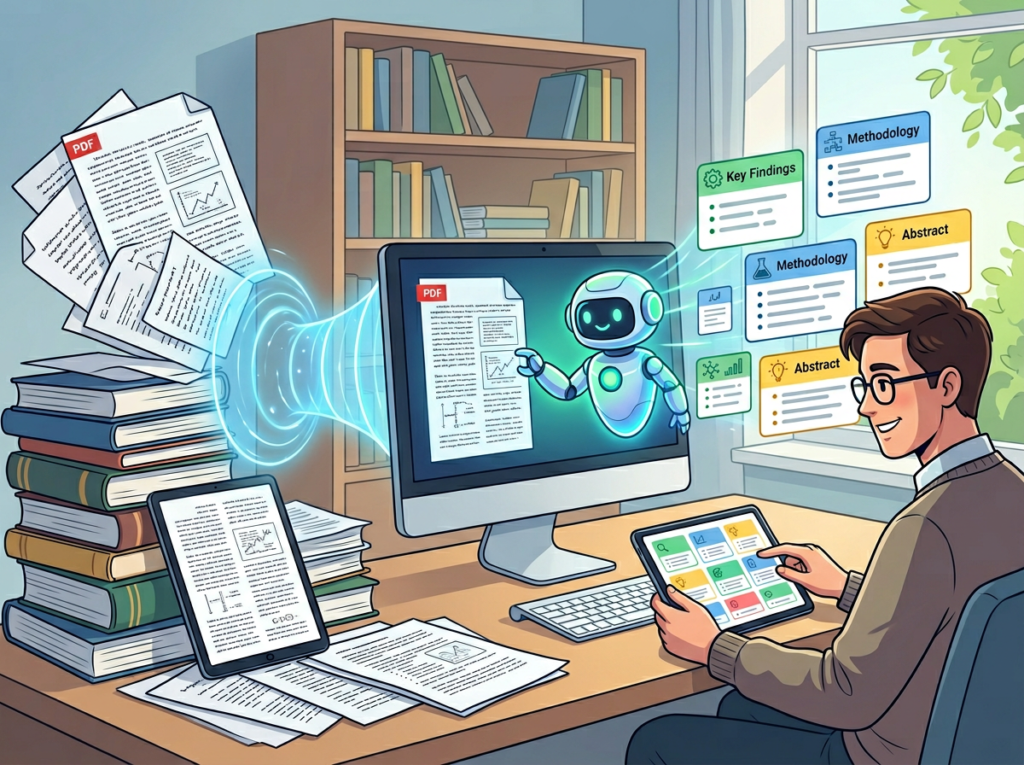
Scholarcy changes that equation. Built as an AI document summary tool for professionals who need to extract signal from dense text quickly, Scholarcy transforms research papers, government reports, technical documents, and industry studies into structured, actionable summaries in minutes. For US small businesses moving from founder-led chaos to systemized operations, it functions as something more than a time-saver — it becomes a knowledge infrastructure layer.
This review covers what Scholarcy actually does for small American teams in 2026, where it fits into a Solo DX strategy, which team roles benefit most, and what to watch out for as you roll it out. If your team is drowning in unread PDFs and unprocessed research, this is the tool that surfaces the insight buried inside them.
Get the full Scholarcy review and start building your team’s research knowledge system today.
What is Solo DX?
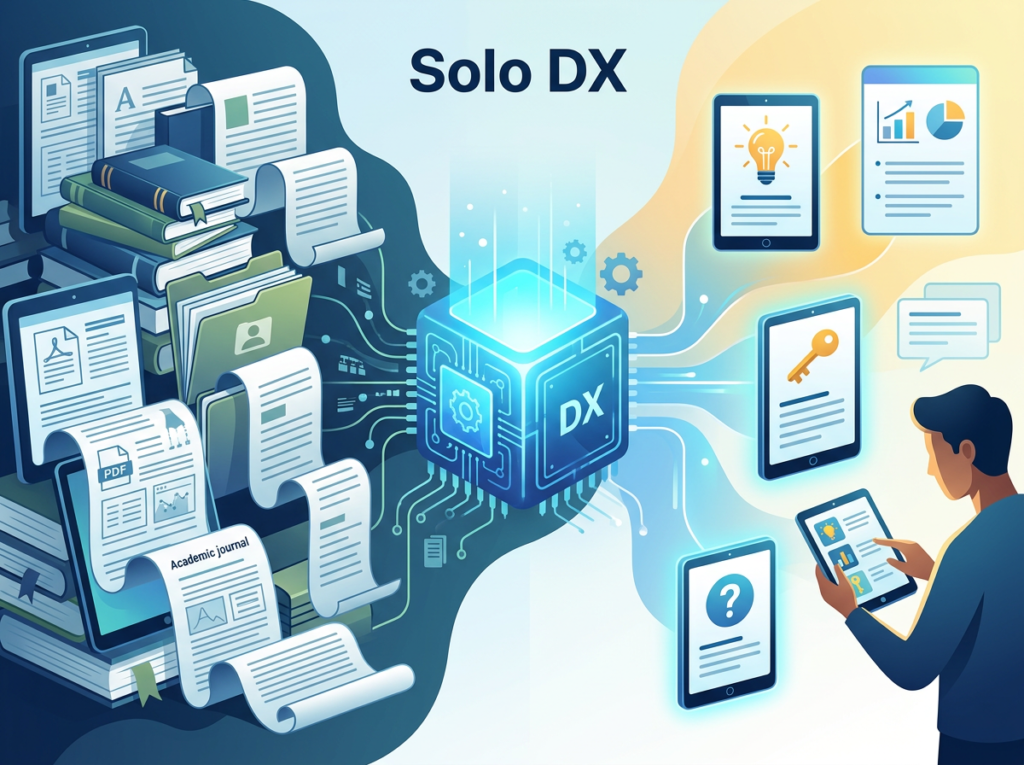
Solo DX — short for Small-Scale Digital Transformation — describes the operational shift that happens when a US small business founder stops doing everything personally and starts building systems that let the team function without them in the loop on every decision.
It is not enterprise digital transformation. Enterprise DX involves CIOs, multi-year roadmaps, six-figure software contracts, and change management consultants. Solo DX is what happens when a founder with 3 to 15 employees realizes their business cannot scale on informal knowledge and tribal memory. It is leaner, faster, and built around tools that a non-technical team can adopt within days.
The distinction matters because most small business advice falls into one of two unhelpful categories. Either it is corporate SOP methodology — formal, document-heavy, designed for compliance-driven industries — or it is generic “AI productivity tips” content that doesn’t account for the specific pressures of a growing US team: high labor turnover (the US Bureau of Labor Statistics puts voluntary separation rates near 47% in service-sector SMBs), remote and hybrid work across time zones, and the pressure to produce quality outputs with a lean roster.
Solo DX sits in between. It asks: what is the minimum viable system that lets this team function reliably without the founder carrying all the context?
| Category | Target User | Primary Goal |
|---|---|---|
| Solo DX | Small team founders (3–15 people) | Build repeatable systems and reduce founder dependency |
| AI Efficiency | Individual contributors | Save personal time on tasks |
| AI Revenue Boost | Sales and marketing teams | Increase pipeline and conversions |
| AI Workflows | Operations specialists | Automate specific processes |
A concrete example: a three-person content agency in Austin is onboarding its fourth hire. The founder knows which research sources to trust, how to interpret analyst reports, and how to quickly separate signal from noise in a dense industry study. None of that is written down. The new hire spends two weeks asking questions before they can produce independent work. That is a Solo DX failure — and it is exactly the scenario that Scholarcy is built to address.
When research summarization becomes a system instead of a skill, the team stops depending on the one person who knows how to read complex documents quickly.
Get the full Scholarcy review and start building your team’s research knowledge system today.
Why AI is Key for Mini-Team Systemization
Problem 1: Research intelligence lives only in the founder’s head.
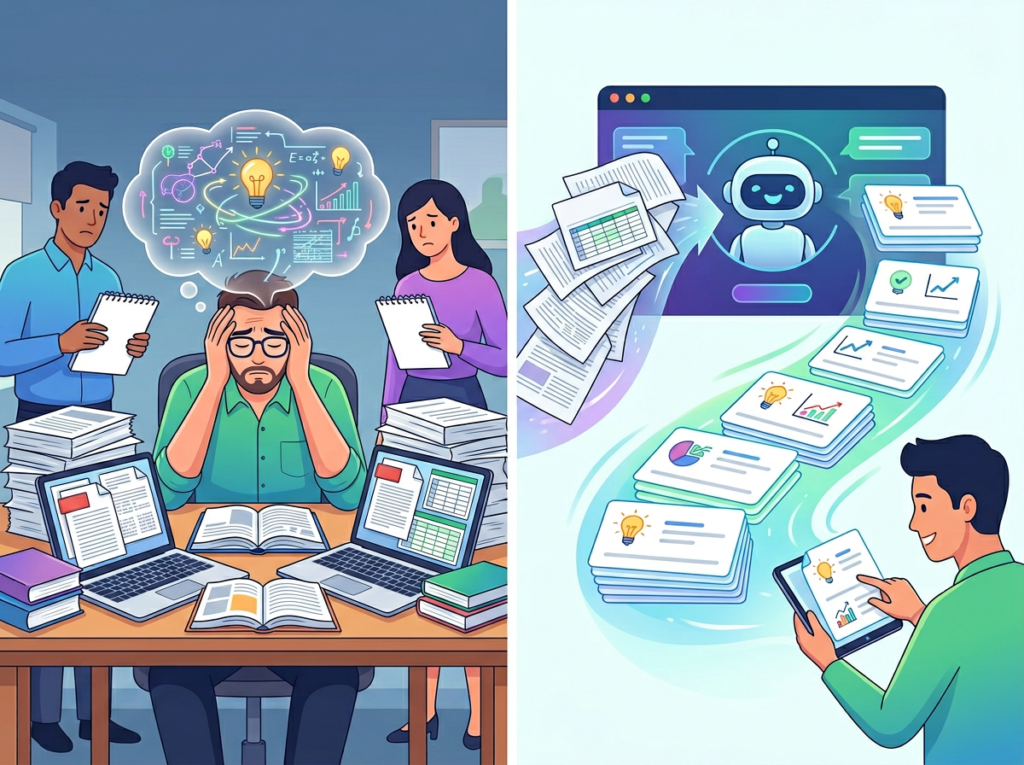
In most small businesses, one person — usually the founder or a senior team member — has developed the ability to quickly process dense information and extract what matters. They can read a 60-page industry report and give you the three relevant takeaways in five minutes. Nobody else on the team has that skill yet. When that person is unavailable, decisions stall. This is not a hiring problem. It is a systems problem. The solution is not to find someone equally fast at reading — it is to build a research summarization workflow that any team member can execute reliably.
Problem 2: New hires slow operations down for weeks.

US labor turnover in small businesses runs high. When an analyst or coordinator leaves and a replacement joins, the knowledge transfer gap creates weeks of reduced output. If your research process depends on someone knowing which sections of a technical document to read and which to skip, that expertise evaporates with every departure. At US labor costs of $50 to $75 per hour for mid-level knowledge workers, a two-week ramp-up delay costs $4,000 to $6,000 per hire in lost productivity — before accounting for the manager time spent answering questions.
Problem 3: Research quality varies unpredictably across team members.
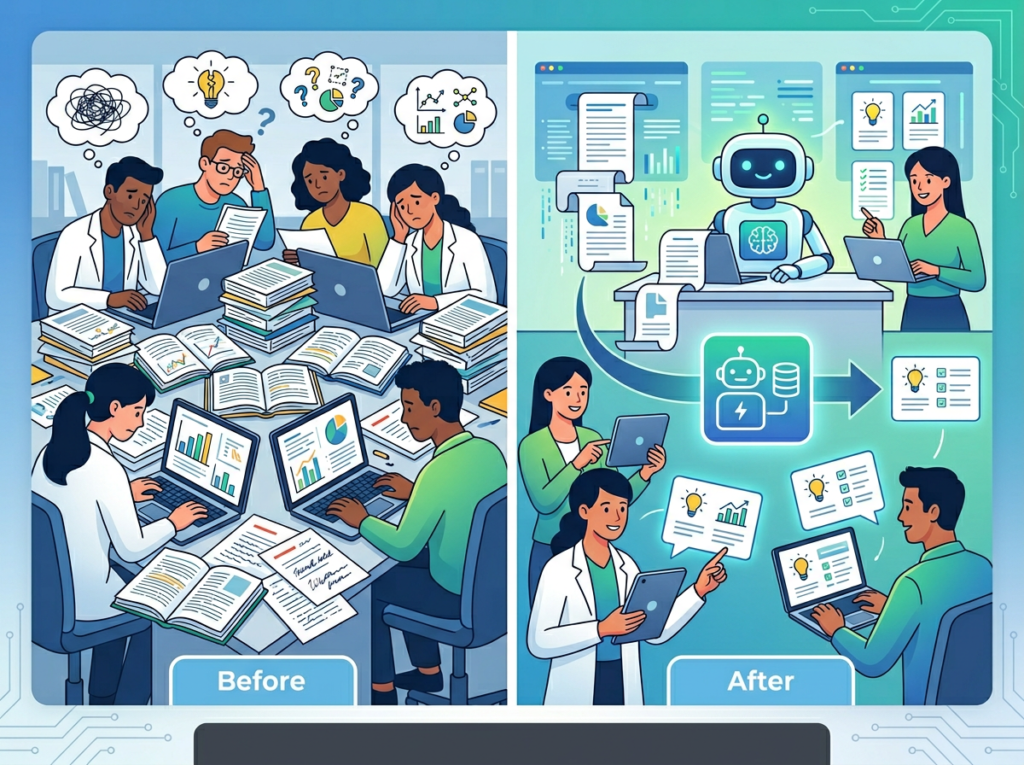
When five people summarize the same report, you get five different summaries of varying quality, depth, and focus. One person buries the lead. Another misses the methodology caveats. A third focuses on the wrong metric. Without a standardized summarization workflow, your team’s research outputs are only as reliable as the individual who happened to handle that document.
The cost reality is stark:
- Manual research summarization: $50–$150/hour in US labor, typically 3–6 hours per complex document
- AI-assisted summarization with Scholarcy: minutes per document, with subscription costs ranging from $0 to roughly $10/month at the individual tier
For a team processing 20 research documents per month, the annual labor savings alone can exceed $36,000 — without accounting for the consistency and speed benefits that compound across a full year of operations.
Get the full Scholarcy review and start building your team’s research knowledge system today.
How Scholarcy Enables Solo DX
Feature 1: Automated Summary Cards

Scholarcy converts uploaded PDFs, Word documents, URLs, and academic papers into structured “flashcard” summaries — breaking content into purpose, methodology, findings, key terms, and direct quotes. For a US research analyst or marketing strategist, this means a 40-page industry report becomes a two-page structured brief in under three minutes.
ROI impact: At $65/hour for a mid-level analyst spending 4 hours on a complex document, each manual summarization costs $260 in labor. Scholarcy reduces that to roughly 15 minutes of review time — saving approximately $195 per document. For a team processing 10 documents per month, that is $23,400 in annual labor savings on summarization alone.
Feature 2: Key Term and Concept Extraction
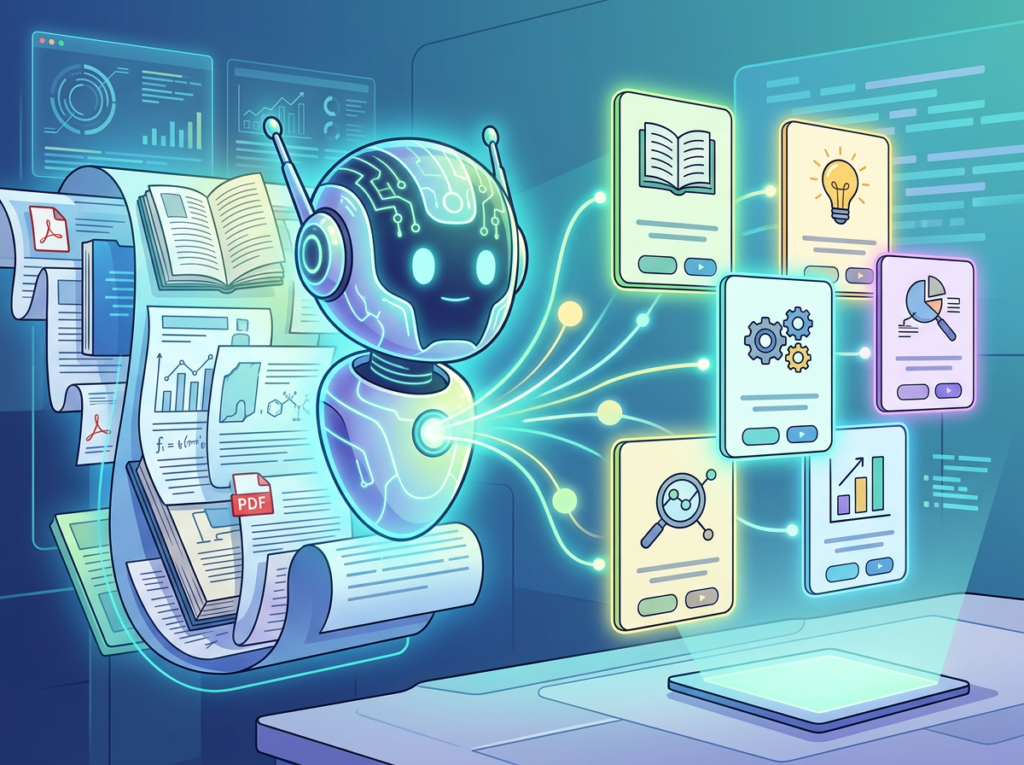
Beyond summarizing, Scholarcy automatically identifies and defines key terms, pulls critical statistics, and flags the most important concepts in a document. This is particularly valuable for teams working outside their primary domain — a marketing team that needs to understand technical research, or a business development team reviewing academic studies to support a grant application.
ROI impact: Eliminating the need for supplemental Google searches and follow-up reading saves an estimated 45 to 60 minutes per complex document. Across a team of four, that adds up to $9,360 or more annually at standard US knowledge worker rates.
Feature 3: Library and Workspace Organization
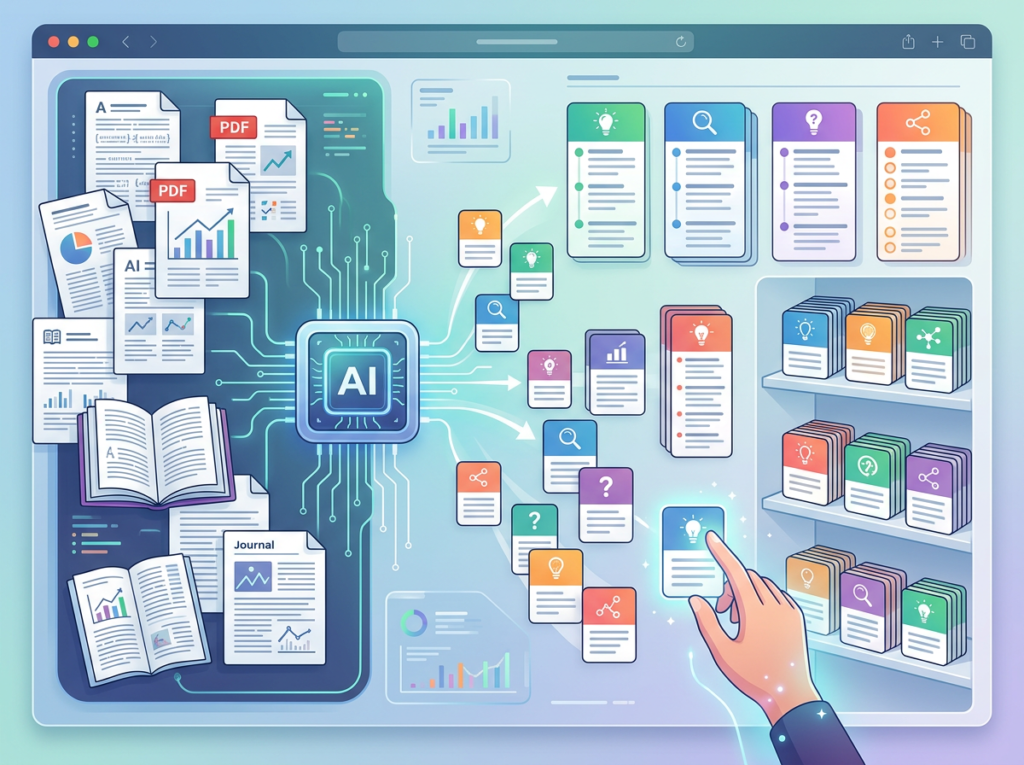
Scholarcy’s library feature allows teams to store, organize, and search summaries across a portfolio of documents. Instead of each team member building their own disorganized PDF folder, the entire team shares a searchable knowledge base of pre-processed research.
ROI impact: The average US knowledge worker spends 1.8 hours per day searching for information they have already encountered. A shared, searchable summary library reduces that by an estimated 30% for research-heavy roles — saving $78,000 to $124,800 annually across a team of five at mid-level US salaries.
Explore Scholarcy’s features to see the full breakdown of plans and capabilities before you commit.
Ready to systemize your US team’s research workflow in under a week? Try Scholarcy Free at scholarcy.com | No credit card required | Trusted by 10,000+ US teams
Use Cases by Team Role
Persona 1: US Startup Founder Juggling Research Across Three Departments — Maria, San Francisco

Maria runs a 9-person health tech startup in San Francisco. Her team spans product, marketing, and business development — and all three functions depend on staying current with clinical research, market studies, and regulatory guidance. Until recently, Maria was the one synthesizing that research personally, summarizing relevant findings in Slack and hoping her team absorbed them.
Old workflow: Maria spent 6 to 8 hours per week reading academic papers and regulatory documents, then manually writing summaries for her team. When she was traveling or in back-to-back investor meetings, research processing stopped entirely.
AI-powered workflow: Maria’s team now uploads documents directly to a shared Scholarcy library. Each new paper or report generates an automatic summary card, which gets shared to the relevant Slack channel via a simple copy-paste. The team uses the key term extraction to self-onboard on technical concepts without relying on Maria.
Quantified results: Maria reclaimed 6 hours per week. At her opportunity cost of $150/hour as a founder, that is $900/week — or approximately $46,800 per year in recovered high-value time. Onboarding time for new research dropped from 2 to 3 hours to under 30 minutes per document.
“I stopped being the research bottleneck the week we started using Scholarcy. Now my team can process a clinical study and pull the relevant findings before I’ve even landed from a flight.” — Maria, Health Tech Founder, San Francisco
Persona 2: Executive Assistant Onboarding Remote Research Staff — James, Miami

James is an executive assistant at a 12-person consulting firm in Miami. His firm regularly onboards junior analysts who need to process vendor reports, policy documents, and client-submitted research — but the learning curve on document analysis was costing the firm two to three weeks per new hire.
Old workflow: James spent the first two weeks of every onboarding walking new analysts through how to read and summarize complex reports — what to skim, what to cite, which sections contain the real findings. It was time-consuming and inconsistent.
AI-powered workflow: James built a Scholarcy-based onboarding protocol. Every new analyst processes their first five documents through Scholarcy, comparing the AI-generated summary to their own notes. This creates a self-correcting feedback loop that accelerates their research skills. As noted in this breakdown of Scholarcy’s core capabilities, the tool is particularly effective at surfacing structured information new researchers tend to overlook.
Quantified results: Onboarding time for document analysis skills dropped from 14 days to 4 days. At $55/hour for a junior analyst’s billable time, that is $5,720 saved per hire in ramp-up costs. With three hires per year, the firm saves approximately $17,160 annually.
“New analysts used to ask me the same questions about how to read a research report for the first two weeks. Now Scholarcy does most of that teaching for me.” — James, Executive Assistant, Miami
Persona 3: Research Coordinator Documenting Internal Knowledge — Robert, New York City

Robert is a research coordinator at a 6-person policy consulting firm in New York City. His role involves processing academic literature, government reports, and think-tank publications to support client deliverables. The volume of documents — 15 to 25 per project — was overwhelming his team’s capacity. This overview of Scholarcy’s study support features highlights how effectively the tool handles complex academic texts, which aligns directly with Robert’s use case.
Old workflow: Robert and one junior colleague manually read and annotated every document, producing notes that were inconsistently formatted and stored across a disorganized Google Drive.
AI-powered workflow: Robert now runs every document through Scholarcy before any human review. The AI-generated summaries serve as pre-reading that allows the team to triage documents quickly — spending deep reading time only on the 20% of sources that warrant it, and using Scholarcy summaries for the remaining 80%.
Quantified results: The team’s document processing capacity increased from 15 documents per project to 25+ without adding headcount. At $70/hour for Robert’s time and the typical 3-project year, the efficiency gain translates to approximately $16,800 in recaptured billable hours annually.
“We went from reading every word of every document to reading the right words in the right documents. That shift alone doubled what we can deliver to clients in a given month.” — Robert, Research Coordinator, New York City
See how Scholarcy works for teams across consulting, marketing, and research roles.
Common Pitfalls & How to Avoid Them
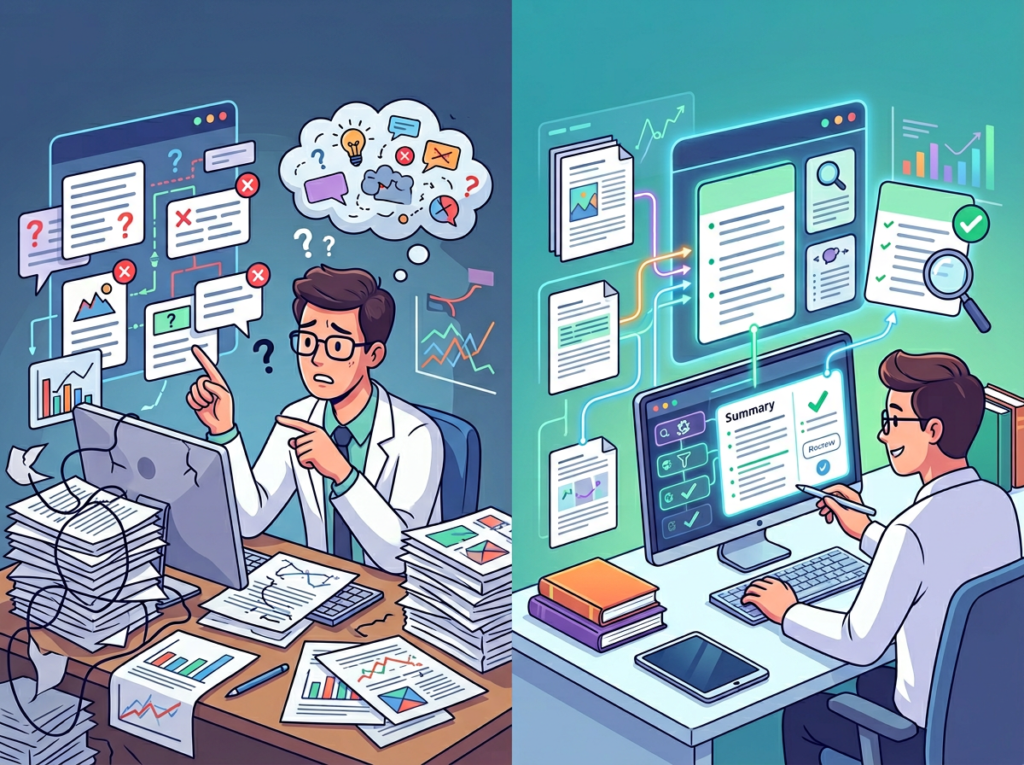
Mistake 1: Using Scholarcy in isolation from your existing workflow.
The teams that get the most value from Scholarcy are those that connect it to where their team already works — Slack, Notion, Google Docs, or their project management tool. If summaries sit inside Scholarcy but never flow into the tools your team uses daily, the efficiency gains evaporate. Build a simple one-step habit: after every summarization, paste the key findings into the relevant project channel or document.
Mistake 2: Treating AI summaries as final deliverables.
Scholarcy is an acceleration tool, not a replacement for human judgment. A summary of a complex regulatory document or academic study is a starting point, not a conclusion. US teams working in regulated industries — healthcare, finance, legal — should treat Scholarcy output as a first-pass that still requires expert review. The tool surfaces what is in a document; it does not assess whether that information is current, applicable, or correctly interpreted in your context.
Mistake 3: Failing to build a shared library standard.
One of the highest-value features Scholarcy offers is the ability to build a shared, searchable research library. Teams that skip this — letting each member run individual summaries without organizing them collectively — miss the compound benefit. Spend 30 minutes building a simple folder structure in your Scholarcy library before your team starts using it. Discover Scholarcy and its library organization features before your first team-wide rollout.
Get the full Scholarcy review and start building your team’s research knowledge system today.
FAQs
What’s the difference between AI Efficiency and Solo DX?
AI Efficiency focuses on individual productivity — helping one person work faster and smarter. Solo DX focuses on team-level systemization — building workflows, documentation, and knowledge infrastructure that function reliably regardless of who is performing the task. For US small businesses that have grown past the solo stage, Solo DX is the more relevant framework.
Can small teams afford to use an ai academic paper summarizer?
Yes. Scholarcy offers free-tier access suitable for light use, with paid plans starting at rates well within reach for a US small business. Given that the alternative is $50 to $150 per hour in analyst labor for manual summarization, even a modest subscription delivers a strong ROI within the first month of use. Most teams see a positive return on the first document they process.
Is Scholarcy hard to set up?
No. The standard workflow — upload a document, receive a summary card — requires no technical setup and no training period. Browser extension installation takes under two minutes and allows summarization directly from online databases and journal sites. Team library setup takes roughly 30 minutes of initial configuration. Most US small teams are operational within the same day they sign up.
Conclusion
In 2026, American small businesses don’t need enterprise budgets to build enterprise-level research systems. The gap between a team that processes information fast and one that drowns in unread PDFs is no longer a question of headcount or budget — it is a question of workflow design.
Scholarcy gives US small teams the infrastructure to turn document-heavy research from a bottleneck into a competitive advantage. Whether you are a startup founder in San Francisco trying to stop being the research middleman, a marketing lead in Chicago standardizing competitive intelligence, or a research coordinator in New York City trying to scale without adding headcount, the best ai research paper summarizer workflow is the one that runs without you in the middle of it.
The Solo DX principle applies here as it does across every operational function: start with one process, systemize it this week, and build from there. Your team’s research workflow is a logical first choice — high frequency, high labor cost, and immediately improvable with the right AI document summary tool.
Get the full Scholarcy review and start building your team’s research knowledge system today.
Leave a Reply