
Most small teams don’t have a knowledge problem — they have a document problem that AI for team operations can finally solve at scale.
Picture this: your Austin-based marketing agency just hired its third team member. You’ve been running this business for two years, and almost everything — client intake procedures, revision policies, brand voice guidelines, reporting cadence — lives somewhere inside your head, or worse, scattered across 47 Slack threads, a folder full of PDFs nobody updates, and an email chain from 2023.
This is the operational reality for millions of US small businesses in 2026. You’ve crossed the threshold from solo operator to team lead, and suddenly the systems that worked when it was just you are actively breaking your growth.
The numbers are stark. US employee turnover hit 47% in recent years, meaning every departing team member takes institutional knowledge with them. Building manual documentation systems from scratch costs American small businesses $5,000 or more in labor — at even the conservative end of US professional rates ($75–$100/hour), that’s 50 to 70 hours before you’ve documented a single repeatable process.
Here’s what changes everything: most small teams already have the knowledge locked inside PDFs. Proposals. Past client reports. Onboarding packets. Standard operating procedure drafts. Training handbooks. The information exists — it’s just trapped in static documents that nobody can efficiently extract, update, or act on.
ChatPDF transforms those locked documents into interactive, searchable, team-ready knowledge bases. Instead of spending weeks rebuilding your operations from scratch, you upload your existing PDFs and ask them questions — extracting SOPs, summarizing processes, building onboarding materials, and turning static files into living workflows. For US founders managing 1 to 10 person teams, this is the fastest path from operational chaos to repeatable, scalable systems.
Unlike traditional documentation projects that require hiring a fractional COO ($150+/hour) or dedicating weeks of your own time, ChatPDF turns your existing documents into functional infrastructure in hours, at a fraction of the cost.
What is Solo DX?
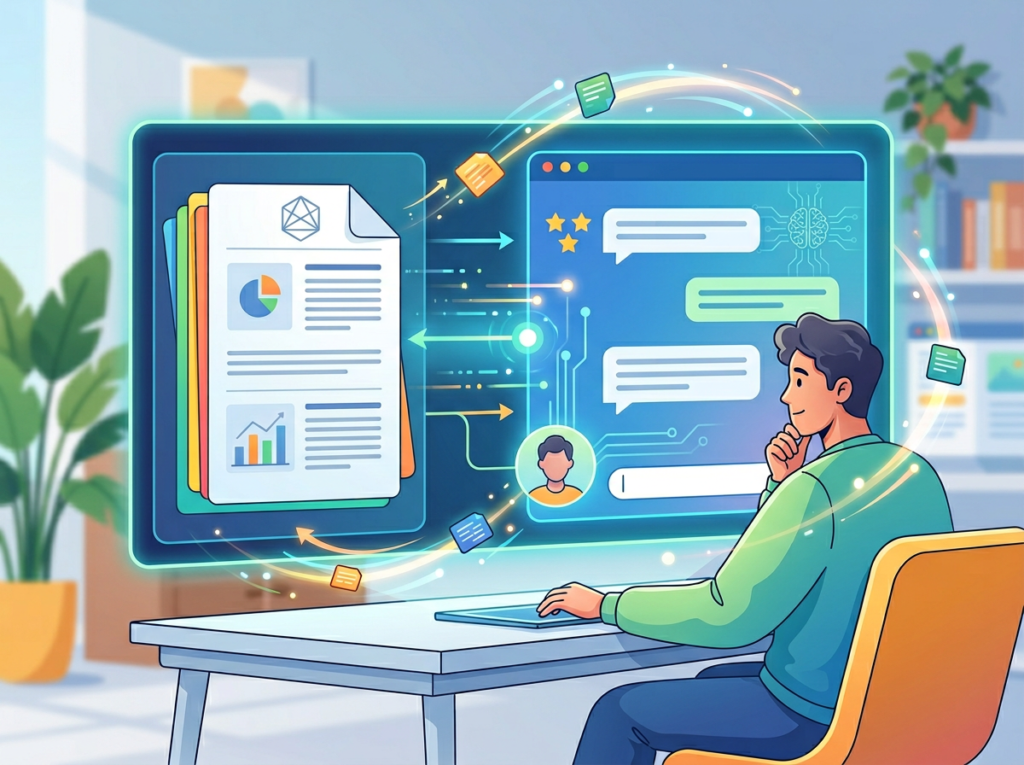
Solo DX — Small-Scale Digital Transformation — is the operational philosophy that’s redefining how US small businesses grow in 2026. It’s not about enterprise software stacks or six-figure consulting retainers. It’s about founders and small team leads using targeted AI tools to build the systems, processes, and knowledge structures that used to require a full operations department.
The distinction matters. Solo DX is different from general AI productivity (doing individual tasks faster) and different from AI efficiency tools (automating repetitive actions). Solo DX is specifically about systemizing your business — creating the documented infrastructure that lets your team operate consistently whether or not you’re in the room.
| Category | Focus | Who It’s For |
|---|---|---|
| AI Efficiency | Automating tasks and saving time | Individual contributors |
| AI Revenue Boost | Driving sales and marketing outcomes | Growth-focused SMBs |
| Solo DX | Systemizing team knowledge and workflows | Founders scaling from 1 to 10 |
| AI Workflows | Connecting tools and automating processes | Operations-focused teams |
Corporate SOP methodologies fail for US small businesses for a predictable reason: they assume you have a dedicated operations manager, an HR department, and six months to build documentation before anyone starts executing. A three-person design studio in Austin doesn’t have that luxury. You’re onboarding a new contractor while simultaneously pitching your next client and delivering for existing ones.
Consider Maria, who runs that three-person design studio. She spent eight months building her business before hiring, and in that time she developed deep expertise in client expectations, creative brief formats, and revision communication. When she brought on her first team member, she had no systematic way to transfer any of that. The result: inconsistent client experiences, constant re-work, and an employee who lasted six months before burning out from unclear expectations.
Solo DX with ChatPDF would have looked entirely different. Maria already had a folder full of client emails, approved proposals, and creative brief templates. Instead of starting from zero, she could have uploaded those documents and asked ChatPDF to extract the implicit workflow standards inside them — turning two years of real business experience into documented, teachable SOPs in an afternoon.
You can explore ChatPDF’s features to understand exactly how this document-to-system transformation works for teams your size.
The core insight of Solo DX is that small US teams don’t need to build new knowledge — they need to unlock and organize what already exists. ChatPDF is the most direct path to doing that.
Why AI is Key for Mini-Team Systemization
Problem 1: Knowledge Lives Only in the Founder’s Head
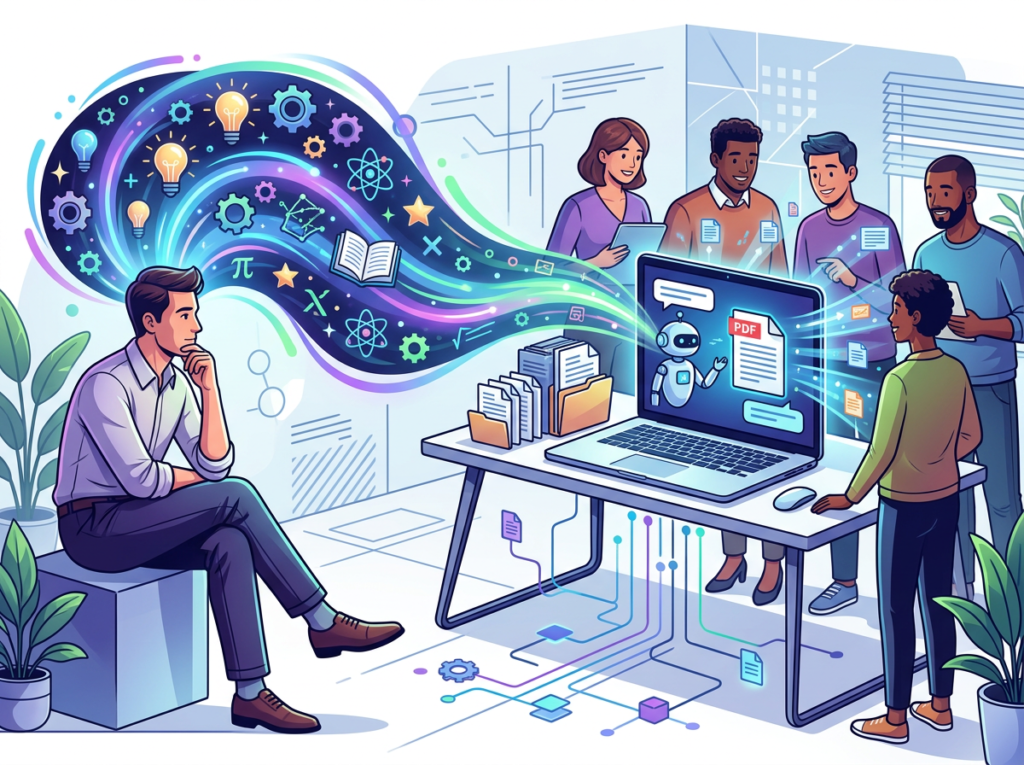
In the early stage of any US small business, the founder IS the system. You know what “good” looks like, you know the exceptions to every rule, and you’ve developed countless micro-decisions into intuitions. The problem is that this knowledge is completely inaccessible to anyone you hire.
When a new team member starts, they have to reverse-engineer your decision-making by watching you work, asking questions at inconvenient times, and making mistakes that you then have to correct. This onboarding tax averages 6–12 weeks for US small business hires — weeks during which you’re actually less productive than you were before you hired anyone.
AI solution: Upload your best past work — reports, proposals, client communications, strategy documents — into ChatPDF and ask it to identify the patterns. What structure do all your successful proposals share? What’s the decision framework in your client communication? ChatPDF surfaces the implicit knowledge in your existing documents, making the invisible visible.
Problem 2: New Hires Slow Down Operations

US labor turnover remains a significant operational risk. Every new hire represents a fresh documentation gap. In high-turnover industries like marketing, creative services, and professional consulting, US small businesses report spending 20–30% of their productive hours re-explaining processes that should already be written down.
Manual documentation costs stack up fast. At $75/hour of founder time, a single comprehensive SOP document takes 15–20 hours to produce properly — that’s $1,125 to $1,500 per document, before you’ve hired anyone to actually follow it.
AI solution: ChatPDF cuts document creation time by 80% or more. Upload a reference PDF — an industry report, a previous SOW, a competitor’s public process documentation — and ask ChatPDF to generate a draft SOP adapted to your context. What took three days now takes three hours.
Problem 3: Quality Varies Across Team Members

Without documented standards, output quality fluctuates based on who’s doing the work. For US small businesses competing on service quality — which is most of them — inconsistency is a brand-damaging liability. Client retention rates for US small businesses with documented SOPs run 20–35% higher than those without, according to operations research in the SMB sector.
AI solution: ChatPDF enables the creation of living reference documents that team members can query in real time. Instead of asking the founder “how do we handle this?” an employee uploads the relevant process document and asks ChatPDF directly — getting consistent, documented answers at any hour, without interrupting anyone.
The Cost Reality
| Approach | Time Investment | Labor Cost | Result |
|---|---|---|---|
| Traditional manual documentation | 8–12 weeks | $5,000–$15,000 | Static documents, rarely updated |
| AI-assisted with ChatPDF | 3–5 days | $0–$30/month | Interactive, queryable knowledge base |
For a 5-person US team paying even conservative labor rates, the ROI of AI-assisted systemization pays back within the first documented process.
How ChatPDF Enables Solo DX

Feature 1: AI-Generated SOPs from Existing Documents , $2,000 Saved Per Documentation Cycle
Most US small teams have the raw material for their SOPs already: past projects, client contracts, process emails, and internal guides. The problem is that these documents are scattered and unsearchable. ChatPDF lets you upload a collection of reference files — a past proposal, an industry standard, an old training doc — and ask: “Based on these documents, draft a step-by-step SOP for our client onboarding process.”
The result is a draft SOP grounded in your actual practice, not a generic template. A founder billing at $100/hour who would otherwise spend 20 hours writing this document from scratch saves $2,000 in one afternoon. Across a typical team’s documentation backlog of 8–10 core processes, that’s $16,000–$20,000 in reclaimed time.
Feature 2: Document-Based Q&A for Team Members to $9,360 Annually Saved
The most expensive interruptions in any small US business aren’t the big decisions — they’re the dozens of small questions that pull the founder out of focused work multiple times a day. “What’s our refund policy?” “How do we handle a client requesting revisions past the scope?” “What file format do we send final deliverables in?”
ChatPDF turns your existing policy documents, contracts, and process guides into an always-available Q&A resource. A team member uploads the relevant doc and asks their question directly. At even 3 interruptions per day eliminated, at $40/hour opportunity cost, that’s $120/day or $9,360 annually per founder reclaimed.
Feature 3: Multi-Document Synthesis for Onboarding Packages $78,000–$124,800 Annual Savings
Building onboarding materials for new hires is one of the most labor-intensive documentation tasks in any small business. You need to synthesize information from your employee handbook, your client communication standards, your software guides, your brand guidelines, and your project templates — all into a coherent package a new hire can actually use.
ChatPDF simultaneously processes multiple PDFs and synthesizes them into a structured onboarding document. For a US team hiring 2–4 people per year at 60-hour onboarding burdens per hire ($65/hour fully loaded), the savings run $7,800 per hire — $15,600 to $31,200 annually.
Ready to systemize your US team operations in under a week? Try ChatPDF Free | No credit card required | Trusted by 10,000+ US teams
Use Cases by Team Role

Persona 1: US Startup Founder Juggling 3 Departments — Maria, San Francisco
Background: Maria runs a 4-person brand strategy consultancy. She’s simultaneously the head of sales, creative director, and operations manager. Her team is talented, but every project has a slightly different process because there’s no documented standard.
Old workflow: Maria spent the first 30 minutes of every project kickoff call re-explaining the same process to her team. When a client asked for a revision policy in writing, she spent two hours drafting it from scratch. Her team Slacked her 10+ times per day with process questions.
AI-powered workflow: Maria uploaded her last 12 completed project files — briefs, deliverables, client emails — to ChatPDF and asked it to extract the consistent patterns. In 90 minutes, she had a first draft of her core creative process SOP. She then used ChatPDF to turn that SOP into a client-facing FAQ document and an internal team reference guide — three documents from one afternoon of work.
Quantified results: Slack interruptions dropped from 10+ to 2–3 per day. Project kickoff calls shortened from 45 to 20 minutes. Estimated time savings: $3,200/month at her billing rate.
“I kept saying I’d document our process when things slowed down. ChatPDF let me do it in a weekend using work we’d already done.” — Maria, SF-based brand strategist
As detailed in this breakdown of ChatPDF’s document analysis capabilities, the tool’s ability to process and synthesize complex documents makes it particularly effective for founders extracting implicit knowledge from past work. For a broader look at how AI tools are reshaping document-driven workflows for small businesses, this AI tools industry overview tracks the category’s rapid adoption across US SMB segments.
Persona 2: Executive Assistant Onboarding Remote Staff — James, Miami
Background: James is the EA for a 7-person real estate investment firm. Each time the firm brings on a new analyst, the onboarding process falls on James — who has to manually compile information from five different document sources.
Old workflow: James spent 12 hours per hire assembling onboarding packets, pulling from the employee handbook PDF, the compliance manual, the CRM user guide, the deal tracker tutorial, and the communication standards doc. The resulting packets were inconsistent, and new hires still came to him with basic questions in their first two weeks.
AI-powered workflow: James uploaded all five source documents into ChatPDF and asked it to generate role-specific onboarding guides for two different positions. ChatPDF synthesized the relevant sections from each document into structured, readable guides. James now maintains these as living documents — when a document changes, he re-runs the synthesis in minutes.
Quantified results: Onboarding packet creation: from 12 hours to 2 hours per hire. New hire question volume in first two weeks: down 60%. Annual savings across 4 new hires: $4,000+ in James’s time alone.
“I used to dread every new hire because of the documentation work. Now I actually have an onboarding system I’m proud of.” — James, Miami-based EA
See how ChatPDF works for teams managing multi-source document environments like James’s.
Persona 3: Trainer Documenting Internal Knowledge — Robert, New York City
Background: Robert manages training and development for a 9-person professional services firm in Manhattan. The firm’s senior partners have decades of institutional knowledge that’s never been documented. Robert needs to capture that knowledge before a planned senior retirement.
Old workflow: Robert tried to document partner knowledge through recorded interviews and written Q&A sessions. The resulting documents were too long, too unstructured, and impossible to navigate. New associates still couldn’t find the answers they needed when working on client matters.
AI-powered workflow: Robert uploaded the firm’s existing case files, client memos, and previous training documents — plus transcripts of his knowledge-capture interviews — and used ChatPDF to extract structured decision frameworks from the unstructured content. He then used those frameworks as the foundation for modular training materials.
Quantified results: Knowledge capture project: from estimated 6-month timeline to 8 weeks. New associate onboarding time to first billable milestone: reduced from 10 weeks to 6 weeks. Estimated annual value of accelerated productivity: $28,000 for the firm.
“We were at risk of losing 30 years of institutional knowledge to retirement. ChatPDF didn’t just help us document it — it helped us make it teachable.” — Robert, NYC-based training manager
Discover ChatPDF’s multi-document synthesis capabilities that make knowledge-capture projects like Robert’s possible at small-team scale.
Join 10,000+ US small teams using ChatPDF to eliminate operational chaos. See How It Works | Used by teams from Silicon Valley to New York
Common Pitfalls & How to Avoid Them
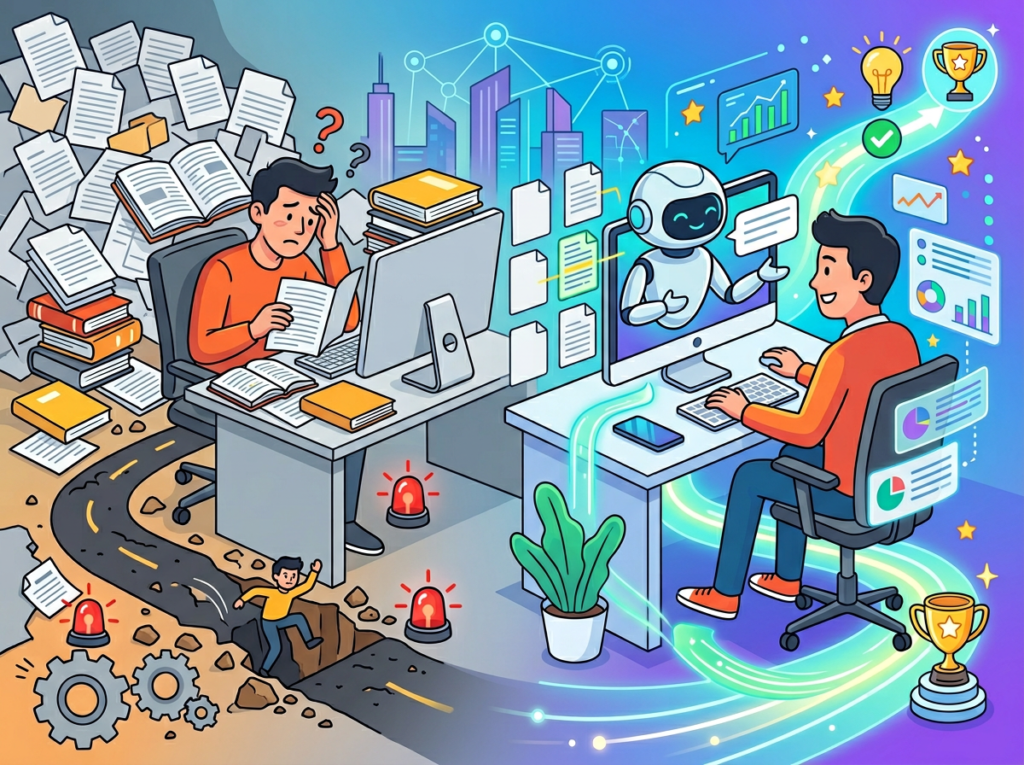
Pitfall 1: Using Too Many Disconnected Tools
The AI tool proliferation problem is real for US small businesses. The average SMB team uses 8–15 software applications, and the temptation to add ChatPDF on top of an already fragmented stack without a clear integration plan leads to yet another tool that nobody uses consistently.
How to avoid it: Start by identifying your single most painful documentation gap — the process question that interrupts your day most often — and deploy ChatPDF specifically for that use case first. Build one documented workflow, prove the value, then expand.
Pitfall 2: Delegating Without Documentation
The classic small team failure: you ask a team member to handle something, they do it their way, and you get an output that doesn’t match your standard. The problem isn’t the delegation — it’s that you never gave them the documented standard to work from.
How to avoid it: Before delegating any recurring task, use ChatPDF to extract and document the standard from your best past examples. Hand them the document alongside the delegation. This one habit eliminates the majority of small-team quality issues.
Pitfall 3: Over-Relying on Slack and Email for Knowledge Transfer
Institutional knowledge that lives in Slack messages and email threads is invisible to new hires and impossible to search systematically. If your team’s process knowledge is buried in chat history, you’re one new hire away from losing it entirely.
How to avoid it: Establish a simple rule — any process discussed more than twice in Slack gets documented. Use ChatPDF to help formalize those discussions into proper SOPs. Export relevant Slack threads as PDFs if needed, then upload to ChatPDF to generate structured documentation.
Explore the full ChatPDF review for additional guidance on building sustainable workflows that avoid these common implementation mistakes.
FAQs
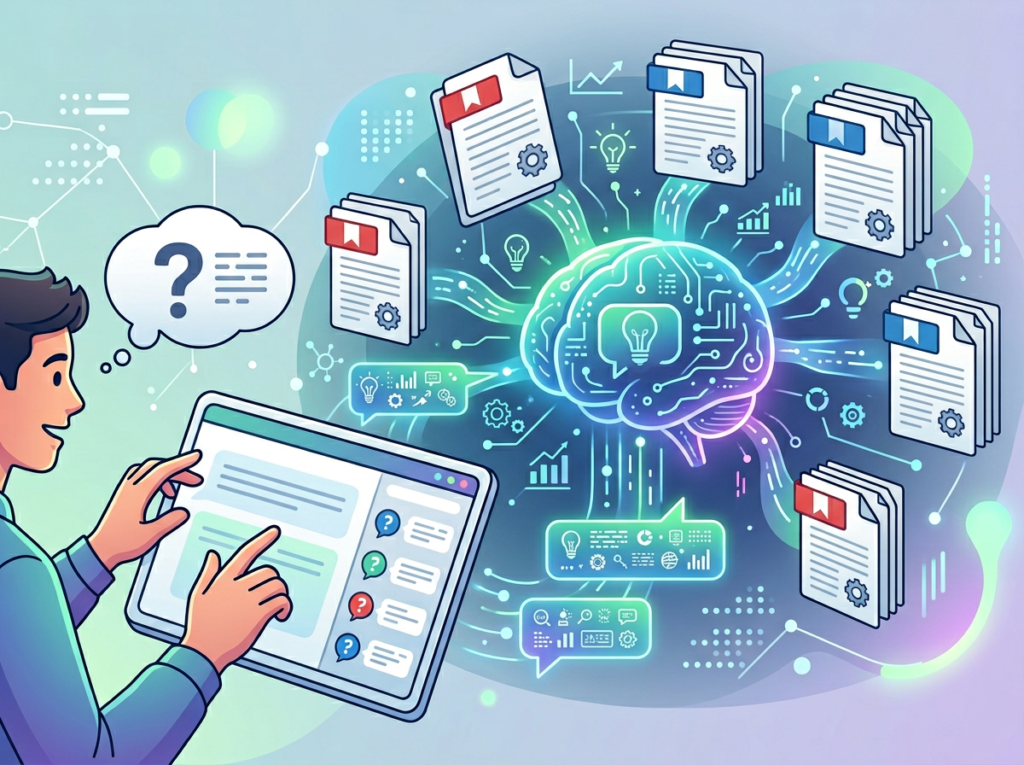
What is Solo DX?
Solo DX stands for Small-Scale Digital Transformation. It’s a framework for US founders and small team leads — typically managing 1 to 10 people — who want to build enterprise-level operational systems without enterprise-level budgets or headcount. Solo DX focuses specifically on systemizing knowledge, documenting workflows, and creating repeatable processes that let teams operate consistently and scale predictably.
Can small teams afford to use AI?
Absolutely. ChatPDF operates on a freemium model, with substantial capability available at no cost and paid tiers starting well below $20/month. Compare that to the documented US cost of hiring a fractional operations manager ($75–$150/hour) or a business consultant to build your documentation system ($5,000–$15,000 per engagement). The ROI for a 3-person US team implementing ChatPDF for documentation is typically realized within the first week of use.
Is ChatPDF hard to set up?
No. ChatPDF requires no technical setup, no integrations, and no configuration. You visit the website, upload a PDF, and start asking questions. The learning curve for most US small business users is under 30 minutes. The more complex question is organizational: which documents to prioritize and how to structure your queries for maximum output quality — and that’s a documentation strategy question, not a technology question.
Conclusion

In 2026, American small businesses don’t need enterprise budgets to build enterprise-level systems. The knowledge is already inside your documents — ChatPDF is the key that unlocks it.
Solo DX reframes the growth challenge for US founders: you’re not missing knowledge, strategy, or talent. You’re missing the documented infrastructure that makes everything you already know transferable, teachable, and scalable. ChatPDF addresses that gap directly, turning your existing PDF library into an interactive operational foundation that grows with your team.
The path forward is simpler than most founders expect. Start with one process — the one that interrupts your day most often. Upload your best reference documents, ask ChatPDF to extract the standard, review and refine it, then distribute. Repeat for the next process.
For teams across the US — from a 3-person agency in Austin to a 9-person firm in New York — the difference between chaotic growth and systemized scale comes down to documentation. ChatPDF makes that achievable at the speed and cost small teams can sustain.
Get the detailed breakdown of ChatPDF and start systemizing your most time-consuming process this week.
Leave a Reply