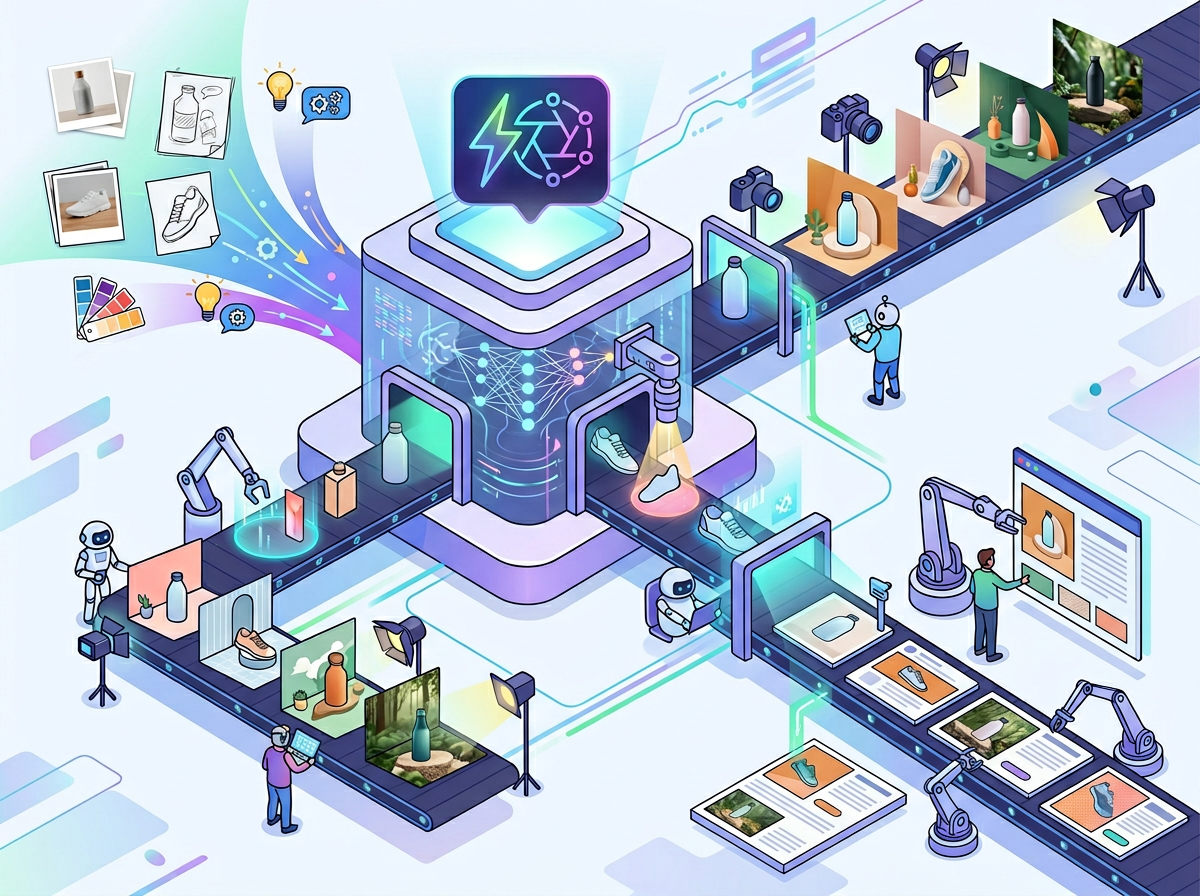
Small teams that replace product photography studios with AI-generated visuals consistently cut marketing costs by 60% or more — and ship campaigns faster.
In 2026, the pressure to produce high-quality product visuals has never been higher for US small businesses — and the gap between what a 3-person team can afford and what the market expects has never been wider. Professional product photography in major US markets runs $1,500 to $5,000 per shoot. Add in retouching, licensing, and turnaround time, and a small e-commerce or DTC brand can easily burn $20,000 to $40,000 a year just keeping product pages and marketing channels visually current.
Most small teams are stuck in a painful cycle: shoot assets, wait days for delivery, request revisions, repeat. Meanwhile, competitors with bigger budgets pump out weekly lifestyle shots, seasonal campaigns, and platform-specific ad creatives at a pace that feels impossible to match without a full creative agency behind them.
The problem isn’t budget alone — it’s process. Knowledge about brand guidelines, visual style, and content standards lives in one person’s head, usually the founder’s. New hires get no documented creative brief. Freelancers reproduce inconsistent aesthetics. Campaigns go out looking like they came from three different companies.
This is exactly the operational chaos that Solo DX — small-scale digital transformation led by US founders without dedicated creative directors — is designed to solve. AI product image generators like Flair AI are turning what was once a resource-intensive, agency-dependent workflow into a repeatable, team-executable system.
Unlike traditional product photography (which can cost $5,000 or more in US labor per campaign cycle), Flair AI’s plans start at $0 and scale to $38/month for high-volume teams — a fraction of the cost of a single studio session. More importantly, it transforms visual content production from a bottleneck into a documented, systemized workflow that any team member can execute.
This guide breaks down exactly how US small teams can use Flair AI to build a scalable visual content operation in 2026 — without a full-time photographer, a design agency, or a $50,000 creative budget.
See the full breakdown of Flair AI to understand exactly which features to prioritize for your team’s content workflow.
What is Solo DX?
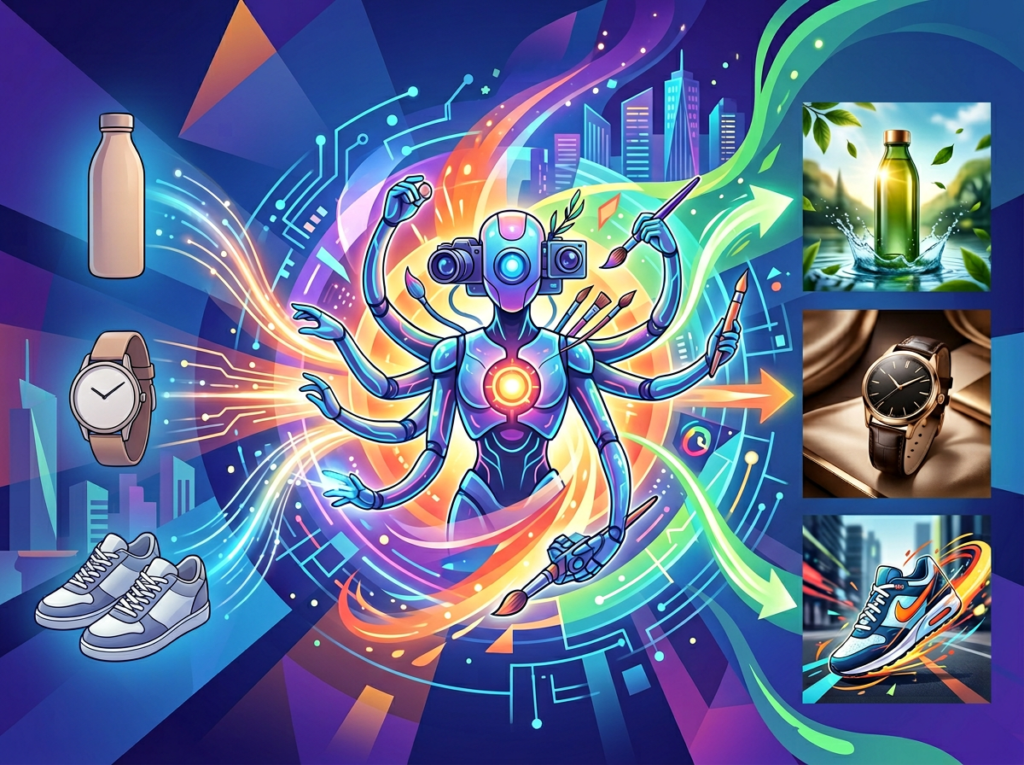
Solo DX stands for small-scale digital transformation — the process by which US founders and small team leads use AI and automation to build the operational infrastructure that larger companies hire department heads to manage. It is not about productivity hacks or personal efficiency. It is about building repeatable systems that allow a 3-to-10-person team to operate with the consistency and output quality of a 50-person organization.
Most content about AI tools focuses on what the tool does. Solo DX focuses on how the tool gets embedded into your operation — how it becomes something your whole team can execute, not just the founder or the one person who figured it out.
Solo DX vs. Adjacent Categories
| Category | Focus | Audience | Outcome |
|---|---|---|---|
| Solo DX | Team systemization via AI | Founders managing 1–10 people | Repeatable workflows, consistent output |
| AI Efficiency | Personal productivity | Individual contributors | Faster personal task completion |
| AI Revenue Boost | Revenue-generating AI | Sales and marketing teams | More leads, higher conversion |
| AI Workflows | Process automation | Ops and tech-forward teams | Reduced manual work across systems |
Corporate SOP methodologies fail US small businesses for a predictable reason: they were designed for organizations with dedicated operations managers, project coordinators, and compliance teams. A 5-person e-commerce brand in Austin doesn’t have any of those roles. What they have is a founder doing six jobs, two or three generalists wearing multiple hats, and a growing pile of institutional knowledge that exists nowhere except in Slack threads and people’s memories.
When creative workflows are undocumented, the consequences are concrete. A 3-person skincare brand in Austin found that every time a new product launched, the same questions would resurface: Which background style did we use last quarter? What aspect ratio does our Instagram template require? What lighting style did the photographer use for the holiday campaign? Without a documented visual brand system, every campaign restart was a $2,000 to $3,000 scramble.
Discover Flair AI’s features and how they support a documented, team-executable visual content workflow that doesn’t depend on any single person’s memory or availability.
Solo DX applied to visual content means this: instead of the founder personally briefing a freelancer every time, there is a documented creative workflow — prompts, templates, style parameters, and output review checklists — that any team member can execute consistently. Flair AI is built specifically to make that kind of systemization possible for teams that produce physical products.
Why AI is Key for Mini-Team Systemization
Problem 1: Visual Brand Knowledge Lives in the Founder’s Head

In most small US e-commerce businesses, the person who knows what the brand looks and feels like is the founder. They have an intuitive sense of the aesthetic — which backgrounds work, which lighting style matches the brand voice, which compositions perform on paid social. But that knowledge is entirely undocumented.
When a marketing coordinator tries to create a new ad set, they’re either guessing or asking the founder for approval on every iteration. The result: a bottleneck that slows campaigns, frustrates team members, and burns founder time on tasks that should be fully delegated.
AI solution: Flair AI’s template system and custom model training allow teams to encode visual brand standards into reusable, promptable formats. Once a founder trains a model on approved product images, those aesthetic standards become executable by anyone on the team — without a briefing call.
Problem 2: Inconsistent Output Quality Across Team Members
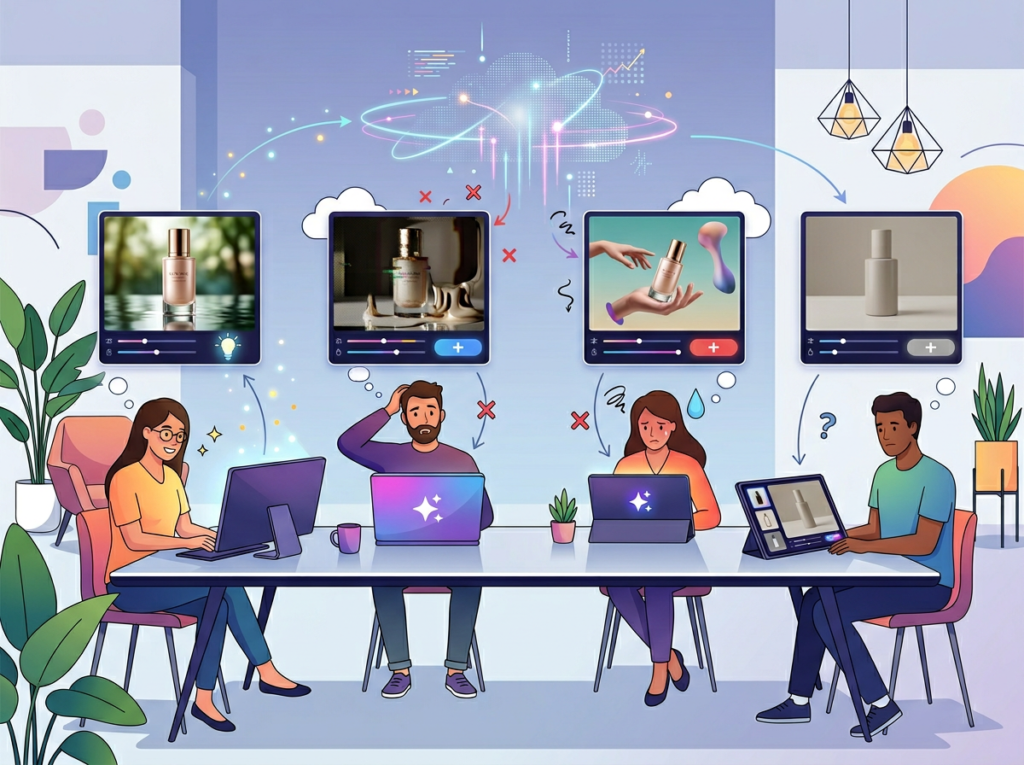
US labor turnover in creative and marketing roles runs high. When a team loses its one designer or the freelancer who knew your brand, output quality drops immediately. New hires or contractors produce visuals that look generic, off-brand, or inconsistent with previous campaigns.
The cost reality is significant. A professional product photography session in San Francisco or New York typically runs $2,500 to $5,000. A 10-person team producing content for four product lines across three seasonal campaigns per year can spend $30,000 to $60,000 annually — before retouching or licensing fees. As this hands-on review of Flair AI’s photography capabilities notes, the platform’s background generation and scene-staging tools directly address the iteration overhead that makes traditional product photography so expensive for small brands.
AI-assisted: With Flair AI, the same 10-person team can generate, iterate, and publish on-brand product images in hours, at $38/month or less. That’s an annual spend of $456 versus $30,000 to $60,000 — a cost reduction of 98% for a significant portion of their content pipeline.
Problem 3: Speed-to-Market Gaps Cost Revenue
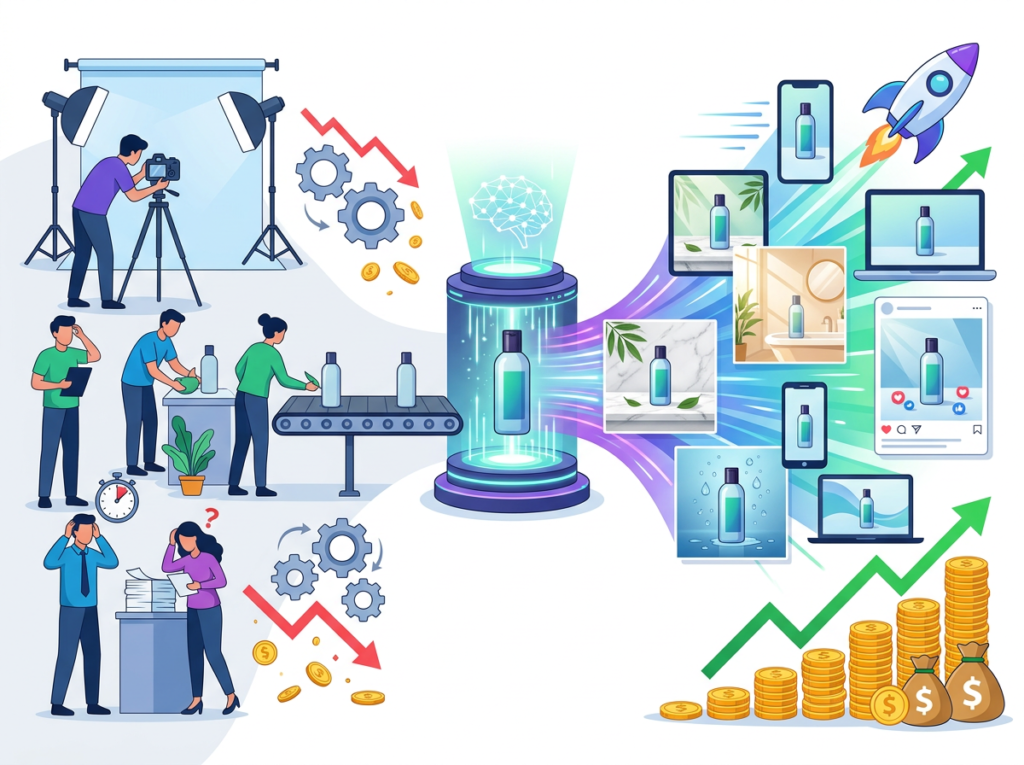
In 2026, US DTC brands that can’t respond to trends within 48 to 72 hours lose ground to competitors who can. Waiting five to seven business days for a photographer to deliver retouched images for a flash sale or seasonal promotion is a structural disadvantage.
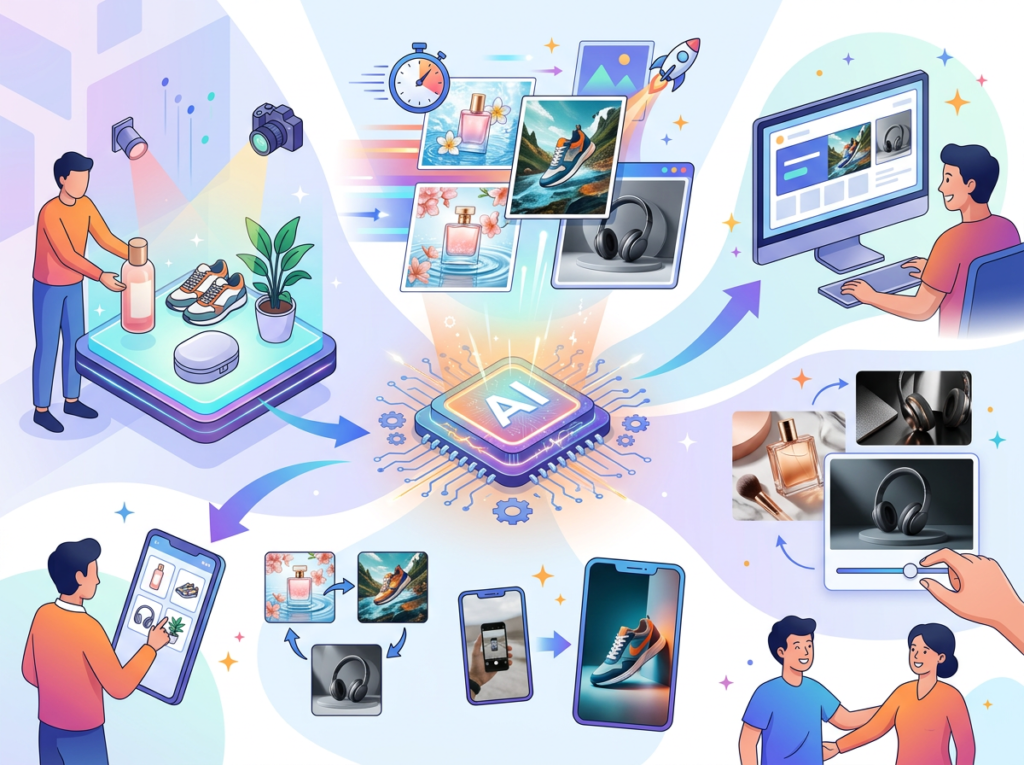
AI solution: Flair AI generates product images in minutes, not days. A team can test five different background styles, generate 20 ad creative variations, and have a complete campaign asset library ready before a competitor has even booked a studio.
The cumulative impact of these three solutions is what makes Flair AI a Solo DX tool rather than just a productivity add-on. It doesn’t just make one person faster — it makes the whole team capable of producing consistent, high-quality visual content as a repeatable system.
See the full breakdown of Flair AI to understand exactly which features to prioritize for your team’s content workflow.
How Flair AI Enables Solo DX for Small Teams: AI Product Image Generation at Scale
1. Custom Model Training to $15,000–$30,000 Saved Per Year Per Product Line

Flair AI’s custom model training allows teams to upload approved product images and generate a custom AI model that understands your specific product’s shape, texture, and key visual details. Once trained, every image generated from that model reflects the product accurately — no hallucinated handles, distorted labels, or approximated colors.
For a small US brand managing three to five product lines, this eliminates the need for a studio shoot every time a new colorway, size variation, or bundle configuration launches. Each model training cycle replaces a photography session that would cost $1,500 to $3,000 in a US market, and can be reused indefinitely.
Systemization payoff: The model becomes the documented standard. Any team member can generate product images from it. The creative brief is built into the model itself.
2. Bulk Content Generation to 5x Faster Campaign Asset Production
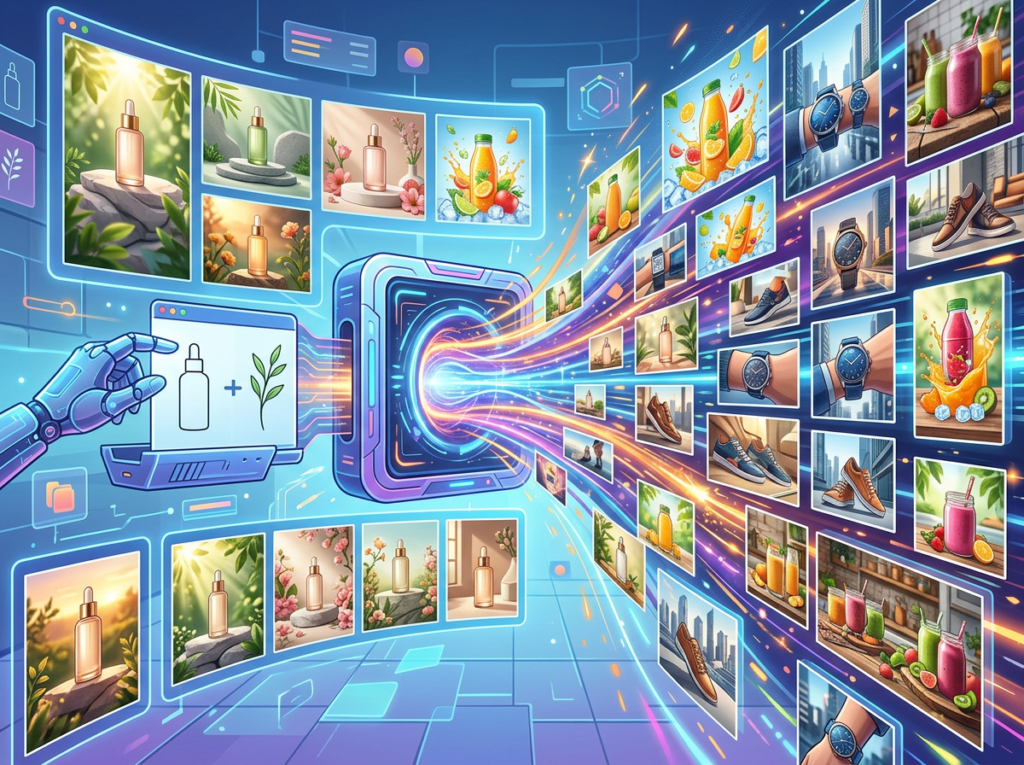
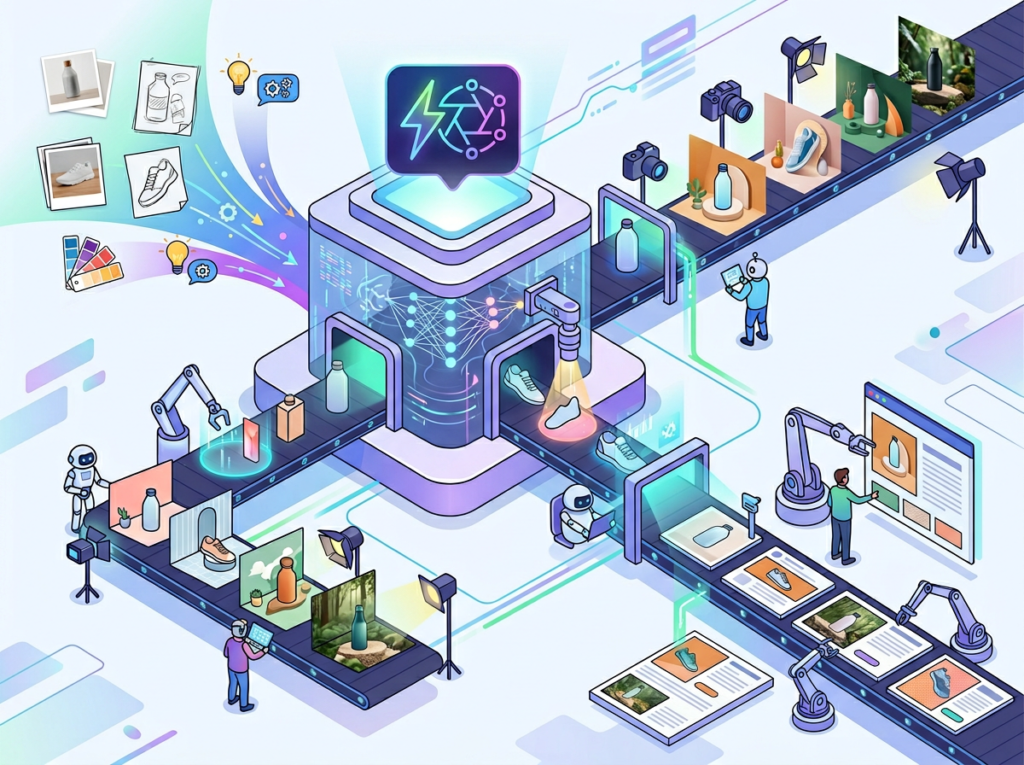
Flair AI’s bulk generation capability allows teams to create dozens of image variations from a single product model in one workflow. Instead of manually resizing, re-shooting, and reformatting assets for Instagram, Facebook, Google Shopping, and Amazon listings separately, a team can generate a full suite of platform-optimized assets in a single session.
See how Flair AI works for bulk content workflows that take a single product shoot and expand it into 30 to 50 platform-ready assets in under two hours.
For a team running three to five product launches per quarter, this alone saves 15 to 20 hours of production time per launch cycle. At a fully-loaded US labor cost of $50–$75/hour for a marketing coordinator, that’s $3,750 to $7,500 per launch, or $45,000 to $90,000 annually for a team managing a busy product calendar.
3. AI Ad Generation to $6,000–$12,000 Saved Annually in Agency Creative Fees
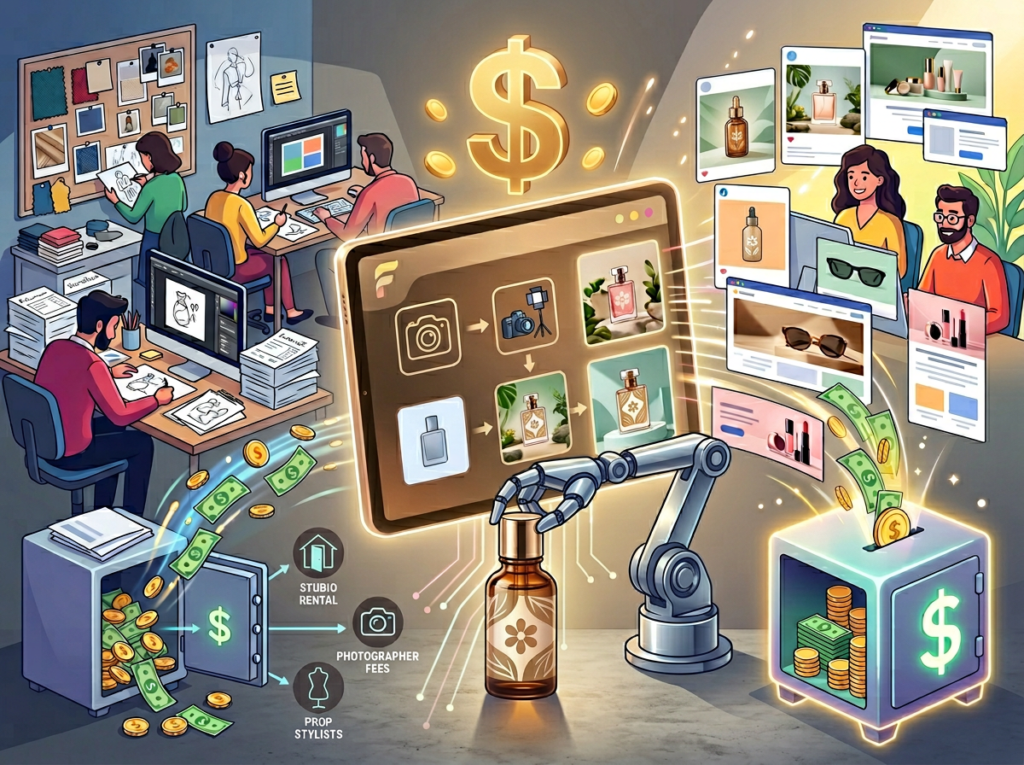
Flair AI includes native ad generation capabilities that take a product image and generate advertising creative with brand-consistent compositions, optimized for paid social formats. For small US teams that previously outsourced ad creative to agencies or freelancers, this replaces a recurring line item.
A typical US digital agency charges $500 to $1,500 per ad creative set. A small team running monthly paid campaigns can save $6,000 to $18,000 annually by bringing ad creative in-house using Flair AI’s generation tools — with no decrease in visual quality and a significant increase in iteration speed.
Ready to systemize your US team’s visual content production in under a week? Try Flair AI Free | No credit card required | Used by brands including Shein, Bonobos, and Samsonite
Use Cases by Team Role
Persona 1: E-Commerce Founder Juggling Product Launches and Marketing (Maria, San Francisco)
Role: Founder of a 6-person DTC skincare brand
Old workflow: Maria briefed a product photographer every quarter at $3,500 per session. New product variations required a new shoot. Seasonal campaigns required sourcing and booking a lifestyle photographer separately. Total annual photography spend: $28,000 to $35,000. Turnaround time: 5 to 8 business days per shoot.
AI-powered workflow: Maria trained a custom Flair AI model on her flagship products using approved hero images. Her marketing coordinator now generates new colorway images, seasonal background variations, and platform-optimized assets directly from the model — without a new shoot.
Results: Annual photography costs reduced from $32,000 to under $500 (Flair AI Scale plan). Campaign asset turnaround dropped from 5 days to 4 hours. New product launch image sets now take one afternoon instead of one week.
“We launched a new SPF variation last month and had the full asset library ready in three hours. That used to take us a week and a half and two rounds of revision emails with our photographer.” — Maria’s experience, representative of small DTC brands in the SF Bay Area
Explore Flair AI’s features to see how custom model training supports rapid product launches without recurring photography costs.
As this Practical Ecommerce interview with Flair’s founder describes, smaller brands with budget constraints represent the core use case — teams that previously couldn’t execute their vision due to coordination costs and studio access can now replicate those shoots virtually.
Persona 2: Marketing Coordinator Scaling Ad Creative Across Channels
Role: Marketing coordinator at a 4-person consumer goods startup
Old workflow: James relied on a freelance designer ($95/hour) for every ad creative iteration. Testing a new audience on Meta required a new creative set. At 3 to 4 creative tests per month, James was generating $1,140 to $1,520 in freelance design fees monthly, or $13,680 to $18,240 annually.
AI-powered workflow: James uses Flair AI’s ad generation tool to create new creative variations in-house. He enters the product model, selects from brand-approved background templates, and generates five to ten ad creative options in under an hour.
Results: Monthly freelance design spend reduced by 80%, from $1,400 to $280. Ad creative test velocity increased from 3 to 4 tests per month to 10 to 12. ROAS on paid Meta campaigns improved 22% within 90 days of increasing creative test frequency.
“I used to wait three days for a freelancer to send options. Now I can test a new angle by 9 AM and know by end of day whether it’s working.”
Join thousands of US small teams using Flair AI to eliminate visual content bottlenecks. See How It Works | Used by brands from Silicon Valley to New York
Common Pitfalls & How to Avoid Them
Pitfall 1: Using Flair AI as a One-Off Tool Instead of a System
The most common mistake is treating Flair AI like a search engine — using it ad hoc when you need an image, with no documented workflow, no saved templates, and no trained models. This captures maybe 20% of the tool’s potential.
The fix: Build your template library and custom models before you need them. Spend two to three hours at setup encoding your brand’s visual standards into reusable Flair AI assets. Every future content production session then draws from those standards automatically.
Pitfall 2: Skipping Custom Model Training
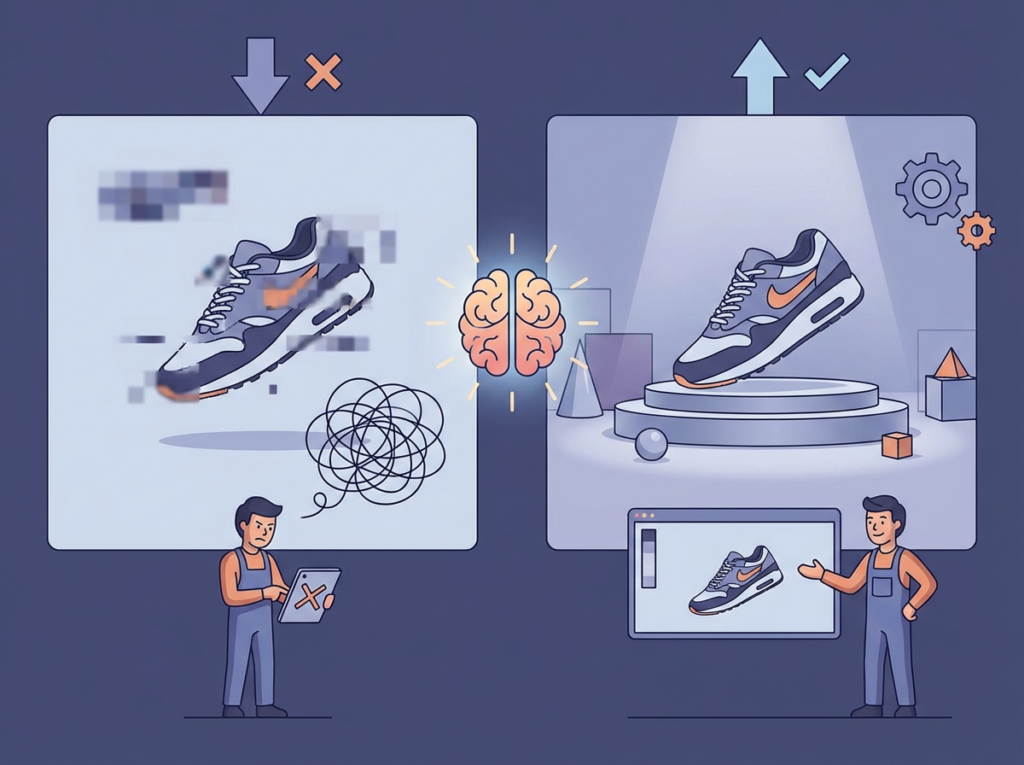
Teams that use Flair AI’s instant generation without training a custom model on their actual products get generic, approximate results. The images look good but don’t accurately represent the specific product — which creates legal and customer expectation problems for e-commerce brands.
The fix: Invest in custom model training for each primary product line. The Pro+ plan ($26/month) supports up to 8 standard custom models — more than enough for most small US brands. Learn more about Flair AI’s model training before deploying to your full team.
According to this analysis of practical Flair AI monetization use cases, users who leverage custom-trained models and documented prompt workflows consistently generate higher-quality, more commercially viable output than those who use the tool without structured setup.
Pitfall 3: Not Reviewing AI Output Before Publishing
Flair AI generates impressive results, but AI image generation still requires a human review step — particularly for product details like text on packaging, fine product features, and color accuracy. Teams that skip review and publish directly to e-commerce platforms encounter customer complaints and Amazon listing rejections.
The fix: Build a two-step output review into your workflow. Generate images, then run a 10-minute quality check against a documented checklist (packaging text legibility, color accuracy, background cleanliness, platform dimension compliance). This adds 15 minutes to a session that would otherwise take days.
See the full breakdown of Flair AI to understand exactly which features to prioritize for your team’s content workflow.
FAQs
What’s the difference between AI Efficiency and Solo DX?
AI Efficiency is about helping individual contributors work faster — processing more tasks in less time. Solo DX is about building organizational systems that make a whole team consistently capable of high-quality output. The difference is personal speed versus organizational scalability.
Can small teams in the US afford AI product image tools?
Yes — significantly more than traditional alternatives. Flair AI’s free plan covers basic use, and the Pro+ plan at $26/month gives a small team access to custom model training and bulk generation. Compare that to a single US product photography session at $1,500 to $5,000, and the economics are clear even in the first month.
Is Flair AI difficult for a small team to set up?
The core workflow — uploading product images, training a model, and generating new images — can be completed in a few hours by a non-technical team member. The more involved setup is building the template library and documented workflow that enables the rest of your team to use the tool independently. Budget a full day for initial setup; the payoff is a system that runs without founder involvement going forward.
Conclusion
In 2026, American small businesses don’t need enterprise budgets to produce enterprise-level visual content. The same AI product image generator capabilities that large brands like Samsonite and Bonobos use in-house are available to a 4-person DTC brand in Austin for $38/month or less.
But the brands that capture the full value of tools like Flair AI are not the ones that use them occasionally — they’re the ones that build them into documented, repeatable systems. That is the core promise of Solo DX: not just faster output, but a visual content operation that any team member can execute consistently, that doesn’t restart from scratch with every new hire, and that scales with the business rather than breaking under it.
The math is straightforward. A US small brand spending $20,000 to $40,000 annually on product photography, freelance design, and ad creative can reduce that to under $1,000 per year with a properly implemented Flair AI workflow — while increasing output velocity by 5x or more.
Start with one process. Pick your highest-frequency visual content need — whether that’s marketplace listing images, ad creative, or seasonal campaign assets — and build a documented Flair AI workflow around it this week. The ROI will be measurable within 30 days.
See the full breakdown of Flair AI to understand exactly which features to prioritize for your team’s content workflow.
Leave a Reply