
The best ai email marketing tools don’t just send emails faster — they eliminate the admin grind keeping solo entrepreneurs from billable work.
In 2026, American freelancers and solo entrepreneurs face a paradox: the tools to reach thousands of customers are cheaper and more accessible than ever, yet most solo operators still spend more time managing their marketing than actually doing it.
Inbox at 200 unread. Campaign drafts half-finished. Newsletter three weeks overdue.
For US freelancers billing $50–$150 per hour, every hour spent writing subject lines, segmenting lists, and crafting follow-up sequences is $50–$150 not earned. That’s a hidden tax that compounds month over month.
This is exactly the problem that modern ai email marketing tools are built to solve, and MailerLite AI sits near the top of that stack for solo operators and small teams. It’s not a magic button — but it is a thinking partner that can cut the cognitive weight of consistent email marketing by 40–60% for the right user.
In this guide, you’ll get four specific workflows you can implement this week — each designed to save 2–5 hours on your recurring email marketing overhead. You’ll also get an honest look at where AI email automation falls short, so your expectations stay grounded from day one.
Try MailerLite AI free and build your first AI-assisted campaign today. Start Free | No credit card required
Key Concepts of AI Email Marketing Efficiency
Concept 1: Cognitive Offloading

Cognitive offloading is the practice of transferring mental work — decisions, drafts, formatting choices — to an external system. In email marketing, it means letting AI handle the first-draft problem.
The first-draft problem is real and expensive: most freelancers don’t struggle to improve a newsletter; they struggle to start one. When an AI writing assistant generates a structured first draft from a short prompt, the cognitive bottleneck disappears. You move from creator to editor — a fundamentally faster and lower-stress mode.
Scenario — Sarah, freelance brand designer in Portland with 8 active clients: Before using AI email tools, Sarah spent roughly 2.5 hours every Tuesday writing, formatting, and scheduling her monthly client newsletter. After setting up MailerLite AI with a saved brand voice prompt, that same process takes 45 minutes. She writes a brief prompt, reviews and edits the AI draft, adjusts the subject line, and schedules. That’s 1 hour and 45 minutes per newsletter, or roughly 21 hours per year — back in her calendar.
For advanced cognitive offloading strategies specific to email marketing workflows, explore MailerLite AI in detail.
Concept 2: Context Switching Cost
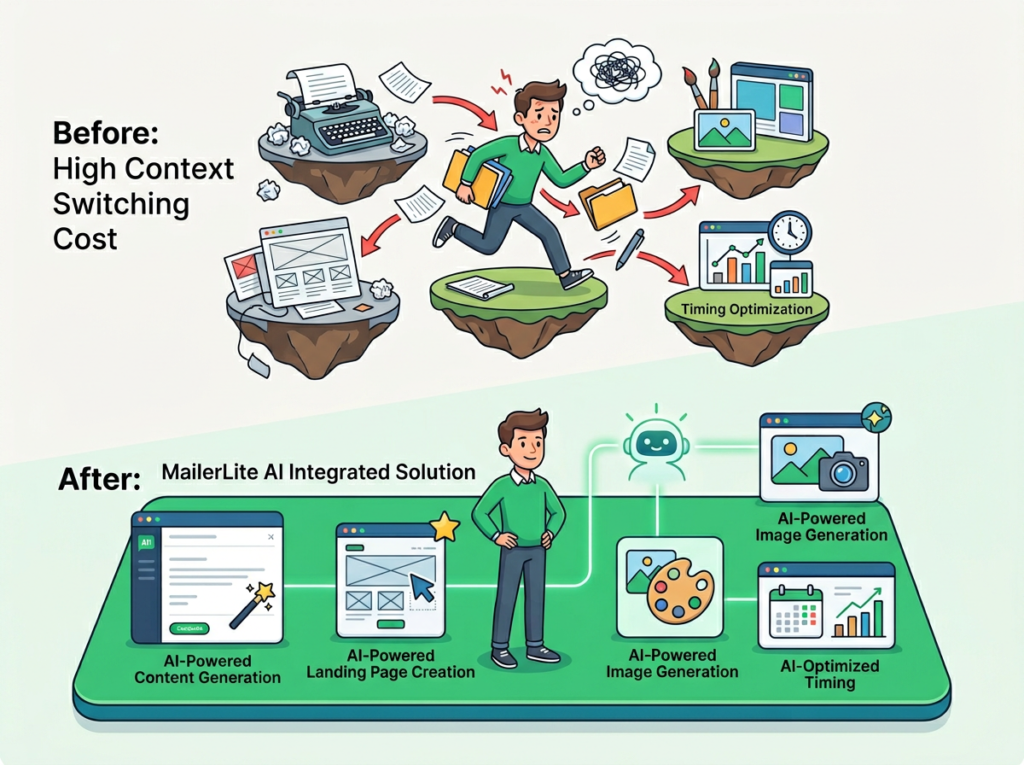
Research consistently shows the average worker takes approximately 23 minutes to fully regain focus after an interruption. For solo entrepreneurs, email marketing tends to be the highest-frequency context switch — pulled from client work to think about subject lines, list segments, and send timing.
AI tools like MailerLite reduce this overhead by pre-populating campaign structures, suggesting subject line variations, and remembering your audience segments — so each session starts with context already loaded rather than rebuilt from scratch.
Scenario — Marcus, solo management consultant in Chicago: Marcus runs a biweekly email nurture sequence for leads who haven’t converted to retainer clients. Before AI automation, preparing each email took 3–4 hours of scattered work across two days. With templated automations and AI-assisted copy, he batches the entire month’s sequence in a single 2.5-hour session. He recovers roughly 5 hours per month — 60 hours per year — from context switching overhead alone.
Concept 3: Workflow Orchestration

The most sophisticated application of AI in email marketing isn’t writing assistance — it’s workflow orchestration: coordinating when, to whom, and with what content emails go out, without manual intervention after initial setup.
Think of AI as a conductor, not just a performer. A well-configured MailerLite automation workflow can welcome a new subscriber, deliver a lead magnet, send a nurture sequence, and tag the subscriber based on click behavior — all without touching a button after the initial build.
Scenario — Elena, Shopify store owner in Austin selling handmade home goods: Elena’s abandoned cart sequence and post-purchase follow-up were previously managed manually, meaning she sent them when she remembered, which was inconsistently. After a 4-hour setup session building AI-assisted automation workflows in MailerLite, those sequences now run on autopilot. She estimates recovering 4–5 hours per month she was previously losing to manual campaign checks and reactive follow-up emails.
Try MailerLite AI free and build your first AI-assisted campaign today. Start Free | No credit card required
How MailerLite AI Helps Efficiency
Feature 1: AI Writing Assistant (OpenAI-Powered)

MailerLite’s AI writing assistant, powered by OpenAI’s GPT models, generates email body copy, subject line variations, and call-to-action text from short natural language prompts. You describe what you want — tone, goal, audience, product — and the assistant generates a structured draft you can edit directly in the campaign editor. As documented in MailerLite’s official AI writing guide, the tool also works inside landing page and pop-up form editors, not just campaigns — making it a unified writing assistant across your entire subscriber acquisition funnel.
For freelancers who send 2–4 email campaigns per month, this feature alone can reduce campaign production time by 50–70%. If you previously spent 90 minutes per campaign on copywriting, AI-assisted drafting gets you to a workable version in 20–30 minutes. Over a year, that’s 40–60 hours recovered — worth $2,000–$9,000 at US freelance rates.
A key advantage over standalone writing tools: MailerLite’s assistant can identify and remove spam-trigger language from your copy, improving deliverability alongside speed. That’s a dual efficiency win — faster production and fewer campaigns landing in Promotions.
Feature 2: AI Subject Line Optimization

Subject lines are the highest-leverage, lowest-complexity part of email marketing — and they’re the part most solo operators agonize over longest. MailerLite’s AI assistant generates multiple subject line variations from your email content, allowing you to select or A/B test options without spending 30 minutes staring at a blank field.
To see these features in action alongside implementation examples, see our full MailerLite AI review.
For operators sending 2 campaigns per week, recovering 20 minutes per subject line decision translates to roughly 35 hours per year — $1,750–$5,250 in recovered time annually.
Feature 3: Drag-and-Drop Editor with AI-Powered Formatting

MailerLite’s editor is built on the principle that email design should not require a designer. The drag-and-drop interface handles layout, mobile responsiveness, and brand consistency without manual CSS or template customization. Pair this with AI-assisted copy generation, and a complete, on-brand campaign can go from concept to scheduled in under an hour.
For freelancers who have historically outsourced email design or skipped it altogether, this feature brings professional formatting in-house at no additional cost — eliminating a common $50–$150/campaign design expense for small operators.
Combined annual efficiency value: Across writing assistance, automation, subject line optimization, and design: 100–130 hours recovered per year = $5,000–$19,500 in additional earning capacity at US freelance rates.
Ready to cut email marketing time in half? Try MailerLite AI free and build your first AI-assisted campaign today. Start Free | No credit card required
Use Cases: Small Business & Freelancer Efficiency

Persona 1: Kai, Freelance Brand Designer in Portland, OR
Business: Brand identity and packaging design. 6–8 active clients at any time. Monthly newsletter to 1,200 subscribers showcasing recent work and sharing design trends.
Old workflow: Jessica spent roughly 10 hours per week on marketing overhead — not just email, but email was the heaviest single task. Monthly newsletter production: 3 hours. Quarterly promotional campaign: 4 hours. Ad hoc follow-up emails to warm leads: 2–3 hours/month.
After MailerLite AI: Jessica set up a monthly newsletter template with a pre-loaded brand voice prompt in MailerLite’s AI assistant. Campaign production dropped to 45 minutes. She built a three-email nurture automation for new subscribers that introduces her process and portfolio — a sequence she built once in an afternoon and hasn’t touched since. She also set up a quarterly promotional automation that triggers based on subscription date.
Results: Marketing overhead dropped from 10 hours to roughly 4.5 hours per week. At her $85/hour blended rate, that’s $19,550 in potential additional design hours per year.
“I used to push my newsletter to the last day of the month, every month. Now it goes out on the 15th, automatically, and it actually looks good.”
As detailed in this practical MailerLite setup guide, consistent send schedules and clean infrastructure matter more than perfect copy — something AI-assisted workflows help solo operators maintain even during busy client periods.
Persona 2: Jun, Independent Management Consultant in Chicago, IL
Business: Organizational change management consulting. Solo practice, 2–3 retainer clients, 40-person email list of potential clients and referral partners.
Old workflow: David sent a monthly “insight email” — his primary marketing channel — but it regularly slipped to bimonthly because writing it consumed 4–5 hours he didn’t have. Total monthly email marketing overhead: approximately 22 hours including research, drafts, follow-ups, and list management.
After MailerLite AI: David switched to a templated insight format: one core observation, one practical application, one resource link. MailerLite’s AI assistant generates a draft from a bulleted outline he writes in 10 minutes. He edits for 20 minutes, adds his signature framing, and schedules. The monthly email now goes out within 2 business days of his target date — every month.
Results: Monthly email overhead dropped from 22 hours to approximately 9 hours. At his $200/hour consulting rate, that represents $26,400 in recovered annual capacity. More importantly, consistent monthly sends to his referral network have become his highest-leverage business development activity.
“Consistency was always the problem, not content. AI drafting solved the consistency problem.”
Persona 3: Tom, Shopify Store Owner in Austin, TX
Business: Handmade ceramic home goods. Online-first, 3,800-subscriber email list, seasonal sales cycles.
Old workflow: Priya was managing email marketing manually — a situation common to small Shopify operators without dedicated marketing staff. Weekly promotional campaigns: 3 hours each. Abandoned cart emails: sent manually when she remembered. Post-purchase follow-up: non-existent. Total email overhead: roughly 17 hours per week during peak seasons.
After MailerLite AI: Priya spent one weekend (approximately 8 hours) building out her core automation architecture in MailerLite: a welcome sequence, an abandoned cart trigger, a post-purchase review request, and a re-engagement sequence for inactive subscribers. She used MailerLite’s AI assistant to write copy for all 11 emails in that stack. Ongoing weekly campaign production now takes 1.5–2 hours.
Results: Weekly email overhead dropped from 17 to approximately 6 hours. Over 52 weeks, that’s 572 hours recovered. At a conservative valuation of her time at $35/hour (her part-time hire cost benchmark), that’s $20,020 in recovered capacity annually — plus the revenue impact of consistently executed abandoned cart and post-purchase sequences.
As noted in this comprehensive overview of MailerLite’s segmentation and automation capabilities, targeted email segmentation can increase engagement rates by up to 14% — a figure that compounds meaningfully for Shopify operators where open rates directly influence conversion volume.
Streamline your email marketing with smart automation. Join 800,000+ businesses using MailerLite to run consistent, professional campaigns. Start Free Today
Best Practices for Implementing AI Email Automation

1. Start with One Automation, Not All of Them
The highest-ROI first automation for most solo operators is the welcome sequence. New subscribers are most engaged in the first 48 hours — and yet most small business email lists have no automated welcome at all. Build a 3-email welcome series (Day 0, Day 3, Day 7) using MailerLite’s automation builder and AI writing assistant. This single setup, done once, will consistently outperform sporadic manual sends.
Commit to getting that one automation live and performing before touching anything else.
2. Keep a Human in the Loop for High-Stakes Emails
Not every email should go out on autopilot. Client-facing communications, pricing announcements, and anything involving your personal brand at a critical moment deserve your eyes before sending. Treat AI output as a 70% solution you refine to 100% — not a finished email to approve uncritically.
3. Avoid Tool Overload
Freelancers new to AI marketing often stack five tools to cover every use case — $29 here, $49 there, $15 for the integration layer. That adds up to $129/month or more, with significant time overhead just maintaining the stack.
MailerLite’s consolidated approach — email, automation, landing pages, forms, and AI writing in one platform — starts free (up to 1,000 subscribers) and stays under $20/month for most solo operators. Consolidation almost always beats specialization at this scale.
Limitations and Considerations

Where MailerLite AI is NOT ideal:
High-stakes brand voice copy. AI writing assistants are trained on broad language patterns, not your specific brand equity. For campaigns tied to major launches, rebrands, or critical conversion moments, AI drafts require heavy editing to match the nuance, irony, or warmth that defines a recognizable brand voice. Use AI for infrastructure emails (welcome, onboarding, transactional) and save your full creative effort for the campaigns that carry the most commercial weight.
Legal, contractual, or compliance-adjacent communications. Terms of service updates, refund policy notifications, GDPR consent emails, and anything touching financial or health claims must be reviewed by a qualified professional before sending. AI-generated language in these contexts can inadvertently create liability — MailerLite’s assistant is not a legal editor.
Sensitive client or customer interactions. Complaint responses, refund negotiations, service failure acknowledgments, and relationship-repair emails require human empathy, contextual judgment, and accountability that no AI tool can reliably replicate. Sending an AI-generated response to an upset customer often makes things worse, not better.
Key risks to manage:
- Hallucination: AI can generate plausible-sounding but incorrect statements — always verify factual claims in AI-generated copy before sending.
- Privacy: MailerLite processes subscriber data under GDPR and CAN-SPAM. Review their data processing agreements if you handle sensitive subscriber categories.
- Over-reliance: Freelancers who stop writing copy entirely often find their marketing voice weakening over time. Use AI to reduce busywork, not to outsource your creative identity.
Frequently Asked Questions

What is AI email marketing efficiency for small businesses?
AI email marketing efficiency refers to using AI-powered tools to reduce the time and cognitive effort required to plan, write, design, and send email campaigns. For small businesses and freelancers, this typically means using AI writing assistants to draft copy, automation workflows to send sequences without manual intervention, and AI optimization tools to improve subject lines and send timing — freeing up 5–15 hours per month for higher-value work.
What’s the best AI email marketing tool for reducing workload?
For solo entrepreneurs and freelancers, the best tool is usually the one with the least integration overhead and the most automation capability per dollar. MailerLite AI scores well here: its AI writing assistant, visual automation builder, and full-featured free tier make it accessible without a significant upfront investment. The right tool also depends on your list size, send frequency, and whether you need e-commerce integrations — which is why comparing your options before committing matters.
Do I need technical skills to use MailerLite AI for email marketing?
No. MailerLite is designed specifically for non-technical users. The drag-and-drop editor, visual automation builder, and AI writing assistant all operate through natural language prompts and point-and-click interfaces. Most solo operators can build their first automation workflow within 2–3 hours of creating an account, with no coding or design background required. The learning curve is front-loaded — once your core automations are built, ongoing management is minimal.
Conclusion

For US freelancers and solo entrepreneurs billing $50–$150 per hour, the ROI on adopting modern ai email marketing tools is a present arithmetic problem with a clear answer.
If MailerLite AI recovers 100 hours of email marketing overhead per year, at a conservative $75/hour opportunity cost, that’s $7,500 in recovered capacity on a platform that starts free. At the paid tier, the return is 100x to 200x annually.
Consistent email marketing — the kind that AI automation enables for solo operators who previously sent campaigns whenever they could — compounds in ways that irregular marketing never does. Subscribers who receive a consistent, valuable newsletter develop trust over months. That trust converts to clients, referrals, and retention at rates that irregular marketing cannot match.
MailerLite AI’s role in the ai email marketing tools landscape is to make professional-grade email marketing achievable for the solo operator without 20 hours a month to dedicate to it. Not as a replacement for human judgment, but as the infrastructure layer that handles consistency, volume, and formatting so your best thinking can go into the campaigns that actually move your business forward.
The question isn’t “Should I use AI for email marketing?” — it’s “Can I afford the $7,500/year opportunity cost of not doing it?”
Start with one automation this week. Build the welcome sequence. See what it feels like to have that one thing running without you.
Try MailerLite AI free and build your first AI-assisted campaign today. Start Free | No credit card required
Leave a Reply