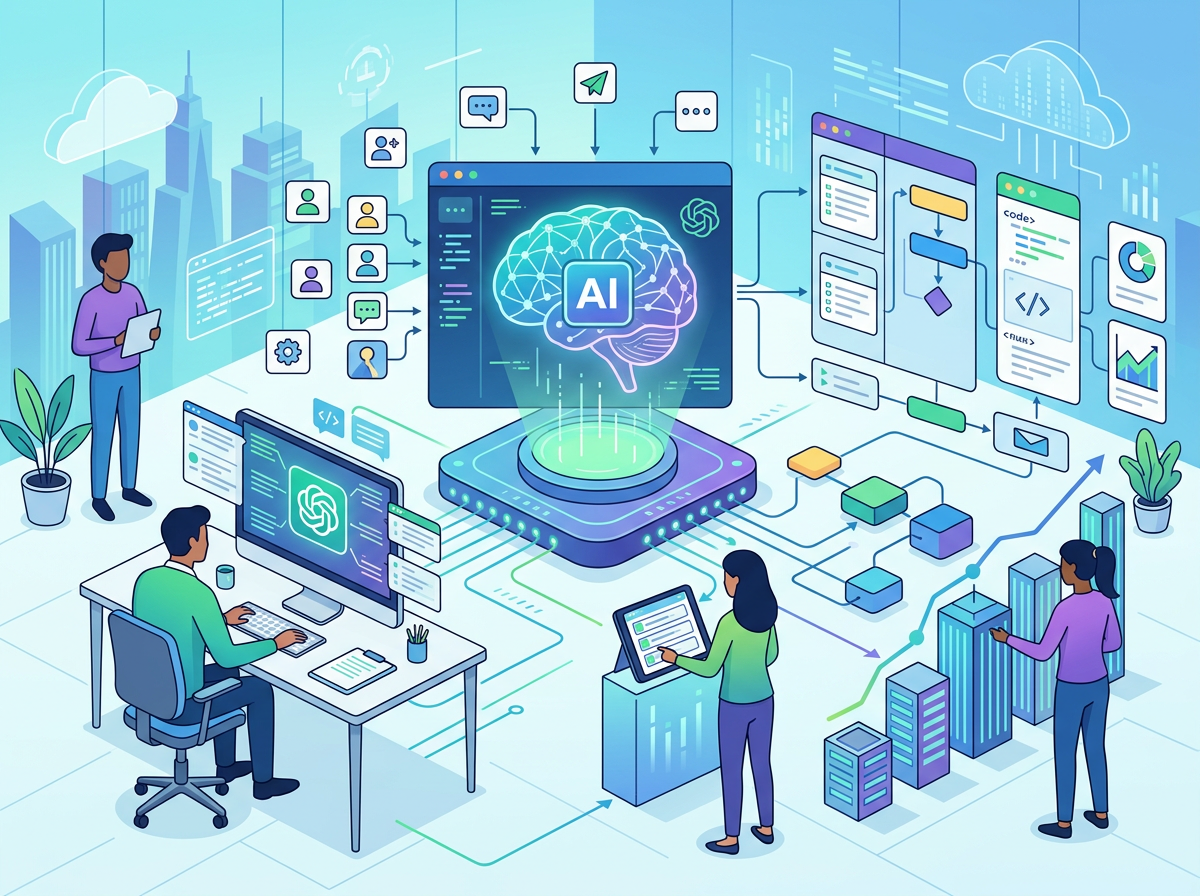
Most small teams don’t have a growth problem — they have a documentation problem that ChatGPT can solve in days, not months.
You hired your second employee, then your fifth. You onboarded a contractor in Denver. You added a part-time marketing coordinator in Chicago. And somewhere between those decisions, your business stopped running on systems and started running on you.
By 2026, this is the defining crisis for American small teams. Knowledge lives in Slack threads. Processes exist only in the founder’s memory. New hires take three to four weeks to become minimally productive — not because they’re slow, but because no one wrote anything down. Meanwhile, US labor turnover runs at approximately 47% annually in small businesses, meaning the tacit knowledge walking out the door is costing teams real money each time.
The traditional fix — hiring an operations manager or a consultant to document your processes — costs $5,000 to $15,000 in US labor before you see a single SOP. For a team of five or eight people, that budget doesn’t exist.
This is exactly the gap that ChatGPT fills in 2026. Not as a chatbot for personal productivity hacks, but as a system-building ally for founders who need to scale operations without scaling headcount. Teams using ChatGPT for workflow automation are building repeatable, documented processes in hours instead of weeks — at a fraction of the traditional cost.
This guide shows you exactly how to use ChatGPT for business automation: how to systemize knowledge, create SOPs your team will actually follow, and build the operational backbone that lets you grow past ten people without everything breaking.
Ready to build systems that scale? Learn more about ChatGPT and start your first SOP this week.
What Is Solo DX? The Framework Behind Small-Team Systemization

Solo DX — Small-Scale Digital Transformation — is the operational philosophy for US founders who have outgrown solo work but can’t afford enterprise-level operations infrastructure. It’s not about deploying a hundred software tools. It’s about one founder, or one small leadership team, making deliberate decisions to replace memory-based operations with documented, repeatable systems.
The distinction matters because most advice about business automation assumes you have an IT department, an operations team, or at minimum a dedicated project manager. Corporate SOP methodologies were designed for companies with 200 employees and six-figure documentation budgets. Applying those frameworks to a seven-person agency in Austin or a twelve-person e-commerce team in Phoenix produces beautiful documents that no one reads and no one maintains.
Solo DX looks different:
| Approach | Corporate SOP | AI Efficiency | Solo DX |
|---|---|---|---|
| Who leads it | Operations manager | Individual contributor | Founder or team lead |
| Primary goal | Compliance and audit trails | Personal productivity | Team-wide repeatability |
| Documentation cost | $10,000–$50,000 | Near zero | Near zero |
| Maintenance | Quarterly review cycles | Ad-hoc | Living documents |
| AI role | Backend automation | Prompt shortcuts | System architect |
Solo DX uses AI not to do tasks faster for one person, but to build systems that work the same way whether you’re in the office or on a flight to New York. The target is institutional memory — the kind that stays with the company when someone quits, when you onboard a new hire in Miami, or when you hand off a client relationship to a team member in Seattle.
A three-person design studio in Austin applied this approach after losing a senior designer who had managed all client communication protocols in her head. Rather than spending three weeks rebuilding those protocols from scratch, the founder used ChatGPT to interview herself — answering questions about how client calls were structured, how revisions were handled, how invoices were timed — and turned those answers into a complete client workflow SOP in under four hours. The new hire was fully independent in six days instead of three weeks.
That’s Solo DX in practice. The tool doesn’t matter as much as the intention: to move operational knowledge out of people’s heads and into a format the entire team can use.
Ready to build systems that scale? Learn more about ChatGPT and start your first SOP this week.
Why AI Is the Key to Mini-Team Systemization
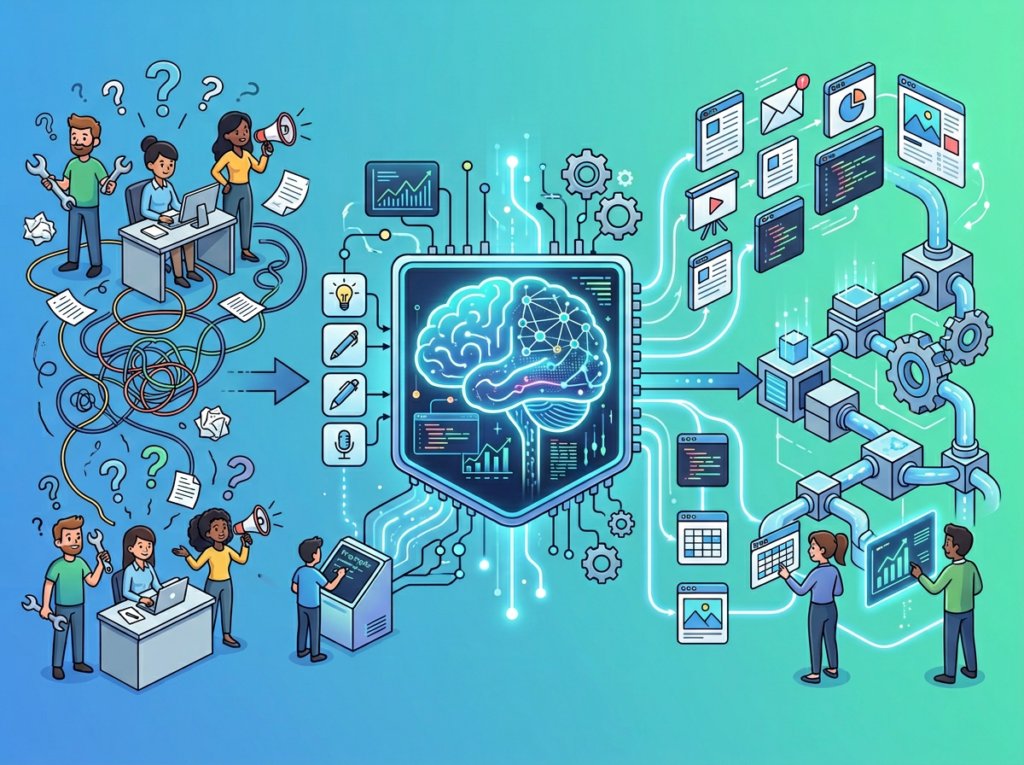
Problem 1: Knowledge Lives Only in the Founder’s Head
The average founder of a 1–10 person US business makes dozens of micro-decisions every week that no one else on the team could replicate. How do you respond when a client misses a payment deadline? What’s the exact process for onboarding a new vendor? How should a junior team member handle a scope creep conversation?
None of this is written down. And it can’t be — not sustainably — without a tool that makes documentation fast enough to actually happen. Traditional documentation takes between 3 and 8 hours per process in US labor time, at an average cost of $50 to $120 per hour. For a business with forty core processes, that’s a $6,000 to $38,000 documentation project that never gets prioritized.
Problem 2: New Hires Slow Down Operations
US labor turnover means small teams are constantly in onboarding cycles. A new hire spends their first two to four weeks asking questions, interrupting senior team members, and making costly mistakes because no written processes exist. Research consistently shows that structured onboarding programs improve new employee productivity by 70% — but building those programs requires documentation infrastructure most small teams lack.
AI-assisted documentation changes the math. What costs $5,000+ in US labor takes hours with ChatGPT for workflow automation, at a total cost of $0 to $20 in subscription fees.
Problem 3: Quality Varies Across Team Members
When processes live in people’s heads, execution quality varies with the person. Your best team member delivers client reports at one standard. Your newest hire delivers them at another. Without written, AI-assisted templates and checklists, you can’t systematize quality — you can only hope for consistency.
The cost of inconsistency isn’t visible on a balance sheet, but it shows up in client churn, rework cycles, and the hours you spend fixing what should have been done right the first time. For a US small business billing $150,000 to $500,000 annually, a 10% rework rate represents $15,000 to $50,000 in lost productivity each year.
Ready to build systems that scale? Learn more about ChatGPT and start your first SOP this week.
How ChatGPT Enables Solo DX

1. AI-Generated SOPs: $2,000 Saved Per Documentation Cycle
The most immediate application is SOP generation. Using the right prompting approach (detailed later in this guide), founders and team leads can produce a complete, structured SOP for any business process in 30 to 90 minutes.
The typical alternative — hiring a consultant or dedicating a senior team member’s time to documentation — costs $1,500 to $3,000 per process cycle when you account for research, drafting, review, and revision. For a team that needs ten to twenty core processes documented, AI-assisted SOP creation saves $15,000 to $60,000 in its first year.
The key is prompt architecture. Rather than asking ChatGPT to “write an SOP for client onboarding,” effective prompts follow an interview structure: “Ask me ten questions about how our team currently handles client onboarding. Then use my answers to generate a step-by-step SOP with clear ownership, decision points, and escalation paths.” This approach captures institutional knowledge systematically rather than producing generic templates.
2. Workspace Memory and Context Persistence: $78,000–$124,800 Annual Savings
One of the most underutilized capabilities for small teams is building a persistent operational context within ChatGPT. By maintaining a detailed “company context document” that team members paste into new conversations, ChatGPT can function as a de facto operations assistant that already knows your business — your client segments, your pricing structure, your communication standards, your brand voice.
This eliminates the context-setting overhead that costs US small teams an estimated 30 to 60 minutes per knowledge worker per day in repeated explanations, email back-and-forth, and re-briefing cycles. At US labor rates of $40 to $80 per hour, that’s $78,000 to $124,800 annually for a team of ten, conservatively estimated.
Explore ChatGPT’s features to understand how persistent context-setting works across different plan tiers.
3. Template Automation and Content Standardization: $6,000/Year Saved
Client-facing documents — proposals, reports, onboarding packets, status updates — are built from scratch repeatedly in most small teams, even when the underlying structure is identical every time. A single team member spending two hours per week on template-based document creation is costing your business $3,000 to $6,000 per year in avoidable labor.
ChatGPT’s template automation capability — where you build a master prompt that generates correctly formatted, brand-consistent documents from minimal inputs — eliminates most of this overhead. A marketing agency can produce a new client proposal in fifteen minutes instead of two hours. A consulting firm can generate a monthly performance report from a bulleted data dump in under thirty minutes.
As noted in this breakdown of advanced ChatGPT strategies, power users who build reusable prompt libraries see the most dramatic productivity gains — a principle that scales even further when applied across teams rather than individuals.
Ready to systemize your US team operations in under a week? Try ChatGPT Free | No credit card required | Trusted by 10,000+ US teams
Use Cases by Team Role

Maria Chen — Startup Founder, San Francisco
Situation: Maria runs a 7-person SaaS startup in San Francisco. She’s the de facto head of product, sales, and customer success — a situation she describes as “wearing every hat and dropping half of them.”
Old workflow: New team members learned by shadowing Maria for their first two weeks. Client escalations came directly to her. Product feedback from customers existed only in her notes and memory.
AI-powered workflow: Maria used ChatGPT to build a complete operational knowledge base over three days. She structured the project as a series of “brain dump” sessions where she narrated her decision-making processes and ChatGPT converted them into structured SOPs. She now has twenty-three documented processes covering sales calls, customer onboarding, product feedback collection, and escalation handling.
Results: New hire ramp time dropped from fourteen days to six. Maria’s direct involvement in operational questions dropped by approximately 70%. Estimated time recovered: 8 hours per week, representing $60,000+ annually at her effective hourly rate.
Maria’s take: “I kept saying I’d document everything after things calmed down. ChatGPT made me realize I’d been waiting for a calm that was never coming. I built the systems during the chaos instead.”
James Okafor — Executive Assistant, Miami
Situation: James supports a 9-person professional services firm in Miami and is responsible for onboarding all new remote staff members, most of whom are based in different time zones across the US.
Old workflow: James had a mental checklist for onboarding that he executed differently each time. New hires reported inconsistent experiences. Some missed critical system access on day one. Others received conflicting information about company policies.
AI-powered workflow: James worked with ChatGPT for workflow automation to build a comprehensive onboarding playbook — a 14-step process with decision trees, email templates, system setup checklists, and a day-by-day guide for the new hire’s first two weeks. The playbook runs largely without James’s involvement; new hires follow it independently.
Results: Onboarding consistency improved dramatically. New hire time-to-productivity dropped from 18 days to 9 days — saving the firm approximately $2,400 per hire in lost productivity costs at current US labor rates. James recovered roughly 5 hours per onboarding cycle.
James’s take: “The playbook ChatGPT helped me build is better than anything I could have written on my own. It asks questions I forgot to ask and catches edge cases I would have missed.”
Robert Kim — Operations Trainer, New York City
Situation: Robert manages training and internal knowledge documentation for a 10-person e-commerce company in New York City. The company had grown quickly and had almost no written procedures.
Old workflow: Robert delivered training verbally and through informal demonstrations. When he was unavailable, operations slowed or errors increased. Critical process knowledge existed only in his head and a disorganized folder of outdated PDFs.
AI-powered workflow: Robert used ChatGPT for SOP creation to systematically rebuild the company’s process library. He developed a documentation sprint — two weeks of structured sessions where each team member narrated their core processes and ChatGPT helped convert those narratives into clean, standardized SOPs. The company now has forty-one documented processes covering operations, customer service, fulfillment, and vendor management.
Results: Robert’s direct involvement in routine training dropped by 60%. Error rates on fulfillment processes declined by an estimated 35% within two months. The company onboarded two new team members using only the documented playbooks, with no dedicated trainer involvement for the first time in company history.
Robert’s take: “We went from a company that ran on tribal knowledge to a company with actual systems. It took two weeks and cost us almost nothing except time.”
As noted in this guide to ChatGPT best practices for business teams, integrating ChatGPT with existing operational workflows — rather than treating it as a standalone tool — is what drives lasting productivity gains. See how ChatGPT works for team-based applications.
Join 10,000+ US small teams using ChatGPT to eliminate operational chaos. See How It Works | Used by teams from Silicon Valley to New York
Common Pitfalls and How to Avoid Them
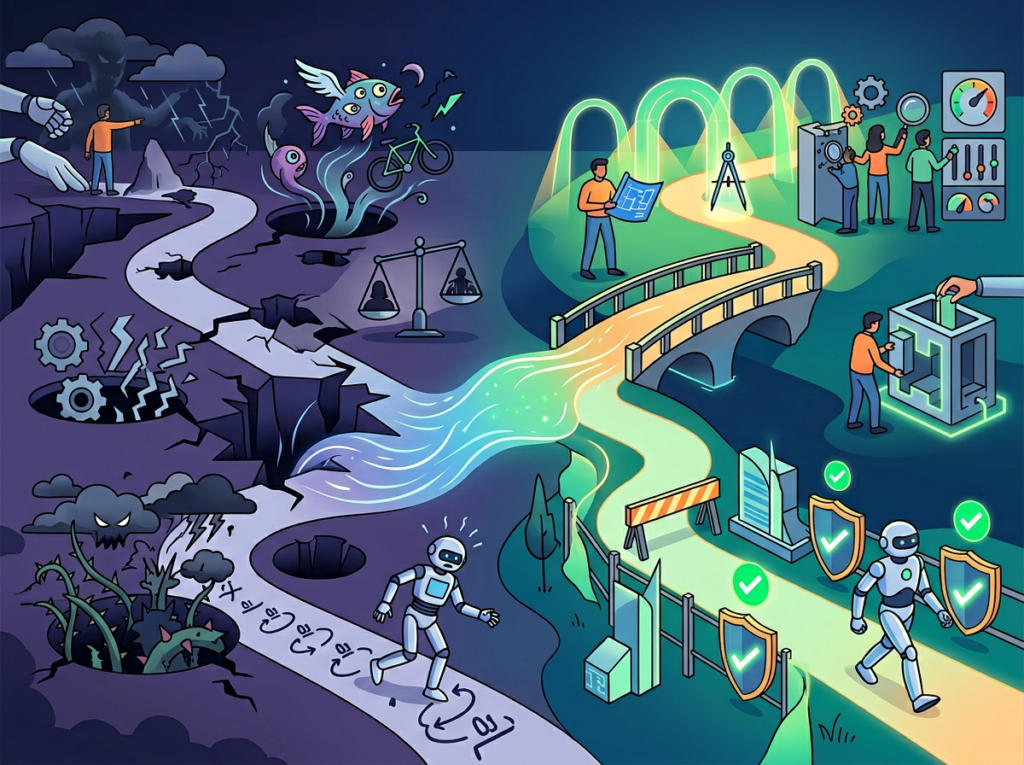
Mistake 1: Using Too Many Disconnected Tools
8The most common failure pattern is deploying ChatGPT alongside four other AI tools — each handling a different slice of operations — without a unified system connecting them. The result is more complexity, not less. Tools that don’t share context produce inconsistent outputs, and team members spend more time managing tools than managing work.
The fix: start with ChatGPT as your primary documentation and knowledge engine before adding specialized tools. Build your SOP library and workflow templates first. Then evaluate additional tools only for gaps ChatGPT genuinely can’t fill.
Mistake 2: Delegating Without Documentation
Some founders instruct team members to “just use ChatGPT” for their tasks without building the underlying prompt library and context documents that make outputs consistent. The result is six team members using ChatGPT six different ways, producing six different quality levels of work.
Effective chatgpt for small business operations requires a centralized prompt library — a shared document where your best prompts for common tasks are stored, tested, and maintained. Treat it like any other operational asset.
Mistake 3: Over-Relying on Slack and Email for Knowledge
Perhaps the most damaging habit in US small teams is treating Slack threads and email chains as the primary knowledge repository. Critical decisions get made in DMs that no one can find later. Process guidance gets buried in email threads from eight months ago. New hires inherit a search problem instead of a knowledge base.
ChatGPT doesn’t fix this if you continue routing operational knowledge through ephemeral channels. The commitment to Solo DX means routing knowledge decisions through documented formats — and discover ChatGPT as the engine that makes documentation fast enough to be sustainable.
For context, this overview of practical ChatGPT usage patterns highlights iterative refinement as a key habit — the same principle applies at the team level: your prompt library and SOP templates should be treated as living documents that improve with each use.
FAQs

What is Solo DX? Solo DX — Small-Scale Digital Transformation — is the practice of US founders and small-team leaders systematically replacing memory-based operations with documented, AI-assisted workflows. It’s designed specifically for teams of 1–15 people who need enterprise-level operational consistency without enterprise-level budgets or headcount.
How can AI write my SOPs? The most effective approach is treating ChatGPT as an interviewer rather than a writer. Describe your process conversationally — as if explaining it to a new hire — and ask ChatGPT to convert your explanation into a structured SOP with numbered steps, decision points, ownership assignments, and escalation paths. This captures your actual process rather than generating generic templates. Most founders can complete a solid first-draft SOP in 30 to 60 minutes this way.
What’s the difference between AI Efficiency and Solo DX? AI Efficiency focuses on individual productivity — helping one person accomplish their tasks faster through AI assistance. Solo DX focuses on team-level repeatability — building systems that produce consistent outcomes regardless of which team member executes them. Both matter, but they’re different investments. Automate tasks with ChatGPT for personal efficiency, but apply the Solo DX framework when you need the entire team to operate consistently.
Can small teams afford to use ChatGPT for business automation? Yes — and the ROI is typically substantial in the first 60 days. ChatGPT’s paid tier costs $20 per month. The documentation cycle savings alone — replacing $2,000+ consultant or labor costs per process — make the investment positive after a single SOP project. Teams using ChatGPT for small business operations report recouping their annual subscription cost within the first week of serious implementation.
Conclusion
In 2026, American small businesses don’t need enterprise budgets to build enterprise-level operational systems. The tools exist. The cost barrier is effectively zero. The only remaining obstacle is the decision to prioritize documentation over the perpetual sense that there isn’t enough time.
ChatGPT’s value for how to use ChatGPT for business automation isn’t in the individual features — it’s in what those features unlock at the team level. When a 7-person company in San Francisco has the same quality of process documentation as a 200-person company in Chicago, they compete differently. They hire differently. They scale differently.
Solo DX is the framework for getting there. Start with one process. Pick the one that causes the most confusion, the most rework, or the most founder involvement. Build the SOP this week. Test it with your team next week. Refine it the week after.
That single documented process is worth more to your business than a hundred productivity hacks applied to individuals. The compound effect of twelve months of consistent Solo DX implementation is a team that runs reliably — with or without you in the room.
Ready to build systems that scale? Learn more about ChatGPT and start your first SOP this week.
Leave a Reply