
The right ai search engine for research doesn’t just find answers faster — it eliminates the hours small businesses waste chasing unreliable sources.
In 2026, American freelancers and solo entrepreneurs face a paradox that would have seemed absurd a decade ago: there is more information available than ever — and yet finding the right answer still takes forever.
Inbox at 200 unread. Calendar packed. A client asking for a competitive analysis by Friday. You open a browser tab, type a question, and spend the next forty-five minutes chasing links that are outdated, paywalled, or vaguely related to what you actually need. You triangulate between three sources, worry one of them is biased, and draft a summary you’re still not fully confident in. By the time you’re done, half the morning is gone.
This is the research bottleneck — and for most small business owners, it’s invisible precisely because it feels like work.
This article delivers four specific workflows you can implement this week using Perplexity as your ai search engine for research, each designed to reclaim 2–5 hours of your working time without sacrificing the accuracy your clients expect.
Try Perplexity free and experience AI-powered search firsthand. Start Free at Perplexity.ai | No credit card required
Key Concepts of AI Efficiency
Concept 1: Cognitive Offloading
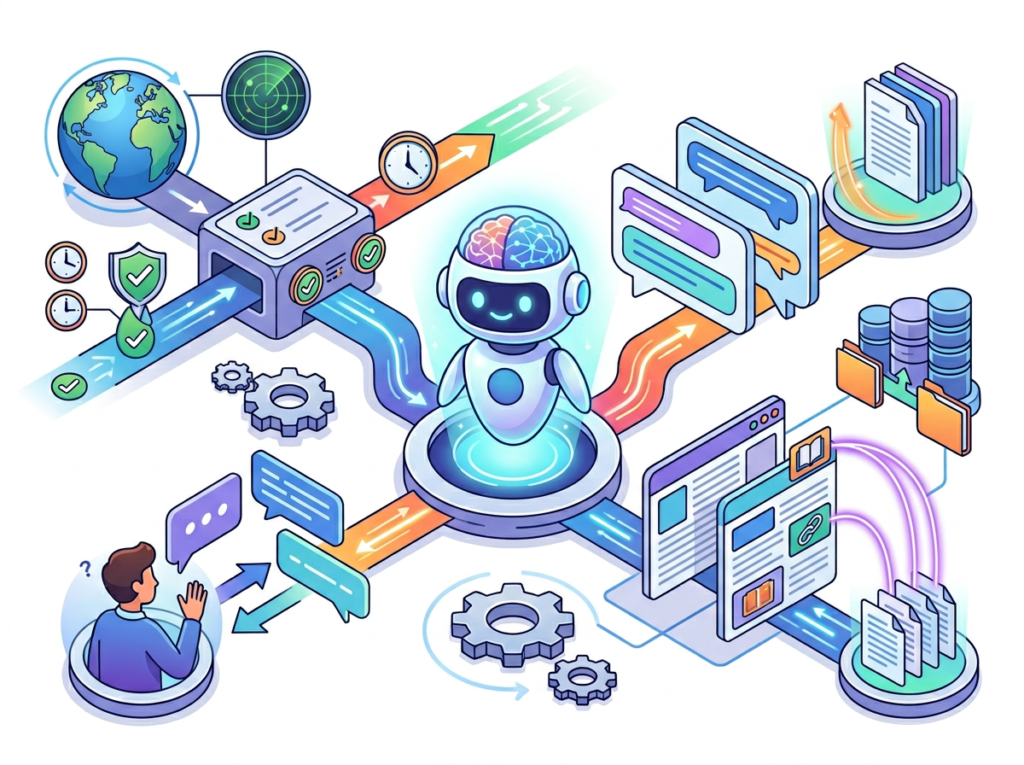
Every hour a small business owner spends doing research manually is an hour spent on a task that doesn’t require their unique expertise. That’s the core inefficiency. Cognitive offloading is the practice of deliberately transferring information-gathering and synthesis tasks to an external system — in this case, an AI search engine — so your mental energy stays reserved for higher-value decisions.
Sarah is a freelance brand designer based in Denver who manages eight client relationships simultaneously. Before using AI search tools, she spent roughly 2.5 hours every day on background research: studying competitor brands, surveying industry trends, checking color and typography conventions, and verifying the accuracy of claims she planned to include in client presentations. After integrating Perplexity into her workflow as her primary ai search engine for research, she reduced that daily overhead to under 45 minutes. The tool handles the synthesis; she handles the creative interpretation.
The result: 2.5 hours saved daily, or roughly 12.5 hours per week — time she now redirects to billable design work.
Concept 2: Context Switching Cost
Research as most people practice it isn’t a clean, linear process. It involves constant tab-switching, re-reading, losing your place, and mentally rebuilding context every time you return to a source. Research on workplace productivity has long established that it takes an average of 23 minutes to fully regain focus after an interruption — and traditional search-based research is structured entirely around interruption.
Marcus is a solo management consultant in Atlanta who previously tracked his research time in billable blocks. His typical approach involved six to ten browser tabs, multiple note-taking windows, and a constant back-and-forth between source material and the document he was building. Each pivot between tabs cost him minutes of re-orientation. After switching to Perplexity for initial research synthesis, he cut his context-switching overhead dramatically. He now enters a single query, reads a synthesized answer with sources attached, asks follow-up questions conversationally, and moves on.
The result: five fewer hours of fractured attention per week — time that now goes into actual analysis rather than information retrieval logistics.
Concept 3: Workflow Orchestration
The most sophisticated use of an AI search engine for research isn’t a single query — it’s treating the tool as the first node in a repeatable research workflow. Workflow orchestration means designing a consistent sequence: Perplexity synthesizes the landscape, you evaluate what’s relevant, you ask follow-up questions to drill down, and you export the structured output into whatever deliverable comes next.
Elena runs a Shopify-based home goods brand in Phoenix and produces a weekly competitive intelligence summary for her own strategic planning. Her old process — manually visiting competitor websites, checking Google News, scanning Reddit threads and industry blogs — consumed nearly four hours every Sunday evening. After building a standardized Perplexity query sequence for competitive monitoring, she produces the same quality summary in under one hour.
The result: three hours saved per research cycle, or twelve hours reclaimed per month.
For an advanced look at how these concepts translate into tool-specific workflows, explore Perplexity in detail on AI Plaza’s dedicated review page.
How Perplexity Helps Efficiency
Feature 1: Real-Time Web Synthesis with Citations
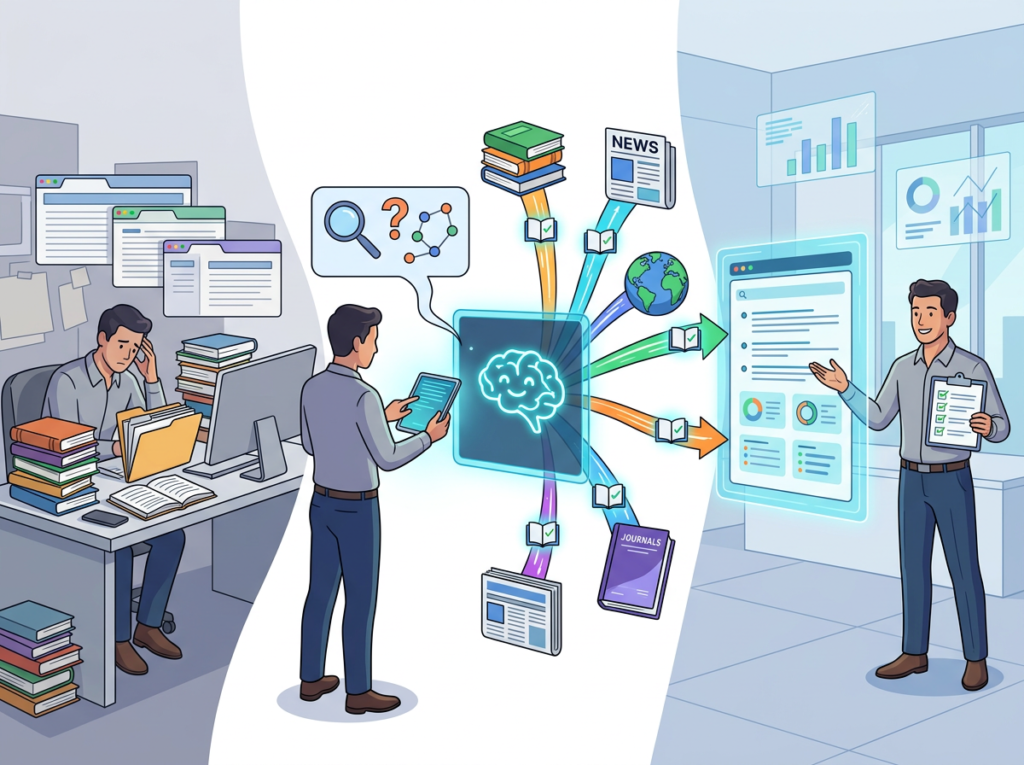
Unlike general-purpose AI chatbots that draw on a fixed training dataset, Perplexity pulls live information from the web and synthesizes it into a single, readable answer. Crucially, every claim is tied to a source link you can verify — a feature that matters enormously for freelancers whose professional credibility depends on accuracy.
This distinction is significant. As noted in this detailed breakdown from TechTarget, Perplexity differs from traditional search by delivering direct answers in natural language with citations rather than a list of links to chase. For a freelancer preparing a market analysis, this means getting a reliable first draft of the research landscape in minutes rather than hours.
Annual time saved: 52 hours (1 hour/week reclaimed from link-chasing) = $2,600–$7,800
Feature 2: File Upload and Document Analysis
The Pro plan allows unlimited file uploads, which means Perplexity can analyze PDFs, research reports, and documents you feed it directly. For a freelancer who regularly needs to synthesize dense reports — industry studies, legal filings, client briefs — this transforms an hour-long reading task into a ten-minute query session.
Annual time saved: 65 hours = $3,250–$9,750
Combined Annual ROI Estimate: At the Pro tier ($200/year), the total time recovered across these four features is approximately 187 hours annually — worth $9,350 to $28,050 in billable capacity for a US freelancer billing $50–$150/hour. That’s a return of 46x to 140x on the annual subscription cost.
To see these features applied to real business workflows with step-by-step implementation guidance, see our full Perplexity review on AI Plaza.
Ready to cut research time in half? Try Perplexity free and experience AI-powered search firsthand. Start Free at Perplexity.ai | No credit card required
Use Cases: Small Business & Freelancer Efficiency
Persona 1: Jessica, Freelance Brand Strategist in Portland, OR

Old Workflow: Jessica charges $95/hour for brand strategy work and wins projects through her reputation for deeply researched deliverables. Her research process was thorough but slow: she’d spend 10 hours per week across browser tabs, industry newsletters, Reddit communities, and competitor audits. Every new client meant rebuilding a research foundation from scratch. She used no consistent system and frequently lost time relocating information she’d found before.
AI-Enhanced Workflow: Jessica now opens a Perplexity Space for each client engagement at project kickoff. Her first session is a broad orientation: she asks Perplexity to synthesize the competitive landscape in the client’s category, recent brand positioning shifts, and consumer sentiment signals from the past six months. She follows up with three to five targeted questions based on the initial answer, drilling into areas where she needs deeper specificity. The whole session takes 90 minutes and produces a research summary she couldn’t have assembled manually in under four hours.
She also uses Perplexity’s file upload feature to analyze brand briefs and competitor annual reports her clients share — asking targeted questions rather than reading every page linearly.
Persona 2: Alex, Solo SaaS Developer in San Francisco, CA

Old Workflow: Alex is building a B2B SaaS product solo and wears every hat: product, engineering, sales, and market research. His research overhead was 9 hours per week — reading competitor changelogs, scanning developer forums for pain points, reviewing product reviews on G2 and Capterra, and staying current on the technical landscape relevant to his stack. He had no system; he researched reactively when a question came up and often spent an hour finding an answer that should have taken ten minutes.
AI-Enhanced Workflow: Alex uses Perplexity as his first stop for any research question, technical or strategic. For competitive intelligence, he queries Perplexity for recent product updates, customer sentiment patterns, and feature gaps across his main competitors — getting a synthesized landscape in minutes. For technical questions, he uses Perplexity’s ability to pull from documentation, forums, and recent blog posts simultaneously, rather than cycling through Stack Overflow, GitHub issues, and vendor docs separately.
He also uses Perplexity to rapidly get up to speed on market segments he’s considering entering, synthesizing buyer personas, pricing norms, and competitive density before deciding whether to pursue a new direction.
Quantified Results:
- Old research overhead: 9 hours/week New overhead: 2.5 hours/week
- Hours saved: 6.5 hours/week, or 338 hours/year
- Time redirected to product development and sales: 338 hours annually
“The compounding effect is real. Every week I don’t spend chasing down information is a week I spend building.” — Alex, San Francisco
For persona-specific workflow templates and platform-specific implementation guidance, discover how Perplexity works across different business contexts in AI Plaza’s full review.
Streamline your research workflow with AI-powered search. Join thousands of freelancers and entrepreneurs using Perplexity to work smarter. Start Free Today at Perplexity.ai
Best Practices for Implementing AI Efficiency
Practice 1: Start with One Repeatable Research Task
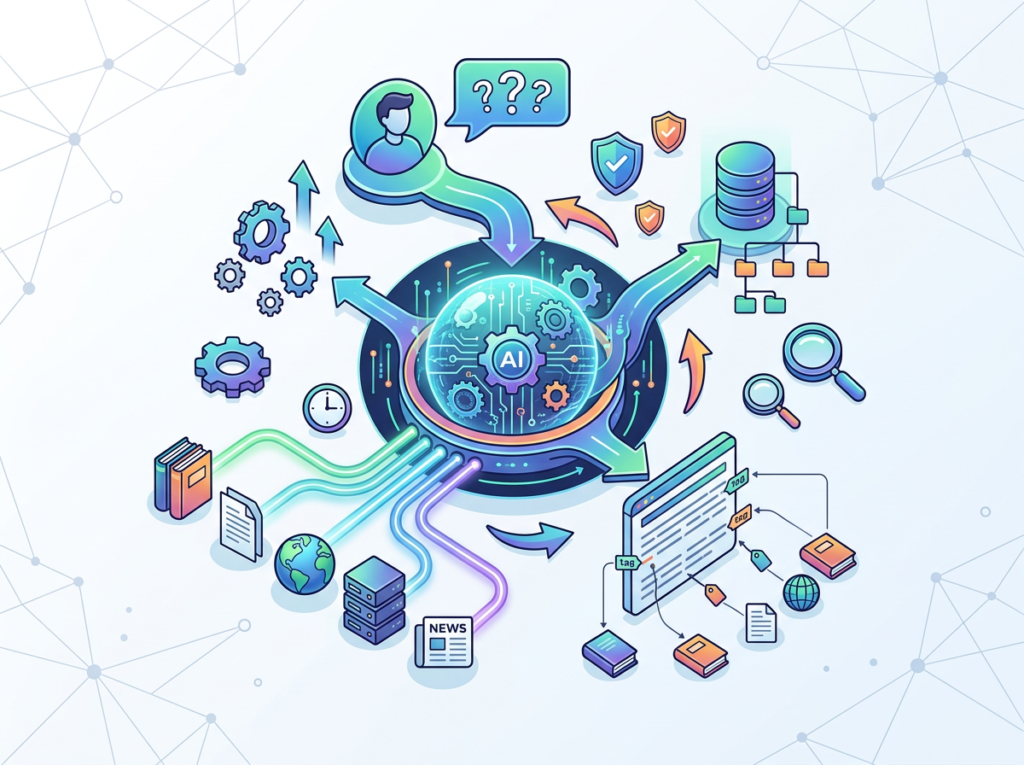
Don’t try to replace every research habit at once. Pick the single research task you do most frequently — competitive monitoring, client background checks, regulatory updates, technical documentation — and route it exclusively through Perplexity for two weeks. Build a template query you refine over time. Get comfortable with the follow-up conversation mechanics before expanding.
Starting focused means you’ll notice the efficiency gains clearly, which builds the internal momentum to expand the system further.
Practice 2: Always Verify Citations Before Acting
Perplexity is dramatically more reliable than a generic AI chatbot because it cites its sources — but that doesn’t mean every answer is accurate. Perplexity’s own practical tips for getting better results reinforce this point: the tool is designed to assist human judgment, not bypass it. AI systems can still hallucinate or surface outdated source material. For any claim that will influence a business decision, client deliverable, or public communication, click through to the cited source and verify the specific claim directly.
Think of Perplexity’s output as a high-quality first draft of your research landscape, not a final authority. The tool dramatically accelerates the path to a reliable answer — it doesn’t eliminate the need to exercise judgment at the end.
Practice 3: Avoid Tool Overload
Many small business owners who try to fix their productivity problem end up with a different problem: too many subscriptions solving overlapping problems. Before adding Perplexity to an existing stack, audit what you’re already paying for. If you’re currently subscribing to a news aggregator ($15/month), a research summarizer ($20/month), and a browser extension for AI search ($10/month), Perplexity Pro ($20/month) likely replaces all three and does it better.
Tool bloat at $129/month across fragmented research tools consolidates to $20/month with a single well-chosen platform. That’s $1,308 saved annually before counting any time savings.
Limitations and Considerations

Where Perplexity Is NOT the Right Tool
High-Stakes Original Analysis: Perplexity synthesizes what already exists on the web. It does not generate original insight, identify non-obvious strategic connections, or replace the judgment of an expert who has spent years in a domain. For deliverables where your value-add is a unique analytical perspective, Perplexity provides raw material — not the finished product.
Legal, Contractual, or Compliance-Critical Documents: Never use Perplexity’s output as the authoritative source for legal obligations, contract terms, or regulatory compliance decisions without independent verification from a licensed professional. The tool can help you understand a regulatory landscape quickly — it cannot replace a compliance attorney or HR specialist for decisions with legal liability attached.
Sensitive Client or Business Information: Perplexity processes queries through external servers. Never enter sensitive client data, proprietary business information, or personally identifiable information into any query. Treat every Perplexity session as if it’s a public conversation when it comes to what information you put in.
Key Risks to Manage
Hallucination: Even with citations, Perplexity can surface inaccurate information, especially for very recent events or highly specialized topics with limited online coverage. The verification habit (Practice 2 above) is non-negotiable.
Over-Reliance: Researchers who outsource all synthesis to AI tools risk atrophying their own ability to read primary sources critically. Maintain direct engagement with primary sources for your core areas of expertise — use Perplexity for peripheral research, not as a replacement for deep domain knowledge.
Recency Gaps: Despite real-time web access, Perplexity’s coverage of very recent events (within the last 24–48 hours) can be inconsistent. For breaking developments, supplement with direct source monitoring.
Try Perplexity free and experience AI-powered search firsthand. Start Free at Perplexity.ai | No credit card required
Frequently Asked Questions

How do freelancers use AI search tools to save time?
The highest-impact use cases for freelancers are: client and competitor background research before new engagements, trend and market synthesis for client deliverables, technical documentation lookups, and regulatory or compliance orientation for specialized fields. Each of these involves pulling from multiple sources simultaneously — exactly where Perplexity’s synthesis capability delivers the most time savings.
Is Perplexity good for small business owners who aren’t technical?
Yes. Perplexity requires no technical setup, no prompting expertise, and no AI background. You type a question the way you’d ask a colleague, read the answer, and ask a follow-up if you need more detail. The interface is simpler than most project management tools. The free plan is functional for casual use; Pro at $20/month is the right choice for anyone who does research as a meaningful part of their weekly workload.
What’s the best ai search engine for research for a US small business owner in 2026?
Perplexity is the strongest general-purpose option because it combines real-time web access, cited sourcing, conversational follow-up, and a free entry tier. For owners who prioritize source verification and want a tool that reduces — rather than bypasses — their critical evaluation process, it’s the right fit. The Pro plan’s access to multiple underlying AI models also provides flexibility as your research needs grow more sophisticated.
Conclusion

The research bottleneck is one of the most expensive invisible costs in a small business — and it’s invisible precisely because it looks like productive work. Tabs open, notes taken, links saved. But when you calculate what an hour of information-gathering overhead actually costs at $50–$150/hour billing rates, the number is uncomfortable.
Perplexity changes the math. As an ai search engine for research, it doesn’t just speed up the retrieval phase — it compresses the entire synthesis process that typically follows retrieval. A research session that used to require an hour of link-chasing, tab-switching, and note-taking now takes ten to twenty minutes when routed through Perplexity. The output is more consistent, the sources are attached, and your judgment can engage earlier and more directly.
That’s AI as augmentation, not replacement. Perplexity handles the information infrastructure; you provide the analysis, the strategy, and the relationships that actually make the work worth paying for.
Start small. Pick one repeatable research task — competitive monitoring, client background checks, regulatory orientation — and run it through Perplexity for two weeks. Track the time. Then decide whether to expand.
For US small business owners and freelancers, the annual ROI on Perplexity Pro is not a rounding error. Across the workflows described in this article, conservative estimates put the time savings at 150–200+ hours per year. At $100/hour billing rates, that’s $15,000–$20,000 in reclaimed capacity on a $200/year investment.
The question isn’t “Should I use an AI search engine for research?” — it’s “Can I afford NOT to?”
Try Perplexity free and experience AI-powered search firsthand. Start Free at Perplexity.ai | No credit card required
Leave a Reply