Your small team’s biggest operational risk isn’t the market — it’s the knowledge trapped in your head that no one else can access.
In 2026, the fastest-growing pain point for US small business founders isn’t finding customers — it’s keeping the team running without constant hand-holding. You hired your second, third, and fifth person to take things off your plate. Instead, you’re fielding the same questions on Slack at 9 PM, watching new hires reinvent workflows you invented two years ago, and realizing that your “systems” are really just habits no one else has learned yet.
This is the operational gap that hits US teams hardest between headcounts of 3 and 15. Knowledge lives in Slack threads. Brand standards exist only in the founder’s memory. New hires from Austin to Chicago take three to six weeks to reach baseline productivity — at US labor rates averaging $65–$90 per hour, that’s $15,000–$25,000 in onboarding drag per hire. And with US labor turnover rates hovering near 47% across service industries, the cycle repeats constantly.
The problem isn’t that your team lacks talent. It’s that your operations lack structure. Corporate enterprises solve this with dedicated operations managers, documentation specialists, and six-figure SOP platforms. US small businesses — the ones running lean, remote-first, multi-state — don’t have those resources.
That’s where AI for team operations changes the equation. And specifically, where Adobe Express enters as something far more useful than a design tool: a system-building ally that lets small US teams create, standardize, and distribute operational knowledge without a single dedicated ops hire.
Unlike traditional documentation approaches — which run $5,000 or more in US labor just to produce a basic onboarding guide — Adobe Express’s AI features allow founder-led teams to build brand-consistent, professionally formatted SOPs, training materials, and internal content in hours. This article breaks down exactly how that works, who it works for, and what the real-dollar ROI looks like for US teams in 2026.
Learn more about Adobe Express and take the first step toward operations that scale without you.
What is Solo DX?

Solo DX — Small-Scale Digital Transformation — is the category of AI adoption designed specifically for US founders and team leads who are scaling operations without a dedicated ops team.
It’s distinct from standard AI productivity use. Most AI content you’ll find online focuses on individual efficiency: write faster, edit quicker, generate more. Solo DX is fundamentally different. The goal isn’t personal output — it’s organizational systemization. You’re not using AI to do your job faster. You’re using AI to build the systems that let your team do their jobs consistently, without you.
Here’s how Solo DX differs from adjacent AI categories:
| Category | Primary User | Goal | Output |
|---|---|---|---|
| AI Efficiency | Individual contributor | Personal productivity | Faster task completion |
| AI Revenue Boost | Sales/marketing teams | More pipeline, more conversions | Revenue metrics |
| Solo DX | Founder / Team Lead | Operational systemization | Repeatable, scalable processes |
| AI Workflows | IT / Ops specialists | Integration automation | Connected tool stacks |
Corporate SOP methods — heavyweight documentation platforms, ISO-compliant process management, dedicated knowledge managers — fail US SMBs for three reasons. First, they’re built for teams of 100+, not 5. Second, they require weeks of implementation time that founder-led teams simply don’t have. Third, they produce documents no one actually uses because they’re formatted for compliance, not usability.
Solo DX flips that model. Consider a 3-person design studio in Austin. The founder, creative lead, and account manager each know their role — but when the account manager leaves and a replacement joins, two months of institutional knowledge walks out the door. A Solo DX implementation using a tool like Adobe Express turns that institutional knowledge into a branded, visual onboarding guide, a client communication template library, and a project kickoff SOP — all produced in under a week, all maintained in one place, all accessible to anyone on the team from day one.
That’s not enterprise ops. That’s small-scale digital transformation — and in 2026, it’s the single highest-ROI investment a US small team can make.
Learn more about Adobe Express and take the first step toward operations that scale without you.
Why AI is Key for Mini-Team Systemization
Problem 1: Knowledge lives only in the founder’s head.
In most US small businesses, the founder is the system. They know the client intake process because they built it. They know the brand voice because it’s their voice. They know the exception to every rule because they made the rules. When that knowledge isn’t documented, every delegation creates a quality gap. AI-assisted documentation tools can extract, structure, and format that knowledge in a fraction of the time manual documentation requires — and in a format the team can actually use.
Problem 2: New hires slow down operations instead of accelerating them.
US labor turnover sits near 47% across service sectors. Every new hire costs the team 3–6 weeks of reduced productivity while they learn unwritten rules. At US labor rates of $65–$90 per hour, a single new hire’s onboarding drag costs $15,000–$25,000 before they hit baseline. AI-generated onboarding materials, visual SOPs, and role-specific training content — the kind that Adobe Express produces in hours — cut that ramp time by 40–60% according to operational benchmarks from teams that have implemented structured AI onboarding workflows.
Problem 3: Quality varies across team members.
Without documented standards, quality becomes personality-dependent. Your best team member produces A-level work. Your newest produces C-level work. The gap is rarely talent — it’s access to the institutional knowledge that the A-player has absorbed over months or years. Systematized workflow automation built on AI-generated templates and SOPs closes that gap by making the A-player’s process the team’s default process.
The Cost Reality
Manual systemization — hiring a consultant, running documentation sprints, building a knowledge base from scratch — costs US small businesses $5,000–$15,000 in labor and takes 4–8 weeks. AI-assisted systemization using tools in the Solo DX category costs $0–$54 per month in subscription fees and can produce a fully operational knowledge base in under two weeks. The math isn’t close. For US founders weighing budget constraints against operational chaos, AI for team operations isn’t a nice-to-have in 2026 — it’s the most defensible operational investment available at this team size.
Adobe’s own overview of AI features in Adobe Express outlines the full scope of generative tools now available — from text-to-image generation to AI-assisted layout and content suggestions — all accessible to teams without a dedicated creative hire. What matters for US small teams isn’t any single feature in isolation, but how those features combine into a systemization workflow that replaces ad hoc content creation with repeatable, brand-consistent production at scale.
Learn more about Adobe Express and take the first step toward operations that scale without you.
How Adobe Express Enables Solo DX

Feature 1: AI-Powered Content Generation for SOPs and Training Materials
Adobe Express’s generative AI features allow non-designers to produce professional-quality visual documents — training guides, SOPs, onboarding decks, process maps — in minutes rather than days. For US teams, this means the founder can describe a process in plain language and have a formatted, brand-consistent document ready for team distribution within the hour.
Estimated ROI: A single documentation cycle — producing one comprehensive onboarding guide manually — costs $2,000–$4,000 in US labor (20–40 hours at $65–$90/hour, plus review and formatting time). Adobe Express reduces that cycle to 3–5 hours of active work. Annual savings per documentation cycle: $2,000–$3,500.
Feature 2: Brand Kit and Template Standardization
Adobe Express’s Brand Kit feature allows teams to lock in logos, fonts, colors, and brand standards once — then propagate them across every asset anyone on the team creates. This eliminates the brand drift that plagues growing US small teams as more people start producing client-facing content independently.
For a 5-person US team where each member spends 3 hours per week reformatting content to match brand standards, template standardization saves 15 hours of team labor per week. At $65/hour average labor cost, that’s $50,700 annually in recovered productive time.
Feature 3: AI Text and Visual Generation for Repeatable Content
Adobe Express’s AI generation capabilities extend beyond design to content — generating on-brand copy for recurring content types, producing visual variations for A/B testing, and creating formatted templates for recurring deliverables like client reports, weekly updates, and proposal decks.
For a US marketing or agency team producing 10–15 recurring content pieces per month, AI-assisted template automation saves 2–3 hours per piece in setup and formatting time. At $75/hour average labor cost, that’s $18,000–$33,750 annually across the team.
Explore Adobe Express’s full feature set to see how these capabilities map to your team’s specific operational gaps.
Total Estimated Annual ROI for a 5-Person US Team: $79,700–$102,950
That’s against a subscription cost that ranges from free (Adobe Express Starter) to approximately $54.99/month for the Premium plan — or $659.88 annually. The ROI ratio exceeds 100:1 for teams that implement systematically.
It’s worth noting that the ROI calculation above assumes conservative adoption — one team member using each feature category. Teams that fully embed Adobe Express into their operational workflow, using shared workspaces, brand kits, and template libraries across all five team members, regularly report ROI multiples in the 150:1 to 200:1 range against subscription costs. The variable isn’t the tool’s capability. It’s implementation depth: teams that treat Adobe Express as a systemization platform rather than a design app get dramatically more value than teams that use it only for occasional graphics.
Ready to systemize your US team operations in under a week? Try Adobe Express Free | No credit card required | Trusted by 10,000+ US teams
Use Cases by Team Role
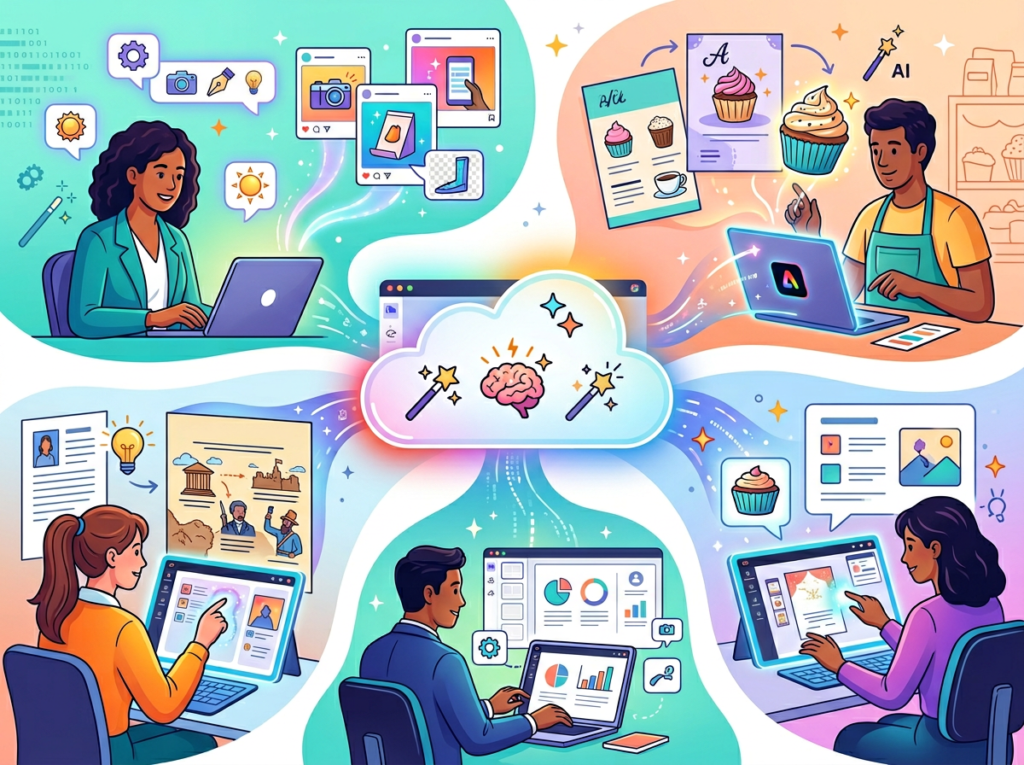
Persona 1: US Startup Founder Juggling 3 Departments Maria, San Francisco | 7-person SaaS startup
Old workflow: Maria personally reviewed every piece of client-facing content before it went out — pitch decks, proposal templates, onboarding emails. With three departments now reporting to her, this review process consumed 12+ hours per week and created a bottleneck that delayed client deliveries by 2–3 days.
AI-powered workflow: Maria used Adobe Express to build a locked brand kit and master template library covering every recurring content type — proposals, onboarding decks, client update reports, social proof one-pagers. Team members now work from approved templates with brand standards built in. Maria’s review time dropped from 12 hours per week to under 2 hours.
Quantified results: 10 hours of founder time recovered per week × $150/hour opportunity cost × 50 weeks = $75,000 annually in founder time recovered. Client delivery delays eliminated, reducing churn risk on 3 accounts worth $8,000 MRR combined.
“I went from being the brand police to trusting my team completely. The templates do the work I was doing manually.” — Maria, SF
Persona 2: Executive Assistant Onboarding Remote Staff James, Miami | 12-person professional services firm
Old workflow: James managed onboarding for new remote hires across four states. Each onboarding involved 8–10 hours of manual document assembly — pulling policy docs from Google Drive, formatting role-specific guides in Word, compiling tool access instructions. For a firm with 4–6 new hires per year, this consumed 40–60 hours of EA time annually.
AI-powered workflow: James built a modular onboarding system in Adobe Express — role-specific onboarding decks, visual process guides for each department, and a standardized first-week schedule template. New hire onboarding assembly dropped from 8–10 hours to under 90 minutes per hire. As noted in this breakdown of Adobe Express’s AI capabilities, the platform’s AI generation tools significantly reduce production time for recurring formatted content.
Quantified results: 7.5 hours saved per hire × 5 hires per year × $65/hour = $2,437.50 annually in direct labor savings. New hire ramp time reduced from 5 weeks to 3 weeks, recovering 80 hours of productive team time per hire = $5,200 per hire in recovered productivity.
“Our new hires now show up day one knowing exactly what to do. The onboarding deck answers every question before it’s asked.” — James, Miami
Persona 3: Trainer Documenting Internal Knowledge Robert, New York City | 6-person e-learning development studio
Old workflow: Robert was the sole keeper of the studio’s production process — video scripting standards, client feedback protocols, QA checklists. When a new contractor joined, Robert spent 6–8 hours in live knowledge transfer sessions. With 6–8 new contractors onboarded per year, this consumed 48–64 hours of senior staff time annually.
AI-powered workflow: Robert built a visual knowledge base in Adobe Express — illustrated process guides, annotated workflow diagrams, QA checklists with visual callouts. Live knowledge transfer sessions dropped from 6–8 hours to a 90-minute orientation using the prepared materials. As this analysis of effective AI prompting in Adobe Express demonstrates, structured AI prompting dramatically accelerates production of complex educational and process content.
Quantified results: 5.5 hours saved per contractor onboarding × 7 contractors per year × $95/hour senior rate = $3,657.50 annually in direct savings. Knowledge base now serves as a living asset that continues generating value across all future hires.
“I built the documentation once. Now it runs the onboarding for me.” — Robert, NYC
See how Adobe Express works for your team type and find the workflow that maps to your biggest operational bottleneck.
Join 10,000+ US small teams using Adobe Express to eliminate operational chaos. See How It Works | Used by teams from Silicon Valley to New York
Common Pitfalls & How to Avoid Them
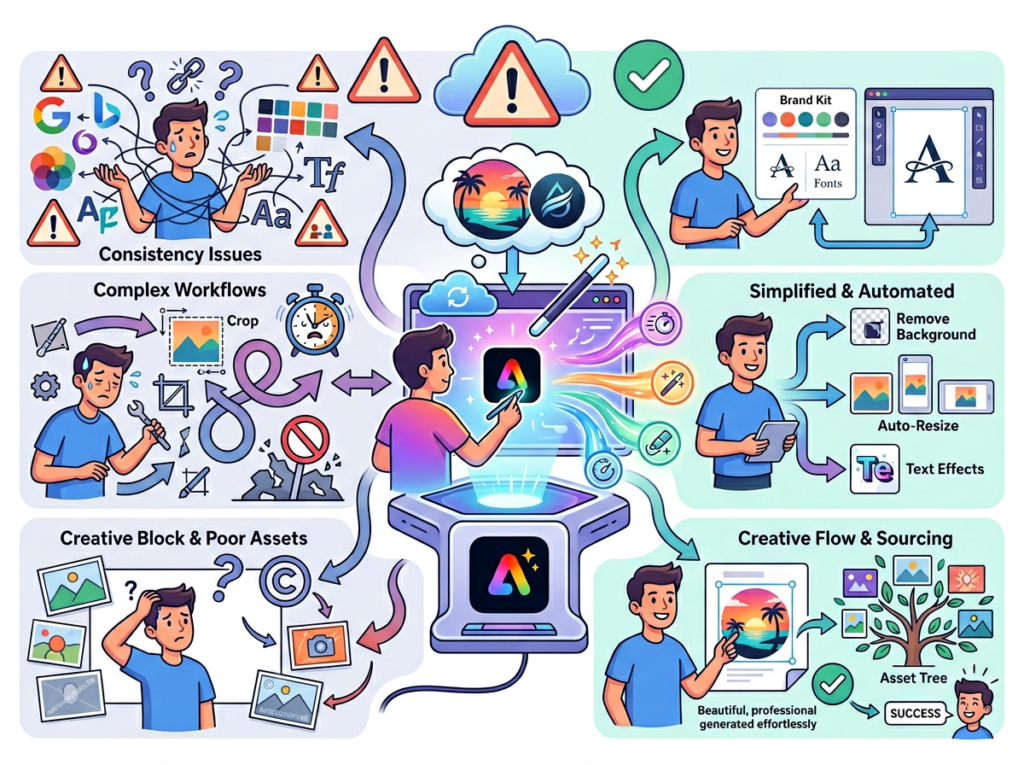
Mistake 1: Using too many disconnected tools.
The most common Solo DX failure pattern is tool sprawl — design in Canva, docs in Notion, brand assets in Dropbox, SOPs in Google Docs. Each tool in isolation creates value. Together, they create coordination overhead that cancels the efficiency gains. Adobe Express consolidates design, content creation, brand management, and collaborative asset storage in one platform. Before adding any new tool to your stack, map whether it can be absorbed into a platform you already use.
Mistake 2: Delegating without documentation.
Delegation without documentation is just delayed chaos. “Show, don’t tell” onboarding — where a senior team member demonstrates a process once and assumes the new hire absorbed it — is the primary driver of quality inconsistency in US small teams. Every delegation should be paired with a documented process. The detailed breakdown of Adobe Express shows how quickly professional-quality process documentation can be produced, removing the “it takes too long” objection from the delegation equation.
Mistake 3: Failing to review AI output.
AI-generated content is a starting point, not a finished product. US teams that publish AI-generated SOPs or training materials without human review accumulate small inaccuracies that compound over time — wrong process steps, outdated tool references, tone mismatches. Build a lightweight review step into every AI-assisted documentation workflow. 15 minutes of review per document prevents weeks of confusion downstream.
Learn more about Adobe Express and take the first step toward operations that scale without you.
FAQs

What is Solo DX?
Solo DX stands for Small-Scale Digital Transformation. It’s the practice of using AI tools to build operational systems — SOPs, training materials, workflow templates, knowledge bases — in small US businesses without dedicated ops staff. The goal is organizational systemization, not individual productivity.
Can small teams afford to use AI?
Adobe Express has a free tier that covers basic design and content generation. The Premium plan runs approximately $9.99–$19.99 per user per month. For context, the average US small team implementing Adobe Express for systemization recovers $79,000–$103,000 in annual operational value — against a subscription cost under $1,200/year for a 5-person team. The affordability question inverts quickly when framed against actual ROI.
Is Adobe Express hard to set up?
No. Adobe Express is designed for non-technical users. A founder with no design background can have a Brand Kit configured, a first template built, and the shared workspace active within 2–3 hours. Most US teams report reaching operational capability — where the team is actively using templates and the shared workspace — within the first week.
Conclusion
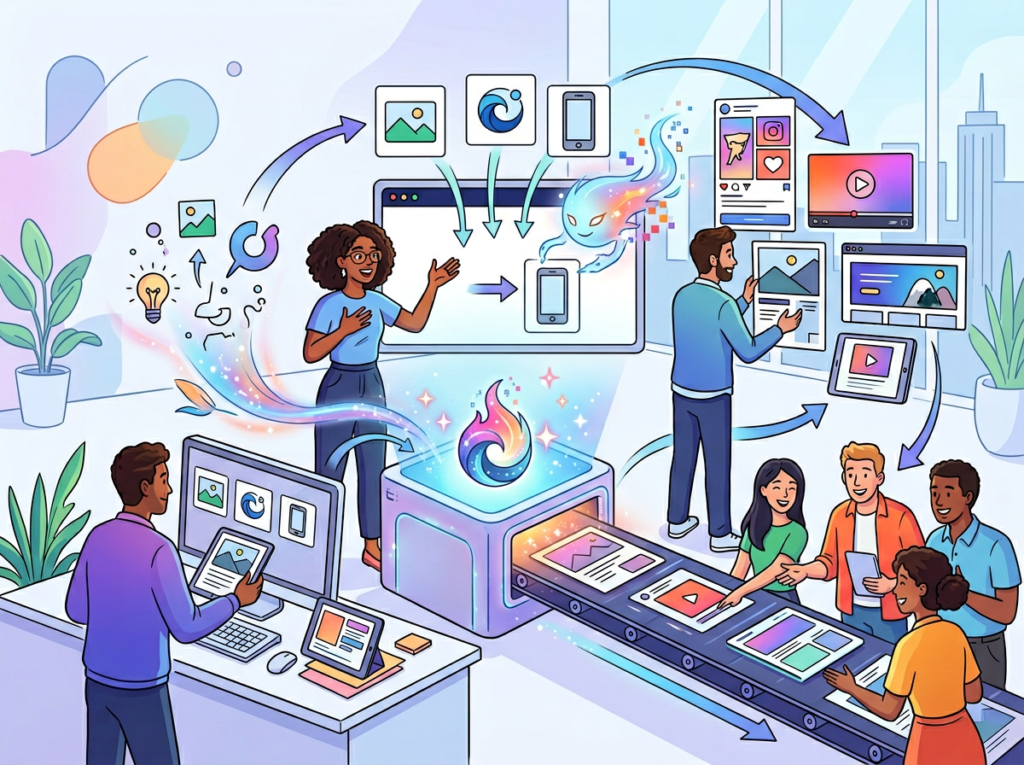
In 2026, American small businesses don’t need enterprise budgets to build enterprise-level operational systems. The tools exist. The ROI is documented. The implementation timeline is measured in days, not quarters.
The Solo DX approach — using AI for team operations to build repeatable, scalable workflows without a dedicated ops hire — is the highest-leverage investment available to US founders managing teams of 3–15 people. Adobe Express makes that approach accessible by combining AI content generation, brand standardization, and collaborative asset management in one platform that non-technical teams can implement immediately.
The founder who systemizes wins. Not because they work harder — but because their team can work consistently without them at the center of every decision. The personas in this guide — Maria in San Francisco, James in Miami, Aisha running her agency, Robert documenting studio knowledge in New York — aren’t outliers. They represent the majority of US small business founders who discovered that their team’s performance ceiling was set by the quality of their systems, not the quality of their people.
Start with one process. Pick the one that creates the most bottleneck or quality variance in your team right now — maybe it’s client onboarding, maybe it’s recurring reporting, maybe it’s brand consistency across deliverables. Systemize it this week using the workflows described in this guide. Once that first process is documented and running without you, move to the next one. Solo DX isn’t a one-time project. It’s an operating philosophy that compounds.
Learn more about Adobe Express and take the first step toward operations that scale without you.
Leave a Reply