An AI logo maker for small business can cut branding costs by 95% — without sacrificing the professionalism your brand needs to compete.
In 2026, American freelancers and solo founders face a branding paradox that no one talks about honestly. You know your business needs a strong visual identity — a logo that communicates credibility from the first glance, a mark that works on your website, your invoices, your social profiles, and a business card you’re not embarrassed to hand out. But professional logo design from a freelance designer costs $500 to $2,500. A branding agency will start at $5,000 and climb from there. And the time cost is just as steep: back-and-forth revision cycles that drag three to six weeks while your launch stalls.
Meanwhile, you’re billing $75 an hour as a consultant, $100 an hour as a copywriter, or hustling to move units in your Etsy or Shopify store. Every hour you spend hunting for the right visual direction, interpreting design briefs you barely understand, and waiting on revision turnarounds is an hour of real money left on the table.
This is where the ai logo maker for small business category has quietly become one of the highest-ROI AI efficiency tools available today. Not because these tools replace great design — they don’t, and we’ll be honest about that — but because for the majority of solo entrepreneurs, they deliver 90% of the outcome at 5% of the cost and 10% of the time.
LogoAI is one of the most established platforms in this space, helping hundreds of thousands of founders create professional logos without design experience or agency budgets.
For US freelancers and solo entrepreneurs, the math is stark: if you bill $75/hour and a traditional logo project consumes 20 hours of your time, you’ve burned $1,500 in opportunity cost before paying the designer’s invoice. LogoAI compresses that to under an hour of active engagement and a one-time cost under $100.
In this article, you’ll get four specific workflows for using AI branding tools to build a professional visual identity this week — each one mapped to a real business type with before-and-after time comparisons and quantified ROI.
To see these features in action with detailed workflow examples, see our full LogoAI review.
Key Concepts of AI Efficiency

Concept 1: Cognitive Offloading in Creative Work
Cognitive offloading is the practice of externalizing mental work to a tool, system, or environment — freeing your brain to focus on what only you can do. In creative tasks like logo design, cognitive load is enormous even for non-designers. You’re simultaneously making aesthetic judgments you’re not trained to make, translating brand values into visual decisions you can’t fully articulate, and evaluating dozens of options without a clear framework.
AI logo generators offload the generative phase entirely. Instead of staring at a blank canvas or a designer’s first draft wondering whether something “feels right,” you’re reacting to dozens of generated options in seconds. Reaction is cognitively cheaper than creation. Your brain moves from creator to curator — a much lower-effort mode that paradoxically produces better outcomes because you’re working with your instincts rather than against them.
Consider Sarah, a freelance UX designer in Denver who launched her own consultancy in 2026. Before AI branding tools, she spent 8 hours over three weeks briefing a designer and managing revisions. With an ai logo maker for small business, she generated 40+ concepts in 20 minutes and had final files the same afternoon. Net time saved: 7+ hours. At $110/hour, that’s $770 in recaptured earning capacity from the logo phase alone.
For advanced cognitive offloading strategies applied across your full branding workflow, explore LogoAI in detail.
Concept 2: Context Switching Cost in Early-Stage Business Building
Research consistently shows that the average knowledge worker takes approximately 23 minutes to fully regain focus after an interruption. For solo entrepreneurs in the early stages of a business launch, branding tasks are interruption generators. Every time you need to jump from product development or sales to creative feedback and design decisions, you’re paying that 23-minute tax — often multiple times a day.
Traditional logo projects drag this out over weeks. You receive a draft at 2pm, spend the afternoon in a low-grade distraction loop, draft feedback, second-guess it, and finally send a revision note at 5pm. The next morning you’re back in reactive mode.
Marcus, a solo management consultant in Dallas, tracked his distraction and context-switching overhead during a traditional logo project: approximately 5 hours lost across three weeks, none of it billable. Switching to an AI branding workflow compressed the same process into a single 90-minute session. He recaptured those 5 hours at $125/hour: $625 back in one project.
Concept 3: Workflow Orchestration — AI as Brand Foundation Layer
Workflow orchestration is the concept of using AI not for isolated tasks but as a connective layer that unlocks downstream efficiency. In the context of branding for small business, your logo is not just an aesthetic asset — it’s the foundation for every subsequent brand touchpoint: your website color palette, your social media templates, your email signature, your product packaging.
When you establish your brand identity quickly and cheaply through an AI logo maker, you unlock that entire downstream chain faster. Elena, a Seattle-based e-commerce owner selling handmade ceramics, had delayed her website launch for two months because she couldn’t finalize her logo. Once she used an AI branding tool to settle on a direction in a single afternoon, she was able to commission Canva templates, configure her Shopify theme colors, and launch her site — all within the same week. The logo wasn’t just a time save in isolation; it unblocked 4+ weeks of downstream work.
As noted in this breakdown of the AI logo creation workflow, the key to getting a brand-ready result from an AI logo maker is treating the tool as a production engine rather than a template picker — prioritizing vector exports, editing precision, and format versatility.
To see these features in action with detailed workflow examples, see our full LogoAI review.
How LogoAI Helps Efficiency
Feature 1: AI-Powered Logo Generation
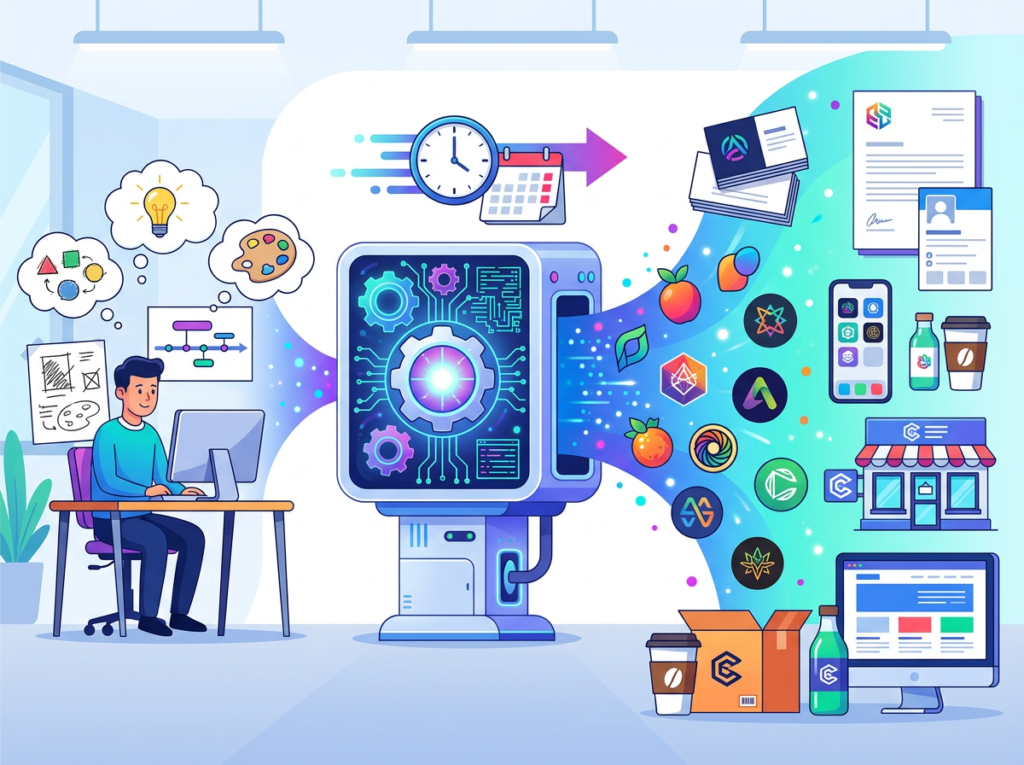
LogoAI’s core engine generates logo concepts based on your business name, industry, style preferences, and color direction. Within seconds you have dozens of distinct, customized logo options — not generic stock templates, but AI-generated compositions matched to your inputs.
A traditional designer discovery process consumes 8 to 12 hours before you see a single concept. LogoAI compresses this to under 10 minutes.
Annual time saved: 10–15 hours per logo project = $750–$2,250 in opportunity cost at $75–$150/hour.
Feature 2: In-Browser Logo Editor with Full Customization
LogoAI’s editor lets you adjust colors, swap fonts, resize elements, and change icons — all in-browser, no Illustrator or Photoshop required. Each traditional revision round requires a brief, a wait, and a review session. In LogoAI, you make changes in real time.
Annual time saved: 5–8 hours per project in revision cycles = $375–$1,200 recaptured.
Feature 3: Brand Identity Kit Generation
LogoAI extends beyond the logo to generate business card mockups, social media header templates, email signature formats, and brand guidelines with your color codes and font specs — a complete kit you download in minutes rather than build manually in Canva over hours.
Annual time saved: 8–12 hours in brand asset creation = $600–$1,800 recaptured.
Combined ROI: At under $100 for a basic plan, LogoAI replaces 26–40 hours of branding work — worth $1,950–$6,000 in opportunity cost at US freelance rates. That’s a 20x to 60x return on a single use.
To see these features in action with detailed workflow examples, see our full LogoAI review.
Ready to cut your branding timeline from weeks to hours?Try LogoAI free and launch your visual identity today. Start Free at LogoAI | No design experience required
Best Practices for Implementing AI Efficiency
1. Start With a One-Sentence Brand Brief
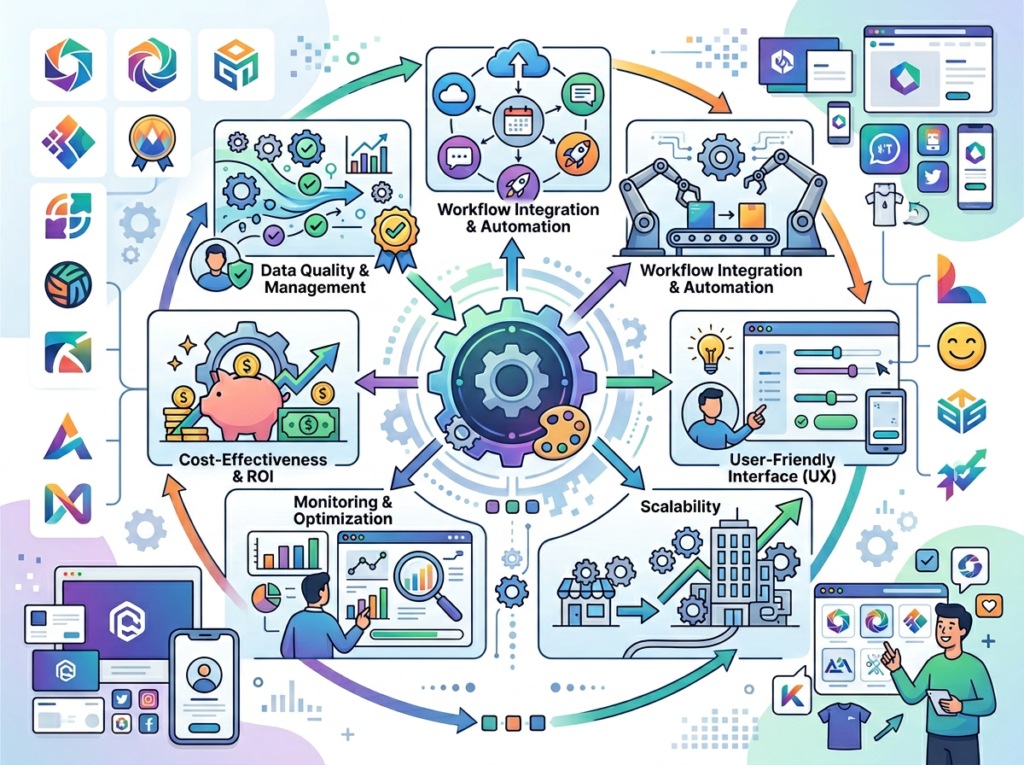
Before you open LogoAI, write two sentences: one describing what your business does and who it serves, and one describing the feeling your brand should communicate. This takes five minutes and dramatically improves the quality of the concepts the AI generates.
Bad input: “I sell wellness products.”
Good input: “I sell organic skincare for millennial women who want clean ingredients without clinical packaging. The feeling should be warm, earthy, and confident.”
The AI uses your style and industry inputs to filter its generation. Better inputs produce better outputs. Skip this step, and you’ll spend 20 minutes sorting through misaligned concepts instead of 5 minutes landing on a direction.
2. Use the AI as a Direction Generator, Not a Final Arbiter
The highest-value use of an AI logo maker isn’t to download the first thing that looks good — it’s to rapidly identify which visual direction resonates with you before committing. Generate multiple concept families, screenshot your favorites, and look at them together before starting any customization. Your gut reaction to seeing three or four directions side-by-side is more reliable than your reaction to seeing them one at a time.
This curatorial mindset keeps you in control of the creative outcome while letting the AI handle the generative labor.
3. Avoid Stacking Multiple Branding Tools
A common trap for solo entrepreneurs is subscribing to multiple branding platforms simultaneously — a logo tool here, a color palette generator there, a font pairing service somewhere else. Tool bloat is real: a stack of $20–$40/month subscriptions adds up to $120–$200/month for overlapping functionality. LogoAI’s brand kit handles logos, color specifications, font pairings, and social media templates in one platform. Start with one comprehensive tool before adding others.
Limitations and Considerations
Where AI Logo Makers Are NOT Ideal
1. Highly differentiated or category-defining brands
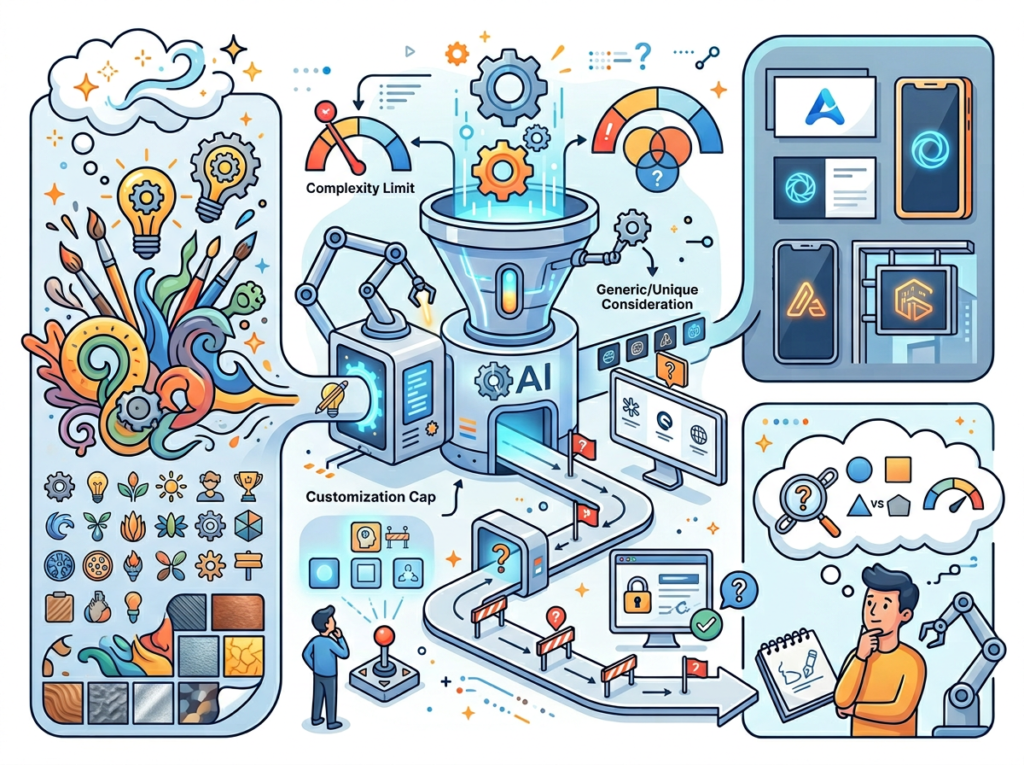
If you’re building a brand where visual identity is a primary competitive advantage — a luxury goods company, a high-end creative agency, a consumer brand targeting design-literate audiences — AI logo tools may not produce the level of originality that differentiates you. Professional designers bring cultural context, trend awareness, and conceptual thinking that AI generation currently doesn’t replicate at the highest levels.
2. Trademark-sensitive categories
AI-generated logos, particularly icon elements, can inadvertently produce marks that resemble existing registered trademarks. If you’re operating in a high-stakes industry where logo confusion carries legal risk — pharmaceuticals, financial services, established consumer brands — invest in a professional designer who includes trademark screening in their workflow.
3. Mascots and complex custom illustration
LogoAI and similar platforms handle wordmarks, lettermarks, and abstract icon marks well. Complex illustrated mascots — the kind of character-driven branding used by sports teams, food brands, and gaming companies — remain better served by skilled illustrators.
Key risks to manage:
- Hallucination equivalents in design: AI generators occasionally produce icons that look great at thumbnail size but contain distorted details at full resolution. Always zoom to 100% and review your chosen concept carefully before downloading.
- Platform dependency: You own the files you download, but the design lives in a cloud platform. Export your SVG source file and back it up locally.
- Over-reliance and brand consistency: A logo is a starting point, not a complete brand system. Complement it with consistent application guidelines — even a simple one-page document — to maintain visual coherence as your business grows.
The LogoAI blog’s own guidance on startup logo creation is transparent that the tool is designed for speed and accessibility — understanding this positioning helps you apply it appropriately in your business context.
To see these features in action with detailed workflow examples, see our full LogoAI review.
Frequently Asked Questions

How do freelancers use AI branding tools to save time?
Freelancers use AI logo makers to eliminate the three biggest time sinks in the traditional branding process: the search-and-brief phase (finding and briefing a designer), the revision cycle (multiple rounds of back-and-forth feedback), and the file coordination phase (getting the right formats in the right sizes). By handling all three in a single self-directed session — typically 60 to 90 minutes — freelancers recapture 10 to 20 hours that would otherwise be lost to process overhead on a traditional project.
What’s the best AI logo maker for small business in 2026?
LogoAI is one of the most established and full-featured platforms in this category, offering AI-powered generation, a comprehensive in-browser editor, multi-format export, and a brand identity kit that includes social media templates, business card mockups, and brand guidelines. It’s particularly well-suited for US small businesses that need a complete, production-ready brand identity package rather than just a logo file. Other platforms in this space include Looka and Wix Logo Maker, but LogoAI’s combination of generation quality and brand kit depth makes it a strong default choice for solo entrepreneurs.
Do I need any design or technical skills to use an AI logo maker?
No. AI logo makers like LogoAI are explicitly designed for users with zero design experience. The entire workflow — from entering your business details to downloading final files — requires only the ability to recognize what looks good to you and make basic preference selections (colors, fonts, layouts). No design software, no technical knowledge, and no creative background required. If you can use a website and trust your own aesthetic instincts, you can produce a professional logo.
Conclusion
The gap between “scrappy bootstrap brand” and “professional visual identity” has never been smaller for US small businesses. AI logo makers — and LogoAI specifically — have made it possible for any solo founder, freelancer, or small business owner to build a brand that looks credible, communicates professionalism, and works across every digital touchpoint in a single afternoon.
This is what ai logo maker for small business efficiency actually means in practice: not cutting corners, but eliminating process waste. The weeks of briefing, waiting, revising, and coordinating that traditional logo projects require aren’t adding value to your brand — they’re just overhead. AI removes that overhead while leaving the creative judgment where it belongs: with you.
The ROI is concrete. At a one-time cost under $100 and a time investment under two hours, LogoAI delivers an outcome that would cost $500–$2,500 and 20+ hours through a traditional process. For US freelancers billing $75–$150/hour, that’s a 20x to 60x return on a single project — and the brand foundation it creates unlocks downstream efficiency across your entire digital presence.
AI is not replacing your creative vision. It’s removing the friction between having a vision and expressing it. The most successful solo entrepreneurs in 2026 aren’t the ones who resist that shift — they’re the ones who adopt it strategically, stay clear-eyed about its limits, and reclaim the hours to do the work that actually requires them.
The question isn’t “Should I use an AI logo maker for small business?” — it’s “Can I afford NOT to?”
To see these features in action with detailed workflow examples, see our full LogoAI review.
Leave a Reply