
Small teams that treat social media as an afterthought are losing ground — AI for social media management is now the fastest way to close that gap.
In 2026, American small businesses are drowning in social media obligations they were never staffed to handle. A founding team of four manages Instagram stories before morning standups. A marketing coordinator in Denver juggles LinkedIn posts, community replies, and performance reports — alone. An operations lead in Chicago is supposed to be building systems, but spends Tuesday afternoons manually scheduling content for five different platforms.
This is the reality of social media at the small-team level: not chaotic creativity, but chaotic logistics. Knowledge lives in Slack threads. Posting schedules live in someone’s head. Analytics reports get summarized in email because nobody has access to the platform. New hires take weeks just to understand the content calendar, and by then it’s already outdated.
The US small business market is facing a unique squeeze in 2026. Consumer expectations for social media responsiveness have risen sharply while hiring budgets have stayed flat. According to US labor market data, the average annual cost of a full-time social media manager now exceeds $68,000 — a figure most 5-to-10 person teams simply cannot justify. Yet falling silent on social costs even more in lost visibility and revenue.
That’s where Sprout Social AI enters the picture. Built for teams that need enterprise-grade social media intelligence without enterprise-level headcount, Sprout Social AI functions as a system-building ally — not just another scheduling tool. With its Trellis AI Agent now fully integrated across the platform, small teams can automate content creation, scheduling, analytics, and audience insights using plain-language queries and AI-powered workflows.
Traditional social media management methods cost US small businesses $5,000 or more in labor just to set up repeatable content systems. AI-assisted approaches like Sprout Social AI compress that to a few hours of configuration and a subscription that starts at $199 per month. This guide shows exactly how US small teams can use Sprout Social AI to replace manual social media chaos with repeatable, scalable workflows — without adding headcount.
See the full Sprout Social AI review and feature breakdown before you start, so you configure the platform for your team’s specific workflow from day one.
What is Solo DX?
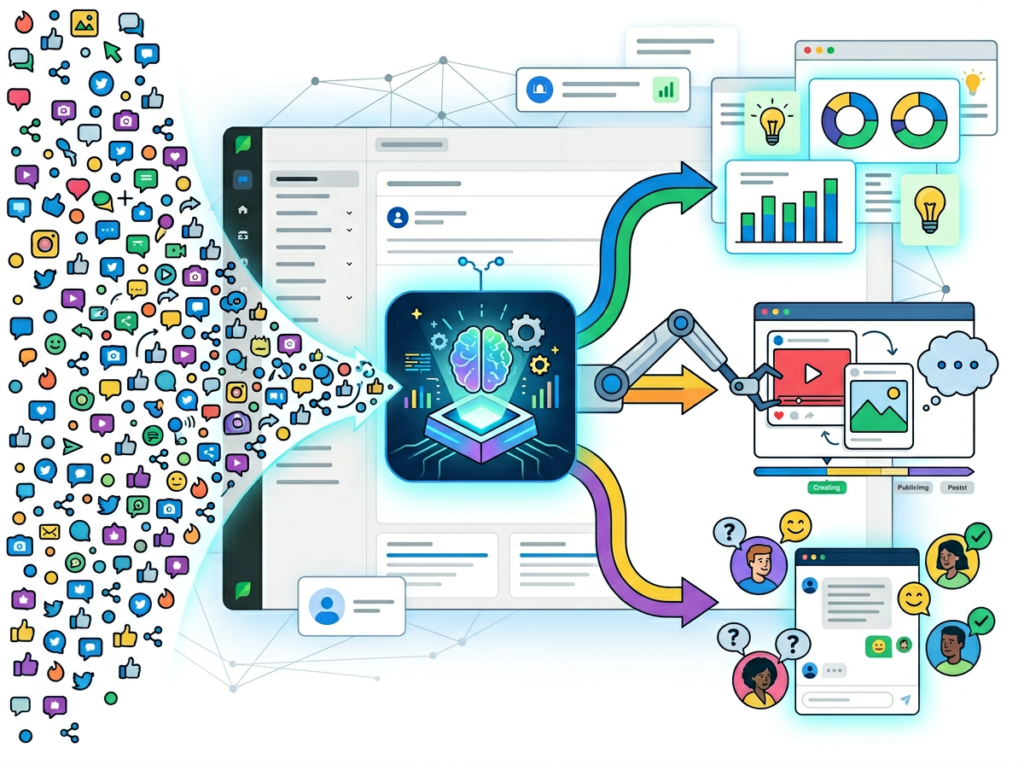
Solo DX — short for Small-Scale Digital Transformation — describes the process by which US founders and small team leaders systematically replace founder-dependent, manual workflows with AI-powered, repeatable systems. It is not a technology trend. It is an operational survival strategy for American businesses scaling from 1 to 15 people without the benefit of a dedicated operations team.
Solo DX sits in a distinct category from general AI efficiency work. Here is how the three major categories compare:
| Category | Who It’s For | Primary Goal | Outcome |
|---|---|---|---|
| AI Efficiency | Solo operators, freelancers | Personal productivity | Do more in less time |
| Solo DX | Founders leading small teams | Operational systemization | Build repeatable workflows |
| AI Revenue Boost | Growth-stage teams | Revenue generation | Directly increase sales |
Corporate SOP methodologies — the kind taught in business school and deployed at Fortune 500 companies — fail at the small business level for a simple reason: they require dedicated process owners, change management budgets, and months of rollout time. A 4-person design studio in Austin doesn’t have a Chief Operating Officer. They have a founder who is also the lead designer, the sales team, and the client liaison. Standard documentation playbooks were built for organizations that look nothing like theirs.
Solo DX works differently. It focuses on capturing the three to five highest-leverage workflows — the ones that break down most often when a new hire joins or a founder takes a vacation — and building AI-powered systems around them. For social media, those workflows are: content ideation and drafting, scheduling and publishing, audience engagement, and analytics reporting.
Consider a 3-person brand consultancy in Austin, Texas. Before implementing Solo DX principles, their Instagram content lived entirely in the founder’s head. When she hired a part-time social media assistant, onboarding took three weeks because there was no documented voice guide, no content calendar template, and no analytics baseline. After deploying Sprout Social AI and restructuring around Solo DX workflows, that same onboarding took four days. The AI-generated content drafts matched the brand voice. The scheduling templates were already built. The Trellis agent could answer questions about top-performing post formats on demand.
Explore Sprout Social AI’s features to see how the platform maps directly to Solo DX implementation at the small business level.
Why AI is Key for Mini-Team Systemization

Problem 1: Social media knowledge lives only in the founder’s head
In most small businesses, the person who built the brand voice is also the person who cannot afford to be bottlenecked by content approvals. Yet that is exactly what happens when social media systems are undocumented. Every post goes through the founder for tone check. Every new caption requires a briefing on what the brand “sounds like.” The AI solution: a platform like Sprout Social AI that stores brand voice parameters, generates on-brand copy using AI Assist, and learns what resonates through engagement data — so the founder’s judgment is captured in the system, not just in their head.
Problem 2: New hires slow down operations, not speed them up
US labor turnover reached 47% annually across industries including marketing and communications roles. Every time a social media coordinator leaves, their institutional knowledge — the posting schedule logic, the hashtag strategy, the engagement response templates — walks out with them. Small teams pay an average of $4,800 in replacement and onboarding costs per marketing hire, not counting the three-to-six weeks of lost productivity during ramp-up. AI-powered scheduling tools and documented content workflows mean a new hire can be operational within days, not weeks.
Problem 3: Content quality varies wildly across team members
When social media is a shared responsibility — split between a founder, a part-time coordinator, and whoever has a free hour on Thursday — the result is inconsistent. Different tones, different hashtag approaches, different post frequencies. Audiences notice. Engagement drops. AI social media automation tools like Sprout Social solve this by giving every team member access to the same AI-generated templates, the same Optimal Send Times recommendations, and the same brand voice guardrails.
See the full Sprout Social AI review and feature breakdown before you start, so you configure the platform for your team’s specific workflow from day one.
How Sprout Social AI Enables Solo DX

Feature 1: AI Assist for Content Creation, $2,000+ saved per content cycle
Sprout’s AI Assist feature generates post copy for any connected social network using brand voice parameters and historical performance data. A small team that previously spent 6–8 hours per week drafting content can reduce that to 90 minutes of review and approval. At a conservative internal cost of $65 per hour, that is a savings of $292 per week, or approximately $15,000 annually. For teams that outsource content creation at $1,500–$2,000 per month to freelancers, AI Assist allows that work to be brought in-house with no quality degradation — saving $18,000–$24,000 per year.
The tool generates captions, hashtags, and post variations across LinkedIn, Instagram, Facebook, X, and TikTok from a single prompt. Founders who previously reviewed every post before publishing can now set brand voice guardrails and approve in batches — cutting approval time by an estimated 60%.
Feature 2: Trellis AI Agent for Analytics to $9,000+ saved annually
Trellis is Sprout’s proprietary AI Agent, launched in late 2025 and expanded significantly in Q1 2026 with the Trellis Monitoring Agent for real-time reputation management. Where traditional analytics require a team member to log in, pull reports, cross-reference platforms, and compile a summary — a process that takes 6–10 hours per week — Trellis responds to plain-language questions instantly.
A small business owner can ask: “What were our top three performing posts this month and why did they outperform?” Trellis queries billions of social data points and returns a structured, actionable answer in seconds. As noted in Sprout’s Trellis AI Agent best practices documentation, good prompts include clear goals, timeframe context, and requests for actionable next steps — not just raw data.
For a 5-person team paying $75 per hour blended rate for marketing labor, eliminating 6 hours of weekly analytics work saves approximately $23,400 per year. Even at reduced utilization — say, 3 hours saved per week — that is $11,700 annually. Trellis also functions as an always-on monitoring agent, surfacing sentiment spikes and emerging complaints before they become crises.
Feature 3: Smart Inbox and Engagement Automation to $6,000+ saved annually
Sprout’s Smart Inbox consolidates all social messages — comments, DMs, mentions, reviews — into a single prioritized stream. Rule-based automation routes messages by keyword, follower count, language, topic, and urgency. For a small team managing four or five social platforms simultaneously, this eliminates the daily scavenger hunt across native apps and reduces response time dramatically. According to third-party analysis, platforms using Sprout’s inbox management tools have reduced average response times from 48 hours to under 10 minutes — a metric that directly impacts customer satisfaction scores.
For a US small business where one team member handles engagement 10 hours per week at $60 per hour, reducing that time by half saves $15,600 annually. Even modest efficiency gains compound quickly at US labor rates.
See how Sprout Social AI works across each of these features, including current pricing and platform integrations available to US small teams.
Ready to systemize your US team’s social media operations in under a week? Try Sprout Social AI | Plans starting at $199/month | Trusted by 30,000+ brands worldwide
Common Pitfalls & How to Avoid Them

Pitfall 1: Using too many disconnected tools
Many small teams arrive at Sprout Social already running Buffer, Canva’s scheduler, native platform schedulers, and a spreadsheet for analytics. Adding Sprout on top without consolidating creates more confusion, not less. The fix: audit every tool you are currently using for social media and identify which ones Sprout replaces entirely. For most teams, Sprout consolidates four to six separate tools into one — reducing context-switching and eliminating duplicate subscription costs.
Pitfall 2: Delegating without documentation
Assigning social media tasks to a team member or contractor without first documenting voice guidelines, approval processes, and content standards guarantees inconsistency. AI tools amplify whatever inputs they receive. If the brand voice is not configured correctly in AI Assist, every generated post will drift from the intended tone. The fix: spend two hours upfront building a brand voice document and entering it into Sprout’s configuration before any content generation begins.
Pitfall 3: Over-relying on Slack and email for social media knowledge
When content decisions, brand guidelines, and approval history live in Slack threads and email chains, they become effectively invisible to anyone who joins later. The fix: use Sprout as the system of record for social media activity. Every decision that affects your content strategy — including why you stopped posting on a given platform or changed your hashtag approach — should be documented in Sprout or an attached knowledge base that Trellis can reference.
Learn more about Sprout Social AI including its workflow configuration options, approval chain setup, and Trellis integration capabilities for US small business teams.
FAQs
What’s the difference between AI Efficiency and Solo DX?
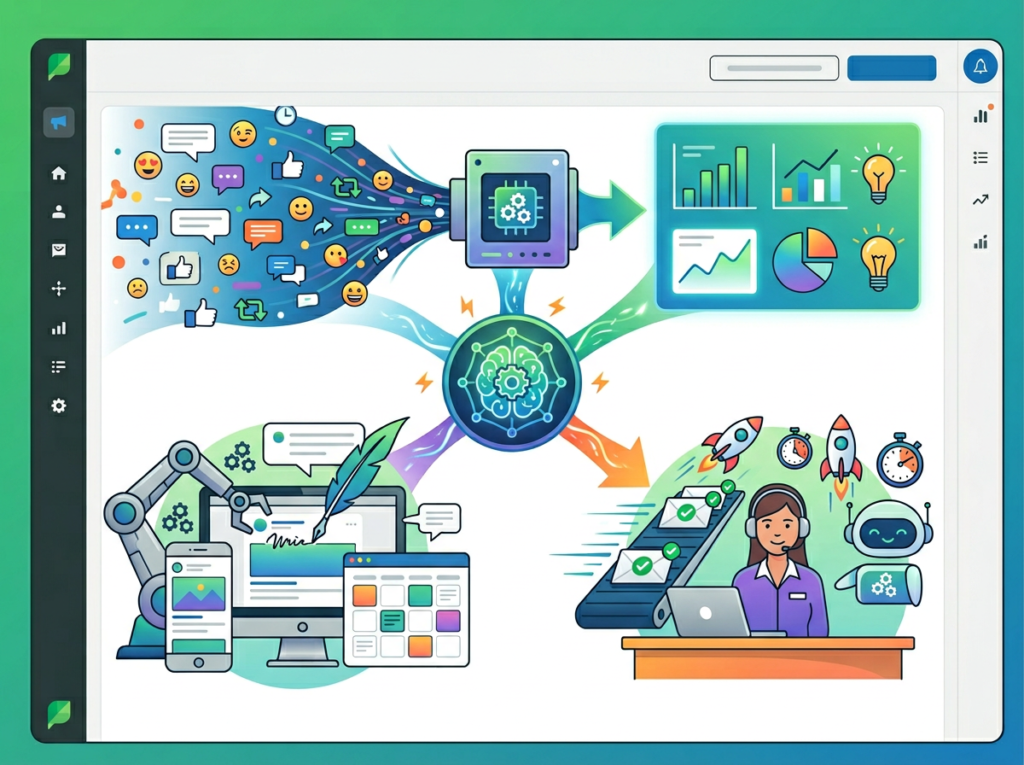
AI Efficiency tools help individual contributors get more done faster — think writing assistants, meeting summarizers, and personal task managers. Solo DX is about building systems that work even when key people are absent. A Solo DX implementation of Sprout Social AI means your social media operation runs consistently whether the founder is present or not, because the brand voice, the scheduling logic, and the analytics review process are all embedded in the platform.
Can small teams afford to use AI for social media management?
Yes. Sprout Social AI starts at $199 per month for standard accounts. For context, the average US freelance social media manager charges $1,500–$3,000 per month for part-time support. For teams where social media work was previously consuming 10+ hours per founder week, AI automation often returns more value in the first month than the annual subscription cost. The ROI case is strongest for teams handling four or more social platforms simultaneously.
Is Sprout Social AI hard to set up?
No. Connecting social accounts, configuring AI Assist, and activating Trellis for analytics queries can be completed in a half-day of setup. Sprout offers onboarding support, training materials, and a support team available for US-based accounts. Most small teams report being functional — scheduling content, reviewing analytics, and managing their inbox — within 48 hours of activation.
Conclusion

In 2026, American small businesses don’t need enterprise budgets to build enterprise-level social media systems. What they need is a platform that embeds AI intelligence directly into the workflows their teams already use — content creation, scheduling, engagement, and analytics — so that social media stops being a founder-dependent bottleneck and becomes a repeatable operational function.
That is the Solo DX value proposition applied to social media: not just doing social faster, but building a system that runs consistently, scales with your team, and captures institutional knowledge in tools rather than in people’s heads. Sprout Social AI delivers this through AI Assist for content generation, Trellis for conversational analytics, Smart Inbox for engagement automation, and Optimal Send Times for reach maximization — all in a single platform built for the 30,000+ brands that have already made social intelligence a core business function.
Start with one process. Pick your highest-friction social media workflow — whether that’s weekly content drafting, Monday reporting, or new-hire onboarding on brand voice — and systemize it this week using Sprout Social AI. The compounding returns on that single investment will make the next system easier to build.
See the full Sprout Social AI review and feature breakdown before you start, so you configure the platform for your team’s specific workflow from day one.
Leave a Reply