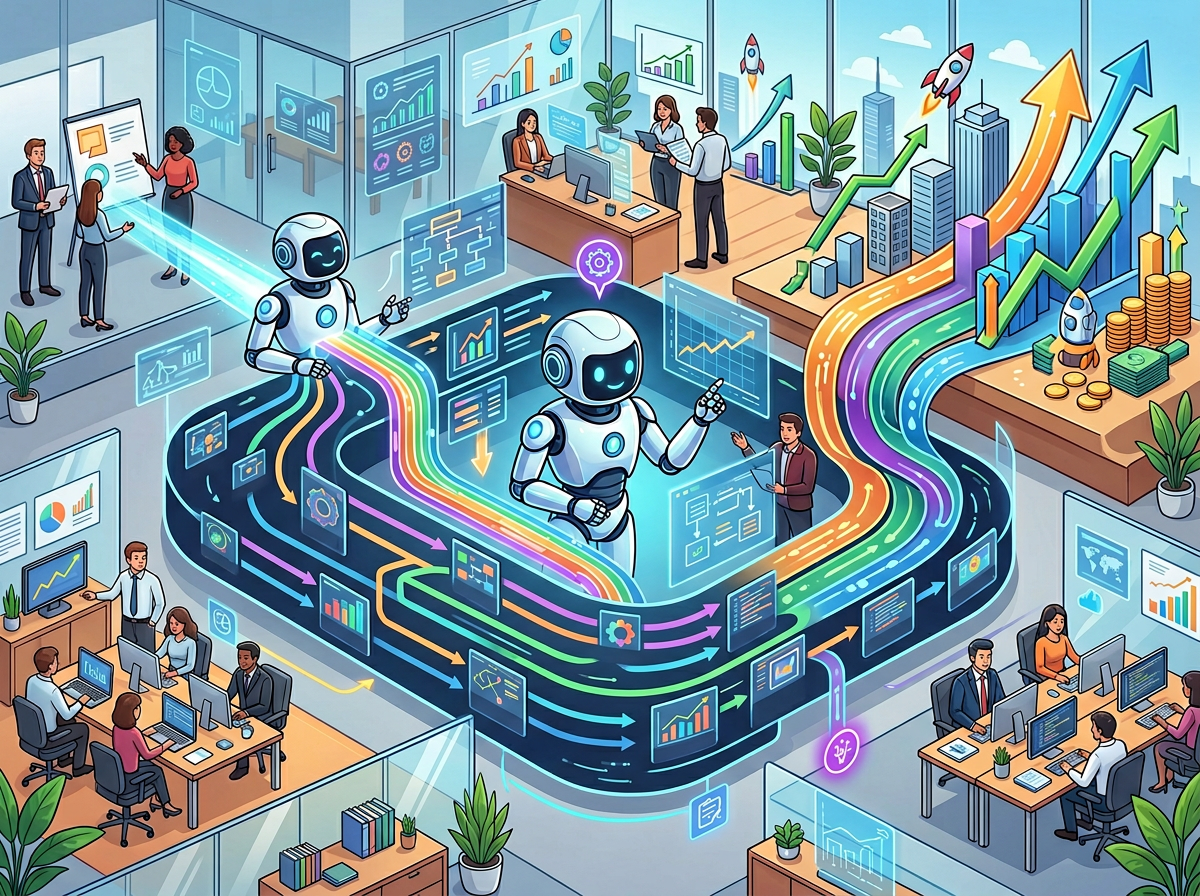
AI agents for business automation are no longer a luxury — small teams deploying them now are outpacing rivals twice their size without adding headcount.
Running a small team in 2026 means operating in two worlds simultaneously. In one world, you’re expected to deliver at the pace of a mature company. In the other, you’re doing it with five, eight, maybe twelve people, no dedicated operations manager, and a Slack inbox that functions as your entire company knowledge base.
Manus is the most capable general-purpose AI agent built for this kind of delegation. Developed originally by Butterfly Effect and now part of Meta’s AI infrastructure following a $2B+ acquisition in late 2025, it scored 86.5% on the GAIA benchmark — outperforming OpenAI’s Deep Research by more than 10%. For US small teams dealing with the grind of repetitive, time-consuming work, that performance gap translates directly into hours recovered and overhead avoided.
Unlike traditional productivity software that costs $5,000 or more in US labor to configure and maintain, Manus operates on subscription tiers starting at $0, with team plans at $39 per member per month. The economics alone make it worth examining. The automation potential makes it worth deploying immediately.
This guide breaks down exactly how small US teams are using ai agents for business automation to reclaim bandwidth, eliminate repetitive bottlenecks, and scale operations without expanding headcount.
See the full breakdown of Manus’s agent capabilities on AI Plaza.
What is Solo DX?
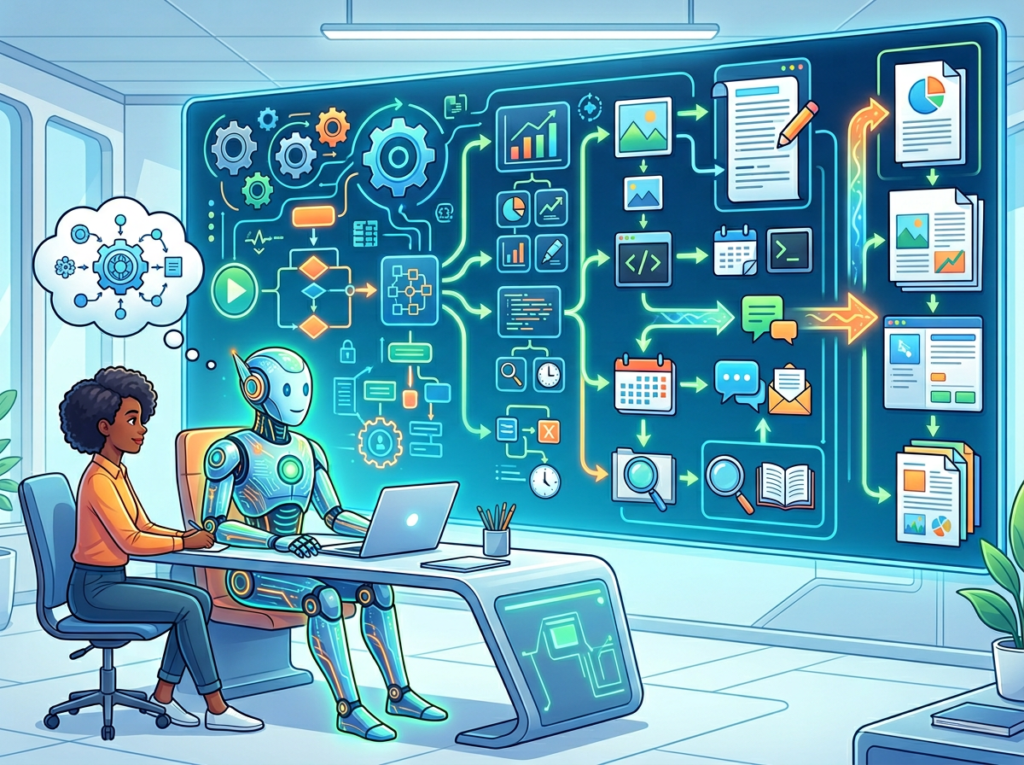
Solo DX — Small-Scale Digital Transformation — refers to the deliberate effort by US small business founders to systematize, automate, and scale their operations without the enterprise budgets, IT departments, or operations managers that large companies rely on. It’s digital transformation on a human scale, driven by founders who are tired of being the bottleneck in every process.
This category is distinct from general AI Efficiency work, which focuses on doing individual tasks faster. Solo DX is about changing how work moves through a business — replacing founder-dependent, memory-based operations with repeatable, delegatable systems. It’s the difference between answering the same client question for the 40th time and building a process that answers it automatically.
| Category | Focus | Typical User | Outcome |
|---|---|---|---|
| AI Efficiency | Faster individual tasks | Any team member | Save hours per week |
| AI Revenue Boost | More leads, higher conversions | Sales/marketing teams | Increase monthly revenue |
| Solo DX | Systemize how work gets done | Founders, team leads | Reduce founder dependency |
| AI Workflows | Automate multi-step processes | Operations-minded teams | Eliminate manual handoffs |
Traditional corporate SOP methods fail small US teams for a predictable reason: they were built for enterprises with dedicated process engineers, change management budgets, and months of implementation runway. A seven-person marketing agency in Austin doesn’t have any of those. What they have is a founder who knows how everything works and a team that interrupts that founder 15 times a day to ask how to do things.
Solo DX using AI agents flips this. Instead of documenting everything manually and hoping staff read it, you deploy an agent that can execute the task itself — researching, analyzing, producing output — and only surfaces decisions that genuinely require human input.
Consider a three-person design studio in Denver. The founder spends roughly six hours a week fielding questions about client workflow, project status, and design revisions. With an autonomous AI agent handling research briefs, status summaries, and client-facing prep work, those six hours compress to under two. The founder didn’t hire an operations manager. They delegated to a system.
Discover how Manus fits into this framework on the AI Plaza tool detail page.
Why AI Is Key for Mini-Team Systemization
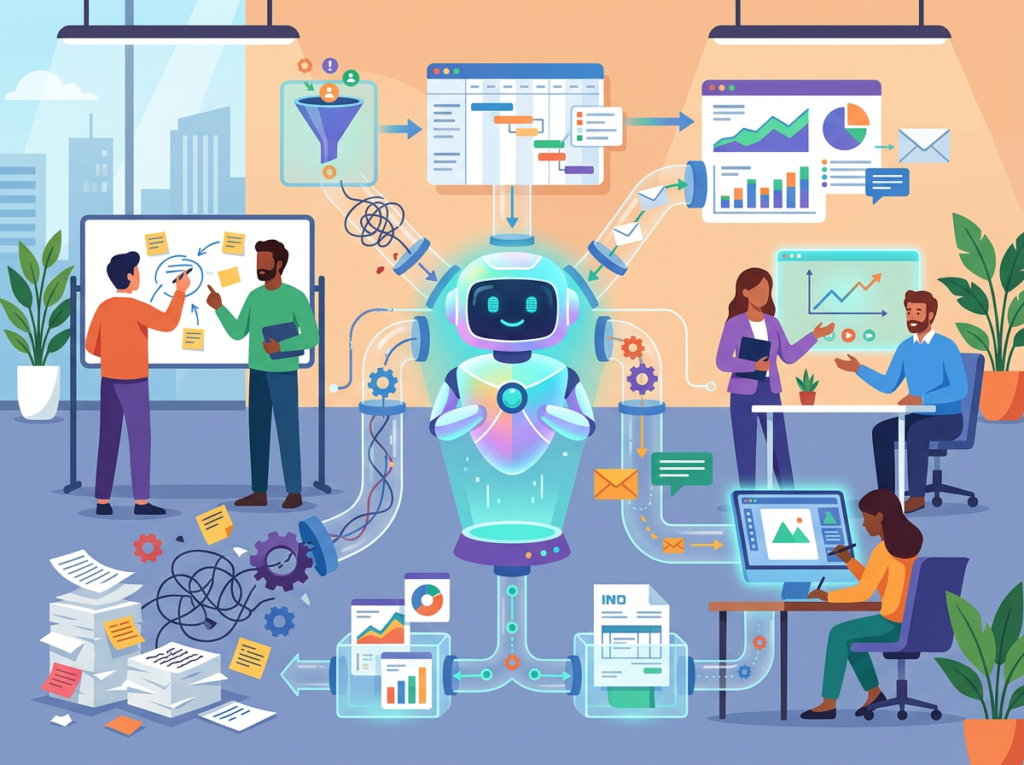
Problem 1: Knowledge lives entirely in the founder’s head.
When a three-person team operates on institutional memory, every decision routes back to one person. The founder becomes the de facto operations manual. This works at two people. At eight, it creates bottlenecks that cost real money. At $100/hour in US knowledge worker wages, six founder interruptions per day averaging 12 minutes each equal $720 in lost productivity per week — over $37,000 annually. Autonomous AI agents reduce this by taking on research, analysis, and first-draft production that previously required founder input.
Problem 2: New hires slow everything down before they speed anything up.
US labor turnover across industries runs at approximately 47% annually, according to Bureau of Labor Statistics data. For small teams, that means the cost of onboarding — which averages $4,000 to $20,000 per hire — recurs constantly. Even when staff stay, ramp time costs output. An AI agent that handles defined research and production tasks doesn’t require onboarding, doesn’t turn over, and doesn’t need a two-week learning curve.
Problem 3: Output quality is inconsistent across team members.
A client deliverable produced by your best team member looks different from one produced by a recent hire. In agencies and professional services firms, that inconsistency erodes client trust. AI agents enforce a consistent output baseline — the research methodology, the format, the depth of analysis — regardless of who initiates the request.
See the full breakdown of Manus’s agent capabilities on AI Plaza.
How Manus Enables Solo DX

1. Agent Mode: Autonomous Task Execution
Agent Mode is Manus’s core engine. You describe an end goal — “research the top 10 CRM tools for a 5-person sales team and produce a comparison report with pricing and feature gaps” — and Manus builds a plan, opens a virtual computer, browses relevant sources, analyzes data, and returns a finished document. You can watch progress through the “Manus’s Computer” window or walk away and return when the work is done.
For a small team, this replaces a meaningful portion of junior research and first-draft production work. A task that would take a team member three to four hours at $75/hour costs $225–$300 in US labor. Delegated to Manus on a Pro plan, that same task costs fractions of a credit cycle and runs in 15–30 minutes. Over a 12-month period, even modest automation of research tasks yields $18,000–$36,000 in recovered labor value for a team that runs two to three such tasks per week.
2. Wide Research: Parallel Multi-Agent Analysis at Scale
Standard AI chatbots degrade in quality after the first 8–10 items because context window saturation causes progressive hallucination and brevity. Manus’s Wide Research deploys dozens of dedicated sub-agents in parallel — each with a fresh context window, independent virtual machine, and live internet access. Item #100 gets the same analytical quality as item #1.
For US small teams doing competitive intelligence, lead research, or market analysis, this capability eliminates the need for a research contractor entirely. A founder in San Francisco who previously budgeted $3,000–$5,000 for a freelance market researcher can run equivalent 100-company analysis through Manus Wide Research in under an hour at a fraction of the cost. That’s a real $3,000–$5,000 per analysis cycle in contractor savings.
3. Mail Manus and Browser Operator: Integration Without API Work
Two features that specifically benefit small US teams without dedicated IT: Mail Manus lets you forward an email to a personal Manus address, and Manus reads the full context — including attachments — then produces the deliverable. A client brief emailed to the team becomes a structured research report without anyone touching a keyboard. Browser Operator transforms Chrome or Edge into an AI-powered agent that operates with your existing logins, allowing Manus to pull data from tools like SEMrush, LinkedIn, or your CRM without requiring API configuration.
See the full breakdown of Manus’s agent capabilities on AI Plaza.
Common Pitfalls & How to Avoid Them
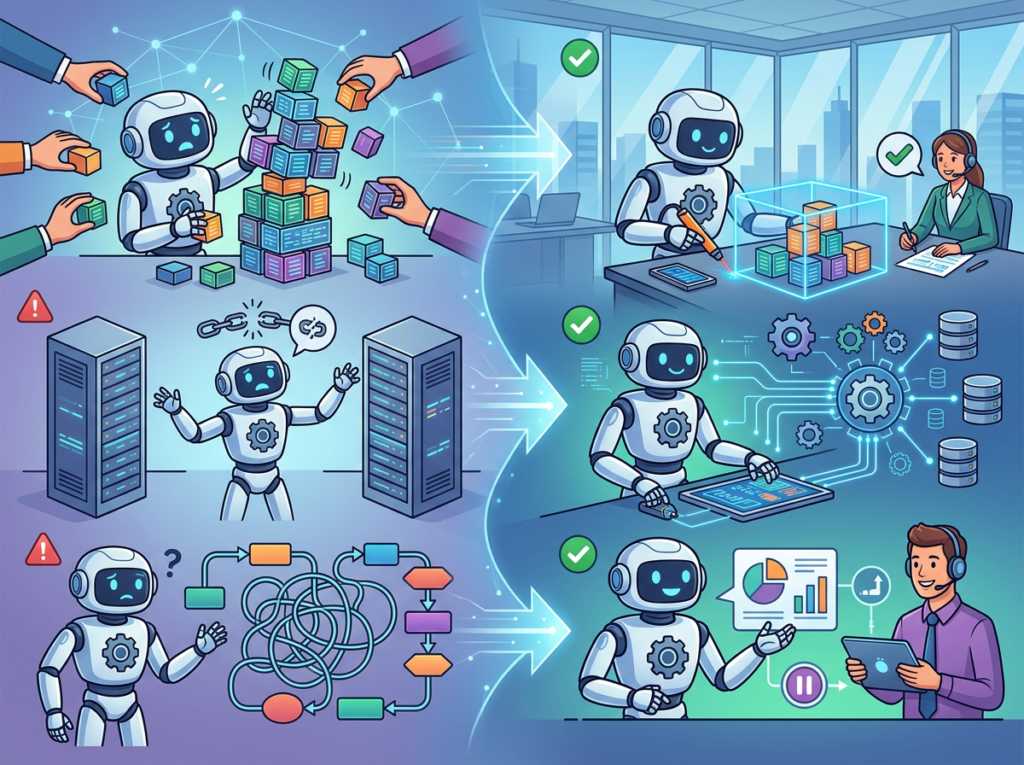
Pitfall 1: Treating Manus Like a Chatbot
The most common mistake is using Manus the way you’d use ChatGPT — one prompt at a time, with constant hand-holding. Manus is built for goal-based delegation. If you’re prompting it for a single paragraph, you’re leaving most of its value on the table. The ROI comes from full task delegation: give it an end goal, define the output format, and let it execute autonomously. Review Manus’s agent task architecture to understand the difference.
Pitfall 2: Skipping Output Review on High-Stakes Deliverables
Manus is highly accurate on benchmark tasks, but autonomous AI agents — like competent human team members — can miss context-specific nuances. As this comprehensive overview of Manus’s capabilities from a detailed practitioner guide makes clear, the tool works best as a “digital employee” whose output gets a final review before client delivery. Build a 10-minute review step into any client-facing workflow.
Pitfall 3: Automating Tasks Before Defining the Output Standard
Scheduled Tasks and recurring workflows produce consistent results — but “consistent” means consistently matching whatever standard you defined when you set them up. If the first brief you gave was vague, every automated output will be equally vague. Spend 20 minutes defining the exact output format, depth, and success criteria before scheduling any recurring task.
FAQs
What’s the difference between AI Efficiency and Solo DX?
AI Efficiency focuses on making individual tasks faster for individual team members — writing faster, summarizing faster, coding faster. Solo DX focuses on changing how work moves through your business — replacing manual, founder-dependent workflows with systems that operate consistently at scale. Both matter, but Solo DX produces the more durable operational impact.
Can small teams in the US actually afford autonomous AI agents?
Yes. Manus offers a free tier with 300 daily credits, a Plus plan at $39/month, and a Team plan at $39 per member per month. For a five-person team spending $195/month on Manus, recovering even 10 hours per month across the team — at average US knowledge worker wages of $50–$75/hour — produces $500–$750 in monthly labor value. The ROI is positive by the first month.
Is Manus difficult to set up for a non-technical team?
No. Manus requires no API configuration, no developer resources, and no integration work for its core Agent Mode and Scheduled Tasks features. The Browser Operator runs as a Chrome or Edge extension. Mail Manus requires only forwarding to a personal Manus email address. Most teams are running their first automated workflow within 30 minutes of signing up.
See the full breakdown of Manus’s agent capabilities on AI Plaza.
Conclusion
In 2026, American small businesses don’t need enterprise budgets to operate at enterprise efficiency. The gap between a seven-person team and a 70-person company has never been smaller — but only for teams that deploy the right tools deliberately.
The practical case for ai agents for business automation is no longer theoretical. US teams using autonomous AI agents are recovering $40,000–$80,000 in annual labor value, eliminating contractor costs, and building operational systems that scale with growth instead of breaking under it. The competitive advantage is real, and it compounds over time.
Solo DX isn’t about adopting every AI tool available. It’s about identifying the workflows where human time is most wasteful — recurring research, report production, competitive analysis, knowledge capture — and delegating them to systems capable of handling them end-to-end. Manus is purpose-built for exactly this kind of delegation.
Start with one process. Pick the task your team does most repetitively. Delegate it this week. Measure the time recovered. Then scale from there. Manus’s website builder and web app documentation is a useful starting point for understanding how its agent capabilities extend across different output types.
Get the full breakdown of Manus’s automation capabilities for US teams. Explore Manus | No credit card required to start | Used by teams across the US
Leave a Reply