
The right workflow documentation tools don’t just save time — they transform tribal knowledge into scalable systems any small business can run.
In 2026, American freelancers and solo entrepreneurs face a paradox that no productivity app has fully solved. You know exactly how to do your job — but the moment you try to delegate, hire a contractor, onboard a new client, or simply step away for a week, everything falls apart. The process lives in your head, and nowhere else.
Inbox at 200 unread. Calendar packed. To-do list endless. And somewhere buried underneath it all, a contractor you hired last month is doing things three different ways because you never had time to write it down properly.
This is the workflow documentation gap — and it costs US small businesses more than they realize. For freelancers billing $75–150/hour, every hour spent re-explaining a process, fixing inconsistent output, or fielding the same question twice is $75–150 you didn’t earn. Multiply that across a year, and undocumented processes become one of the most expensive invisible costs in your business.
Guideless is an AI-powered documentation tool designed specifically to close this gap — without requiring you to become a technical writer, video editor, or SOP architect. It captures your actual browser-based workflows as you click through them, then automatically generates narrated, step-by-step guides ready to share, embed, or build into your knowledge base.
This article covers four specific workflow documentation strategies you can implement this week, each designed to save 2–5 hours and eliminate the recurring cost of undocumented processes. You’ll see concrete before-and-after scenarios from real business types, honest limitations you should know before committing, and a clear ROI framework grounded in US freelance market rates.
The question isn’t whether your business needs documented workflows. It’s whether you can afford to keep storing them only in your own memory.
Try Guideless free and build your first process guide in under 10 minutes. Start Free | No credit card required
Key Concepts of Workflow Documentation

Concept 1: The Knowledge Externalization Problem
Every experienced freelancer or small business owner carries an enormous amount of tacit knowledge — the kind of expertise you’ve accumulated through repetition and mistakes that lives entirely in your head. You know exactly which Shopify settings to toggle before launching a sale. You know which three steps to take when a client’s Facebook ad account gets flagged. You know the exact sequence for onboarding a new retainer client without losing a week of back-and-forth emails.
The problem is that tacit knowledge doesn’t scale, and it doesn’t survive delegation.
Externalizing that knowledge — converting it from mental habit into documented process — is the foundational act of building a business that doesn’t depend entirely on you. Most solo operators never do it, because traditional methods (writing SOPs in Google Docs, recording Loom videos, building Notion wikis) are time-consuming enough to defer indefinitely.
Consider Sarah, a freelance social media manager in Denver with eight active clients. Before implementing AI process documentation, she spent 2.5 hours each week re-explaining her monthly reporting process to new subcontractors. Once she documented it as a narrated AI guide, that time dropped to 15 minutes of review — 125 hours annually recovered, worth roughly $10,600 at her $85/hour rate.
For advanced workflow documentation strategies, explore Guideless in detail.
Concept 2: Process Inconsistency Cost
Process inconsistency is the invisible tax on every business that hasn’t standardized its workflows. When the same task gets done five different ways by five different people — or even by the same person on five different days — quality variance becomes the norm rather than the exception.
Research on knowledge work interruptions has found that recovering full focus after a task switch takes an average of 23 minutes. But process inconsistency creates a different kind of cognitive overhead: the ongoing mental energy of deciding, each time you do a task, which approach you’re using today.
Marcus, an independent IT consultant in Atlanta, tracked his time for one month and discovered he was spending five hours weekly on process overhead — not doing client work, but reconstructing his own methods and correcting inconsistent output. After documenting his core service delivery workflows, that five hours collapsed to under 90 minutes. The consistency the documentation enforced turned out to be as valuable as the time savings.
Concept 3: The Documentation Compound Effect
Workflow documentation doesn’t have linear returns. It has compound returns.
The first guide you create saves you time once. The second builds on it, establishing a pattern your contractors already understand. By the time you’ve documented ten core processes, you’ve built an operational system — a knowledge base that new hires can navigate independently and that clients can reference without emailing you.
Elena, an e-commerce operator in Phoenix, documented her product-launch workflow over three sessions totaling four hours. Her VA started executing the process independently within days. Six months later, onboarding a second VA took three days instead of two weeks because the guides handled most of the training automatically.
This compound effect explains why the ROI on create step by step guides with AI accelerates over time. Guideless’s own compare pages, including their breakdown against category alternatives, demonstrate how removing documentation creation friction is the key variable that determines whether a small business actually builds and maintains its process library.
How Guideless Helps Workflow Documentation

Feature 1: One-Click Capture to Narrated Guide
The most significant friction in traditional documentation is the time gap between doing the thing and documenting the thing. They’re separate activities, which means documentation always gets deferred. Guideless collapses that gap by capturing the workflow while you perform it — the guide is built as a byproduct of doing the task.
For a US freelancer spending 3 hours per week re-explaining processes to contractors, this feature alone reclaims roughly 130 hours annually — worth $7,800 at a $60/hour billing rate.
Feature 2: AI-Generated Narration and Script
Guideless doesn’t just capture screenshots — it generates a natural-language narration for each step. The script is professional-sounding, clear, and immediately ready to use. You can edit it, adjust the tone, or choose from multiple AI voice options to match your brand.
This eliminates the single biggest bottleneck in traditional SOP creation: writing. Most operators who attempt to build documentation get stuck at the writing phase, where converting tacit knowledge into clear prose requires cognitive effort they don’t have bandwidth for. Guideless handles the first draft automatically, turning a 3-hour writing task into a 15-minute review-and-adjust workflow.
See our full Guideless review to understand how the narration engine works with real workflow examples.
Feature 3: Embeddable, Shareable Guide Format
Documented processes only create value if people can find and follow them. Guideless outputs guides as embeddable, shareable assets — not locked PDFs or Google Docs buried in a folder. You can share a direct link, embed the guide in Notion, Confluence, your help center, Slack, or your client portal.
This means your workflow documentation becomes a living resource that’s actually accessed, not an archive that nobody opens. For small business owners who’ve built Notion wikis that nobody reads, the shift to visual, narrated guides is significant — completion rates on step-by-step video guides consistently outperform static text documentation.
As noted in this employee training breakdown from Guideless, teams using narrated guides report 60% faster ramp-up times for new hires, and a 50% reduction in repetitive training questions.
Ready to turn your workflows into documented, shareable guides? Try Guideless free and build your first process guide in under 10 minutes. Start Free | No credit card required
Best Practices for Implementing AI Process Documentation

Document while you do, not after. The single biggest advantage of Guideless over traditional documentation approaches is that it captures during execution rather than after. Don’t schedule a separate documentation session — activate Guideless when you’re doing the actual task. This ensures the guide reflects how the process actually runs, not how you remember it running.
Plan for maintenance from day one. Documented processes go stale. Your tool stack changes, your pricing updates, your client communication approach evolves. When you create a guide, add a recurring calendar reminder to review it quarterly. Guideless makes re-recording a single step easier than rewriting a paragraph, which lowers the maintenance burden enough to make it sustainable.
Resist tool bloat. A common failure mode in small business operations is accumulating documentation tools — a Loom library here, a Notion wiki there, a Google Drive of PDFs somewhere else. Consolidating into one documented workflow system (with Guideless as the guide creation layer) eliminates the coordination overhead of maintaining multiple formats. The goal is one place your team or contractors look for process guidance — not three.
Limitations and Considerations
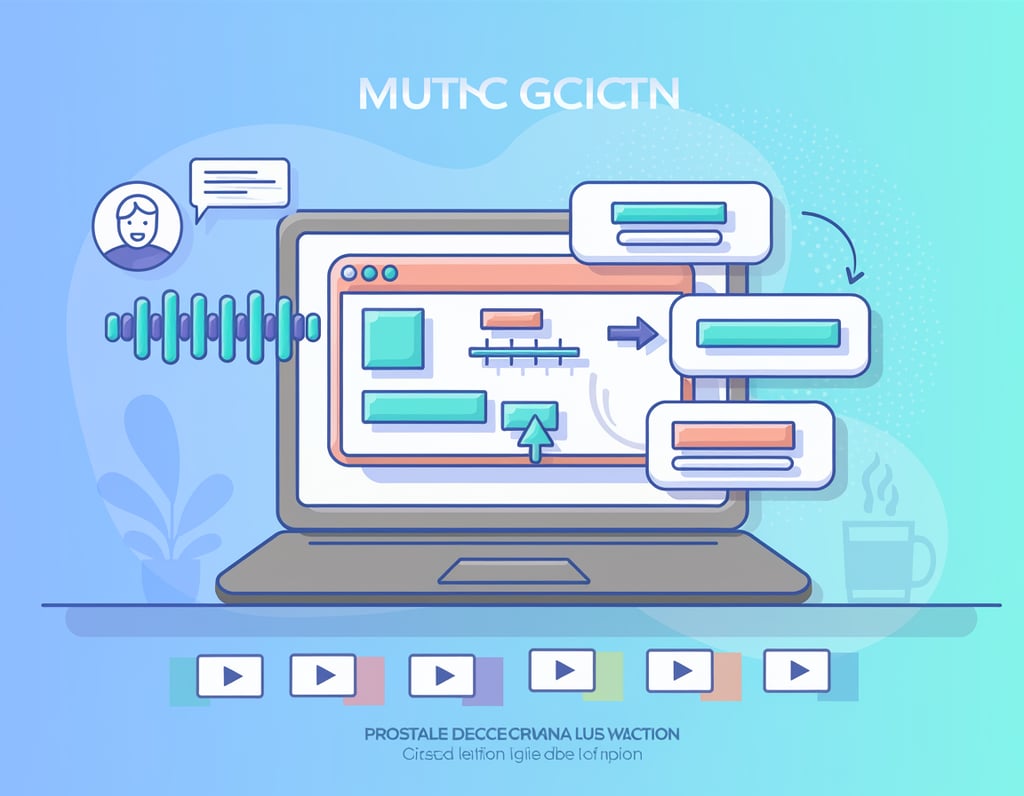
Narration accuracy requires review. Guideless’s AI-generated narration is impressive and generally accurate, but it’s generated from your click sequence, not your spoken explanation of intent. Step descriptions can occasionally miss the “why” behind an action, or phrase something in a way that makes sense grammatically but not contextually. Always review narration before sharing guides externally — especially with clients.
Privacy and sensitive data. Because Guideless captures your browser activity, be deliberate about what’s on-screen when you record. Don’t record workflows involving client financial data, personal information, or proprietary system configurations without first understanding your data handling obligations and Guideless’s privacy policy.
Ongoing AI dependency risk. AI-narrated guides that change format with product updates could disrupt your documentation system. Keep raw process notes as a backup so your operational knowledge isn’t entirely dependent on any single tool.
Frequently Asked Questions

What are workflow documentation tools, and why do small businesses need them?
Workflow documentation tools help businesses capture, organize, and share the step-by-step processes that make their operations run. For small businesses and freelancers, they’re especially valuable because processes often live in the owner’s head — creating a bottleneck whenever work needs to be delegated, handed off, or scaled. AI workflow documentation tools like Guideless automate most of the creation process, making documentation fast enough to actually happen.
Can I use Guideless to create step-by-step guides with AI if I’m not technical?
Yes. Guideless is designed specifically for non-technical users. You install a Chrome extension, click through your workflow, and the tool handles the rest — capturing steps, writing narration, generating the voice, and producing a shareable guide. No video editing, no script writing, and no design skills required.
How long does it take to create a guide with Guideless?
A typical 10–15 step workflow guide takes 5–10 minutes to capture and another 5–10 minutes to review the narration and make any adjustments. For most common business workflows, you can go from zero documentation to a shareable, narrated guide in under 20 minutes — which makes the “I’ll do it when I have time” excuse significantly harder to justify.
Conclusion

Undocumented workflows are one of the most expensive invisible costs in a small business. For US operators billing $75–150/hour, every hour spent re-explaining, correcting inconsistent output, or re-inventing your own processes is a direct hit to earning capacity.
Guideless changes the economics of workflow documentation tools by making creation fast enough to actually compete with the real alternative — which, for most small business owners, means competing with doing nothing. When documenting a 15-step process takes 20 minutes instead of three hours, the calculation changes.
The four use cases in this article represent real ROI: $21,000–$40,000 in recovered capacity annually for operators who systematically document their highest-repetition processes. That’s not from using AI to do their work — it’s from using AI to ensure work gets done consistently, by whoever does it, without requiring the owner’s presence every time.
AI process documentation is augmentation, not replacement. Your expertise still drives the process — Guideless converts that expertise from something that lives in your head into something your entire operation can use.
The practical starting point: pick one process you’ve explained more than five times this month. Open Guideless, walk through it, and ship the guide today. The compound effect starts with that first one.
The question isn’t whether your business needs standardized processes. It’s how much longer you can afford to run without them.
Try Guideless free and build your first process guide in under 10 minutes. Start Free | No credit card required
Leave a Reply