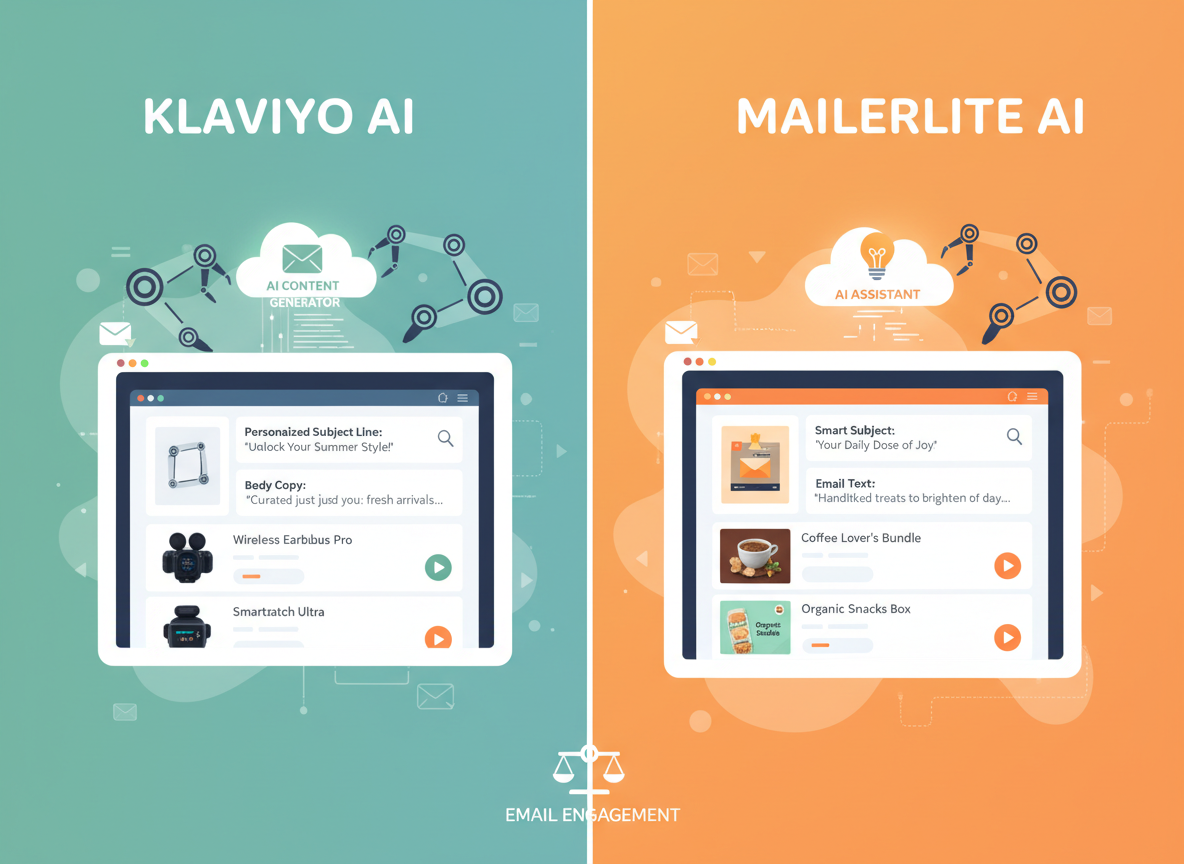
Choosing the wrong email marketing platform doesn’t just waste money — it quietly kills revenue while you’re too busy to notice.
If you’re a small business owner or e-commerce operator trying to grow revenue through smarter email automation, here’s the bottom line before we dive deeper.
Klaviyo AI is the better choice if: You run a product-based business or online store with at least a modest customer list, you need deep behavioral triggers and predictive segmentation, and you’re willing to invest time (and a higher budget) to unlock serious revenue-driving automation. It’s built for businesses where email is a primary revenue channel.
MailerLite AI pulls ahead when: You’re a service-based small business, content creator, or early-stage startup with a tight budget. You want AI-assisted email writing, simple automation flows, and a clean interface — without a steep learning curve or a pricing model that penalizes growth.
Neither is ideal if: You need enterprise-grade CRM integration, omnichannel marketing across SMS, push, and paid ads in one unified platform, or you have zero interest in building an email list strategically. Both tools require you to actually have a working contact acquisition strategy to deliver value.
Honest caveat: both tools now include AI features, but the depth and purpose of that AI differs significantly. Explore Klaviyo AI in detail to see how its predictive capabilities stack up — or explore MailerLite AI in detail if simplicity and affordability are your priority.
Why This Comparison Matters in 2026

In 2026, there are dozens of email marketing platforms all claiming to use “AI.” Most comparison articles stop at feature checklists — open rate tracking here, A/B testing there — without addressing what actually matters: does this tool fit the way your business runs today, and can it grow with you?
The klaviyo vs mailerlite for email marketing automation question isn’t really about features. It’s about workflow fit, pricing reality, and what kind of AI actually moves the needle for a small business with limited time and a real budget to protect.
Most small business owners aren’t choosing between tools in a vacuum. They’re already stretched — managing client relationships, fulfillment, social media, and trying to squeeze revenue from a list they’ve spent months building. Picking the wrong email platform in this context doesn’t just cost you a monthly subscription fee. It costs you the opportunity to turn that list into consistent, automated revenue.
According to this in-depth analysis from Email Tool Tester, the platforms differ significantly in how they approach audience segmentation and pricing — a gap that becomes critical when your contact list crosses the 1,000 subscriber mark.
Here’s why this comparison matters specifically in 2026: AI email marketing for small business has matured. Both Klaviyo and MailerLite have integrated generative AI into their platforms, but they’ve done so with very different philosophies. Klaviyo’s AI is predictive and revenue-focused. MailerLite’s AI is productivity-focused and accessibility-first. Knowing which philosophy matches your business model is the real decision you’re making.
This article is focused exclusively on the US market, using USD pricing, realistic small business workloads (1–10 person teams), and outcomes that matter: time saved, revenue generated, and automation that actually runs without constant babysitting.
Who This Comparison Is Best For
This comparison is built around real business situations, not job titles. Here’s who will get the most out of reading this.
Situation 1: E-Commerce Owner with a Growing Product Catalog

You sell physical or digital products and you’ve got at least a few hundred subscribers. Your pain is this: you know email should be driving more revenue, but your automations are basic — a welcome sequence and maybe an abandoned cart flow you set up once and never touched again. You’re leaving money on the table every week. You need behavioral segmentation, purchase-prediction tools, and flows that fire at the right moment without you manually triggering them. This comparison will help you understand whether Klaviyo’s more sophisticated AI capabilities justify its higher cost — or whether MailerLite’s simpler approach gets you 80% of the results at a fraction of the price.
Situation 2: Service-Based Small Business Building a Newsletter

You’re a consultant, coach, agency owner, or local service provider. You’re building an email list to stay top of mind with prospects and past clients, nurture leads, and eventually sell a course, workshop, or retainer package. You don’t need complex e-commerce flows. You need clean templates, AI-assisted writing to save time drafting campaigns, and automation sequences that don’t require a marketing degree to set up. MailerLite was designed for people exactly like you. But Klaviyo has been expanding beyond e-commerce — and understanding whether that expansion changes the calculus is worth knowing.
Situation 3: Startup Founder Testing Email as a Channel

You’re pre-revenue or early revenue. Your list is small — maybe under 500 people. You’re testing whether email can become a meaningful customer acquisition or retention channel before you invest seriously in it. Budget matters enormously. Paying $45–$100/month on a tool you’re still learning to use is a real cost when cash is tight. You need to understand which platform lets you learn faster and see results sooner, not just which one has more features.
Who this comparison is NOT for: Enterprise teams with dedicated CRM and marketing ops staff, professional email marketers evaluating tools for large-scale deployment, or businesses with highly specialized regulatory requirements (healthcare, finance) where platform compliance certifications take precedence over AI features.
Real-world example: Jess runs a 4-person Shopify store selling skincare products in Portland. She has 3,200 subscribers, a solid welcome sequence, and an abandoned cart flow — but her repeat purchase rate is low and she suspects email is the lever she’s not pulling hard enough. She spends about 3 hours a week writing campaigns manually and isn’t sure her segmentation is working. The right tool could save her 2 of those hours and meaningfully increase her customer lifetime value.
Why Each AI Fits Different Needs
Klaviyo AI: Strengths and Best-Fit Scenarios

Klaviyo has been the gold standard for e-commerce email automation for years, and its AI layer is built to serve one primary purpose: help you predict and influence purchasing behavior at scale.
Revenue Intelligence as the Core AI Feature. Klaviyo’s AI isn’t primarily about helping you write emails faster — it’s about telling you who to email, when, and with what offer. Its predictive analytics engine estimates things like customer lifetime value, churn probability, and next purchase date. For a product-based business, these predictions can fundamentally change how you segment and sequence outreach. Instead of sending the same promotional email to your entire list, you can target customers who are statistically likely to purchase again in the next 30 days — and suppress messaging to those who are likely churned.
Learning Curve and Time to First Value. Klaviyo is not a beginner tool. The interface is dense, the terminology assumes some familiarity with email marketing concepts, and setting up a sophisticated flow requires real configuration work. Most new users report getting a basic welcome and abandoned cart flow running within a few hours, but unlocking the platform’s full predictive power takes weeks of data accumulation and workflow iteration. If you’re starting from scratch with a small list, you may not see Klaviyo’s AI shine for 60–90 days.
Pricing Reality for US Small Businesses. This is where Klaviyo becomes a real conversation. The free plan covers up to 500 contacts. After that, pricing scales with list size: 1,000 contacts runs roughly $45/month, 5,000 contacts around $100/month, and 10,000 contacts closer to $150/month. For a business where email drives meaningful revenue, this is usually justifiable. For a business still testing the channel, it’s a harder sell.
See our full Klaviyo AI review for a complete breakdown of its AI feature set, pricing tiers, and integration capabilities.
Real-World Business Result. E-commerce businesses using Klaviyo’s predictive segmentation and flow automation consistently report email as their highest-ROI marketing channel. Businesses with lists in the 2,000–10,000 range and well-configured flows often attribute 20–35% of total revenue to email — a figure that’s hard to hit with basic automation tools.
MailerLite AI: Strengths and Best-Fit Scenarios

MailerLite has spent years earning its reputation as the best-value email marketing tool for small businesses and creators, and its AI additions have reinforced that positioning rather than repositioning it.
AI Writing Assistant as the Primary Value-Add. MailerLite’s AI is primarily a content creation tool. Its AI writing assistant helps you draft subject lines, email body copy, and CTAs faster — shaving meaningful time off your weekly content creation workflow. If you’re sending 2–4 campaigns per week and writing them yourself, this feature alone can save an hour or more weekly. It’s not predictive intelligence; it’s productivity acceleration.
Learning Curve and Time to First Value. MailerLite is genuinely beginner-friendly. The drag-and-drop editor is clean, automation workflows are visual and intuitive, and the platform’s documentation is excellent. Most new users can have a functional welcome sequence and their first campaign sent within an afternoon. That low barrier to entry is a real competitive advantage for time-strapped small business owners.
Automation Capabilities. MailerLite’s automation builder covers the core use cases well: welcome sequences, lead magnet delivery, course drip sequences, birthday emails, and conditional branching based on subscriber behavior. It’s not as sophisticated as Klaviyo’s behavioral trigger system, but for most service-based businesses and content creators, it’s more than sufficient.
Pricing Advantage. MailerLite’s pricing is a significant differentiator. The free plan supports up to 1,000 subscribers and 12,000 emails per month — genuinely useful for early-stage businesses. The Growing Business plan starts at $9/month for up to 500 subscribers, scaling to around $19/month for 2,500 and $32/month for 5,000. For the same 5,000-contact list, MailerLite costs roughly one-third of Klaviyo. That gap is hard to ignore when margins are tight.
Learn more about MailerLite AI including its AI writing features, template library, and free-tier capabilities.
Real-World Business Result. Service businesses, consultants, and content creators using MailerLite report meaningful time savings on email creation and solid open rates when list hygiene is maintained. The platform is less likely to drive a step-change in revenue attribution, but it keeps businesses consistently communicating with their audiences without becoming a full-time job to manage.
As noted in this comparison from Campaign Monitor, MailerLite’s strength lies in its simplicity and cost-efficiency, while Klaviyo’s advantage is its e-commerce data depth.
Comparative Summary. Klaviyo AI is a revenue intelligence platform with email at its core. MailerLite AI is an email productivity platform with enough automation to serve most small businesses well. Your choice depends on whether your primary need is smarter targeting or faster content creation — and whether your budget can support the premium for predictive capabilities.
Who Should Choose Another AI Entirely
Before committing to either platform, it’s worth knowing when neither is the right answer.
Need 1: Full Omnichannel Marketing Automation
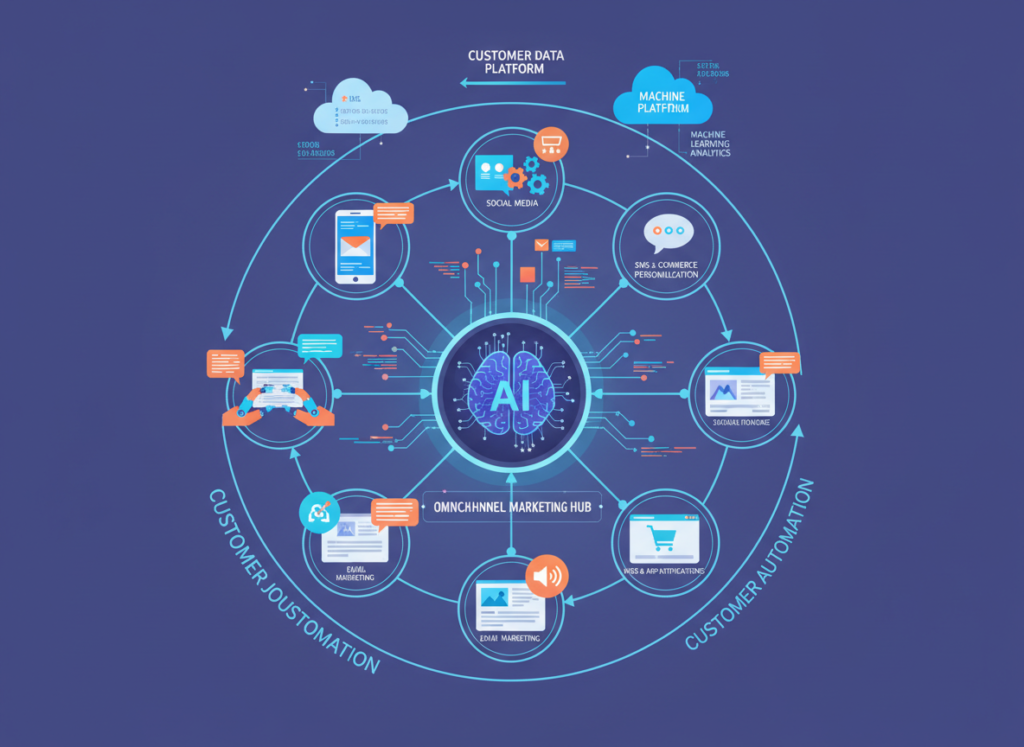
If you need to orchestrate email, SMS, push notifications, paid ad audiences, and social retargeting from a single platform, both Klaviyo and MailerLite fall short in different ways. Klaviyo has SMS capabilities, but its paid ad integration is limited. MailerLite is primarily an email tool with minimal SMS functionality. Businesses needing true omnichannel orchestration should evaluate platforms like Omnisend, Drip, or ActiveCampaign, which are purpose-built for that use case.
Need 2: High-Volume Transactional Email

If your primary need is transactional emails — order confirmations, receipts, password resets, shipping notifications — neither Klaviyo nor MailerLite is the ideal primary platform. These use cases are better served by dedicated transactional email infrastructure like SendGrid, Postmark, or Mailgun, which prioritize deliverability and developer-friendly API access over marketing features.
Need 3: Advanced CRM-First Marketing
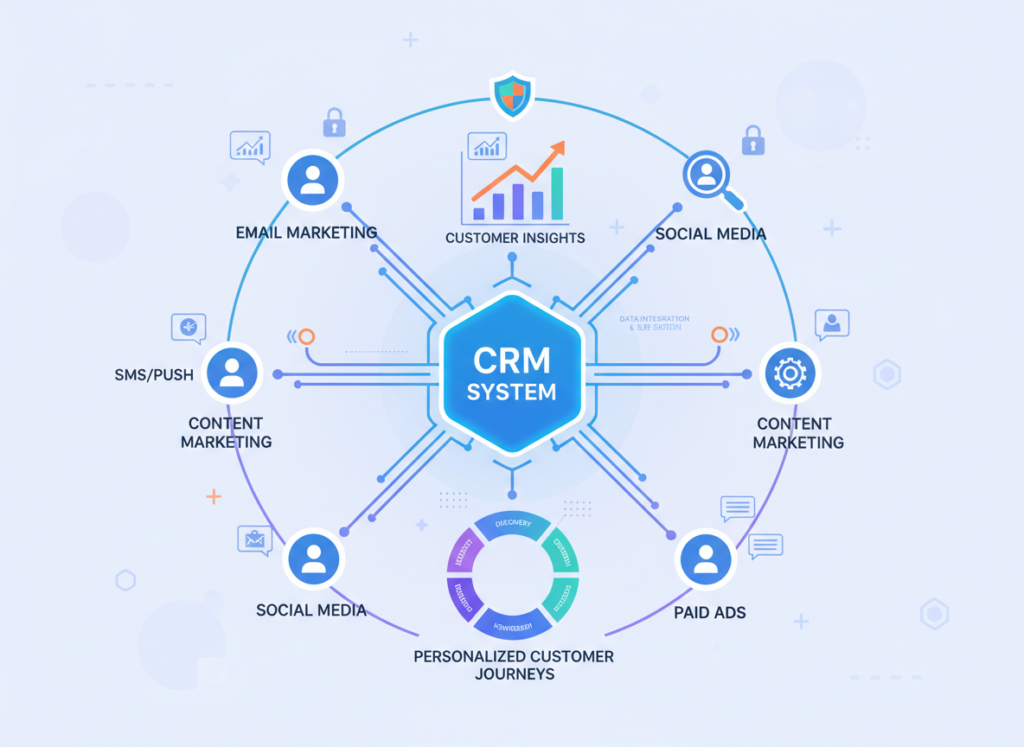
If your business operates primarily through relationship-driven sales rather than e-commerce or content marketing — think B2B companies with long deal cycles, consulting firms with high-touch client relationships — you likely need a CRM with email marketing built in, not an email marketing tool with light CRM features. HubSpot or ActiveCampaign would serve these businesses better.
Use Cases by Business Goal
Productivity: Faster Campaign Creation and List Management

Use Case: A solo consultant sending a weekly newsletter to 1,800 subscribers needs to cut email creation time from 90 minutes to 30 minutes per send.
Klaviyo AI Approach: Klaviyo’s AI can assist with subject line generation and offers some copy suggestions, but this isn’t where it shines. Its productivity value comes from automation — emails that fire automatically based on behavior mean fewer manual sends. Time to productivity value: 2–4 weeks of setup, then ongoing automation handles the heavy lifting.
MailerLite AI Approach: MailerLite’s AI writing assistant directly addresses this use case. You can describe the campaign angle, let the AI draft body copy, refine subject line suggestions, and send — all within 25–30 minutes. For newsletter-focused businesses, this is the more immediate productivity win. Time to value: available from day one.
Decision Criteria: Choose Klaviyo AI if your productivity goal is “fewer manual sends through automation.” Choose MailerLite AI if your goal is “faster content creation for consistent sends.”
For more ways to systematically reduce marketing busywork, discover AI efficiency strategies that apply across your full workflow stack.
Revenue & Marketing: Driving Purchases Through Behavioral Email
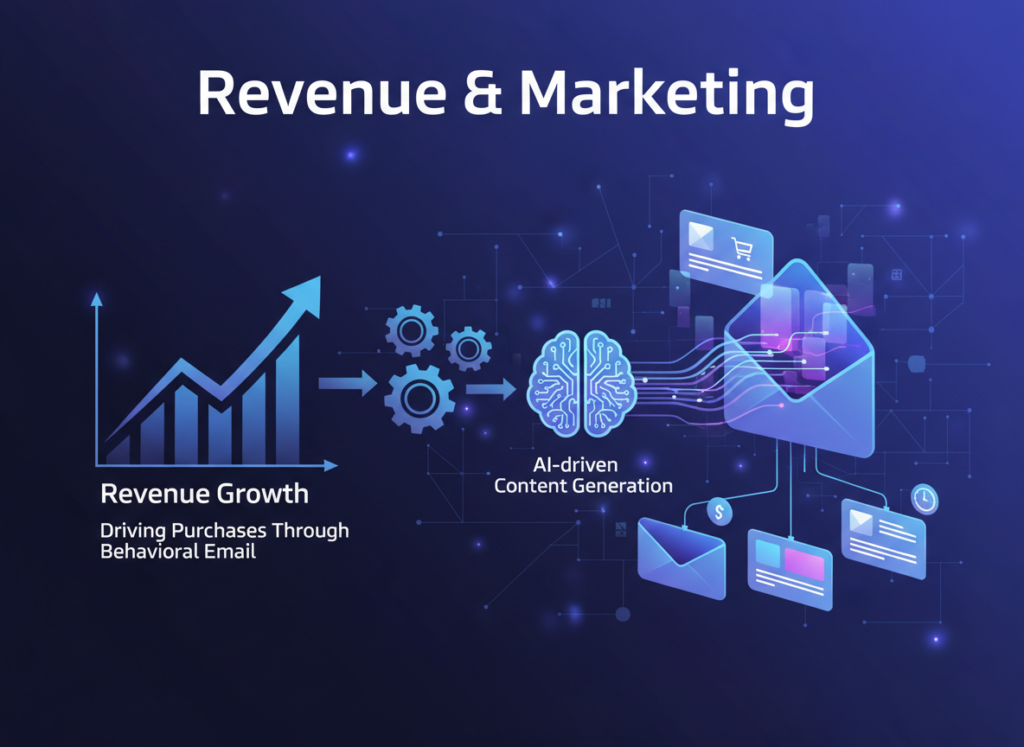
Use Case: A Shopify store owner with 4,000 subscribers wants to increase repeat purchase rate and recover more abandoned carts.
Klaviyo AI Approach: This is Klaviyo’s home turf. Its Shopify integration pulls in product view data, cart events, and purchase history automatically. The AI can identify customers approaching their predicted next purchase window and trigger campaigns proactively — not just reactively. Abandoned cart sequences can be configured with multi-step logic (reminder at 1 hour, follow-up at 24 hours, discount at 72 hours) and suppressed automatically once purchase occurs. Business impact: well-configured Klaviyo flows regularly contribute 20–30% of Shopify store revenue for businesses with lists in this size range.
MailerLite AI Approach: MailerLite integrates with Shopify and supports abandoned cart emails, but the behavioral trigger sophistication is significantly lower. You can create basic conditional flows, but predictive segmentation based on purchase probability isn’t available. For a store doing meaningful volume, this limitation becomes real. Business impact: useful for basic automation but unlikely to drive the same revenue attribution as Klaviyo.
Decision Criteria: For product-based businesses where email drives direct purchases, Klaviyo AI’s behavioral intelligence has a clear advantage. MailerLite works for basic e-commerce email; Klaviyo works for optimized e-commerce email.
Systemization & Workflows: Building Automations That Run Without You
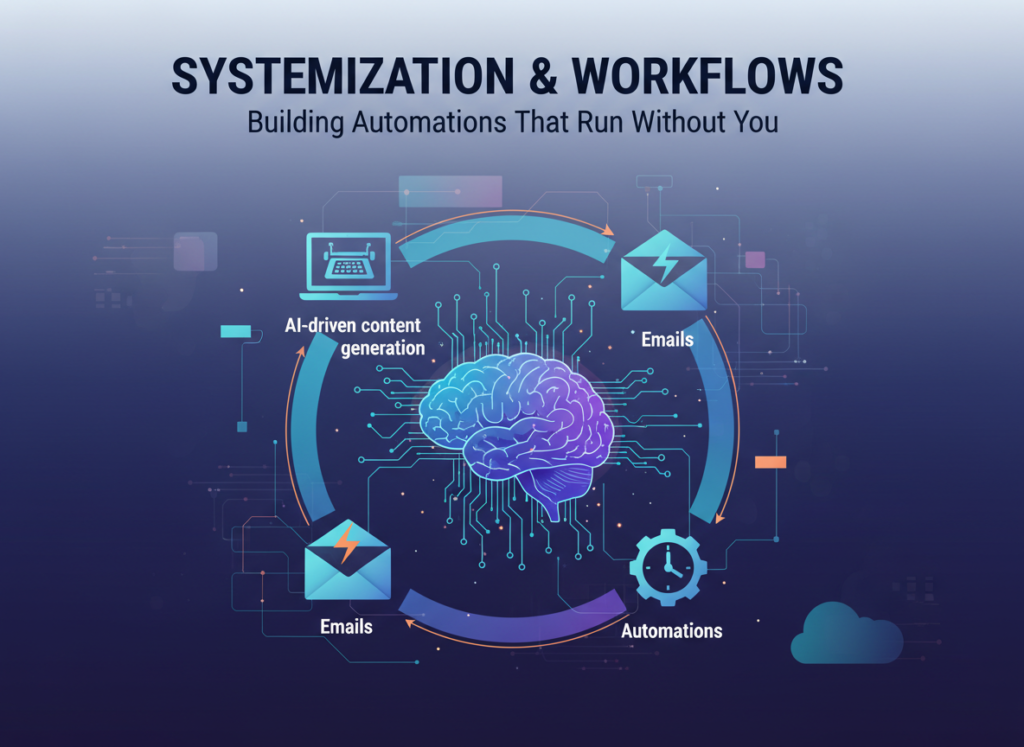
Use Case: A 5-person marketing agency wants to build onboarding sequences, lead nurture flows, and re-engagement campaigns that run automatically across their client roster.
Klaviyo AI Approach: Klaviyo’s flow builder is powerful but complex. Building multi-branch conditional flows takes time and some strategic thinking, but the result is highly granular automation that responds to specific subscriber behaviors. For agencies managing e-commerce clients, Klaviyo’s client-facing reporting and revenue attribution make it easier to demonstrate email ROI. Long-term stability is strong once flows are configured — they require minimal maintenance unless the underlying offer or product catalog changes significantly.
MailerLite AI Approach: MailerLite’s automation builder is faster to set up and easier to replicate across client accounts. For agencies whose clients are service businesses, coaches, or creators (rather than e-commerce), MailerLite’s workflow simplicity is an asset, not a limitation. The visual builder makes it easy to document and hand off automation logic to clients. However, as noted in this SendPulse analysis, MailerLite’s automation lacks some of the advanced conditional logic that Klaviyo offers for complex multi-step sequences.
Decision Criteria: Choose Klaviyo AI for e-commerce client workflows that need behavioral triggers and revenue reporting. Choose MailerLite AI for service-based clients who need reliable, maintainable automations without complexity overhead.
Side-by-Side Comparison Table
| Comparison Axis | Klaviyo AI | MailerLite AI |
|---|---|---|
| Primary AI Focus | Predictive segmentation, revenue intelligence | AI writing assistant, content acceleration |
| Ease of Use | Moderate to complex; assumes marketing familiarity | Beginner-friendly; intuitive visual interface |
| Best For | E-commerce, product businesses, high-revenue email | Service businesses, creators, early-stage startups |
| Free Plan | Up to 500 contacts | Up to 1,000 contacts + 12,000 emails/month |
| Paid Pricing (US) | ~$45/mo (1K contacts), ~$100/mo (5K contacts) | ~$9/mo (500 contacts), ~$32/mo (5K contacts) |
| E-Commerce Integration | Class-leading (Shopify, WooCommerce, BigCommerce) | Solid for basic e-commerce use cases |
| Behavioral Triggers | Advanced — purchase probability, churn prediction | Standard — clicks, opens, form submissions |
| AI Writing Tools | Subject line suggestions, limited copy assist | Full AI drafting: subject lines, body copy, CTAs |
| Automation Complexity | High — multi-branch, conditional, predictive | Moderate — visual builder, core use cases covered |
| Learning Curve | 2–4 weeks to confident use | Same day to first campaign sent |
| Reporting & Analytics | Revenue attribution, CLV, predictive metrics | Standard open/click/conversion tracking |
| SMS Capabilities | Yes — integrated SMS automation | Limited — not a core feature |
| API Access | Robust developer API | Available; less feature-complete |
| Best Use Case | Revenue-driven email for product businesses | Consistent email communication for service businesses |
| Main Limitation | Price scales aggressively; complex for beginners | Less sophisticated AI; limited behavioral depth |
After the Table: How Business Maturity Changes the Calculus
Early-Stage (0–12 months, under 1,000 subscribers): Budget sensitivity is high and list size limits how much behavioral AI can do anyway. MailerLite’s free plan covers this entire phase — you can build your list, test messaging, and set up basic automations without spending a dollar. Klaviyo’s free plan maxes out at 500 contacts, which you’ll outgrow quickly.
Growth Phase (12–36 months, 1,000–10,000 subscribers): This is where the decision gets genuinely complex. If you’re in e-commerce and email is driving measurable revenue, Klaviyo’s pricing premium starts to make sense — the platform’s ability to drive incremental purchases through smarter segmentation typically generates more revenue than the cost difference. If you’re a service business or creator, MailerLite’s advanced plan at $32/month for 5,000 contacts is likely more than sufficient, and the $68/month savings versus Klaviyo is real money.
Established Phase (36+ months, 10,000+ subscribers): At this scale, Klaviyo’s predictive intelligence and revenue attribution are nearly irreplaceable for product businesses. For service businesses, even at 10,000+ subscribers, MailerLite or alternatives like ConvertKit may still be the right answer.
Cost-to-Value Reality Check (US Market): The pricing gap between Klaviyo and MailerLite at the 5,000-contact mark is roughly $68/month — $816/year. For an e-commerce business, a single well-configured Klaviyo flow that recovers 10–15 abandoned carts per month can easily justify that gap. For a service business sending newsletters, it almost certainly can’t.
How to Choose the Right AI for Your Business
Checkpoint 1: What Does Your Business Model Look Like?
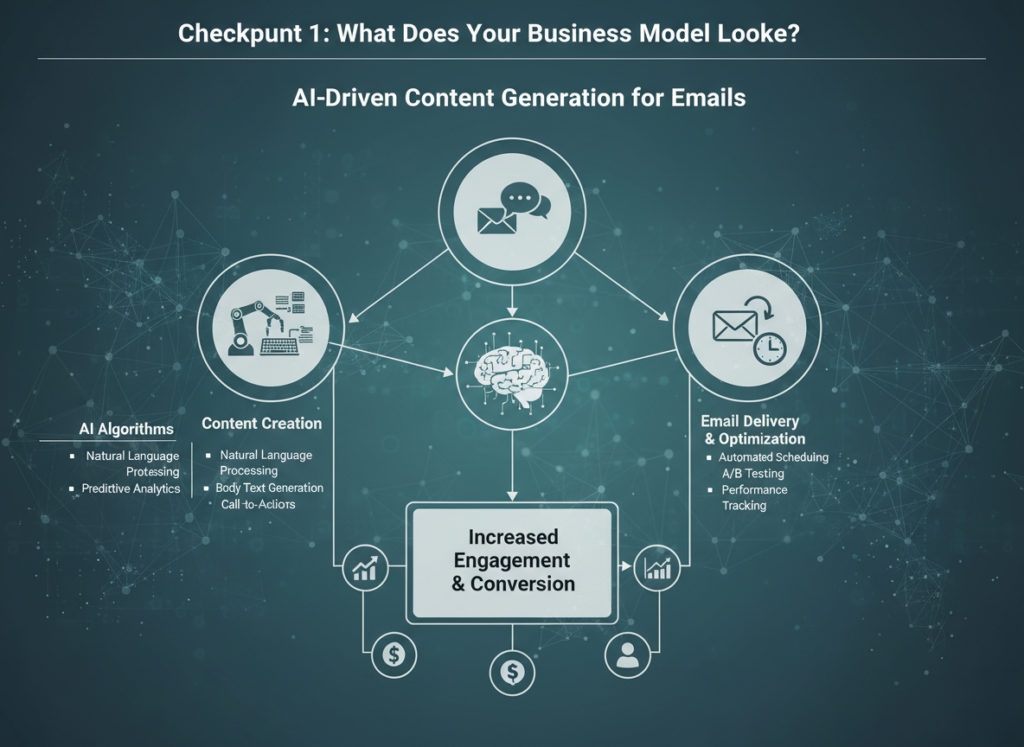
If you sell products (physical or digital) and email directly influences purchase decisions, Klaviyo AI is the stronger investment. Its behavioral intelligence is purpose-built for this model. If you sell services, expertise, or content — and email is about relationship-building and nurture rather than direct purchase conversion — MailerLite AI is almost certainly sufficient and far more cost-effective.
Checkpoint 2: What’s Your Current List Size and Budget?

Under 1,000 subscribers: Start with MailerLite’s free plan. Build your list, refine your messaging, and revisit the decision when you hit 1,000–2,000 contacts. Between 1,000–5,000 subscribers: Run the numbers. If you’re in e-commerce and email is a real revenue channel, Klaviyo’s pricing is justifiable. If not, MailerLite’s $9–19/month is the smarter choice. Over 5,000 subscribers in e-commerce: Klaviyo is almost always the better investment at this stage.
Checkpoint 3: How Important Is AI-Assisted Writing?

If time savings on content creation is your primary pain point, MailerLite’s AI writing assistant is a more direct solution than Klaviyo’s. If your pain is targeting accuracy and revenue attribution, Klaviyo’s predictive AI wins.
Common Mistakes to Avoid:
The biggest mistake in this comparison is choosing based on feature lists rather than actual use cases. Klaviyo has more features — that’s true. But features you don’t use don’t generate ROI. Test whichever tool you’re leaning toward with your actual email workflow for 30 days before committing to an annual plan.
The second most common mistake is underestimating the impact of list quality on AI performance. Klaviyo’s predictive models work better with clean, engaged lists than with large, low-quality ones. Before investing in either platform’s AI features, make sure your list is properly segmented and regularly cleaned.
See our full MailerLite AI review for a detailed walkthrough of its AI writing features and how they perform in real campaign creation scenarios.
Frequently Asked Questions
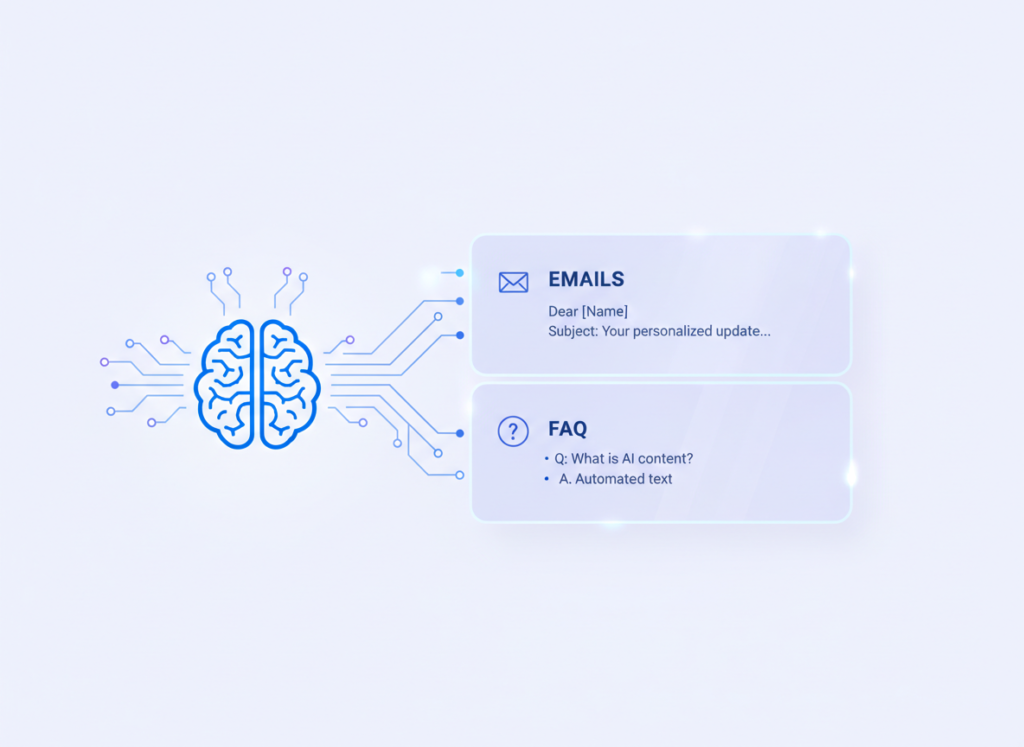
Is Klaviyo AI better than MailerLite AI for small business email marketing?
Neither is universally better — the right answer depends entirely on your business model. Klaviyo AI is better for product-based businesses that need behavioral segmentation, predictive analytics, and deep e-commerce integration. MailerLite AI is better for service businesses, creators, and early-stage companies that need an affordable, easy-to-use platform with AI writing assistance. For most small businesses comparing these two on cost-effectiveness alone, MailerLite wins. For e-commerce businesses where email drives direct revenue, Klaviyo typically generates higher returns.
Can I use either platform if I’m new to email marketing automation?
Yes, but with different experiences. MailerLite is genuinely beginner-accessible — you can send your first campaign within hours of signing up, and the automation builder uses plain-language visual flows. Klaviyo has a steeper curve; its interface assumes some familiarity with email marketing concepts. New users consistently report needing 2–4 weeks before feeling comfortable navigating Klaviyo’s full feature set. If you’re brand new to email marketing, MailerLite is the lower-risk starting point.
Do I need both Klaviyo and MailerLite?
No. These tools overlap significantly in core functionality — using both would mean paying for redundant capabilities and managing split contact lists, which creates data quality problems. Choose one platform based on your primary use case and commit to it. The only scenario where using both makes sense is if you’re an agency managing different client types — e-commerce clients on Klaviyo, service business clients on MailerLite — which is a legitimate agency workflow.
How much time can AI email tools actually save for small business owners?
Based on typical small business usage patterns, expect 30–60% time savings on email campaign creation with MailerLite’s AI writing assistant, particularly on subject line testing and initial draft generation. Klaviyo’s AI time savings come primarily from automation — flows that run without manual triggering save 2–5 hours per week for businesses with complex segmentation needs. Both tools deliver meaningful time savings, but in different parts of the email workflow.
Leave a Reply