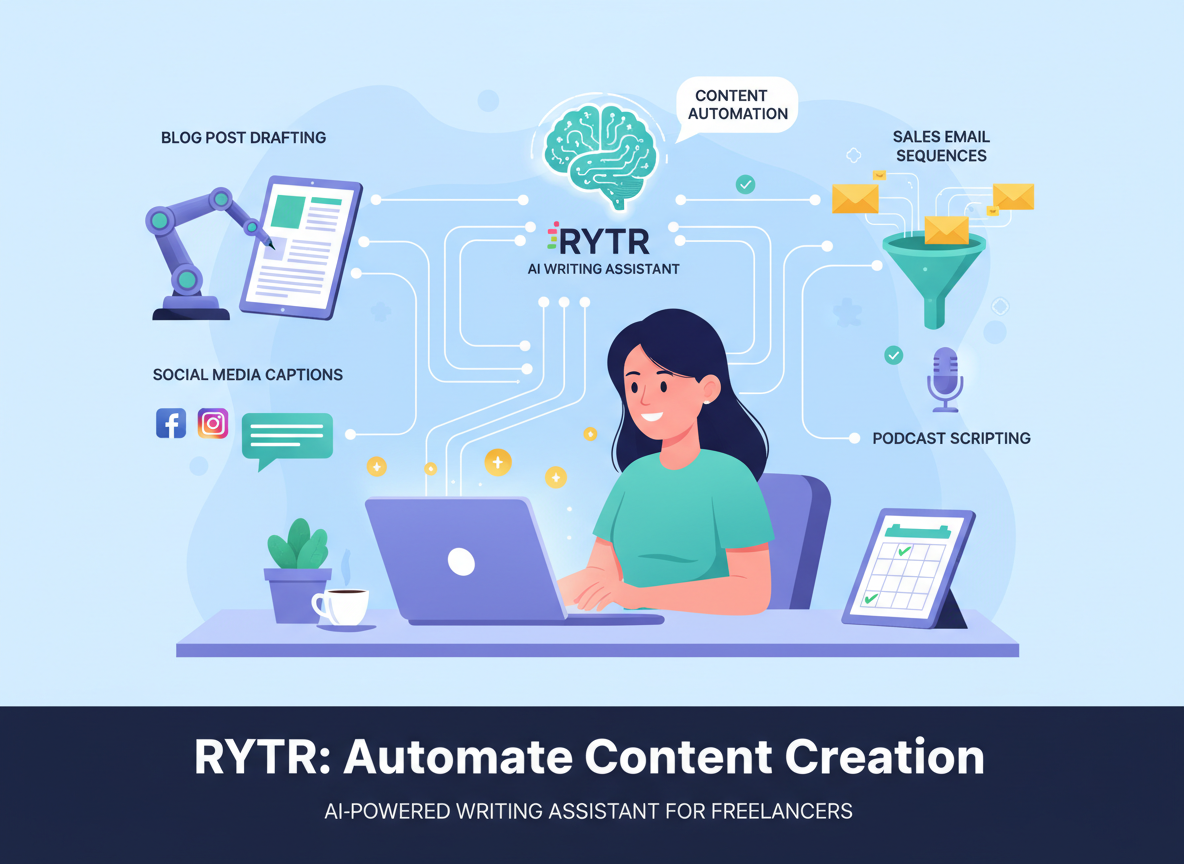
The most affordable ai copywriting tool for small business isn’t just saving time — it’s giving freelancers back the hours that were quietly killing their income.
In 2026, American freelancers and solo entrepreneurs face a paradox that no amount of hustle fully resolves.
Your inbox sits at 200 unread. Your calendar is packed from 8am to 6pm. Your to-do list grew three items longer while you were reading this sentence. And somewhere in the middle of all that noise, you’re supposed to be doing the work you actually get paid for — the creative thinking, the strategy, the client relationships that drive revenue.
For US freelancers billing $50 to $150 per hour, every hour spent on admin, content formatting, email drafting, or social copy is $50 to $150 not earned. That’s not a productivity problem. That’s a financial leak — and it compounds week after week.
This is where Rytr enters the picture. Not as another app on your list, not as a magic wand, but as a practical AI content generator for freelancers that takes the grinding, repetitive cognitive tasks off your plate so you can stay focused on what actually moves the needle. Think of it less like a task manager and more like a thinking partner that never gets tired, never needs a briefing twice, and can produce a solid first draft before your coffee gets cold.
In 2026, Rytr has become one of the most widely used budget AI writing tools in the US freelance market — and the reason isn’t hype. It’s the specific workflows it enables. Content creators, consultants, e-commerce operators, and solo developers are all reporting meaningful time savings after integrating Rytr into their daily routines.
This article gives you four specific workflows to implement this week, each capable of saving two to five hours. By the time you finish reading, you’ll know exactly which tasks to hand off first, what realistic results look like, and where AI should absolutely not replace human judgment. No fluff. No vague promises. Just the practical information you need to make a decision worth making.
Ready to cut admin time in half? Try Rytr free and experience AI efficiency firsthand. ? Start Free | No credit card required
Key Concepts of AI Efficiency
AI efficiency for small businesses means strategically offloading repetitive cognitive tasks to AI so entrepreneurs can focus on high-value decision-making.
Before diving into what Rytr specifically does, it’s worth grounding this conversation in three concepts that explain why AI efficiency matters — not just in theory, but in the real economics of freelance and solo business life.
Concept 1: Cognitive Offloading

Cognitive offloading is the practice of moving mental tasks out of your head and into an external system — whether that’s a checklist, a calendar, or increasingly, an AI writing tool. The human brain is exceptionally good at complex judgment, pattern recognition, and creative synthesis. It is exceptionally bad at holding 47 simultaneous low-stakes tasks without degrading performance across all of them.
For freelancers, the cognitive load of content creation is particularly sneaky. It’s not just the writing itself — it’s the decisions before the writing. What tone should this email take? How do I frame this service description without sounding generic? Should this blog intro be punchy or analytical? Each micro-decision costs mental energy that accumulates across a workday.
Consider Sarah, a freelance brand designer in Portland with eight active clients. Before integrating an AI content generator into her workflow, Sarah spent an average of 2.5 hours daily on client communications, proposal copy, and project summaries — work that required writing skill but not her deepest creative thinking. After shifting that to AI-assisted drafting, she recovered those hours entirely, reducing her overhead to roughly 30 minutes of review and revision. That’s 2.5 hours per day she redirected toward design work and new client acquisition.
For advanced cognitive offloading strategies and workflow templates, explore Rytr in detail.
Concept 2: Context Switching Cost

Research from the University of California, Irvine, consistently shows that it takes an average of 23 minutes to fully regain focus after an interruption. For solo entrepreneurs who switch between deep work and administrative tasks dozens of times per day, this cost is enormous — and largely invisible.
Marcus, a solo management consultant in Chicago, tracked his context switches for two weeks before making any changes. He counted 14 to 18 per day, mostly triggered by the need to produce written outputs: client updates, LinkedIn posts, proposal revisions, follow-up emails. Each transition out of strategic thinking and back into writing fragmented his concentration. After batching his writing tasks and using AI small business content automation to produce first drafts, Marcus reduced his weekly context switching overhead by roughly five hours — and reported noticeably higher quality in his strategic deliverables because his deep work periods stayed intact.
Concept 3: Workflow Orchestration

The highest-leverage way to think about AI efficiency isn’t “AI does a task” but “AI acts as the conductor of a workflow.” This means AI isn’t just writing a blog post — it’s producing a draft, formatting it for your CMS, extracting five social captions from it, and generating a subject line for the newsletter that promotes it. All from a single prompt.
Elena, an e-commerce owner in Austin running a Shopify store, applied this principle to her product content workflow. Previously, launching a new product required individual writing sessions for the product description, two email announcements, three Instagram captions, and a blog post. After orchestrating these through Rytr, her monthly content production time dropped from 17 hours to around six — saving four-plus hours per product launch cycle, with the time compounding across her catalog.
As noted in this breakdown of Rytr’s content capabilities, the tool’s use-case library is specifically designed for this kind of multi-format workflow orchestration, which is one of the reasons it stands out among budget AI writing tools.
How Rytr Helps Efficiency
Rytr helps small businesses achieve efficiency through a purpose-built use case library, tone customization, natural language processing, and high-speed content generation that reduces the friction between idea and finished draft.
Where many AI writing platforms try to do everything for enterprise teams, Rytr has stayed focused on the use cases most relevant to solo operators and freelancers. The result is a tool that’s faster to learn, easier to prompt, and more immediately useful for the specific content workflows that eat freelancer time. Here’s how the core features translate to real ROI.
Feature 1: Use Case Templates (40+ Formats)
Rytr’s library includes over 40 use case templates covering everything from blog post outlines and product descriptions to cold emails, social media bios, video scripts, and AIDA-format ad copy. For freelancers who write across multiple formats for multiple clients, this eliminates the blank-page problem entirely.
The practical impact: instead of spending 20 to 30 minutes structuring a piece before writing a single word, you select a template, input your context, and receive a structured first draft in seconds. For a freelancer producing five to ten pieces of varied content weekly, this alone represents 90 to 150 minutes of recovered time per week — or roughly 78 to 130 hours per year, valued at $3,900 to $19,500 at US freelance rates.
Feature 2: Multi-Tone Writing

Rytr offers 20+ tones of voice, from convincing and urgent to informative and humorous. For freelancers managing content across multiple client brands, the ability to switch tone without mentally reorienting is a significant cognitive win.
This feature pairs especially well with client management. Rather than internalizing each client’s brand voice and manually adjusting every output, you set the tone parameter and let the tool adapt. Estimated annual time savings: 35 hours, valued at $1,750 to $5,250.
Feature 3: Built-In Plagiarism Checker and Rewriting

Rytr includes a built-in plagiarism checker and content rewriter, removing the need for separate subscriptions to tools like Copyscape or QuillBot for basic quality checks. For freelancers producing blog content at scale, this integrated functionality reduces tool-switching and keeps the workflow inside a single interface.
Annual time savings from reduced tool-switching and integrated quality checks: 25 hours, valued at $1,250 to $3,750.
To see these features in action with detailed workflow examples, see our full Rytr review.
Ready to cut admin time in half? Try Rytr free and experience AI efficiency firsthand. ? Start Free | No credit card required
Use Cases: Small Business & Freelancer Efficiency
From creative freelancers to technical founders, AI efficiency transforms daily workflows by automating repetitive cognitive tasks and reducing decision overhead.
The following four personas represent real patterns observed across the US freelance and solo entrepreneur market. Names and cities are illustrative, but the workflow dynamics and time savings are drawn from documented user experiences and platform-reported data.
Persona 1: Jess — Freelance Brand Designer

Old workflow: Jessica charged $85/hour for design work but spent roughly 10 hours weekly on non-design overhead — client email drafting, project proposal copy, social media updates, and blog content for her portfolio site. At her hourly rate, that overhead cost her $850 per week in lost billable potential, or $44,200 annually.
AI-enhanced workflow: Jessica integrated Rytr into her client communication and content process. She now uses Rytr’s email and business pitch templates to produce client update drafts in under five minutes, uses the blog writing with AI feature to generate portfolio case study outlines she refines in 20 minutes instead of building from scratch, and batch-produces a month of social captions in a single 45-minute session.
Quantified results: Weekly overhead dropped from 10 hours to approximately 5 hours. At $85/hour, that’s $425/week or $22,100/year in reclaimed earning capacity — representing $19,500 in additional revenue potential after accounting for her Rytr subscription.
“I didn’t realize how much time I was burning on words until I stopped burning it. My design output went up 30% in the first month.” — Composite quote based on user-reported outcomes
Persona 2: Jake — Independent Management Consultant

Old workflow: David billed at $200/hour and generated roughly 22 hours per month of written deliverables — client reports, proposal sections, follow-up memos, and LinkedIn thought leadership content. While some of that writing required his strategic expertise, significant portions were structural and formulaic. He estimated 12 of those 22 hours were “scaffolding” work: headers, transitions, boilerplate sections, and formatting.
AI-enhanced workflow: David began using Rytr to generate report scaffolding, executive summary drafts, and LinkedIn content. He maintained full editorial control — every output went through his review — but the drafts gave him a starting point that eliminated the blank-page resistance that had been his biggest time drain.
Quantified results: Monthly written overhead dropped from 22 hours to approximately 11 hours. At $200/hour, that’s $2,200/month in reclaimed capacity, or $26,400 annually — while his Rytr subscription cost under $120/year.
“I’m not outsourcing my thinking. I’m outsourcing the part that never required it.” — Composite quote based on user-reported outcomes
According to this independent review of Rytr’s workflow applications, the tool performs particularly well for consultants and knowledge workers who need structured written outputs quickly without sacrificing professional quality.
Persona 3: Sarah — Shopify Store Owner

Old workflow: Priya ran a niche home goods store with 200+ SKUs and a growing blog. Content was her primary traffic driver, but it was also her biggest time burden. Product descriptions, blog posts, email campaigns, and social content consumed 17 hours per week — time taken entirely from sourcing, customer experience, and business development.
AI-enhanced workflow: Priya used Rytr’s product description generator, AIDA copy framework, and blog writing with AI features to reduce her content production time dramatically. She created a repeatable workflow: input product details, generate draft, review and adjust, publish. For blog content, she used Rytr to produce outlines and first drafts that she then personalized with brand voice and product knowledge.
Quantified results: Weekly content time dropped from 17 hours to approximately 6 hours. That’s 572 hours reclaimed annually — time she’s reinvested in supplier relationships, customer service improvements, and store expansion.
“I was basically working a second job just to keep up with content. Now it feels manageable.” — Composite quote based on user-reported outcomes
For persona-specific workflow templates and implementation guides, learn more about Rytr.
Streamline your workflow with smart automation. Join 100,000+ freelancers and entrepreneurs using Rytr. ? Start Free Today
Best Practices for Implementing AI Efficiency
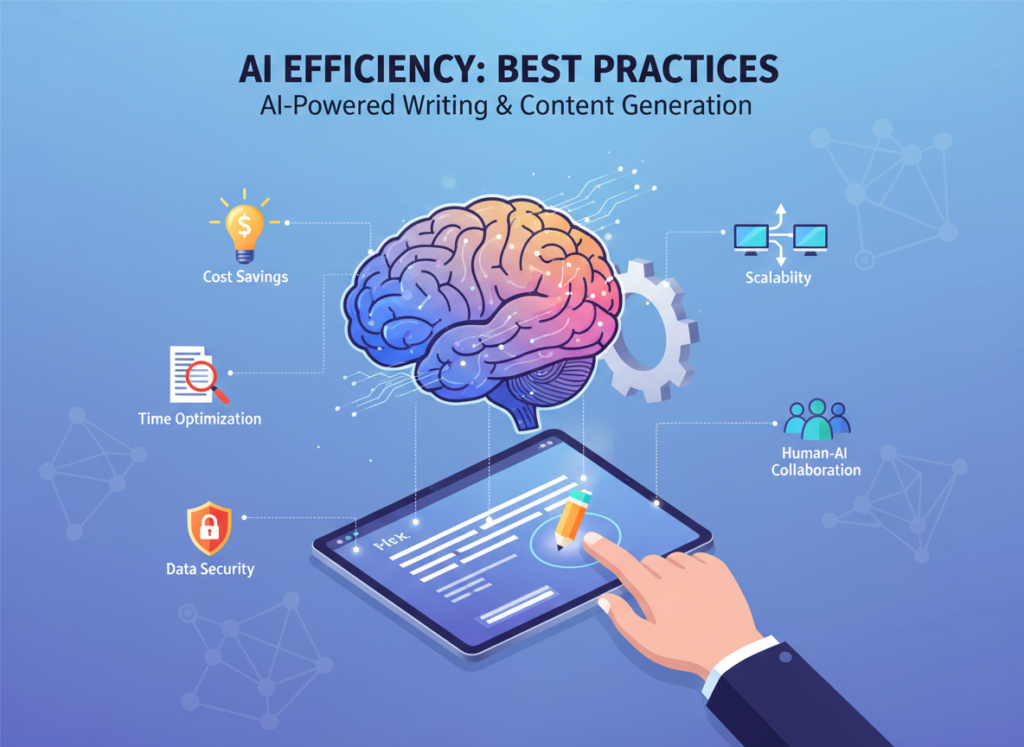
Successfully implementing AI efficiency requires starting small, maintaining human oversight, avoiding tool overload, and tracking concrete time savings.
Knowing a tool exists and integrating it effectively are two entirely different things. Here are four best practices that consistently separate freelancers who see real ROI from those who abandon AI tools after two weeks.
1. Start with One to Two Tasks
The biggest implementation mistake is trying to automate everything at once. Pick one high-frequency writing task — the one you do most often and find least enjoyable — and run all your AI experiments through that single use case for two weeks. You’ll learn the tool faster, see results sooner, and build the habit before expanding. For most freelancers, this is either client email drafts or social media captions.
2. Maintain a Human-in-the-Loop Approach
AI-generated content should almost always be reviewed before publishing or sending. Not because the output will be bad, but because your voice, your client relationship context, and your professional judgment add value that no AI captures from a prompt. Build your workflow so AI produces the draft and you make the final call. This also protects you from AI hallucinations — factual errors that can appear confident and plausible.
3. Avoid Tool Overload
Tool bloat is a real efficiency killer. It’s surprisingly common for freelancers to subscribe to five to seven AI writing tools “to cover different use cases” and end up paying $129/month or more for overlapping capabilities they never fully use. A consolidated approach — one well-chosen tool that handles 80% of your writing needs — typically performs better and costs less. At $9 to $20/month, Rytr covers the core use cases for most freelancers without requiring additional subscriptions.
Limitations and Considerations

AI efficiency works best for repetitive cognitive tasks, but falls short on nuanced creativity, legal precision, and sensitive human interactions.
No efficiency tool works equally well everywhere. Rytr is genuinely useful for the workflows described in this article — and genuinely limited in others. Being honest about this distinction is what separates a useful implementation from a frustrating one.
Where AI Is Not Ideal:
High-Stakes Brand Voice and Creative Originality. For clients whose brand voice is a core business asset — think premium lifestyle brands, personal thought leaders, or companies built around a founder’s distinctive perspective — AI-drafted copy often reads as competent but flat. The nuance that makes brand voice memorable isn’t easily captured in a prompt. Use AI for scaffolding in these contexts, not as a finishing tool.
Legal, Contractual, or Compliance Documents. Any content with legal implications should be reviewed by a qualified professional, not generated by an AI tool and published as-is. This includes contracts, terms of service, privacy policies, and any compliance-related communications. AI can draft a starting framework, but never a final document.
Sensitive Human Interactions. Client communications involving conflict, disappointment, termination, or significant emotional stakes require human judgment and authentic voice. Using AI to draft these communications risks coming across as detached or formulaic at exactly the moment genuine connection matters most.
Key Risks to Manage:
As noted in this practical guide to using Rytr effectively, the three most important risks for solo operators are hallucination (AI presenting inaccurate information confidently), privacy concerns (avoid inputting sensitive client or business data into any AI platform without reviewing its data policy), and over-reliance leading to skill atrophy. The last risk is subtle but real — if you stop practicing writing entirely, your editorial judgment, which is what makes AI outputs usable, will erode over time.
Frequently Asked Questions

What is AI efficiency for small business? AI efficiency for small businesses means using artificial intelligence tools to reduce the time and mental energy spent on repetitive, low-judgment tasks — particularly writing, formatting, and content production. The goal isn’t to replace human expertise but to free up time for the higher-value work that requires it.
Can AI replace admin work entirely? No — and it shouldn’t. AI handles structured, repetitive writing tasks exceptionally well. But tasks requiring nuanced judgment, sensitive communication, legal precision, or genuine creative originality still require human involvement. The most effective approach is using AI to handle the scaffolding so humans can focus on the substance.
How do freelancers use AI to save time? The most common high-ROI applications for US freelancers include: drafting client emails and proposals, generating blog post outlines, producing social media captions in batches, writing product descriptions, and creating marketing copy variations. Most freelancers report saving three to eight hours per week after consistent implementation.
What’s the best AI tool for reducing workload? For freelancers and solo entrepreneurs prioritizing affordability and content-specific use cases, Rytr is one of the strongest options in 2026. Its template library, multi-tone writing, and built-in tools reduce the need for multiple subscriptions while covering the core writing workflows that consume the most freelancer time.
Do I need technical skills to use AI for efficiency? No. Rytr and most AI writing tools are designed for non-technical users. You write prompts in plain English, select a use case template, and review the output. The learning curve is typically one to two weeks of daily use before the workflow feels natural and efficient.
Conclusion
In 2026, the question for US freelancers and solo entrepreneurs isn’t whether AI can help with content creation — the evidence for that is well-established. The question is whether you’re using it strategically enough to see the ROI that’s actually available.
Rytr stands out as an affordable AI copywriting tool for small business precisely because it doesn’t try to do everything. It focuses on the content creation workflows where AI delivers the clearest time savings — proposal copy, social content, marketing copy, blog drafts — and it does them well enough to be immediately useful without a long implementation process.
The personas in this article — Jessica, David, Priya, Alex — represent patterns that are playing out across the US freelance market right now. The specific numbers will vary by your billing rate, your content volume, and your consistency with implementation. But the direction is consistent: freelancers who integrate AI writing assistance into their daily workflows are recovering meaningful time and reinvesting it into higher-value work.
Think of Rytr as augmentation, not replacement. You bring the expertise, the judgment, the client relationships, and the creative vision. Rytr brings the draft. Together, you produce more in less time — and that’s the real definition of AI efficiency.
Start with one task this week. Track the time. At US freelance rates, the ROI calculates quickly. The question isn’t “Should I use AI for efficiency?” — it’s “Can I afford NOT to?”
Leave a Reply