Most small teams waste thousands on video production they could replace in an afternoon — HeyGen AI changes that math permanently.
If you’ve ever watched a new hire sit through a 40-minute Zoom call just to learn how to submit an expense report, you already understand the problem. In 2026, the fastest-growing operational bottleneck for US small businesses isn’t hiring or funding — it’s knowledge transfer. And video is where that bottleneck hits hardest.
Producing a single training or marketing video the traditional way means booking a studio, coordinating schedules, hiring a videographer, and waiting days for editing. In cities like San Francisco and New York, that process can run $3,000–$8,000 per finished video. For a 10-person team trying to onboard fast and market consistently, that math simply doesn’t work.
HeyGen AI is an ai avatar video generator that lets US founders, marketers, and trainers create professional-quality videos using AI-generated presenters, text-to-speech narration, and browser-based editing tools — no cameras, no actors, no production crew required. You paste your script, choose your avatar, and publish. A video that once took days now takes 20 minutes.
But the bigger opportunity isn’t just cost savings on individual videos. It’s what happens when a growing team stops treating video production as a special project and starts treating it as a standard workflow. That’s the Solo DX shift — turning one-off creative chaos into a repeatable, scalable system.
Unlike traditional video documentation, which requires $5,000+ in US labor and weeks of coordination, HeyGen AI lets teams build a working video library in a matter of days. This article breaks down exactly how to make that happen, with real use cases, honest ROI numbers, and a practical implementation path for teams of 3 to 15 people.
Join 10,000+ US small teams using HeyGen AI to eliminate operational chaos. See How It Works
What is Solo DX?
Solo DX — short for Solo Digital Transformation — is the practice of implementing business-grade operational systems inside a small US team, without a dedicated operations manager, IT department, or enterprise budget.
Most digital transformation frameworks assume you have a change management team, a six-month runway, and 50 employees willing to sit through training sessions. Solo DX assumes none of that. It’s designed for the founder running three departments, the marketing lead who’s also the onboarding coordinator, and the executive assistant who somehow became the de facto knowledge base for the entire company.
| Category | Who It’s For | Primary Goal |
|---|---|---|
| Solo DX | 3–15 person US teams | Build repeatable systems from scratch |
| AI Efficiency | Individual contributors | Save personal time via automation |
| AI Revenue Boost | Growth-stage teams | Use AI to acquire and retain customers |
The distinction matters because the failure mode is different. When a solo contributor uses AI to save time, the stakes are low — if the workflow breaks, only one person is affected. But when a growing team fails to systemize, knowledge gets siloed, onboarding takes forever, and quality becomes inconsistent across the company.
Corporate SOP methodologies fail for US SMBs for three predictable reasons. First, they require dedicated documentation staff that small teams don’t have. Second, they assume stable processes, but teams of 5–10 are still iterating their workflows weekly. Third, they produce static documents that nobody reads — PDFs that sit in a shared drive until they’re two years out of date.
Video changes the equation. When a process is explained once on camera (or on screen, via AI avatar), that explanation becomes infinitely replayable. The Austin-based 3-person design studio that used to onboard contractors via 90-minute Slack conversations can now send a 4-minute HeyGen video instead. The knowledge is transferred, documented, and standardized — in a format people actually watch.
To see how this plays out in practice, explore HeyGen AI’s features and see how teams are applying it to documentation and training use cases.
The Solo DX approach to video isn’t “make more content.” It’s “make the right content once, then deploy it as infrastructure.” Every onboarding video, every SOP walkthrough, every client explainer becomes a reusable asset that pays dividends every time it’s used.
Join 10,000+ US small teams using HeyGen AI to eliminate operational chaos. See How It Works
Why AI is Key for Mini-Team Systemization
Problem 1: Knowledge lives in the founder’s head.

In most 5–10 person teams, the person who knows how things actually work is also the person with no time to document it. The result is a dangerous dependency: if that founder travels, gets sick, or simply steps back from day-to-day operations, institutional knowledge evaporates. US labor turnover is running at roughly 47% annually in service industries, which means the cost of undocumented knowledge isn’t theoretical — it’s paid every time someone quits and takes their workflows with them.
AI video tools like HeyGen let founders narrate processes directly from a script or outline. There’s no camera setup, no lighting, no post-production delay. The founder records their knowledge once, in text form, and the AI avatar delivers it on screen. That knowledge is now portable, searchable, and repeatable.
Problem 2: New hires slow down operations instead of accelerating them.
The average US small business spends 15–20 hours of senior staff time onboarding each new hire. At a blended US labor rate of $75/hour, that’s $1,125–$1,500 per hire in direct time costs — before you account for the learning curve drag on productivity. For teams hiring even four people per year, that’s $4,500–$6,000 in lost senior capacity.
When onboarding is systematized through video — a library of role-specific walkthroughs, tool tutorials, and process explainers — new hires self-serve through their first two weeks. Senior staff answer clarifying questions rather than re-explaining fundamentals for the hundredth time.
Problem 3: Quality varies across team members.
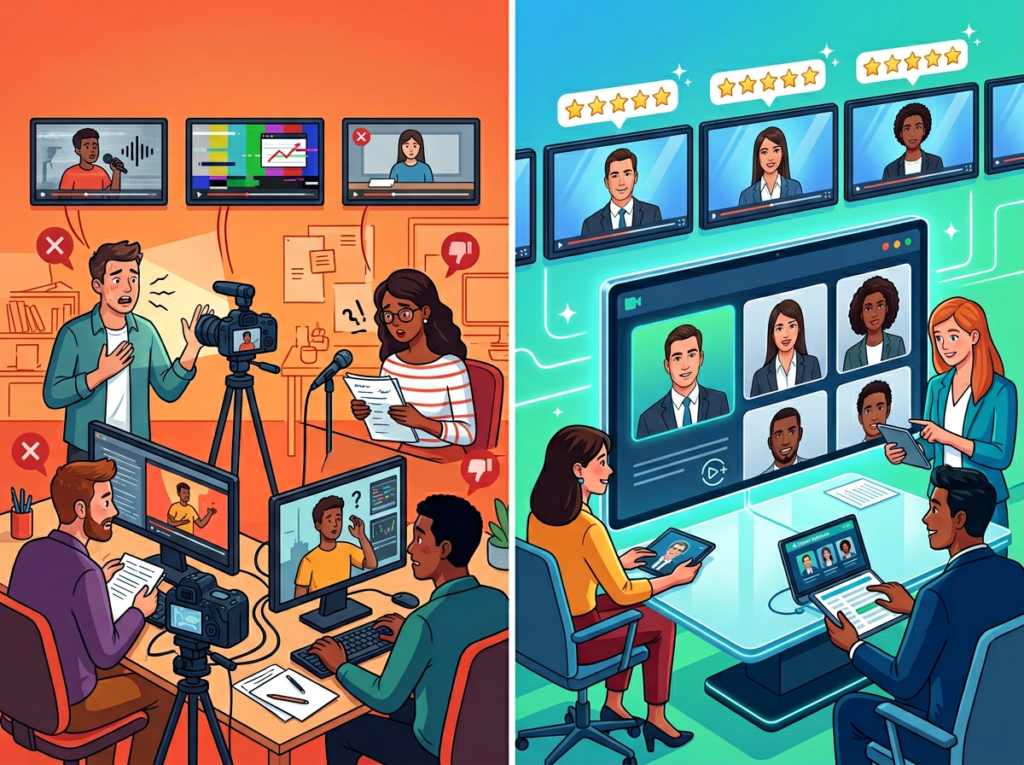
A sales pitch delivered by one team member closes at 30%. Delivered by another, it closes at 12%. A client onboarding call handled by the operations lead leaves clients confident; handled by a junior hire, it leaves them confused. The difference isn’t talent — it’s documentation. When the best version of every customer-facing process lives in a video that every team member can watch and follow, quality stops depending on who happened to handle the interaction.
The cost reality is stark. Manual video production for a 10-video training library runs $30,000–$80,000 in US production costs. The same library built in HeyGen costs under $500 in subscription fees and 20–30 hours of internal time. That’s not a marginal efficiency gain — it’s a structural advantage for every small team that makes the switch.
How HeyGen AI Enables Solo DX

1. AI Avatar Video Creation to $2,400 saved per training cycle
HeyGen’s core feature is its library of 700+ AI avatars paired with 300+ voices in 170+ languages. You write a script, select a presenter, choose a background, and the platform renders a professional-looking talking-head video in minutes. For US teams producing onboarding content, sales training, or client education videos, this replaces the need for on-camera talent entirely.
A single onboarding video that would cost $2,000–$4,000 to produce with a videographer can be built in HeyGen for the cost of a monthly subscription. Across a standard 10-video training library, that’s $20,000–$40,000 in production costs eliminated. At the team level, accounting for the 4–6 videos a small marketing or operations team produces per quarter, the annual savings run $8,000–$15,000.
2. AI Script Generation to 8 hours saved per video project
HeyGen includes AI scriptwriting tools that turn topic outlines into complete, structured video scripts. For a team producing product explainers or client onboarding walkthroughs, this eliminates the most time-consuming part of the process — going from idea to camera-ready copy.
At a US knowledge worker rate of $60–$90/hour, eliminating 8 hours of scripting per video saves $480–$720 per project. A team producing 20 videos annually saves $9,600–$14,400 in scripting labor alone.
3. Video Translation and Localization to $6,000+ annually for teams serving bilingual markets
HeyGen’s video translation feature automatically dubbs existing videos into 40+ languages, with lip-sync adjustments that keep the avatar’s mouth movement synchronized to the new audio. For US teams serving Spanish-speaking clients — a market segment that represents 19% of the US population — this eliminates the cost of producing separate Spanish-language versions of every training or marketing video.
Producing a bilingual version of a 10-video library through traditional dubbing and localization services runs $4,000–$8,000. HeyGen handles the same output in hours, at no additional per-video cost beyond the base subscription.
For a marketing team producing client-facing videos weekly, this eliminates 2–3 hours of formatting work per video. At 40 videos per year and $75/hour, that’s $6,000–$9,000 in recovered time.
Ready to build your video library in under a week? Try HeyGen AI Free at heygen.com | No credit card required | Used by 10,000+ US teams
Putting it together: the systemization math
| Capability | Annual Savings Estimate |
|---|---|
| AI avatar production (replaces videographer) | $8,000–$15,000 |
| AI script generation | $9,600–$14,400 |
| Video translation/localization | $4,000–$8,000 |
| Template-based workflows | $6,000–$9,000 |
| Total annual savings | $27,600–$46,400 |
These aren’t theoretical numbers. They’re based on US market rates for the services HeyGen replaces: videography ($150–$300/hour), scriptwriting ($60–$90/hour), localization ($0.20–$0.40/word), and design formatting time ($60–$75/hour).
As noted in this breakdown of HeyGen’s content creation workflow, the platform is specifically optimized for producing instructional content at scale — the exact use case that drives the most operational value for small US teams.
Join 10,000+ US small teams using HeyGen AI to eliminate operational chaos. See How It Works
Use Cases by Team Role
Persona 1: Mari — Startup Founder, Osaka

Maria runs a 9-person SaaS startup in San Francisco. She’s the de facto head of sales, product, and customer success. Her old workflow for client onboarding involved a 45-minute Zoom call for every new customer — a call that only she could run effectively, because the process lived entirely in her head.
With HeyGen AI, Maria scripted a 6-part onboarding video series: account setup, feature walkthrough, common troubleshooting, best practices, upgrade options, and support access. Each video took 25–35 minutes to produce. The entire library was live in three days.
New customers now self-serve through onboarding. Maria’s direct time per new client dropped from 45 minutes to 8 minutes (a single follow-up call). At 15 new clients per month and her $200/hour opportunity cost, that’s $31,500 recovered annually — time she now spends on sales and product development instead.
“I used to dread onboarding calls. Now clients show up to the check-in already knowing the product. The whole dynamic changed.”
Persona 2: Kim — Executive Assistant, Soul

James supports a 12-person operations team at a Miami logistics company. His biggest pain point: every time a new remote hire joined, James spent his first two weeks answering the same questions about internal tools, communication norms, and reporting workflows.
Using HeyGen AI’s text to video avatar tool, James built a 15-video remote onboarding library covering every recurring question he’d fielded over two years. Videos averaged 3–4 minutes each and were organized by topic in a shared Notion workspace.
New hire onboarding time dropped from 12 hours of James’s time per hire to under 2 hours. With the company hiring 8 remote staff per year at James’s $45/hour blended rate, the library saves $3,600 annually — plus the productivity benefit of new hires ramping 40% faster.
“The questions didn’t stop, but they got better. Instead of ‘how do I submit a PTO request,’ I’m getting ‘how should I think about prioritizing conflicting deadlines.’ That’s a much better conversation.”
Persona 3: Aisha — Marketing Lead, Austin

Aisha leads a 4-person marketing team at an Austin fintech startup. Her challenge: client reporting was handled differently by every team member — different formats, different metrics, different levels of narrative context. Client satisfaction scores were inconsistent, and the team was spending 6+ hours per week in formatting and QA.
Aisha used HeyGen to create a standardized “client report walkthrough” video template — a 5-minute explainer that walked clients through how to read each section of their monthly report. The video was personalized at the intro with a text overlay showing the client’s name and report date, then delivered via email alongside the PDF.
Client comprehension improved measurably: support tickets related to report confusion dropped 60%. Internal QA time dropped from 6 hours/week to under 2. At Aisha’s team’s blended rate of $65/hour, that’s $13,520 annually in recovered time. An analysis of HeyGen’s template capabilities in this Medium overview confirms that the platform’s template library is especially well-suited to this kind of repeatable, brand-consistent output.
“We went from every report feeling different to having a client say, ‘I love that you always explain it the same way.’ That consistency is worth more than the time savings.”
Join 10,000+ US small teams using HeyGen AI to eliminate operational chaos. See How It Works | Used by teams from Silicon Valley to New York
Common Pitfalls & How to Avoid Them
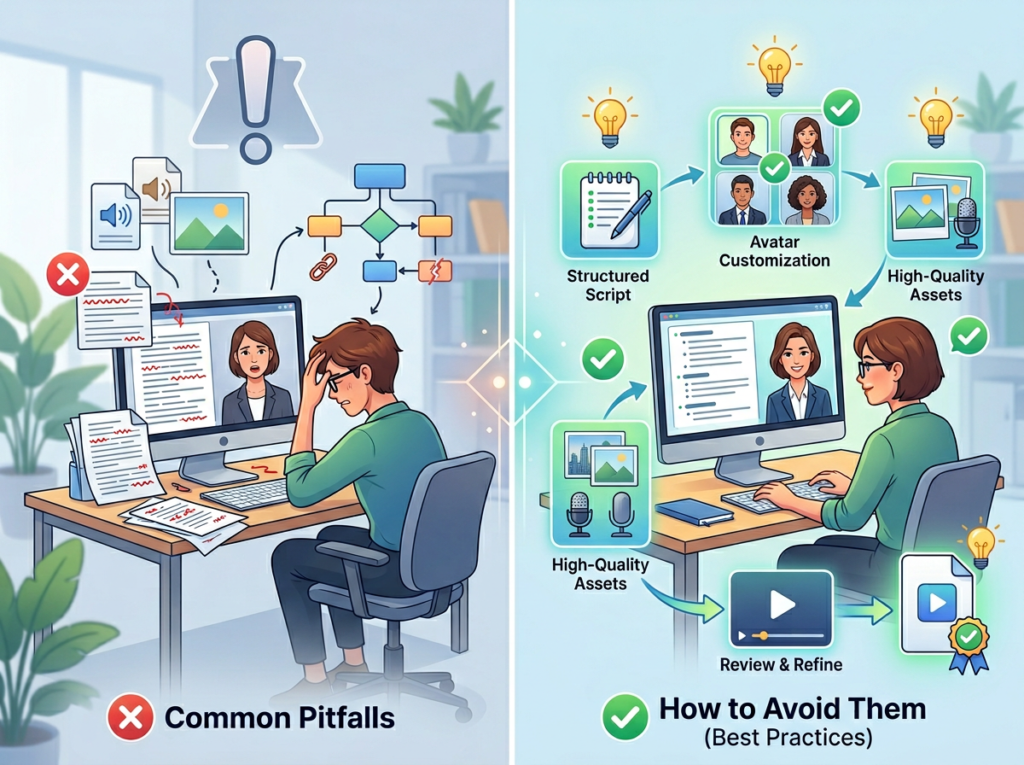
Mistake 1: Treating every video as a custom production project
The biggest efficiency killer is approaching each video as a one-off creative exercise — custom script from scratch, new visual format, no connection to the previous video’s structure. This is how traditional agencies work, and it’s exactly the pattern HeyGen is designed to break.
The fix: build two or three master templates before producing a single video. A training template, a client communication template, and a marketing explainer template cover 90% of small team use cases. Every new video starts from the nearest template, not from a blank slate. Learn more about HeyGen AI to see how the template system is structured.
Mistake 2: Delegating video production without a production brief
HeyGen’s low barrier to entry tempts founders to hand off video production to a junior team member without adequate context. The result: videos that miss the intended audience, use inconsistent terminology, or fail to reflect the brand’s actual voice.
The fix: create a one-page production brief template that covers audience, goal, key message, length, avatar selection, and brand language guidelines. Every video produced — regardless of who creates it — starts with a completed brief.
Mistake 3: Skipping the review step because “AI handled it”
AI-generated scripts are first drafts, not final copy. Teams that publish HeyGen videos without a human review step routinely discover factual errors, off-brand language, or structural gaps that would have been caught in a 10-minute review.
The fix: build a two-step review process into every production workflow. The script is reviewed before rendering; the final video is reviewed before publishing. A 15-minute investment per video prevents the kind of client-facing errors that are genuinely hard to walk back. As highlighted in HeyGen’s own guidance on how-to video production, structuring video production around clear goals and review steps is essential for consistent output quality.
Join 10,000+ US small teams using HeyGen AI to eliminate operational chaos. See How It Works
FAQs
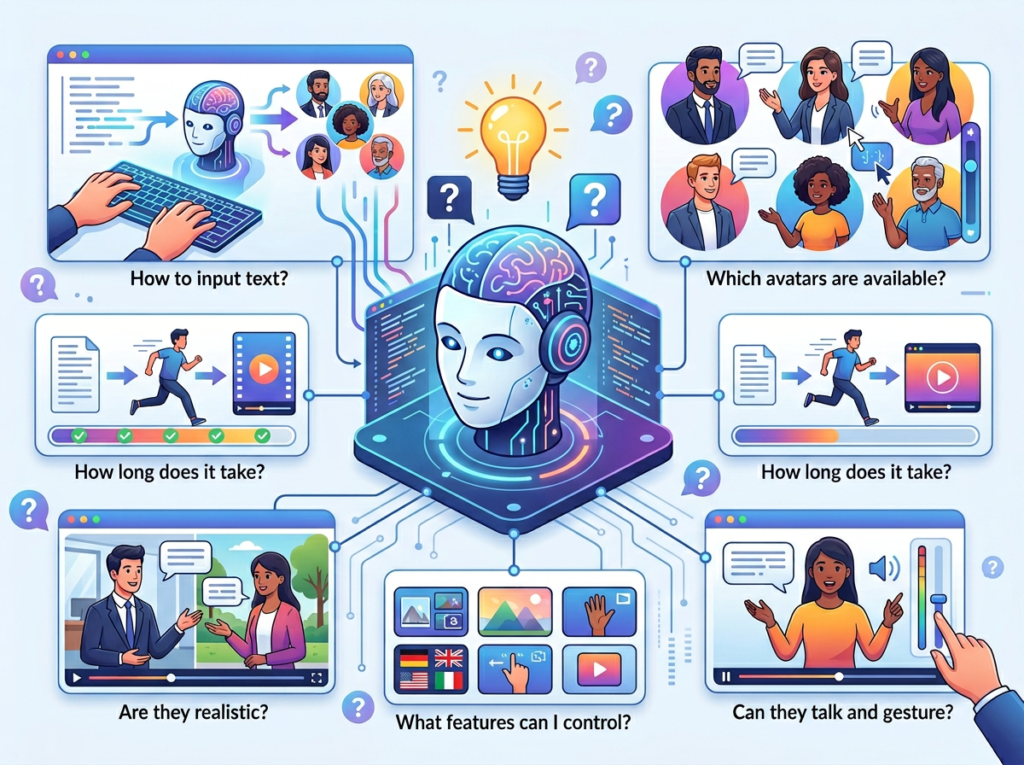
What is Solo DX?
Solo DX (Solo Digital Transformation) is the practice of implementing scalable operational systems in a small US team — typically 3–15 people — without a dedicated operations manager or enterprise-level IT support. It uses AI tools to replace manual documentation, inconsistent workflows, and founder-dependent knowledge transfer with repeatable, system-driven processes.
How can AI generate my training videos?
Tools like HeyGen AI accept a written script as input and render a fully produced video featuring an AI avatar, synchronized voiceover, branded backgrounds, and on-screen text. You provide the content; the platform handles the production. The resulting video is indistinguishable from a professionally produced explainer at a fraction of the cost — typically $50–$150 per video versus $1,500–$4,000 for traditional production.
What’s the difference between AI Efficiency and Solo DX?
AI Efficiency focuses on individual productivity — using AI to help one person work faster or smarter. Solo DX focuses on team systems — using AI to make an entire team’s output more consistent, transferable, and scalable. The difference is whether the benefit lives with one person or with the organization.
Conclusion
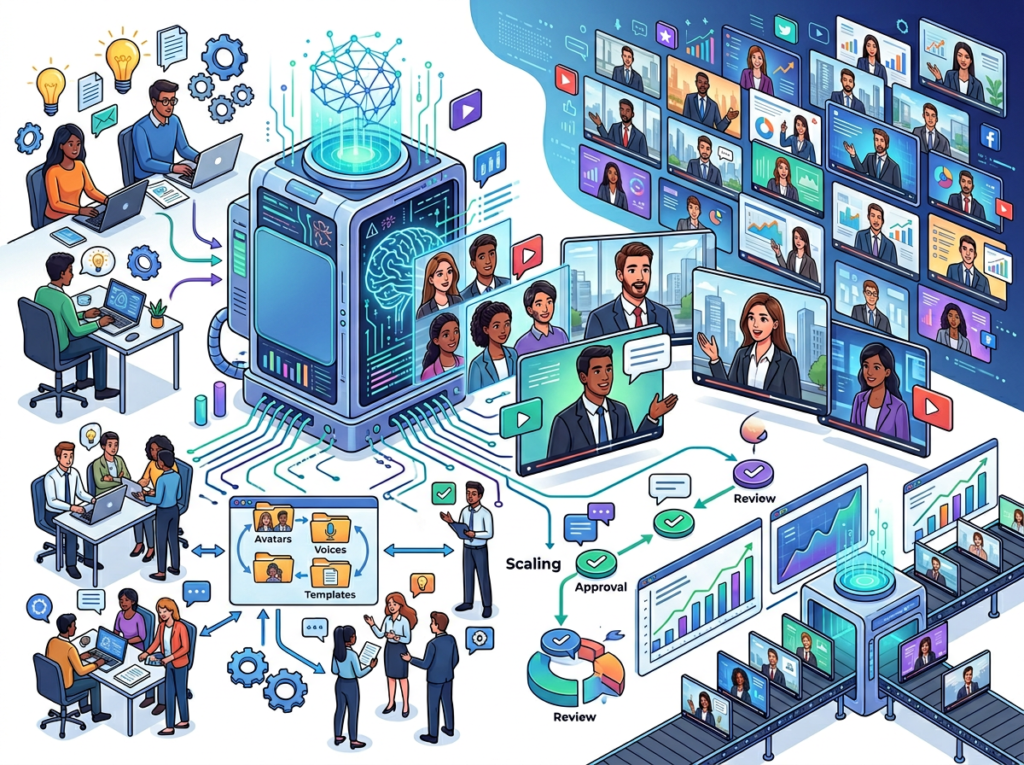
In 2026, American small businesses don’t need enterprise budgets to produce enterprise-quality video content. The infrastructure that once cost $10,000 and two weeks now costs $150 and an afternoon.
HeyGen AI is one of the most practical implementations of that shift. As an ai avatar video generator built for speed and repeatability, it gives US founders and their teams the ability to turn any process, training, or client communication into a professional video — without cameras, actors, or post-production delays.
The Solo DX value proposition is simple: stop treating video production as a special project and start treating it as a standard operational workflow. Build your templates. Document your key processes. Systematize your onboarding and client communications. Every video you produce this month is a reusable asset that pays dividends every time a new hire watches it, every time a client understands your product faster, every time a team member delivers your process consistently instead of improvising.
The teams winning in the current US market aren’t the ones with the biggest budgets — they’re the ones with the best systems. Start with one process. Systemize it this week.
Full HeyGen AI review and feature breakdown | No credit card required
Leave a Reply