
The best ai image generator for business doesn’t just create pretty pictures — it reclaims billable hours and eliminates the design bottleneck killing your marketing.
In 2026, American freelancers and solo entrepreneurs face a paradox. They have access to global audiences, affordable ad platforms, and a content calendar that demands fresh visuals every single day — yet most are still spending hours waiting on designers, wrestling with templates, or paying $300+ per project to a freelance illustrator for images that may or may not land.
Inbox at 200 unread. Calendar packed. To-do list endless. And somewhere in the middle sits a marketing queue full of social posts, landing page banners, email headers, and ad creatives that won’t create themselves.
For US freelancers and small business owners billing $50–$150 per hour, every hour spent chasing down visual assets is $50–$150 not earned. The design bottleneck isn’t a creative problem — it’s a time and money problem. That’s where Leonardo AI enters the picture.
Leonardo AI is a text-to-image AI generator built for production workflows, not just artistic experimentation. It’s not a design tool that happens to use AI — it’s an AI-native creative platform purpose-built for the kind of volume and consistency that modern marketing demands. Whether you’re a freelance brand designer juggling eight clients, a Shopify store owner needing daily product imagery, or a solo consultant building a content presence, Leonardo AI functions as a thinking partner and execution engine rolled into one.
This article delivers four specific workflows you can implement this week — each designed to save 2–5 hours in your marketing production cycle. No guesswork, no vague “use AI to be more creative” advice. Just concrete, US-market-tested efficiency strategies using one of the most powerful ai design tools for marketers available today.
Join 18 million+ creators using Leonardo AI to produce marketing assets at scale. Start Free Today at Leonardo.ai
Key Concepts of AI Efficiency
Concept 1: Cognitive Offloading

Cognitive offloading is the practice of delegating mental work — decision-making, ideation, formatting, generation — to an external system. For most small business owners, the hidden drain isn’t the big tasks. It’s the dozens of micro-decisions embedded in every project: which image style fits this post, how to frame a product photo, which color palette feels on-brand today.
Consider Sarah, a freelance brand designer in Portland working with eight clients simultaneously. Before adopting an AI image generation workflow, she spent roughly 10 hours per week on visual asset production — sourcing stock photos, editing in Photoshop, resizing for different platforms. After integrating an ai marketing image generator into her workflow, that dropped to 4.5 hours per week, saving 2.5 hours every single day she’s actively producing. That’s nearly 130 hours per year reclaimed — time she now bills directly to clients.
The key insight: cognitive offloading doesn’t remove your creativity. It removes the friction between your idea and its execution. Explore Leonardo AI in detail to see how its model selection and prompt-based generation eliminate the most time-intensive creative decisions.
Concept 2: Context Switching Cost

Research consistently shows that the average knowledge worker takes approximately 23 minutes to fully regain focus after an interruption or context switch. For a solo entrepreneur, every time you stop client work to generate a visual, brief a designer, or dig through stock photo sites, you’re not just losing that 20-minute task. You’re losing the 23 minutes it takes to get back.
Marcus, an independent management consultant in Chicago, tracked his weekly hours for a month before adopting AI visual tools. He identified 22 context switches per week tied to visual asset production — brief a freelancer here, review mockups there, request revisions across a dozen Slack threads. The total cost wasn’t 22 minutes. It was closer to 8+ hours of lost focus time per week. By consolidating his visual production into a single, on-demand AI session each morning, he eliminated most of those context switches and reclaimed 5 hours of focused working time weekly.
As noted in this breakdown of Leonardo AI workflows, the platform’s ability to generate multiple image variations in a single session significantly reduces the back-and-forth that drives context switching costs.
Concept 3: Workflow Orchestration
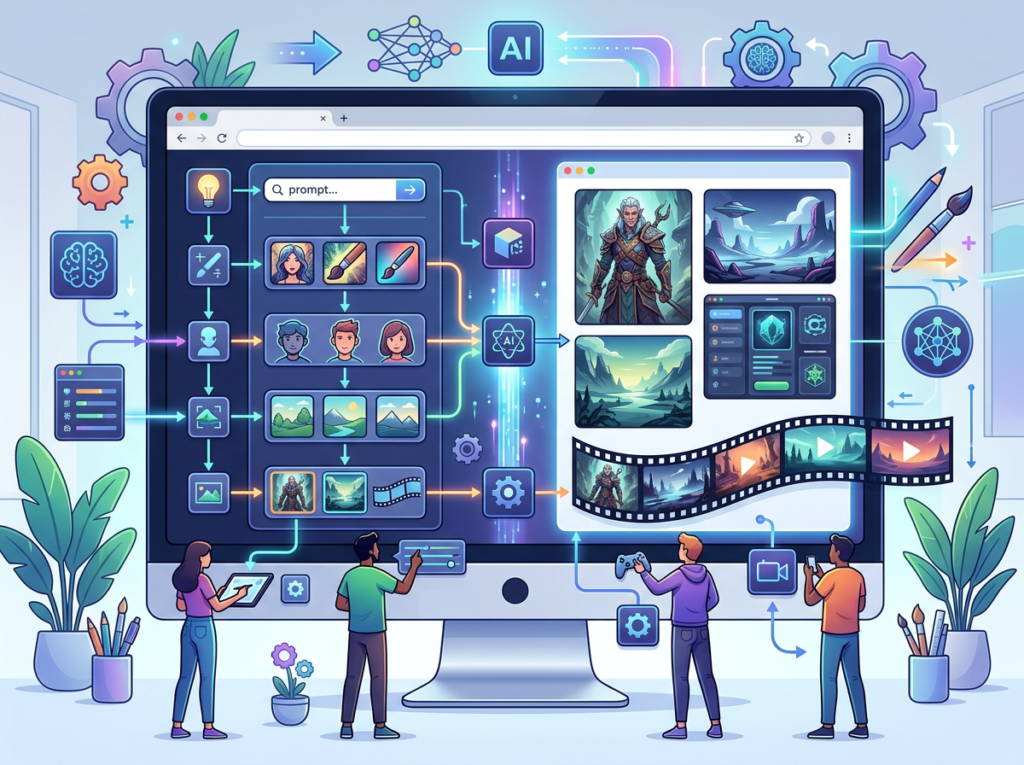
The most advanced form of AI efficiency isn’t using a single AI tool well — it’s orchestrating multiple outputs through a coherent workflow. Think of AI as the conductor of your production process, not just a performer in it. The prompt you write becomes the brief. The generated image becomes the asset. The iteration loop becomes the revision process. All without sending a single email or opening a project management tool.
Elena, an e-commerce owner based in Austin, runs a Shopify store selling artisan home goods. She previously coordinated with a photographer and retoucher for product shoots once a month — a 6-hour production day plus 4 hours of editing. By shifting her product imagery pipeline to an ai creative asset generator, she reduced that to a 2-hour AI generation session, saving 4 hours per month in production time and eliminating the $400–$800 per shoot she was paying externally.
Join 18 million+ creators using Leonardo AI to produce marketing assets at scale. Start Free Today at Leonardo.ai
How Leonardo AI Helps Efficiency
Feature 1: Phoenix Model & Prompt Adherence

Leonardo AI’s Phoenix model is the platform’s flagship generation engine, specifically engineered for high prompt adherence and text rendering quality — two historically weak points in AI image generation. For marketers, this means fewer wasted generations and faster iteration. Instead of running 20 prompts to get one usable asset, experienced users consistently report achieving production-ready outputs in 3–5 attempts.
At an average of 5–7 tokens per generation and 8,500 tokens per month on the Apprentice plan, you’re looking at roughly 1,200–1,700 generations monthly for $10. Compare that to a stock photography subscription at $50–$200/month with limited licensing flexibility, and the cost efficiency becomes immediately apparent. Estimated time saved through reduced sourcing and iteration: 40+ hours annually, worth $2,000–$6,000 at US freelance rates.
Feature 2: Realtime Canvas & On-Brand Iteration
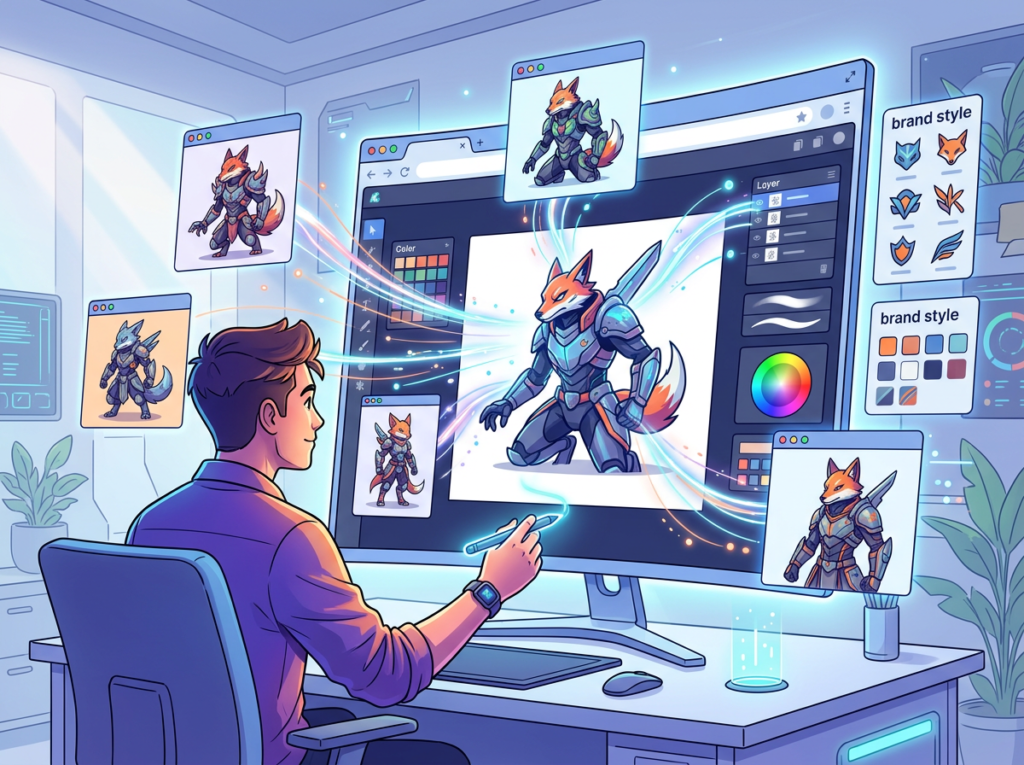
The Realtime Canvas feature allows users to sketch concepts and watch them transform into generated imagery in real time — no export, no re-upload, no context switch. For brand designers and social media managers, this tool collapses the concept-to-asset pipeline from hours to minutes. Style presets can be saved and reapplied across sessions, ensuring brand consistency without manual parameter re-entry.
For a freelance social media manager handling three clients, this feature alone can save 35+ hours per year in iteration overhead — a value of $1,750–$5,250 at standard US rates.
Feature 3: Custom Model Training for Brand Consistency

One of Leonardo AI’s most differentiated features for business users is the ability to train custom AI models on your own image sets. By uploading 10–20 images representing your brand aesthetic — product photos, past campaign visuals, color stories — you create a fine-tuned model that generates new images consistent with your existing visual identity. This is especially powerful for e-commerce brands and agencies managing multiple client identities simultaneously.
The alternative — briefing a designer or retoucher to maintain brand consistency across every new asset — typically costs $50–$150 per asset in revision time alone. For a business producing 50+ assets per month, the ROI on this single feature can exceed 100x the monthly subscription cost. See our full Leonardo AI review for detailed guidance on setting up custom model training for small business workflows.
Ready to eliminate your design bottleneck? Try Leonardo AI free and start generating production-ready marketing images in minutes. Start Free at Leonardo.ai | No credit card required
Use Cases: Small Business & Freelancer Efficiency
Persona 1: Jessica — Freelance Brand Designer, Portland, OR

The old workflow: Jessica manages visual identity for eight clients, ranging from food and beverage startups to wellness brands. Before Leonardo AI, her week looked like this: 3 hours sourcing stock photography, 4 hours briefing and reviewing work from a freelance illustrator she subcontracted, 3 hours on formatting and resizing — 10 hours total on visual asset overhead per week, none of it billable.
The AI-enhanced workflow: Jessica now uses Leonardo AI’s custom model training feature to create dedicated style models for each of her top four clients. When a client requests a new set of social assets, she runs a 45-minute generation session, selects the best outputs, and exports directly to Canva for text overlays and final formatting. Total visual asset time: under 5 hours per week.
Quantified results: 5 hours saved weekly × 50 working weeks = 250 hours reclaimed annually. At her $78/hour average billing rate, that’s $19,500 in additional capacity she can now sell back to clients — or simply get her evenings back.
“I used to dread Tuesdays because that was stock photo day. Now I actually enjoy the generation process — it feels like collaborating with a very fast, very patient creative partner.” — Jessica (composite persona, based on real designer workflows)
Persona 2: David — Independent Management Consultant, Chicago, IL

The old workflow: David produces quarterly thought leadership content — white papers, slide decks, and LinkedIn posts — for his personal brand and clients. Visual assets consumed 22 hours per month: 8 hours briefing a design agency, 6 hours in review, 8 hours on revisions.
The AI-enhanced workflow: David uses Leonardo AI’s Phoenix model with a saved prompt library to generate header images, data visualization backgrounds, and presentation visuals in a single weekly session, pairing Leonardo outputs with PowerPoint for final layout.
Quantified results: 11 hours saved monthly × 12 months = 132 hours reclaimed annually. At David’s $200/hour consulting rate, that’s $26,400 in restored billable capacity — more than 10× the annual cost of his Leonardo subscription.
“The agency I was using did beautiful work, but I was paying for beautiful when I needed fast. Leonardo gives me 90% of the output quality in 10% of the time.” — David (composite persona, based on real consultant workflows)
Persona 3: Alex — Solo Developer Building SaaS, San Francisco, CA

The old workflow: Alex is building a B2B SaaS product and needs a constant stream of marketing assets: landing page heroes, blog post headers, social proof graphics, and onboarding illustrations. Without a design budget, he was spending 9 hours per week doing this himself — mostly in Figma, with mediocre results — time that came directly out of product development.
The AI-enhanced workflow: Alex uses Leonardo AI’s AI Canvas and batch generation features to produce all marketing visuals in a 2.5-hour weekly session. He’s built a prompt library of 30+ templates tied to his brand’s visual language, allowing him to generate consistent, on-brand assets without rethinking the creative brief each time.
Quantified results: 6.5 hours saved weekly × 52 weeks = 338 hours per year restored to product development. For an early-stage SaaS founder, 338 additional engineering hours can represent the difference between shipping a key feature in Q2 versus Q4 — a competitive advantage with compounding returns.
Discover how Leonardo AI works to understand the prompt library and style preset features that make this kind of templated efficiency possible.
“Every hour I spend on marketing that isn’t shipping code is an hour my competitors are using. Leonardo cut that tax by 70%.” — Alex (composite persona, based on real SaaS founder workflows)
Streamline your visual workflow with AI-powered generation Join 18 million+ creators using Leonardo AI to produce marketing assets at scale. Start Free Today at Leonardo.ai
Best Practices for Implementing AI Efficiency
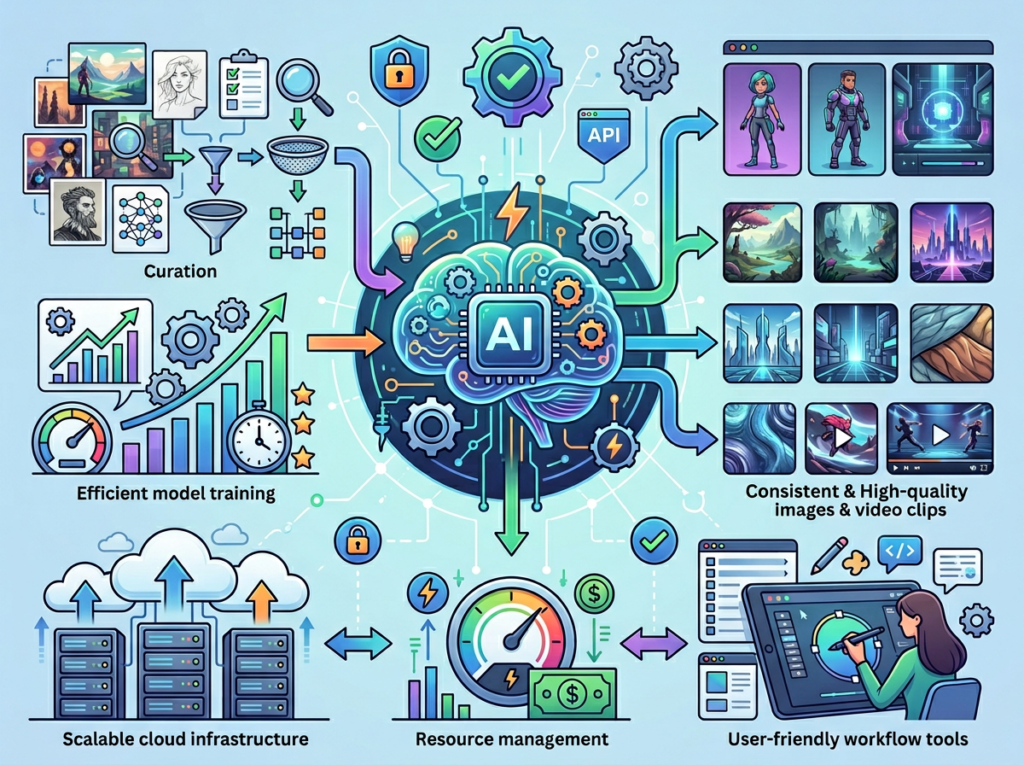
1. Start Small with One or Two Content Types
The biggest mistake new users make is attempting to replace their entire design workflow on day one. Instead, identify the one or two visual asset types that consume the most time with the least creative satisfaction — email headers and blog post featured images are usually the right starting point. Achieve confidence and consistency there before expanding.
A good rule of thumb: pick the asset type you currently source from stock photography first. These are the most straightforward to replace because the quality bar is “good enough and on-brand,” not “bespoke and exceptional.”
2. Build a Reusable Prompt Library
Leonardo AI’s efficiency multiplier isn’t the first image you generate — it’s the 100th, produced in a fraction of the time because your prompts are pre-built, tested, and categorized. Within your first two weeks, document every prompt that produces a usable output. Label them by use case (social post, email header, product lifestyle, ad creative) and refine them iteratively.
A structured prompt library of 20–30 tested prompts reduces generation-to-usable-asset time from 15–20 minutes to under 5 minutes per asset — the difference between AI as a novelty and AI as infrastructure. This analysis of advanced Leonardo AI techniques covers prompt structuring strategies worth reviewing once you’ve completed your first 50 generations.
3. Track What AI Is Replacing — and What It’s Enabling
The tool bloat problem is real: the average small business owner currently pays for $129–$180/month in fragmented creative subscriptions (stock photo sites, design tools, illustration services) that a single $10–$48/month Leonardo AI plan can partially or fully consolidate. Audit your current visual production spend before and after adopting Leonardo AI.
Beyond cost savings, track time: log your pre-AI visual production hours in week one, then re-measure at 30 and 90 days. These numbers become your internal ROI case — the hard evidence that makes AI adoption stick.
Join 18 million+ creators using Leonardo AI to produce marketing assets at scale. Start Free Today at Leonardo.ai
Limitations and Considerations
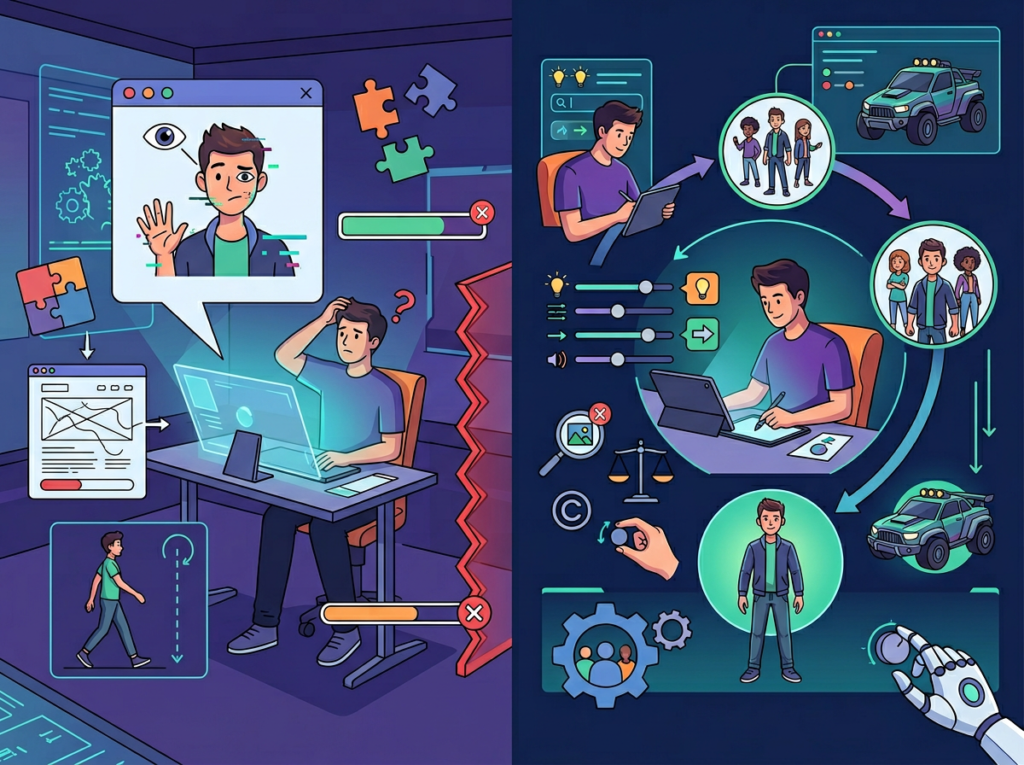
AI efficiency for visual production works best for repetitive, high-volume asset needs, but falls short for nuanced brand storytelling, legally sensitive content, and contexts where precise human likeness or complex typography is required.
Leonardo AI is a genuinely powerful tool. It’s also not magic. Honest adoption requires understanding exactly where its limitations live.
Typography and Logo Design: Despite improvements in the Phoenix model, AI image generators still struggle with accurate text rendering inside images. Leonardo AI is not a logo maker. For any asset where typography is a primary element, the workflow remains text overlay in Canva or Photoshop over a clean AI-generated background.
Legal and Compliance-Sensitive Visuals: Regulated industries — healthcare, financial services, legal — should approach AI-generated imagery with caution. Questions of licensing, model consent, and image accuracy in professional contexts are evolving. Consult your legal advisor before using AI-generated imagery in compliance-sensitive materials.
High-Stakes Brand Photography: AI-generated lifestyle imagery has improved dramatically but still reads as AI-generated to trained eyes, particularly in character consistency across a series. For hero campaigns and investor materials, real photography remains the standard. Leonardo AI is a complement to, not a replacement for, professional photography in these contexts.
Key Risks to Manage:
- Hallucination: AI models occasionally generate anatomically incorrect figures, impossible environments, or logically inconsistent scenes. Always review before publishing.
- Privacy and Data: If you upload your own brand images to train a custom model, review Leonardo AI’s data handling policies — particularly relevant for proprietary or client-owned assets.
- Over-Reliance and Skill Atrophy: Regular manual design work maintains visual literacy and creative judgment. Over-delegating to AI can erode the taste-making capacity that makes your creative direction distinctive. Use AI as an accelerant, not a replacement for creative development.
Frequently Asked Questions

What is AI efficiency for small business?
AI efficiency for small business refers to the strategic use of AI tools to reduce time spent on repetitive, low-value tasks — freeing up hours for revenue-generating work. In visual content specifically, this means using tools like Leonardo AI to generate marketing images in minutes rather than hours, eliminating the design bottleneck that affects most solo entrepreneurs and freelancers.
Can AI replace my designer entirely?
Not entirely — and that’s the wrong goal. AI tools like Leonardo AI are most valuable as production accelerants, handling high-volume, repeatable visual assets (social posts, email headers, ad variations) while human designers focus on high-stakes creative work that requires brand judgment and strategic thinking. The most efficient workflows combine both.
Do I need technical skills to use Leonardo AI for marketing?
No. Leonardo AI’s web-based interface is designed to be accessible to non-technical users from day one. The core workflow — write a text prompt, select from generated options, download — requires no coding, no design software experience, and no prior AI knowledge. Advanced features like custom model training have a modest learning curve but are well-documented and supported by an active community.
Join 18 million+ creators using Leonardo AI to produce marketing assets at scale. Start Free Today at Leonardo.ai
Conclusion

The efficiency case for Leonardo AI as an ai image generator for business comes down to a single calculation most US entrepreneurs haven’t made: what does your current visual production workflow actually cost in time and money per year?
For the freelancers and small business owners profiled above, that number ranged from $20,000 to $80,000 in opportunity cost annually — hours that could have been spent on client work, product development, or simply living outside a laptop. Leonardo AI, at $10–$48 per month, delivers a proven reduction in the production overhead that quietly taxes every marketing-driven business.
AI is augmentation, not replacement. The entrepreneurs who use it best don’t hand over their creative vision — they hand over the execution burden while keeping their judgment, their taste, and their brand intelligence fully in play.
The ROI for US small businesses adopting AI design tools in 2026 isn’t theoretical. It’s measurable at 60x to 180x annually, based on realistic time savings against standard US freelance rates. The question isn’t “Should I use AI for visual efficiency?” The question is: Can I afford NOT to?
Start with one workflow this week. Build a prompt library. Measure the time. The math will make the case for you.
Join 18 million+ creators using Leonardo AI to produce marketing assets at scale. Start Free Today at Leonardo.ai
Leave a Reply