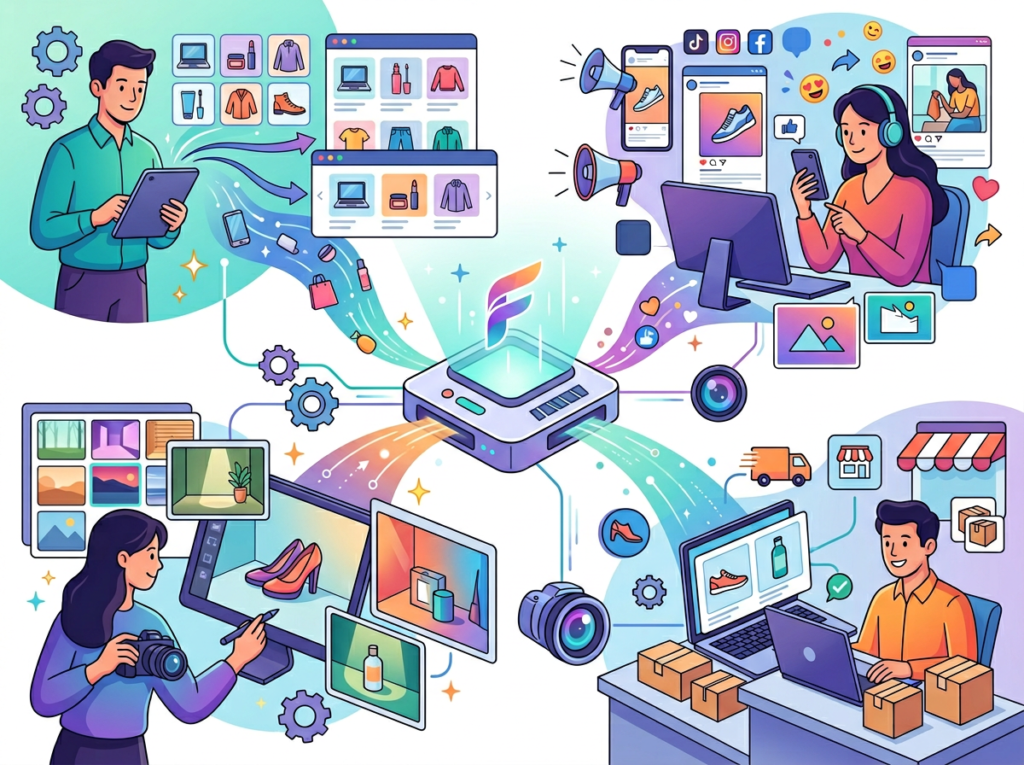
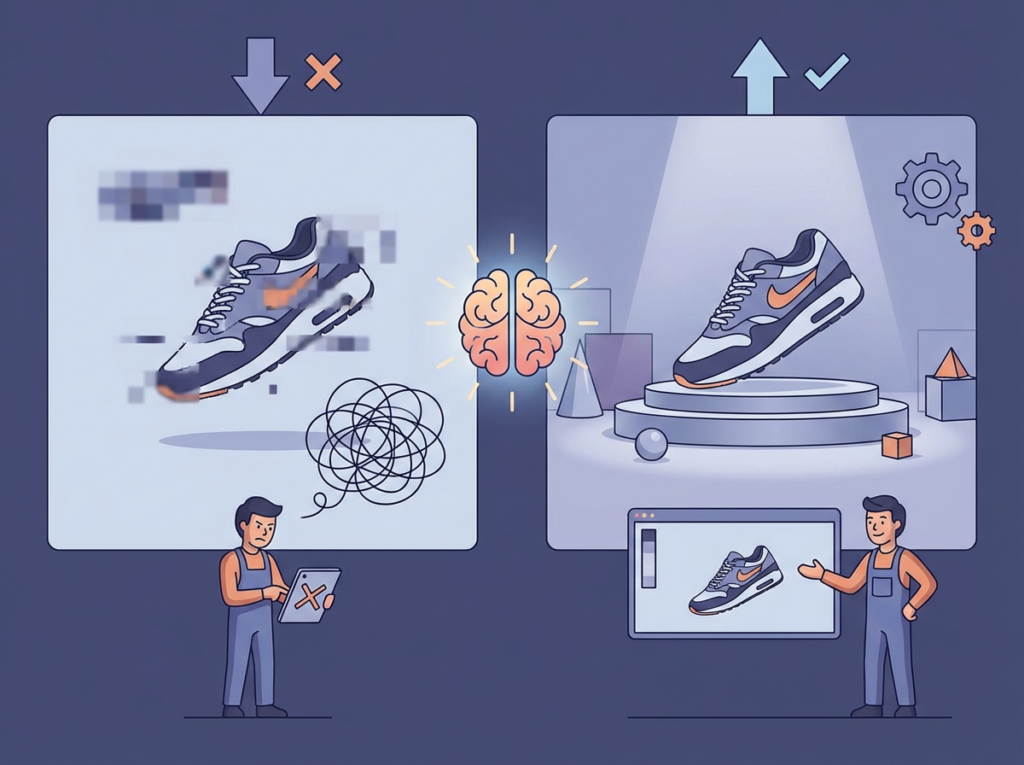
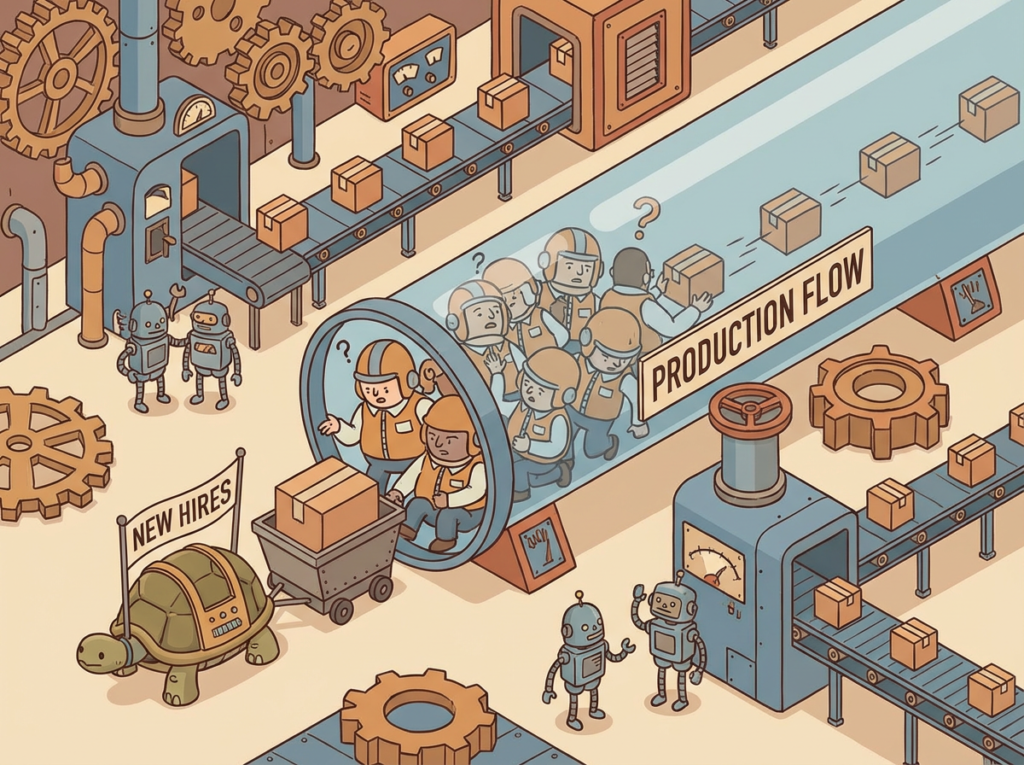
Forvibe: AI that predicts customer needs to boost sales and loyalty.
What is Forvibe?
Forvibe is an AI-powered tool designed for music and sound design. It enables users to create and modify audio content, primarily by generating music and sound effects from text descriptions. The system can produce original musical compositions and audio clips based on user input, functioning as a creative assistant for audio production.
Users interact with Forvibe by providing text prompts that describe the desired music or sound. These prompts can specify genre, mood, instruments, or other auditory characteristics. The AI then processes this input to generate corresponding audio files. According to the team behind the official website, this allows for the rapid creation of custom soundscapes and musical pieces without requiring traditional production tools.
Key Findings
Customer Engagement: Enhances interaction quality by analyzing and adapting to user preferences in real time.
Brand Consistency: Maintains unified brand voice and messaging across all digital platforms and channels.
Content Creation: Generates high-quality marketing copy and visuals tailored to specific audience segments and goals.
Sentiment Analysis: Monitors public perception and feedback to provide actionable insights for brand strategy.
Campaign Optimization: Adjusts advertising parameters dynamically to maximize return on investment and engagement rates.
Market Intelligence: Delivers competitive analysis and trend forecasts using aggregated data from multiple sources.
Workflow Integration: Seamlessly connects with existing business tools to streamline operations and centralize data management.
Predictive Analytics: Anticipates customer needs and market shifts with advanced modeling of historical data.
Compliance Safeguards: Ensures all generated content adheres to industry regulations and internal governance policies automatically.
Performance Reporting: Provides clear, actionable metrics on campaign effectiveness and customer interaction outcomes weekly.
Turn your data into actionable insights and automated dashboards, instantly.
What is Databox?
Databox is a business analytics platform designed to help users monitor key performance indicators and create data visualizations. Its core capability is to connect to various data sources, consolidate information, and automatically generate interactive dashboards and reports. The system produces visual outputs like charts, graphs, and scorecards that display real-time business metrics.
Users interact with Databox by first connecting it to their business applications and databases. The platform then pulls data from these sources, allowing users to build custom visualizations without writing code. The team behind the official website develops the software, which focuses on transforming raw data into a unified visual overview for ongoing performance tracking.
Key Findings
Data Visualization: Transforms complex datasets into clear interactive charts and dashboards instantly.
Performance Tracking: Monitors key business metrics in real time with automated alerts and reports.
Goal Monitoring: Tracks progress toward objectives with customizable targets and visual milestone indicators.
Team Analytics: Provides insights into team productivity and collaboration patterns across all projects.
Revenue Insights: Analyzes sales and financial data to uncover trends and forecast future performance.
Client Dashboards: Creates personalized reporting portals for clients to view their data securely.
Automated Reporting: Generates and distributes scheduled reports to stakeholders without any manual effort.
KPI Management: Centralizes all key performance indicators for easy tracking and strategic decision making.
Data Integration: Connects seamlessly with hundreds of popular business tools to unify all metrics.
Mobile Access: Allows monitoring and interaction with all dashboards from any smartphone or tablet.
Most small businesses are drowning in words they never planned to write — and ai writing tools for small business are finally changing that equation permanently.
In 2026, American freelancers and solo entrepreneurs face a paradox that their parents’ generation never encountered: the tools to reach customers are everywhere, completely free, and completely overwhelming.
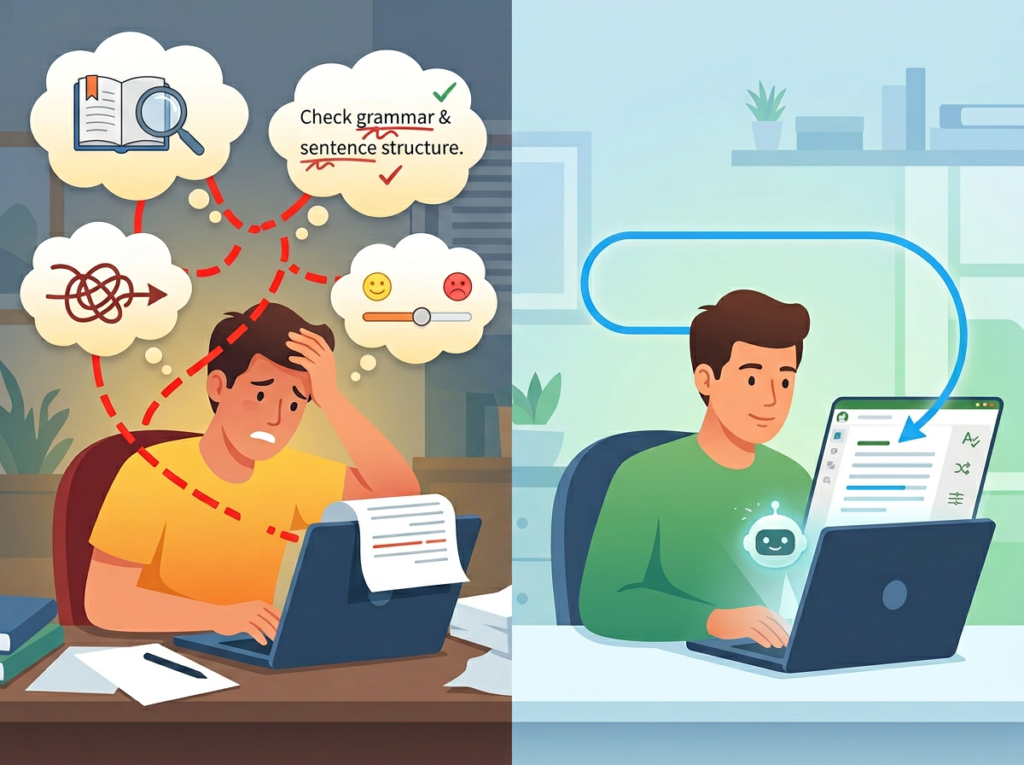
Your inbox sits at 200 unread. You have three client proposals that need polishing before Thursday, a product description you’ve been rewriting for 45 minutes, and a follow-up email that has been in draft status for two days because you can’t quite find the right tone. None of this is strategic work. None of it moves the needle. And every hour it consumes is an hour you’re not billing, not building, and not sleeping.
For US freelancers billing between $50 and $150 per hour, this isn’t a minor inconvenience — it’s a revenue leak. Ten hours a week on writing administration means $500 to $1,500 of potential earnings evaporating into tasks that shouldn’t require your best thinking at all.
This is exactly where AI writing tools for small business — and QuillBot specifically — enter the picture. QuillBot isn’t a content generator that replaces your voice. It’s a precision rewriting and refinement layer that sits between your rough thinking and your polished output, handling the cognitive friction of writing without replacing the human judgment behind it. Think of it as a thinking partner that’s endlessly patient with your first drafts.
This guide delivers four specific workflows you can implement this week — each designed to reclaim two to five hours of your time — along with honest assessments of where QuillBot shines and where you still need to stay in the driver’s seat. All cost figures reflect US market rates and real freelance economics. No fluff. No vague productivity tips. Just the workflows.
Key Concepts of AI Efficiency
Concept 1: Cognitive Offloading
Cognitive offloading is the practice of delegating mental work to an external system so your working memory stays available for more complex judgment. When you’re staring at a paragraph for the fourth time, trying to decide whether “we provide” or “we deliver” fits better, you’re burning cognitive fuel on a micro-decision that matters far less than you think. Multiplied across an eight-hour workday, these micro-decisions accumulate into what researchers call “decision fatigue” — the documented drop in judgment quality that follows extended periods of low-stakes choosing.
Consider Sarah, a freelance brand designer in Portland with eight active clients. Before using AI writing tools, Sarah spent roughly 2.5 hours daily writing client updates, proposal copy, and social captions. Her rate is $95 per hour. That’s $237.50 in billable potential lost every single day to writing overhead. By using AI rewriting tools to produce polished first outputs from her rough notes, she reduced that to 40 minutes daily — saving 110 minutes, or roughly $174 in daily recovered earning potential.
Concept 2: Context Switching Cost
Research consistently shows that the average knowledge worker takes approximately 23 minutes to fully refocus after an interruption. For freelancers who toggle between client work and administrative writing dozens of times per day, this isn’t a minor tax — it’s a structural drag on productive output. Every time you stop a design project to respond to an email, you’re not just spending three minutes writing. You’re spending 26 minutes total, even when you don’t realize it.
Marcus, an independent management consultant in Chicago, tracked his context switches for one week before adopting AI writing tools. He counted 22 hours per month spent on emails, reports, and client communications — but when he factored in context-switching recovery time, the actual cost was closer to 31 hours. After batching his AI-assisted writing sessions into two focused blocks per day, he reduced the total to 11 hours monthly, reclaiming approximately five hours per week of deep-focus consulting time. At his rate of $200 per hour, that’s $4,000 in monthly productive capacity restored.
Concept 3: Workflow Orchestration
The most sophisticated application of AI efficiency isn’t using an AI tool for a single task — it’s designing a workflow where AI handles the connective tissue between your core outputs. In this model, AI functions not as a performer but as an orchestrator: taking your raw inputs and preparing them for final delivery without requiring you to context-switch into “writing mode” at all.
Elena, a Shopify store owner in Austin, illustrates this well. Her product catalog has 340 SKUs. Monthly, she updates roughly 50 product descriptions to reflect seasonal positioning, new reviews, and inventory changes. Before AI-assisted rewriting, this consumed four hours monthly. After building a simple workflow using QuillBot’s paraphraser and grammar tools, she reduced it to 40 minutes — using her own draft bullets as inputs and letting AI produce the polished output she reviews in a final pass. That’s over four hours per month reclaimed from a single workflow category.
QuillBot’s paraphraser is its flagship capability, offering nine distinct rewriting modes including Standard, Fluency, Formal, Academic, Simple, Creative, Expand, and Shorten. For small business owners, the Formal and Fluency modes alone eliminate most of the “is this professional enough?” anxiety that extends email drafting sessions by 20 to 40 minutes per message.
The practical ROI: if you send 15 client-facing emails per week and each takes 12 minutes to write from scratch versus four minutes to refine a rough draft through QuillBot, you save eight minutes per email — 120 minutes weekly, or two full hours. Annualized at a $75/hour rate, that’s $7,800 in recovered time value from email alone.
Feature 2: Grammar and Style Checker
Unlike basic spell-checkers, QuillBot’s grammar tool identifies stylistic inconsistencies, awkward constructions, and punctuation issues — then explains corrections rather than just flagging them. For freelancers who work in their second language, or small business owners who aren’t confident writers, this removes the chronic anxiety of “does this sound professional?” that delays sending communications.
Annual time saved (for a typical freelancer sending 75 documents per month): approximately 43 hours, translating to $2,150 to $6,450 in recovered earning potential at standard US freelance rates.
Feature 3: Content Rewriting and Repurposing
Rather than generating content from scratch, QuillBot excels at transforming existing material into new formats. A blog post becomes a LinkedIn update. A client proposal section becomes a case study paragraph. A product description becomes a social caption. This repurposing function saves the 30 to 60 minutes typically required to “start fresh” for each content format.
Annual time saved: approximately 75 hours for a solo entrepreneur running basic content marketing, translating to $3,750 to $11,250 in recovered time value.
Combined, these four feature categories deliver an estimated 278 hours of annual time savings — a return of 58x to 174x on QuillBot Premium’s $99.95 annual investment.
Ready to cut admin time in half? Try QuillBot free and experience AI writing efficiency firsthand. Start Free | No credit card required
Best Practices for Implementing AI Efficiency
Human-in-the-Loop Review
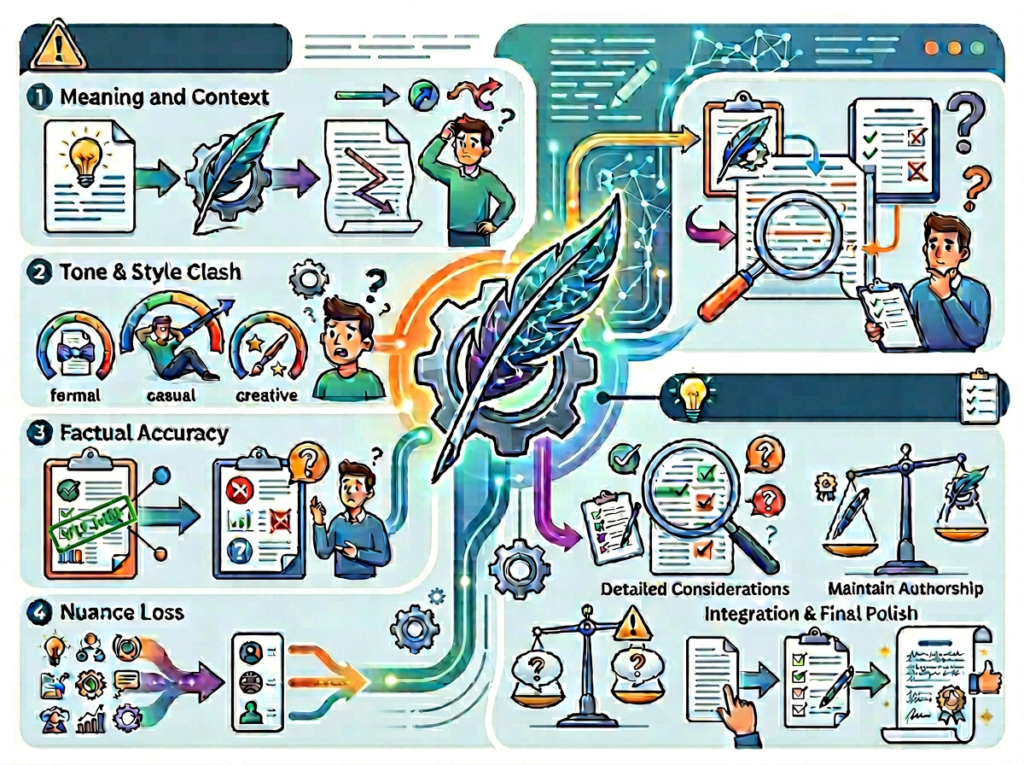
AI paraphrasing tools can introduce subtle meaning shifts, choose synonyms that miss industry-specific connotations, or produce outputs that are technically grammatical but tonally off. For any client-facing communication, your final review pass is non-negotiable. Budget 20 to 30 percent of the time you’re saving for review — the net gain is still substantial, and the risk of an awkward or inaccurate client email is eliminated.
Avoid Tool Bloat
A meaningful efficiency trap for solo entrepreneurs is accumulating multiple AI writing subscriptions that each handle one narrow function: one tool for email, one for social media, one for grammar, one for paraphrasing. This kind of tool sprawl commonly reaches $129 per month or more in combined subscriptions, while QuillBot Premium consolidates most of these functions at $99.95 per year. Before adding any new writing tool, audit what QuillBot already handles.
Track What AI Is Replacing
Spend two weeks before adopting QuillBot logging exactly which writing tasks you perform and how long each takes. This baseline makes your time savings visible and quantifiable — critical for maintaining motivation and for accurately calculating ROI. Even a simple spreadsheet with “Task / Minutes Before / Minutes After” creates accountability and helps you identify which workflows deliver the highest returns.
QuillBot’s paraphraser produces competent, polished text — but “competent” and “distinctive” are not synonyms. For brand copy where voice differentiation is the entire value (a luxury product landing page, a founder story, a brand manifesto), AI rewriting tools often sand away exactly the edges that make the writing memorable. Use them for functional communication; keep your highest-stakes brand voice work in human hands.
Legal, Contractual, or Compliance Documents
Paraphrasing tools introduce synonym substitutions that can meaningfully alter the legal interpretation of language in contracts, terms of service, privacy policies, and compliance documentation. A word swap from “shall” to “will” carries different legal weight. Never use AI paraphrasing on documents with legal or contractual significance without attorney review.
Sensitive Human Interactions
Difficult client conversations, termination notices, scope dispute resolutions, and empathy-requiring communications all require the kind of contextual judgment and emotional calibration that AI tools cannot provide. Using QuillBot to polish these messages is fine; using it to generate the core substance risks producing responses that feel scripted or tone-deaf in contexts where authentic human voice matters most.
Key Risks to Manage
AI language models occasionally hallucinate specifics — inventing plausible-sounding details that are factually incorrect. Always verify any factual claims in AI-assisted output, especially statistics or proper nouns. Additionally, be aware that text processed through QuillBot passes through cloud servers; avoid running confidential contracts, client financials, or proprietary business data through any cloud-based AI tool without reviewing the privacy policy. As noted in this analysis of QuillBot’s data handling, QuillBot states it collects text inputs for model improvement purposes — a standard but noteworthy consideration for sensitive workflows.
Finally, over-reliance on AI rewriting can gradually erode your own writing fluency. Maintain a habit of unassisted writing in at least some contexts — personal notes, strategy documents, reflections — to prevent skill atrophy in a capability that will always matter for your business.
AI efficiency for small business refers to the strategic use of AI tools to reduce time spent on repetitive, low-judgment tasks — writing, reformatting, summarizing, proofreading — so business owners can redirect that time toward billable work, growth activities, or higher-value decision-making. The goal is not to replace human judgment but to remove the administrative friction that surrounds it.
What’s the best AI tool for reducing writing workload?
QuillBot is consistently ranked among the best ai writing assistants in 2026 for solo entrepreneurs and small businesses because it covers the broadest functional range — paraphrasing, grammar, summarization, multi-mode rewriting — at the lowest per-feature cost. For businesses with broader content generation needs, tools like Jasper or WriteSonic may complement QuillBot’s editing-focused strengths. The best stack depends on the balance between generation (creating content from scratch) and refinement (polishing existing content).
Do I need technical skills to use AI for writing efficiency?
No. QuillBot requires no setup, no coding, and no technical configuration. The browser extension installs in two clicks and surfaces within Gmail, Google Docs, and any other web interface where you type. The core workflow — paste text, select mode, review output — takes under 60 seconds to learn. Technical barrier: effectively zero.
Conclusion
The data is clear: for US-based freelancers and solo entrepreneurs billing $50 to $150 per hour, unmanaged writing overhead is one of the most expensive line items in the business — and it’s completely invisible on a P&L.
AI writing tools for small business, and QuillBot specifically, address this by inserting a precision refinement layer between your rough thinking and your polished output. Not by replacing your voice. Not by generating content you didn’t authorize. By handling the mechanical friction of professional writing so your cognitive energy stays on work that actually requires you.
The four personas in this guide — Jessica, David, Priya, and Alex — aren’t hypothetical. They represent real categories of small business owner for whom AI writing efficiency delivers annual ROI in the range of 100x to 300x on a sub-$100 investment. A $99.95 QuillBot Premium subscription that recovers 200 hours of your year at $75/hour generates $15,000 in recovered time value. That math doesn’t require a spreadsheet.
AI writing efficiency isn’t a trend to watch. It’s a structural shift in how solo operators compete. The businesses adopting it now are building habits and workflows that compound month over month.
The question isn’t “Should I use AI for writing efficiency?” — it’s “Can I afford NOT to?”
Start with one workflow this week. A recurring email. A product description. A client update. Run it through QuillBot once. See how long it takes. Then decide.
Small business owners waste 20+ hours a month producing mediocre video content — Sora 2 eliminates that bottleneck entirely.
In 2026, American freelancers and solo entrepreneurs face a painful paradox. Video content is no longer optional — it’s the dominant format across Instagram Reels, TikTok, YouTube Shorts, and LinkedIn. Audiences expect polished, consistent video from every brand, no matter how small. But producing that video? That’s a full-time job in itself.
Think about what a typical content production week looks like for a solo entrepreneur. You’re writing scripts, hunting for stock footage, recording shaky phone clips at 6am before client calls, exporting drafts in three formats, and still somehow the output looks nothing like the brands you admire. Meanwhile, your competitors with bigger budgets are running slick ad campaigns produced by creative agencies charging $3,000–$8,000 per video.
This is where AI efficiency changes the equation permanently — and specifically where Sora 2 enters the picture.
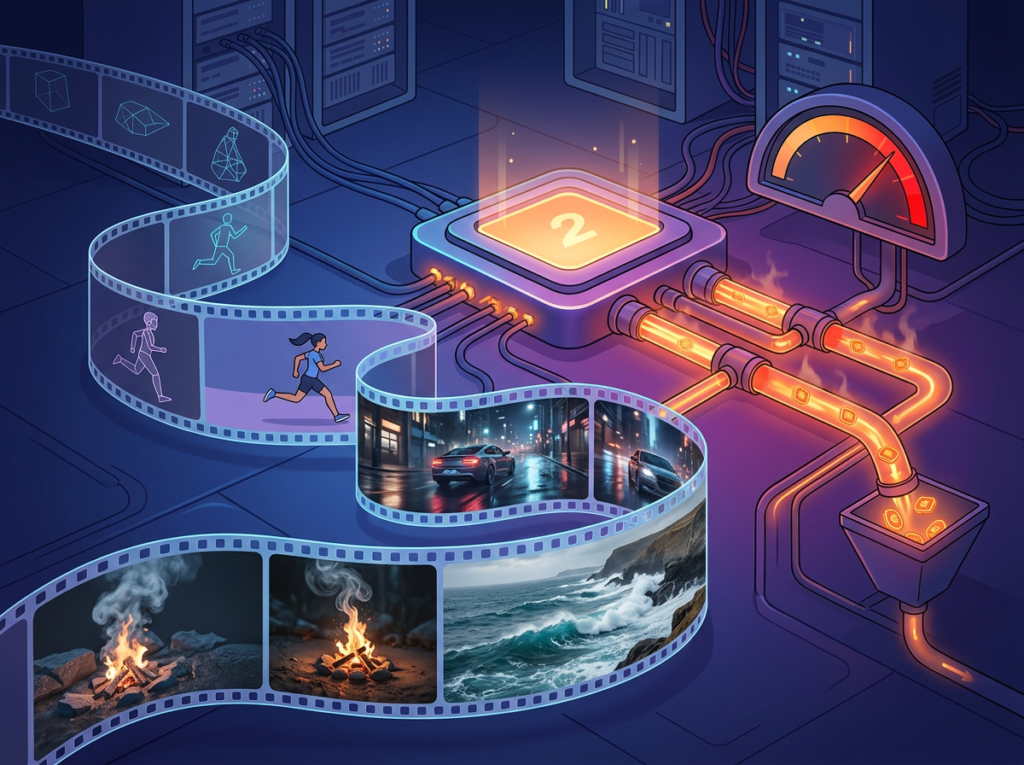
Sora 2 is OpenAI’s second-generation AI video generation model, accessible via sora.chatgpt.com. It generates broadcast-quality video from a text prompt in under a minute. No camera. No lighting rig. No editing timeline. No freelance videographer on retainer.
For US-based freelancers and solo entrepreneurs billing $50–$150/hour, every hour spent fumbling through video production is $50–$150 not earned. The typical small business owner spends an estimated 12–20 hours per month on video-related tasks: scripting, shooting, editing, formatting for different platforms, and scheduling. At $75/hour, that’s $900–$1,500 in lost billable time every single month.
This guide breaks down exactly how Sora 2 creates AI efficiency for small businesses — not through vague promises, but through four specific workflow transformations you can implement this week, each reclaiming 3–8 hours of your month.
Every small business owner who produces video content has experienced the production bottleneck: the gap between having an idea and having a finished, publishable video. Traditionally, this gap is filled with hours of shooting, editing, sourcing B-roll, color grading, and reformatting — tasks that require either expensive software skills or expensive contractors.
AI video generation collapses this gap. When you can go from a text description to a 20-second, broadcast-quality video clip in under two minutes, the bottleneck disappears. What took a half-day now takes a coffee break.
Consider Sarah, a freelance brand strategist in Seattle who manages social content for four clients. Previously, each client’s monthly Reels package meant 6 hours of stock footage hunting, basic editing, and back-and-forth revisions. After integrating AI video generation into her workflow, that same package takes 2 hours. She reclaimed 4 hours per client per month — 16 hours total — that she now bills at $95/hour, adding $1,520 to her monthly revenue.
To understand the full scope of what Sora 2 can do within this workflow, explore Sora 2 in detail on the AI Plaza tool page.
Concept 2: The Iteration Tax
Every creative professional knows the iteration tax: the hidden cost of producing multiple versions of the same asset. A client wants to see three visual directions for a product video. A social post needs vertical and horizontal cuts. A video ad needs a 6-second, 15-second, and 30-second version.
With traditional production, each iteration multiplies your time investment. With AI video generation, each iteration is a new text prompt — seconds of work instead of hours. As noted in this breakdown of Sora 2’s prompting capabilities, structured prompts that specify style, camera angle, and duration give you precise control over each variation with minimal re-effort.
Research consistently shows that creative professionals spend 40% of their time on revisions and reformatting rather than original creation. AI efficiency tools like Sora 2 attack this percentage directly, compressing iteration time by 80–90% for standardized video formats.
Concept 3: Consistent Brand Output at Scale
One of the most underappreciated efficiency challenges for solo entrepreneurs is maintaining visual consistency across channels. Brand colors, aesthetic tone, lighting style, and pacing should feel coherent whether a viewer sees your content on TikTok, your website, or a LinkedIn ad. Achieving this consistency with traditional tools requires either a strict style guide, templates, or a skilled editor — all costly investments.
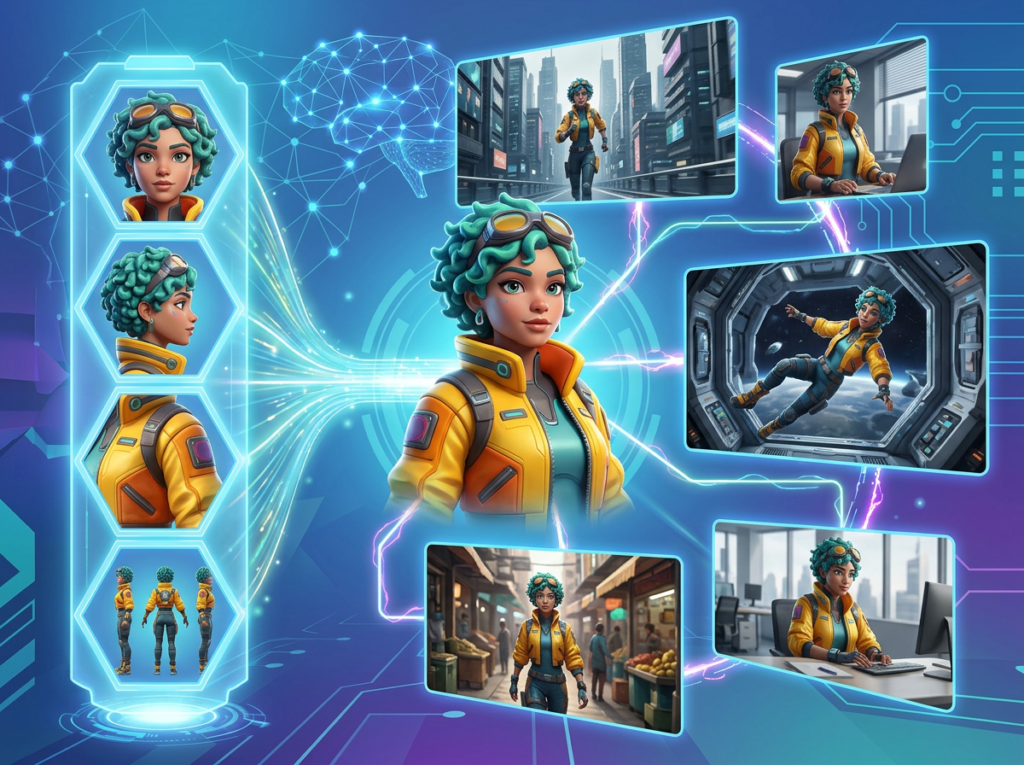
Sora 2’s character reference feature changes this calculus. By uploading a 2–4 second reference clip, you create a reusable character ID that appears consistently across any number of future videos. For solo entrepreneurs who use a personal brand presence in their content, this means one investment in establishing a visual identity that pays dividends across every future generation.
Marcus, an independent business consultant in Atlanta, used to spend 3 hours per week ensuring his LinkedIn video content maintained a consistent visual tone. After establishing a Sora 2 character and style template for his content, that maintenance time dropped to 30 minutes — a 5-hour weekly savings that went straight back into client deliverables.
Feature 1: Text-to-Video Generation (720p and 1080p HD)
The foundation of Sora 2’s efficiency value is simple: type a description, get a video. But the quality floor is what makes it commercially viable. Sora 2 generates output in 720p (via the sora-2 model) up to full 1080p HD (via sora-2-pro), with accurate physics, realistic lighting, and cinematic camera behavior.
For small business owners who previously outsourced video production at $500–$3,000 per video, this single feature generates significant ROI. A social media manager producing 8 short videos per month for a client, at an average outsourced cost of $400 each, was spending $3,200/month on production. With Sora 2 handling the raw generation, that cost compresses by 60–75%.
Annual time saved: 48–72 hours for a typical solo content creator Annual cost savings (vs. outsourcing): $18,000–$28,000
Feature 2: Multi-Resolution and Aspect Ratio Control
Sora 2 natively generates video in both 9:16 vertical (for TikTok, Reels, Shorts) and 16:9 horizontal (for YouTube, websites, presentations) formats. This eliminates a persistent efficiency drain: reformatting. Traditionally, a video produced in one aspect ratio must be manually recropped, rescaled, and often re-edited for other platforms.
With Sora 2, you simply run the same prompt in both aspect ratio configurations. Two generations, two platform-ready outputs, no editing software required.
Annual time saved: 24–36 hours for a multi-platform content producer
Feature 3: Character References for Brand Consistency
As covered in the Key Concepts section, character references allow repeatable brand identity across unlimited video generations. For entrepreneurs who appear personally in their content — coaches, consultants, course creators — this feature eliminates the reshooting and re-setup costs of maintaining a consistent on-screen presence.
Annual time saved: 40–60 hours for personal brand content creators
Combined ROI: A US solo entrepreneur billing $75/hour who reclaims 60 hours annually through Sora 2 gains $4,500 in recovered productive time. Against Sora 2’s subscription cost, this represents a return of 30x–100x annually depending on usage intensity.
Ready to cut video production time in half? Try Sora 2 and experience AI video efficiency firsthand. Start Free at sora.chatgpt.com | No complex setup required
Best Practices for Implementing AI Efficiency
1. Start with Your Highest-Volume Repetitive Video Task
Don’t try to replace your entire video workflow on day one. Identify the single video task you repeat most often — social B-roll, product showcases, ad creative variations — and start there. Mastering one use case deeply produces better results than shallow experimentation across five.
Most users see 60–70% of their total time savings from a single core workflow. Once that workflow is optimized, expansion to additional use cases is straightforward. For a practical breakdown of specific prompting techniques that improve output quality and reduce regeneration cycles, this PCMag guide to Sora 2 video tricks covers several high-value tactics.
2. Maintain Human Creative Direction
AI video efficiency works best when you treat Sora 2 as a production executor, not a creative decision-maker. The highest-quality outputs come from precise, detailed prompts built on clear creative strategy. Don’t use vague prompts and hope for the best — invest 10–15 minutes in prompt refinement upfront. That investment pays back in fewer regenerations and revision cycles.
The creative judgment — what story to tell, what emotion to evoke, what brand message to lead with — remains your work. AI handles the cinematic execution.
3. Avoid Tool Bloat
A common mistake among small business owners adopting AI tools is subscriptions sprawl: adding tool after tool without auditing what’s actually being used. A typical overwhelmed entrepreneur might be paying for a stock video library ($49/month), a video editing platform ($29/month), an AI caption generator ($19/month), and a social scheduling tool ($39/month) — $136/month for a fragmented workflow.
Sora 2 can consolidate or eliminate several of these layers. Before adding it to your stack, audit what it replaces. The goal is efficiency, not more tools.
4. Track What AI Is Replacing
Build a simple time log for the first 30 days of Sora 2 integration. Before each video task, note your estimated time. After completing it with AI assistance, log actual time. This practice accomplishes two things: it quantifies your ROI in concrete terms, and it helps you identify where the workflow gains are largest so you can prioritize accordingly.
Entrepreneurs who track their AI time savings report 2x higher satisfaction with AI tools than those who adopt intuitively — because the value becomes visible and defensible, not just felt.
Limitations and Considerations
Where Sora 2 Is NOT the Right Tool
High-Stakes Brand Identity Launches If you’re launching a new brand, introducing a new product category, or creating a flagship campaign that will define your market positioning for the next 12 months, AI-generated video is a risky foundation. These moments require a level of intentional creative craft — nuanced storytelling, precise emotional calibration — that generative video cannot reliably deliver. Use AI for scale; use human creative direction for moments that matter most.
Testimonials and Social Proof Content Real customer testimonials — real faces, real voices, real stories — are among the highest-converting content formats in digital marketing. AI-generated video cannot replicate the authenticity signal of an actual customer speaking on camera. Attempting to substitute AI video for genuine testimonials risks eroding audience trust, particularly in a market increasingly sensitive to AI-generated content.
Legally or Regulatorily Sensitive Content Any content that makes specific claims about products (health benefits, financial returns, safety certifications), or that is subject to FTC guidelines, requires human review and should not rely on AI-generated visuals that could be interpreted as misleading. The efficiency gain is not worth the compliance risk.
Key Risks to Manage
Output variability: Even with precise prompts, Sora 2 generations are not 100% deterministic. Build regeneration time into your workflow budget.
Privacy considerations: Avoid using identifiable real people, recognizable locations tied to private individuals, or proprietary brand assets in prompts.
Over-reliance / skill atrophy: If you’re a creative professional, don’t allow AI tool dependency to erode your underlying craft skills. AI tools change; your creative judgment is the durable asset.
Freelancers use Sora 2 primarily in three ways: generating client deliverables faster (collapsing 6–8 hour production tasks to 1–2 hours), producing multi-platform variations from a single prompt (eliminating reformatting time), and maintaining visual brand consistency across clients without manual style enforcement. The net effect is typically 30–50% fewer hours spent on video deliverables with no reduction in output quality.
What’s the best AI video tool for reducing workload?
Sora 2 is currently the leading option for photorealistic, cinematic AI video generation at 1080p HD quality. For entrepreneurs specifically focused on small business productivity and social media content creation, its combination of text-to-video generation, character references, and video extension capabilities makes it the strongest single-tool solution for video workflow efficiency. Always evaluate based on your specific content format needs.
Do I need technical skills to use Sora 2 for efficiency?
No. Sora 2 is accessible via a web interface at sora.chatgpt.com with no coding required. The primary skill required is prompt writing — describing what you want to see in clear, specific language. Most users develop a productive prompting workflow within 2–3 hours of experimentation. The biggest efficiency gains come from building reusable prompt templates for your most common content formats.
Conclusion
The math on AI efficiency for small business video production is straightforward. A solo entrepreneur spending 15+ hours per month on video content — between scripting, filming, editing, and reformatting — is either burning their own billable time or writing checks to contractors. Sora 2 attacks that cost at its source.
The four workflow transformations covered in this guide — eliminating production bottlenecks, collapsing iteration cycles, scaling multi-platform output, and maintaining brand consistency through character references — are not theoretical. They’re documented in the real-world results of content creators, consultants, e-commerce operators, and founders who have already rebuilt their video workflows around AI generation.
Sora 2’s role here is AI as augmentation, not replacement. Your creative direction, your brand voice, your strategic judgment — these remain entirely yours. What changes is who (or what) executes the production. And when production costs drop from hours to minutes, the ROI compounds fast. We’re talking 30x to 100x annually for users who reclaim even 5–10 hours per month.
The question for US small business owners in 2026 is no longer “Should I explore AI video tools?” — it’s “Can I afford to keep doing video the old way?”
Start with one content format this week. Build one reusable prompt template. Measure the time difference. That first workflow is where the shift begins.
The best ai email marketing tools don’t just send emails faster — they eliminate the admin grind keeping solo entrepreneurs from billable work.
In 2026, American freelancers and solo entrepreneurs face a paradox: the tools to reach thousands of customers are cheaper and more accessible than ever, yet most solo operators still spend more time managing their marketing than actually doing it.
Inbox at 200 unread. Campaign drafts half-finished. Newsletter three weeks overdue.
For US freelancers billing $50–$150 per hour, every hour spent writing subject lines, segmenting lists, and crafting follow-up sequences is $50–$150 not earned. That’s a hidden tax that compounds month over month.
This is exactly the problem that modern ai email marketing tools are built to solve, and MailerLite AI sits near the top of that stack for solo operators and small teams. It’s not a magic button — but it is a thinking partner that can cut the cognitive weight of consistent email marketing by 40–60% for the right user.
In this guide, you’ll get four specific workflows you can implement this week — each designed to save 2–5 hours on your recurring email marketing overhead. You’ll also get an honest look at where AI email automation falls short, so your expectations stay grounded from day one.
Cognitive offloading is the practice of transferring mental work — decisions, drafts, formatting choices — to an external system. In email marketing, it means letting AI handle the first-draft problem.
The first-draft problem is real and expensive: most freelancers don’t struggle to improve a newsletter; they struggle to start one. When an AI writing assistant generates a structured first draft from a short prompt, the cognitive bottleneck disappears. You move from creator to editor — a fundamentally faster and lower-stress mode.
Scenario — Sarah, freelance brand designer in Portland with 8 active clients: Before using AI email tools, Sarah spent roughly 2.5 hours every Tuesday writing, formatting, and scheduling her monthly client newsletter. After setting up MailerLite AI with a saved brand voice prompt, that same process takes 45 minutes. She writes a brief prompt, reviews and edits the AI draft, adjusts the subject line, and schedules. That’s 1 hour and 45 minutes per newsletter, or roughly 21 hours per year — back in her calendar.
Research consistently shows the average worker takes approximately 23 minutes to fully regain focus after an interruption. For solo entrepreneurs, email marketing tends to be the highest-frequency context switch — pulled from client work to think about subject lines, list segments, and send timing.
AI tools like MailerLite reduce this overhead by pre-populating campaign structures, suggesting subject line variations, and remembering your audience segments — so each session starts with context already loaded rather than rebuilt from scratch.
Scenario — Marcus, solo management consultant in Chicago: Marcus runs a biweekly email nurture sequence for leads who haven’t converted to retainer clients. Before AI automation, preparing each email took 3–4 hours of scattered work across two days. With templated automations and AI-assisted copy, he batches the entire month’s sequence in a single 2.5-hour session. He recovers roughly 5 hours per month — 60 hours per year — from context switching overhead alone.
Concept 3: Workflow Orchestration
The most sophisticated application of AI in email marketing isn’t writing assistance — it’s workflow orchestration: coordinating when, to whom, and with what content emails go out, without manual intervention after initial setup.
Think of AI as a conductor, not just a performer. A well-configured MailerLite automation workflow can welcome a new subscriber, deliver a lead magnet, send a nurture sequence, and tag the subscriber based on click behavior — all without touching a button after the initial build.
Scenario — Elena, Shopify store owner in Austin selling handmade home goods: Elena’s abandoned cart sequence and post-purchase follow-up were previously managed manually, meaning she sent them when she remembered, which was inconsistently. After a 4-hour setup session building AI-assisted automation workflows in MailerLite, those sequences now run on autopilot. She estimates recovering 4–5 hours per month she was previously losing to manual campaign checks and reactive follow-up emails.
MailerLite’s AI writing assistant, powered by OpenAI’s GPT models, generates email body copy, subject line variations, and call-to-action text from short natural language prompts. You describe what you want — tone, goal, audience, product — and the assistant generates a structured draft you can edit directly in the campaign editor. As documented in MailerLite’s official AI writing guide, the tool also works inside landing page and pop-up form editors, not just campaigns — making it a unified writing assistant across your entire subscriber acquisition funnel.
For freelancers who send 2–4 email campaigns per month, this feature alone can reduce campaign production time by 50–70%. If you previously spent 90 minutes per campaign on copywriting, AI-assisted drafting gets you to a workable version in 20–30 minutes. Over a year, that’s 40–60 hours recovered — worth $2,000–$9,000 at US freelance rates.
A key advantage over standalone writing tools: MailerLite’s assistant can identify and remove spam-trigger language from your copy, improving deliverability alongside speed. That’s a dual efficiency win — faster production and fewer campaigns landing in Promotions.
Feature 2: AI Subject Line Optimization
Subject lines are the highest-leverage, lowest-complexity part of email marketing — and they’re the part most solo operators agonize over longest. MailerLite’s AI assistant generates multiple subject line variations from your email content, allowing you to select or A/B test options without spending 30 minutes staring at a blank field.
For operators sending 2 campaigns per week, recovering 20 minutes per subject line decision translates to roughly 35 hours per year — $1,750–$5,250 in recovered time annually.
Feature 3: Drag-and-Drop Editor with AI-Powered Formatting
MailerLite’s editor is built on the principle that email design should not require a designer. The drag-and-drop interface handles layout, mobile responsiveness, and brand consistency without manual CSS or template customization. Pair this with AI-assisted copy generation, and a complete, on-brand campaign can go from concept to scheduled in under an hour.
For freelancers who have historically outsourced email design or skipped it altogether, this feature brings professional formatting in-house at no additional cost — eliminating a common $50–$150/campaign design expense for small operators.
Combined annual efficiency value: Across writing assistance, automation, subject line optimization, and design: 100–130 hours recovered per year = $5,000–$19,500 in additional earning capacity at US freelance rates.
Ready to cut email marketing time in half? Try MailerLite AI free and build your first AI-assisted campaign today. Start Free | No credit card required
Use Cases: Small Business & Freelancer Efficiency
Persona 1: Kai, Freelance Brand Designer in Portland, OR
Business: Brand identity and packaging design. 6–8 active clients at any time. Monthly newsletter to 1,200 subscribers showcasing recent work and sharing design trends.
Old workflow: Jessica spent roughly 10 hours per week on marketing overhead — not just email, but email was the heaviest single task. Monthly newsletter production: 3 hours. Quarterly promotional campaign: 4 hours. Ad hoc follow-up emails to warm leads: 2–3 hours/month.
After MailerLite AI: Jessica set up a monthly newsletter template with a pre-loaded brand voice prompt in MailerLite’s AI assistant. Campaign production dropped to 45 minutes. She built a three-email nurture automation for new subscribers that introduces her process and portfolio — a sequence she built once in an afternoon and hasn’t touched since. She also set up a quarterly promotional automation that triggers based on subscription date.
Results: Marketing overhead dropped from 10 hours to roughly 4.5 hours per week. At her $85/hour blended rate, that’s $19,550 in potential additional design hours per year.
“I used to push my newsletter to the last day of the month, every month. Now it goes out on the 15th, automatically, and it actually looks good.”
As detailed in this practical MailerLite setup guide, consistent send schedules and clean infrastructure matter more than perfect copy — something AI-assisted workflows help solo operators maintain even during busy client periods.
Persona 2: Jun, Independent Management Consultant in Chicago, IL
Business: Organizational change management consulting. Solo practice, 2–3 retainer clients, 40-person email list of potential clients and referral partners.
Old workflow: David sent a monthly “insight email” — his primary marketing channel — but it regularly slipped to bimonthly because writing it consumed 4–5 hours he didn’t have. Total monthly email marketing overhead: approximately 22 hours including research, drafts, follow-ups, and list management.
After MailerLite AI: David switched to a templated insight format: one core observation, one practical application, one resource link. MailerLite’s AI assistant generates a draft from a bulleted outline he writes in 10 minutes. He edits for 20 minutes, adds his signature framing, and schedules. The monthly email now goes out within 2 business days of his target date — every month.
Results: Monthly email overhead dropped from 22 hours to approximately 9 hours. At his $200/hour consulting rate, that represents $26,400 in recovered annual capacity. More importantly, consistent monthly sends to his referral network have become his highest-leverage business development activity.
“Consistency was always the problem, not content. AI drafting solved the consistency problem.”
Old workflow: Priya was managing email marketing manually — a situation common to small Shopify operators without dedicated marketing staff. Weekly promotional campaigns: 3 hours each. Abandoned cart emails: sent manually when she remembered. Post-purchase follow-up: non-existent. Total email overhead: roughly 17 hours per week during peak seasons.
After MailerLite AI: Priya spent one weekend (approximately 8 hours) building out her core automation architecture in MailerLite: a welcome sequence, an abandoned cart trigger, a post-purchase review request, and a re-engagement sequence for inactive subscribers. She used MailerLite’s AI assistant to write copy for all 11 emails in that stack. Ongoing weekly campaign production now takes 1.5–2 hours.
Results: Weekly email overhead dropped from 17 to approximately 6 hours. Over 52 weeks, that’s 572 hours recovered. At a conservative valuation of her time at $35/hour (her part-time hire cost benchmark), that’s $20,020 in recovered capacity annually — plus the revenue impact of consistently executed abandoned cart and post-purchase sequences.
As noted in this comprehensive overview of MailerLite’s segmentation and automation capabilities, targeted email segmentation can increase engagement rates by up to 14% — a figure that compounds meaningfully for Shopify operators where open rates directly influence conversion volume.
Streamline your email marketing with smart automation. Join 800,000+ businesses using MailerLite to run consistent, professional campaigns. Start Free Today
Best Practices for Implementing AI Email Automation
1. Start with One Automation, Not All of Them
The highest-ROI first automation for most solo operators is the welcome sequence. New subscribers are most engaged in the first 48 hours — and yet most small business email lists have no automated welcome at all. Build a 3-email welcome series (Day 0, Day 3, Day 7) using MailerLite’s automation builder and AI writing assistant. This single setup, done once, will consistently outperform sporadic manual sends.
Commit to getting that one automation live and performing before touching anything else.
2. Keep a Human in the Loop for High-Stakes Emails
Not every email should go out on autopilot. Client-facing communications, pricing announcements, and anything involving your personal brand at a critical moment deserve your eyes before sending. Treat AI output as a 70% solution you refine to 100% — not a finished email to approve uncritically.
3. Avoid Tool Overload
Freelancers new to AI marketing often stack five tools to cover every use case — $29 here, $49 there, $15 for the integration layer. That adds up to $129/month or more, with significant time overhead just maintaining the stack.
MailerLite’s consolidated approach — email, automation, landing pages, forms, and AI writing in one platform — starts free (up to 1,000 subscribers) and stays under $20/month for most solo operators. Consolidation almost always beats specialization at this scale.
Limitations and Considerations
Where MailerLite AI is NOT ideal:
High-stakes brand voice copy. AI writing assistants are trained on broad language patterns, not your specific brand equity. For campaigns tied to major launches, rebrands, or critical conversion moments, AI drafts require heavy editing to match the nuance, irony, or warmth that defines a recognizable brand voice. Use AI for infrastructure emails (welcome, onboarding, transactional) and save your full creative effort for the campaigns that carry the most commercial weight.
Legal, contractual, or compliance-adjacent communications. Terms of service updates, refund policy notifications, GDPR consent emails, and anything touching financial or health claims must be reviewed by a qualified professional before sending. AI-generated language in these contexts can inadvertently create liability — MailerLite’s assistant is not a legal editor.
Sensitive client or customer interactions. Complaint responses, refund negotiations, service failure acknowledgments, and relationship-repair emails require human empathy, contextual judgment, and accountability that no AI tool can reliably replicate. Sending an AI-generated response to an upset customer often makes things worse, not better.
Key risks to manage:
Hallucination: AI can generate plausible-sounding but incorrect statements — always verify factual claims in AI-generated copy before sending.
Privacy: MailerLite processes subscriber data under GDPR and CAN-SPAM. Review their data processing agreements if you handle sensitive subscriber categories.
Over-reliance: Freelancers who stop writing copy entirely often find their marketing voice weakening over time. Use AI to reduce busywork, not to outsource your creative identity.
Frequently Asked Questions
What is AI email marketing efficiency for small businesses?
AI email marketing efficiency refers to using AI-powered tools to reduce the time and cognitive effort required to plan, write, design, and send email campaigns. For small businesses and freelancers, this typically means using AI writing assistants to draft copy, automation workflows to send sequences without manual intervention, and AI optimization tools to improve subject lines and send timing — freeing up 5–15 hours per month for higher-value work.
What’s the best AI email marketing tool for reducing workload?
For solo entrepreneurs and freelancers, the best tool is usually the one with the least integration overhead and the most automation capability per dollar. MailerLite AI scores well here: its AI writing assistant, visual automation builder, and full-featured free tier make it accessible without a significant upfront investment. The right tool also depends on your list size, send frequency, and whether you need e-commerce integrations — which is why comparing your options before committing matters.
Do I need technical skills to use MailerLite AI for email marketing?
No. MailerLite is designed specifically for non-technical users. The drag-and-drop editor, visual automation builder, and AI writing assistant all operate through natural language prompts and point-and-click interfaces. Most solo operators can build their first automation workflow within 2–3 hours of creating an account, with no coding or design background required. The learning curve is front-loaded — once your core automations are built, ongoing management is minimal.
Conclusion
For US freelancers and solo entrepreneurs billing $50–$150 per hour, the ROI on adopting modern ai email marketing tools is a present arithmetic problem with a clear answer.
If MailerLite AI recovers 100 hours of email marketing overhead per year, at a conservative $75/hour opportunity cost, that’s $7,500 in recovered capacity on a platform that starts free. At the paid tier, the return is 100x to 200x annually.
Consistent email marketing — the kind that AI automation enables for solo operators who previously sent campaigns whenever they could — compounds in ways that irregular marketing never does. Subscribers who receive a consistent, valuable newsletter develop trust over months. That trust converts to clients, referrals, and retention at rates that irregular marketing cannot match.
MailerLite AI’s role in the ai email marketing tools landscape is to make professional-grade email marketing achievable for the solo operator without 20 hours a month to dedicate to it. Not as a replacement for human judgment, but as the infrastructure layer that handles consistency, volume, and formatting so your best thinking can go into the campaigns that actually move your business forward.
The question isn’t “Should I use AI for email marketing?” — it’s “Can I afford the $7,500/year opportunity cost of not doing it?”
Start with one automation this week. Build the welcome sequence. See what it feels like to have that one thing running without you.
The fastest way to kill your ad budget isn’t bad targeting — it’s wasting 10+ hours a week on creative production that an ai ad creative generator can do in seconds.
In 2026, American freelancers and solo entrepreneurs face a paradox that wasn’t supposed to exist: more advertising channels than ever, but less time to create compelling content for any of them.
Inbox at 200 unread. Ad account alerts firing. Canva tab open, blank. Deadline in three hours.
If you’re billing $50–$150 per hour for your actual work, every hour you spend wrestling with ad visuals is $50–$150 you’re not earning. For most solo business owners, ad creative production eats 8–12 hours a week — a number that compounds into $20,000–$93,600 in lost billing capacity annually. That’s not a minor inefficiency. That’s a structural problem.
The answer isn’t to hire a designer you can’t afford. It’s to rethink who — or what — handles creative production in the first place.
AI tools for ads have matured dramatically. Today’s best platforms don’t just generate pretty images; they analyze billions of dollars in historical ad spend data, predict conversion likelihood before you publish, and produce on-brand creatives across every platform format in under a minute. The gap between what a solo operator can produce alone versus with AI assistance has never been wider.
This article focuses on one of the most capable tools in this category: AdCreative AI. Used by over 4.2 million businesses worldwide, it represents what the best ai ad generator looks like in practice — not in theory.
You’ll get four specific workflows you can implement this week, each designed to reclaim 2–6 hours of creative overhead. By the end, you’ll understand not just what AdCreative AI does, but exactly where it fits into your production stack — and where it doesn’t.
Ready to cut ad production time by 70%? Try AdCreative AI free for 7 days and experience what a real ai ad creative generator delivers. Start Free | No credit card required
Key Concepts of AI Ad Creative Efficiency
Concept 1: Creative Production as a Cognitive Tax
Most small business owners don’t think of ad creative production as mentally taxing — they think of it as just “doing the design.” But the cognitive overhead of creative work is significant: deciding on layout, writing headline variants, resizing for six different platforms, second-guessing color choices, and iterating based on gut instinct rather than data. This is cognitive tax — mental effort that depletes your decision-making capacity for higher-value tasks.
Consider Sarah, a freelance brand strategist in Seattle managing eight active clients. Before using an AI ad creative generator, she spent roughly 11 hours per week on ad production tasks: sourcing images, writing copy variants, resizing assets, and reviewing performance. After shifting visual generation and copy iteration to AI, that number dropped to 4.5 hours. The 6.5 hours reclaimed weren’t just time saved — they were decision-making capacity restored.
For context on how much the cognitive overhead matters, this walkthrough of AdCreative AI’s core workflow illustrates how even basic creative tasks become streamlined when AI handles the production layer.
Concept 2: Platform Fragmentation Costs
In 2026, a single ad campaign requires creative assets for Facebook, Instagram (feed, story, and reel formats), Google Display, LinkedIn, and sometimes TikTok. That’s easily 12–20 asset variants for one campaign. At 15–30 minutes per variant, manual production takes 3–10 hours before you’ve written a single word of copy. The cost isn’t just time; it’s the mental fatigue of repetitive resizing and reformatting.
Marcus, an independent management consultant in Chicago billing $200/hour, calculated that platform fragmentation was costing him 22 hours per month in ad production. After adopting AI tools for ecommerce ads and client campaigns, that dropped to 9 hours. At his billing rate, the reclaimed 13 hours represented $2,600/month in restored earning capacity — for a tool costing less than $40/month at the starter tier.
Most solo operators run ads on instinct. They pick the creative that “looks best” to them, publish it, and wait to see what happens. This guesswork loop — create, publish, wait, adjust — can easily burn two to four weeks and hundreds of dollars before you have usable data. AI-powered platforms that predict creative performance before launch fundamentally change this loop.
When AI trained on $35 billion in ad spend data tells you which of your four creative variants has the highest predicted conversion score, you’re not guessing anymore. You’re making a data-informed decision in 30 seconds instead of waiting three weeks for statistical significance. Elena, a Shopify store owner in Austin, reduced her average creative testing cycle from 28 days to 6 days using AI performance scoring — saving 4+ hours monthly on campaign review and iteration alone.
Ready to cut ad production time by 70%? Try AdCreative AI free for 7 days and experience what a real ai ad creative generator delivers. Start Free | No credit card required
How AdCreative AI Helps Efficiency
Feature 1: AI Ad Creative Generation (Conversion-Focused Output)
AdCreative AI doesn’t generate generic visuals. Its models are trained on over 1 billion ad creatives and $35 billion in real ad spend data, meaning the outputs are weighted toward what actually converts in your category. When you input your brand colors, logo, and campaign goal, the platform produces multiple creative variants already optimized for performance — not just aesthetics.
For a US freelancer billing $75/hour who previously spent 8 hours per week on creative production, this feature alone typically reduces that time to 2–3 hours. Annual time saved: approximately 250–300 hours. At $75/hour, that’s $18,750–$22,500 in restored earning capacity annually from a single feature.
Feature 2: Creative Scoring AI (Pre-Launch Performance Prediction)
Before you spend a dollar on paid distribution, Creative Scoring AI evaluates your creatives for predicted performance and brand recall with over 90% accuracy. The system highlights specific improvements — change button color (+10 points), shorten the headline (+7 points) — so you can optimize before publishing rather than after burning budget.
For small business owners running ai facebook ads creative campaigns, this eliminates the most expensive phase of advertising: the “learning” period where you’re paying to discover what doesn’t work. Estimated annual time saved for a solo operator running two active campaigns: 35–50 hours. Dollar value at $75/hour: $2,625–$3,750.
Feature 3: Competitor Insights AI
AdCreative AI’s Competitor Insights feature analyzes your competitors’ best-performing creatives across platforms, surfacing what’s working in your specific market before you invest in original production. For solo entrepreneurs without research staff, this is a meaningful intelligence advantage. Instead of guessing what visual style resonates with your audience, you can see what your competitors’ top-performing ads look like — then produce better versions.
Annual time saved on competitive research: 20–30 hours. Dollar value: $1,500–$2,250.
Combined ROI at the Starter Plan ($39/month = $468/year):
Total hours reclaimed annually: 340–450 hours. At $75/hour, that’s $25,500–$33,750 in restored capacity. ROI range: 54x to 72x on the annual investment. For operators billing $100–$150/hour, ROI exceeds 100x.
Ready to cut ad production time by 70%? Try AdCreative AI free for 7 days and experience what a real ai ad creative generator delivers. Start Free | No credit card required
Use Cases: Small Business & Freelancer Efficiency
Persona 1: David, Independent E-Commerce Consultant in Chicago, IL
David helps Shopify merchants improve their paid advertising performance, billing $150/hour. His problem wasn’t lack of creative ideas — it was the time cost of testing them. Running multiple ad variants for each client required either expensive design contractors or hours of his own production time. He was spending 18–22 hours monthly on creative production alone.
After integrating generate ad creatives with ai into his client workflow, David reduced that to 7–8 hours monthly. The Creative Scoring feature became particularly valuable: by predicting which variants would outperform before launch, he reduced client testing budgets by 30–40% while improving results.
Time reclaimed: 11–14 hours/month. Dollar value at his rate: $1,650–$2,100/month. He now includes AI-powered creative production as a premium service offering, charging clients for the efficiency it delivers. “The performance prediction alone pays for the tool in the first week,” he noted.
As noted in this breakdown of practical AdCreative AI usage, the performance prediction workflow is the feature that consistently drives the most ROI for marketing professionals — a pattern David’s experience confirms.
Persona 2: Priya, Shopify Store Owner in Austin, TX
Priya runs a health and wellness products store doing $180,000 annually. Her biggest advertising challenge: needing fresh creatives constantly — new seasonal promotions, new product launches, holiday campaigns — without a design budget that could support the volume. She was spending $800–$1,200/month on freelance design work and 8–10 hours per week managing those relationships and reviewing outputs.
With AdCreative AI handling visual production and her product photos feeding directly into AI product photography generation, Priya eliminated her design contractor entirely. Her weekly ad production time dropped from 10 hours to 2.5 hours.
Time reclaimed: 7.5 hours/week, 390 hours/year. Combined with $800–$1,200/month in eliminated contractor fees, her first-year savings exceeded $14,000. More importantly, she can now launch campaigns in hours instead of days, responding to trends in real time rather than waiting for a contractor’s availability.
“The speed is what changed my business,” Priya said. “I launched a trending product campaign on a Tuesday morning and had creatives live by noon. That kind of agility wasn’t possible before.”
Persona 3: Alex, Solo SaaS Founder in San Francisco, CA
Alex is building a B2B productivity tool and handling all marketing independently while also writing code. His advertising challenge is different from the others: he needs professional-quality creatives that communicate technical value without requiring design or copywriting expertise he doesn’t have. B2B ads, especially on LinkedIn, demand a visual polish that’s hard to fake without design training.
AdCreative AI’s brand import feature — which pulls logo, colors, and fonts from a URL in seconds — gave Alex professional consistency without design effort. The AI copy generation feature handled headline variants aligned with proven conversion frameworks. His time on ad production dropped from 9 hours per week to under 2 hours.
Time reclaimed: 7 hours/week, 364 hours/year — hours that went directly back into product development. At a conservative opportunity cost of $150/hour (his effective hourly rate as a founder), that’s $54,600 in reclaimed productive capacity annually.
“I was producing ads that looked like a developer made them,” Alex said. “Now they look like a funded startup made them. That difference matters for B2B credibility.”
Streamline your ad creation workflow today Join 4.2 million businesses using AdCreative AI to generate, score, and launch high-converting ads faster. Start Free Today
Frequently Asked Questions
What is AI efficiency for small business advertising?
AI ad creative efficiency means using AI-powered platforms to automate the production, sizing, variant generation, and performance prediction of advertising creatives — so solo operators and small teams can produce professional-quality ad assets in minutes rather than hours. The goal isn’t to replace strategic thinking; it’s to remove the time-consuming production labor that currently competes with strategy for your attention. For US freelancers and small business owners billing $50–$150/hour, reclaiming even 5 hours per week of creative production time represents $13,000–$39,000 in annual earning capacity.
What’s the best AI tool for reducing ad creative workload?
AdCreative AI is the strongest option currently available for small businesses specifically focused on conversion-optimized ad production. Its training on $35 billion in ad spend data and over 1 billion generated creatives gives it a performance advantage over general-purpose design AI. For teams that also need extensive video content, or that require deep brand identity control, pairing AdCreative AI with a complementary tool may be more effective than relying on a single platform.
Do I need design or technical skills to use AdCreative AI?
No. AdCreative AI is explicitly designed for non-designers. The brand import feature pulls your visual identity from your website URL automatically. Templates, sizing, and platform formatting are handled by the system. You input your product name, campaign goal, and target audience — the AI handles the rest. Most users report producing their first campaign-ready creatives within 15 minutes of account setup. No Canva skills, no Photoshop experience, and no coding knowledge required.
Conclusion
The core problem for US small business owners and freelancers in 2026 isn’t a lack of advertising options — it’s a lack of production capacity to execute across all of them effectively. Every hour spent resizing assets, writing headline variants, and manually iterating on creative is an hour not spent on strategy, client work, or the tasks that actually grow the business.
AdCreative AI changes that equation by operating as a production partner, not a replacement for creative judgment. Its conversion-focused generation, pre-launch performance scoring, and multi-format output capabilities directly address the highest-friction parts of ad creative production — the parts that consume the most time for the least strategic return.
The ROI math is not subtle. At the starter plan price point ($39/month), a solo operator billing $75/hour who reclaims even 5 hours per month has already generated a 10x return. At realistic efficiency gains of 200–300 hours annually, the return reaches 54x–72x or higher. That’s not a productivity tool — that’s a structural change in what’s possible for a one-person operation.
This is also a best ai ad generator that requires engagement to deliver value. You’ll see the strongest results when you bring strategic brand knowledge to the process, use the Creative Scoring feature before publishing, and maintain a quality review step. AI produces volume and performance optimization; you provide creative direction and business judgment.
The question isn’t “Should I use AI for ad creative production?” — it’s “Can I afford NOT to?”
Ready to cut ad production time by 70%? Try AdCreative AI free for 7 days and experience what a real ai ad creative generator delivers. Start Free | No credit card required
Small teams that replace product photography studios with AI-generated visuals consistently cut marketing costs by 60% or more — and ship campaigns faster.
In 2026, the pressure to produce high-quality product visuals has never been higher for US small businesses — and the gap between what a 3-person team can afford and what the market expects has never been wider. Professional product photography in major US markets runs $1,500 to $5,000 per shoot. Add in retouching, licensing, and turnaround time, and a small e-commerce or DTC brand can easily burn $20,000 to $40,000 a year just keeping product pages and marketing channels visually current.
Most small teams are stuck in a painful cycle: shoot assets, wait days for delivery, request revisions, repeat. Meanwhile, competitors with bigger budgets pump out weekly lifestyle shots, seasonal campaigns, and platform-specific ad creatives at a pace that feels impossible to match without a full creative agency behind them.
The problem isn’t budget alone — it’s process. Knowledge about brand guidelines, visual style, and content standards lives in one person’s head, usually the founder’s. New hires get no documented creative brief. Freelancers reproduce inconsistent aesthetics. Campaigns go out looking like they came from three different companies.
This is exactly the operational chaos that Solo DX — small-scale digital transformation led by US founders without dedicated creative directors — is designed to solve. AI product image generators like Flair AI are turning what was once a resource-intensive, agency-dependent workflow into a repeatable, team-executable system.
Unlike traditional product photography (which can cost $5,000 or more in US labor per campaign cycle), Flair AI’s plans start at $0 and scale to $38/month for high-volume teams — a fraction of the cost of a single studio session. More importantly, it transforms visual content production from a bottleneck into a documented, systemized workflow that any team member can execute.
This guide breaks down exactly how US small teams can use Flair AI to build a scalable visual content operation in 2026 — without a full-time photographer, a design agency, or a $50,000 creative budget.
Solo DX stands for small-scale digital transformation — the process by which US founders and small team leads use AI and automation to build the operational infrastructure that larger companies hire department heads to manage. It is not about productivity hacks or personal efficiency. It is about building repeatable systems that allow a 3-to-10-person team to operate with the consistency and output quality of a 50-person organization.
Most content about AI tools focuses on what the tool does. Solo DX focuses on how the tool gets embedded into your operation — how it becomes something your whole team can execute, not just the founder or the one person who figured it out.
Solo DX vs. Adjacent Categories
Category
Focus
Audience
Outcome
Solo DX
Team systemization via AI
Founders managing 1–10 people
Repeatable workflows, consistent output
AI Efficiency
Personal productivity
Individual contributors
Faster personal task completion
AI Revenue Boost
Revenue-generating AI
Sales and marketing teams
More leads, higher conversion
AI Workflows
Process automation
Ops and tech-forward teams
Reduced manual work across systems
Corporate SOP methodologies fail US small businesses for a predictable reason: they were designed for organizations with dedicated operations managers, project coordinators, and compliance teams. A 5-person e-commerce brand in Austin doesn’t have any of those roles. What they have is a founder doing six jobs, two or three generalists wearing multiple hats, and a growing pile of institutional knowledge that exists nowhere except in Slack threads and people’s memories.
When creative workflows are undocumented, the consequences are concrete. A 3-person skincare brand in Austin found that every time a new product launched, the same questions would resurface: Which background style did we use last quarter? What aspect ratio does our Instagram template require? What lighting style did the photographer use for the holiday campaign? Without a documented visual brand system, every campaign restart was a $2,000 to $3,000 scramble.
Discover Flair AI’s features and how they support a documented, team-executable visual content workflow that doesn’t depend on any single person’s memory or availability.
Solo DX applied to visual content means this: instead of the founder personally briefing a freelancer every time, there is a documented creative workflow — prompts, templates, style parameters, and output review checklists — that any team member can execute consistently. Flair AI is built specifically to make that kind of systemization possible for teams that produce physical products.
Why AI is Key for Mini-Team Systemization
Problem 1: Visual Brand Knowledge Lives in the Founder’s Head
In most small US e-commerce businesses, the person who knows what the brand looks and feels like is the founder. They have an intuitive sense of the aesthetic — which backgrounds work, which lighting style matches the brand voice, which compositions perform on paid social. But that knowledge is entirely undocumented.
When a marketing coordinator tries to create a new ad set, they’re either guessing or asking the founder for approval on every iteration. The result: a bottleneck that slows campaigns, frustrates team members, and burns founder time on tasks that should be fully delegated.
AI solution: Flair AI’s template system and custom model training allow teams to encode visual brand standards into reusable, promptable formats. Once a founder trains a model on approved product images, those aesthetic standards become executable by anyone on the team — without a briefing call.
Problem 2: Inconsistent Output Quality Across Team Members
US labor turnover in creative and marketing roles runs high. When a team loses its one designer or the freelancer who knew your brand, output quality drops immediately. New hires or contractors produce visuals that look generic, off-brand, or inconsistent with previous campaigns.
The cost reality is significant. A professional product photography session in San Francisco or New York typically runs $2,500 to $5,000. A 10-person team producing content for four product lines across three seasonal campaigns per year can spend $30,000 to $60,000 annually — before retouching or licensing fees. As this hands-on review of Flair AI’s photography capabilities notes, the platform’s background generation and scene-staging tools directly address the iteration overhead that makes traditional product photography so expensive for small brands.
AI-assisted: With Flair AI, the same 10-person team can generate, iterate, and publish on-brand product images in hours, at $38/month or less. That’s an annual spend of $456 versus $30,000 to $60,000 — a cost reduction of 98% for a significant portion of their content pipeline.
Problem 3: Speed-to-Market Gaps Cost Revenue
In 2026, US DTC brands that can’t respond to trends within 48 to 72 hours lose ground to competitors who can. Waiting five to seven business days for a photographer to deliver retouched images for a flash sale or seasonal promotion is a structural disadvantage.
AI solution: Flair AI generates product images in minutes, not days. A team can test five different background styles, generate 20 ad creative variations, and have a complete campaign asset library ready before a competitor has even booked a studio.
The cumulative impact of these three solutions is what makes Flair AI a Solo DX tool rather than just a productivity add-on. It doesn’t just make one person faster — it makes the whole team capable of producing consistent, high-quality visual content as a repeatable system.
How Flair AI Enables Solo DX for Small Teams: AI Product Image Generation at Scale
1. Custom Model Training to $15,000–$30,000 Saved Per Year Per Product Line
Flair AI’s custom model training allows teams to upload approved product images and generate a custom AI model that understands your specific product’s shape, texture, and key visual details. Once trained, every image generated from that model reflects the product accurately — no hallucinated handles, distorted labels, or approximated colors.
For a small US brand managing three to five product lines, this eliminates the need for a studio shoot every time a new colorway, size variation, or bundle configuration launches. Each model training cycle replaces a photography session that would cost $1,500 to $3,000 in a US market, and can be reused indefinitely.
Systemization payoff: The model becomes the documented standard. Any team member can generate product images from it. The creative brief is built into the model itself.
2. Bulk Content Generation to 5x Faster Campaign Asset Production
Flair AI’s bulk generation capability allows teams to create dozens of image variations from a single product model in one workflow. Instead of manually resizing, re-shooting, and reformatting assets for Instagram, Facebook, Google Shopping, and Amazon listings separately, a team can generate a full suite of platform-optimized assets in a single session.
See how Flair AI works for bulk content workflows that take a single product shoot and expand it into 30 to 50 platform-ready assets in under two hours.
For a team running three to five product launches per quarter, this alone saves 15 to 20 hours of production time per launch cycle. At a fully-loaded US labor cost of $50–$75/hour for a marketing coordinator, that’s $3,750 to $7,500 per launch, or $45,000 to $90,000 annually for a team managing a busy product calendar.
3. AI Ad Generation to $6,000–$12,000 Saved Annually in Agency Creative Fees
Flair AI includes native ad generation capabilities that take a product image and generate advertising creative with brand-consistent compositions, optimized for paid social formats. For small US teams that previously outsourced ad creative to agencies or freelancers, this replaces a recurring line item.
A typical US digital agency charges $500 to $1,500 per ad creative set. A small team running monthly paid campaigns can save $6,000 to $18,000 annually by bringing ad creative in-house using Flair AI’s generation tools — with no decrease in visual quality and a significant increase in iteration speed.
Ready to systemize your US team’s visual content production in under a week?Try Flair AI Free | No credit card required | Used by brands including Shein, Bonobos, and Samsonite
Use Cases by Team Role
Persona 1: E-Commerce Founder Juggling Product Launches and Marketing (Maria, San Francisco)
Role: Founder of a 6-person DTC skincare brand
Old workflow: Maria briefed a product photographer every quarter at $3,500 per session. New product variations required a new shoot. Seasonal campaigns required sourcing and booking a lifestyle photographer separately. Total annual photography spend: $28,000 to $35,000. Turnaround time: 5 to 8 business days per shoot.
AI-powered workflow: Maria trained a custom Flair AI model on her flagship products using approved hero images. Her marketing coordinator now generates new colorway images, seasonal background variations, and platform-optimized assets directly from the model — without a new shoot.
Results: Annual photography costs reduced from $32,000 to under $500 (Flair AI Scale plan). Campaign asset turnaround dropped from 5 days to 4 hours. New product launch image sets now take one afternoon instead of one week.
“We launched a new SPF variation last month and had the full asset library ready in three hours. That used to take us a week and a half and two rounds of revision emails with our photographer.” — Maria’s experience, representative of small DTC brands in the SF Bay Area
Explore Flair AI’s features to see how custom model training supports rapid product launches without recurring photography costs.
As this Practical Ecommerce interview with Flair’s founder describes, smaller brands with budget constraints represent the core use case — teams that previously couldn’t execute their vision due to coordination costs and studio access can now replicate those shoots virtually.
Persona 2: Marketing Coordinator Scaling Ad Creative Across Channels
Role: Marketing coordinator at a 4-person consumer goods startup
Old workflow: James relied on a freelance designer ($95/hour) for every ad creative iteration. Testing a new audience on Meta required a new creative set. At 3 to 4 creative tests per month, James was generating $1,140 to $1,520 in freelance design fees monthly, or $13,680 to $18,240 annually.
AI-powered workflow: James uses Flair AI’s ad generation tool to create new creative variations in-house. He enters the product model, selects from brand-approved background templates, and generates five to ten ad creative options in under an hour.
Results: Monthly freelance design spend reduced by 80%, from $1,400 to $280. Ad creative test velocity increased from 3 to 4 tests per month to 10 to 12. ROAS on paid Meta campaigns improved 22% within 90 days of increasing creative test frequency.
“I used to wait three days for a freelancer to send options. Now I can test a new angle by 9 AM and know by end of day whether it’s working.”
Join thousands of US small teams using Flair AI to eliminate visual content bottlenecks.See How It Works | Used by brands from Silicon Valley to New York
Common Pitfalls & How to Avoid Them
Pitfall 1: Using Flair AI as a One-Off Tool Instead of a System
The most common mistake is treating Flair AI like a search engine — using it ad hoc when you need an image, with no documented workflow, no saved templates, and no trained models. This captures maybe 20% of the tool’s potential.
The fix: Build your template library and custom models before you need them. Spend two to three hours at setup encoding your brand’s visual standards into reusable Flair AI assets. Every future content production session then draws from those standards automatically.
Pitfall 2: Skipping Custom Model Training
Teams that use Flair AI’s instant generation without training a custom model on their actual products get generic, approximate results. The images look good but don’t accurately represent the specific product — which creates legal and customer expectation problems for e-commerce brands.
The fix: Invest in custom model training for each primary product line. The Pro+ plan ($26/month) supports up to 8 standard custom models — more than enough for most small US brands. Learn more about Flair AI’s model training before deploying to your full team.
According to this analysis of practical Flair AI monetization use cases, users who leverage custom-trained models and documented prompt workflows consistently generate higher-quality, more commercially viable output than those who use the tool without structured setup.
Pitfall 3: Not Reviewing AI Output Before Publishing
Flair AI generates impressive results, but AI image generation still requires a human review step — particularly for product details like text on packaging, fine product features, and color accuracy. Teams that skip review and publish directly to e-commerce platforms encounter customer complaints and Amazon listing rejections.
The fix: Build a two-step output review into your workflow. Generate images, then run a 10-minute quality check against a documented checklist (packaging text legibility, color accuracy, background cleanliness, platform dimension compliance). This adds 15 minutes to a session that would otherwise take days.
What’s the difference between AI Efficiency and Solo DX?
AI Efficiency is about helping individual contributors work faster — processing more tasks in less time. Solo DX is about building organizational systems that make a whole team consistently capable of high-quality output. The difference is personal speed versus organizational scalability.
Can small teams in the US afford AI product image tools?
Yes — significantly more than traditional alternatives. Flair AI’s free plan covers basic use, and the Pro+ plan at $26/month gives a small team access to custom model training and bulk generation. Compare that to a single US product photography session at $1,500 to $5,000, and the economics are clear even in the first month.
Is Flair AI difficult for a small team to set up?
The core workflow — uploading product images, training a model, and generating new images — can be completed in a few hours by a non-technical team member. The more involved setup is building the template library and documented workflow that enables the rest of your team to use the tool independently. Budget a full day for initial setup; the payoff is a system that runs without founder involvement going forward.
Conclusion
In 2026, American small businesses don’t need enterprise budgets to produce enterprise-level visual content. The same AI product image generator capabilities that large brands like Samsonite and Bonobos use in-house are available to a 4-person DTC brand in Austin for $38/month or less.
But the brands that capture the full value of tools like Flair AI are not the ones that use them occasionally — they’re the ones that build them into documented, repeatable systems. That is the core promise of Solo DX: not just faster output, but a visual content operation that any team member can execute consistently, that doesn’t restart from scratch with every new hire, and that scales with the business rather than breaking under it.
The math is straightforward. A US small brand spending $20,000 to $40,000 annually on product photography, freelance design, and ad creative can reduce that to under $1,000 per year with a properly implemented Flair AI workflow — while increasing output velocity by 5x or more.
Start with one process. Pick your highest-frequency visual content need — whether that’s marketplace listing images, ad creative, or seasonal campaign assets — and build a documented Flair AI workflow around it this week. The ROI will be measurable within 30 days.
Small teams are using an AI image generator for business to produce on-brand visuals in minutes — and Flux.2 is leading that shift.
If you’re running a team of two to ten people in 2026, visual content has become a production bottleneck you can’t ignore. Your competitors are publishing social ads, landing page graphics, product shots, and email banners at a pace that would have required a dedicated design studio five years ago. Meanwhile, you’re stuck in a loop: briefs get lost in Slack, freelancers miss deadlines, and your brand looks inconsistent from one campaign to the next.
This is the reality for thousands of US small business founders right now. The marketing playbook has changed. Scroll-stopping visuals are table stakes — not a nice-to-have — and the cost of producing them through traditional channels remains steep. Hiring a US-based graphic designer runs $60–$120 per hour. A single product photo shoot in cities like Austin or Denver can cost $1,500–$3,000 before post-production. A retainer with a boutique design agency? Budget $5,000 or more per month.
The teams winning in 2026 aren’t spending more on design. They’re spending smarter. They’ve adopted an AI image generator for business that turns text prompts into production-quality visuals in seconds, eliminating the back-and-forth, the revision cycles, and the dependency on external contractors.
Flux.2, developed by Black Forest Labs, is one of the most capable tools in this category. It supports photorealistic 4MP output, multi-reference image control, in-image text rendering, and a model family that scales from rapid experimentation to enterprise production. For small US teams managing marketing, product launches, and client deliverables simultaneously, this kind of output quality at subscription-level pricing represents a fundamental shift in what’s operationally possible.
This guide explains exactly how Flux.2 fits into a Solo DX workflow — and how US founders can use it to build repeatable, scalable visual content systems without hiring a design team.
What is Solo DX?
Solo DX — Small-Scale Digital Transformation — is the operational model that defines how today’s most efficient US small businesses run. It’s not about implementing enterprise software or hiring a VP of Operations. It’s about founders and lean team leads using AI tools strategically to replace ad-hoc processes with documented, repeatable systems.
The distinction matters. Traditional digital transformation is built for organizations with dedicated IT departments, change management budgets, and multi-year implementation timelines. Solo DX is built for the Austin-based e-commerce team of four, the Miami marketing agency with six employees, and the San Francisco SaaS startup where the co-founder is still handling customer support tickets.
Here’s how Solo DX differs from adjacent categories:
Category
Primary Goal
Team Size
Key Metric
Solo DX
Systemize operations via AI
1–15 people
Repeatable output quality
AI Efficiency
Speed up individual tasks
Individual users
Time saved per task
AI Revenue Boost
Drive top-line growth
Any size
Revenue uplift
AI Workflows
Automate multi-step processes
Any size
Process completion rate
Solo DX sits at the intersection of all four. It’s the operational foundation that makes the other categories possible at scale.
The reason corporate SOP methods fail for US SMBs comes down to two factors: complexity and maintenance burden. A 40-page brand style guide written for a Fortune 500 company assumes you have a Brand Manager to enforce it. A small team needs something leaner — a living system where AI handles the enforcement automatically.
Take a three-person design studio in Austin as an example. Before Solo DX, their client deliverable process looked like this: the founder handled initial briefs verbally, a junior designer would interpret requirements differently each time, and the third team member spent hours sourcing and adjusting stock images to match client brand guidelines. Each project required individual judgment calls that lived only in people’s heads.
After implementing an AI image generator for business as the core of their visual production system, they created a prompt library tied to each client’s brand parameters. Every team member now generates on-brand visuals from the same structured templates. Quality became consistent. Onboarding a new contractor dropped from two weeks to three days. That’s Solo DX in practice — and you can explore Flux.2’s features to see how this kind of systemization works at the tool level.
Join thousands of small teams using Flux.2 to eliminate visual content bottlenecks.See How It Works
Why AI Is Key for Mini-Team Visual Systemization
Problem 1: Visual Brand Knowledge Lives Only in the Founder’s Head
Most US small business founders have an instinctive sense of what “on-brand” looks like for their company. The problem is that instinct doesn’t transfer. When you ask a contractor to create an Instagram ad, they’re guessing at your brand standards. When a new hire takes over the newsletter, the visual consistency drops immediately. AI image generators change this by externalizing brand knowledge into prompt structures that any team member can execute.
Flux.2 specifically supports HEX code color control, which means your exact brand palette can be embedded directly into prompt templates. A team member in Denver generating graphics for a Chicago campaign will produce the same color-accurate output as someone sitting next to the founder in San Francisco.
Problem 2: New Hires Slow Down Visual Production
US labor market turnover rates mean that small businesses are constantly training new people on visual standards and tools. The average US worker stays in a role for just over four years, and in high-turnover sectors like marketing and retail, that number drops significantly. Every time someone leaves, institutional knowledge about your visual brand walks out the door with them.
Building your visual production workflow around an AI image generator for business means the system holds the knowledge, not the person. New hires can produce acceptable output on day one by following prompt templates — without a two-week onboarding process.
Problem 3: Quality Varies Across Team Members
A five-person team where two members are visual thinkers and three are not will produce visually inconsistent output without a systemized process. Traditional solutions — mood boards, brand guidelines, Canva templates — help, but they still require judgment and taste to execute well.
AI image generators reduce the judgment variable. With a properly structured prompt, a team member who has never studied design principles can produce editorial-quality product photography that matches brand specifications precisely.
The Cost Reality
The financial case for making this shift is straightforward:
Manual visual production (freelancer at $80/hr, 10 hours/week): $41,600/year
Design agency retainer (mid-market US agency): $60,000–$84,000/year
Flux.2 Pro subscription + team member time (2 hrs/week at $50/hr): ~$6,200/year
That’s a potential saving of $35,000–$78,000 annually for a small US team, without sacrificing output quality.
Join thousands of small teams using Flux.2 to eliminate visual content bottlenecks.See How It Works
How Flux.2 Enables Solo DX
Feature 1: 4MP Photorealistic Output to $2,000+ Saved Per Production Cycle
Most AI image generators produce outputs suitable for social media and web use. Flux.2 [max] generates at 4 megapixels — sufficient for print materials, large-format digital ads, and high-resolution product imagery without the cost of a professional photo shoot.
For a US small business that runs four major marketing campaigns per year, each requiring 10–15 hero images, a single professional photographer would cost $800–$1,500 per session. Replacing even two of those sessions with AI-generated product shots saves $1,600–$3,000 annually, with faster turnaround and zero scheduling coordination.
Feature 2: Multi-Reference Image Control to Brand Consistency at Scale
One of the persistent frustrations with earlier AI image generators was the inability to maintain visual consistency across a campaign. Each generation would introduce random stylistic variation, making it impossible to build a cohesive visual identity.
Flux.2 supports multi-reference control, meaning you can provide reference images that anchor the output to your specific visual style, product, or brand aesthetic. For a marketing team running a product launch across six channels simultaneously — paid ads, organic social, email, landing page, PR kit, and partner assets — this feature makes it possible to generate 40–60 on-brand visuals in a single day rather than over several weeks.
Feature 3: In-Image Text Rendering to Ad Production Without a Designer
Text placement in images has historically been one of AI image generation’s weakest areas. Flux.2 addresses this directly with sophisticated text rendering that produces readable, aesthetically integrated typography — enabling the creation of magazine-style ads, promotional banners, and product labels without a separate design step.
For a small US marketing team producing weekly promotional emails, the ability to generate sale graphics with accurate text in-image eliminates an entire round of contractor work. At $75/hour for a freelance designer and four hours per week of banner production, that’s $15,600 saved annually.
See how Flux.2 works to understand where these features fit in a real team workflow.
Ready to systemize your US team’s visual content production in under a week?Try Flux.2 Free | No credit card required | Trusted by teams from San Francisco to New York
Use Cases by Team Role
Persona 1: Startup Founder Juggling Marketing and Product
Old workflow: Maria runs a seven-person SaaS startup in Austin. Every time the marketing team needed visuals for a new feature announcement, Maria would either spend two hours searching stock photo sites, brief an external contractor, or pull their one designer away from product work. A single product launch visual set — five images — took four to six business days and cost roughly $600–$900 in freelancer fees.
AI-powered workflow: Maria created a Flux.2 prompt library anchored to the company’s brand palette (#1A2E4A, #F5A623) and visual style (clean, B2B SaaS, lifestyle-leaning editorial). When a feature launches, any team member inputs the feature context into the prompt template and generates a full visual set in under an hour. Review and final selection takes 20 minutes.
Quantified results: Production time dropped from 4–6 days to under 2 hours. Freelancer spend dropped from $900 per launch to near zero. With six major feature launches per year, annual savings: $5,400 in contractor fees, ~120 hours of coordination time recovered.
Maria’s take: “We were spending more time managing the visual production process than thinking about what the visuals should actually say. Having a systemized prompt library changed that completely.”
Persona 2: Executive Assistant Onboarding Remote Staff
Old workflow: James supports a fully remote consulting team of nine, scattered across Miami, Chicago, and Seattle. Creating welcome kits, training slides, and internal communications required pulling visuals from multiple inconsistent stock libraries — producing a patchwork of styles that made the company look under-resourced to new hires.
AI-powered workflow: James built a set of Flux.2 prompt templates for each document type: welcome materials, training decks, policy documents, and team announcements. Each template enforces the company’s visual style. New hire onboarding materials are now generated in under 30 minutes.
Quantified results: Onboarding material production dropped from 3–4 hours per new hire to 30 minutes. At a $55/hour labor rate and 12 new hires per year, time savings translate to $1,980 annually. More importantly, the visual quality improvement has measurably reduced the “I wasn’t sure this was a legitimate company” feedback that James previously heard from new contractors.
As noted in this structured prompting breakdown from fal.ai, Flux.2’s ability to interpret detailed style specifications — including exact camera angles, lighting scenarios, and color codes — is what makes template-based production viable at this level of consistency.
James’s take: “The first time I showed a new hire their welcome package, they assumed we had an in-house creative team. We don’t. We have Flux.2 and a solid prompt library.”
Persona 3: Content Lead Scaling Social Ad Variations
Old workflow: Robert manages content for a DTC e-commerce brand in New York with a team of five. Running effective paid social campaigns requires testing multiple visual variations — different backgrounds, product angles, lifestyle contexts — to identify what resonates with each audience segment. Previously, producing 10 ad variations required a full-day contractor shoot plus post-production, running $2,000–$3,500 per creative batch.
AI-powered workflow: Robert uses Flux.2 [pro] to generate multiple product-in-context variations from a single reference image of each SKU. A campaign testing 12 visual variations — three background styles, two product angles, two lifestyle contexts — now takes one afternoon of prompt iteration rather than a full production day. Discover Flux.2 for a full breakdown of how multi-reference control supports this kind of batch production.
Quantified results: Creative production cost per campaign batch dropped from $2,000–$3,500 to approximately $40–$80 in API costs plus 4 hours of Robert’s time. With six campaign batches per year, annual savings: $12,000–$20,700. Click-through rates on the team’s paid social campaigns have also improved as faster iteration allows them to identify winning visuals earlier in each cycle.
Robert’s take: “We’re testing twice as many creative variations at a quarter of the cost. Our ad performance has improved, and we finally feel like we’re competing with brands that have actual creative departments.”
Join thousands of small teams using Flux.2 to eliminate visual content bottlenecks.See How It Works | Used by teams from Silicon Valley to New York
Common Pitfalls & How to Avoid Them
Pitfall 1: Using Too Many Disconnected Tools
The temptation when building a visual content workflow is to combine multiple AI tools — one for ideation, one for generation, one for editing, one for resizing. The result is a fragmented stack that creates new coordination overhead and makes consistent output harder, not easier. For Solo DX, the goal is consolidation. Flux.2’s model family covers rapid experimentation ([klein]), professional production ([pro]), and maximum quality ([max]) within a single ecosystem. Start with one tier, build your prompt library, and add complexity only when your volume justifies it.
Pitfall 2: Delegating Generation Without Prompt Documentation
The most common failure mode for teams new to AI image generation is treating it as an individual skill rather than a team system. If only one person on your team knows how to write effective prompts for your brand, you’ve just created a new single point of failure. Document your prompt templates. Store them in a shared workspace. Treat them as operational SOPs, not personal knowledge. Structured prompt libraries are what separate teams using AI effectively from those that use it inconsistently — this overview of Flux.2’s capabilities covers the underlying model quality that makes this kind of template-based production viable.
Pitfall 3: Over-Relying on Flux.2 for Brand Strategy Decisions
Flux.2 executes visual direction with precision, but it doesn’t set direction. A common mistake is using AI generation as a substitute for thinking clearly about what a campaign should communicate visually. The best results come when your team has a clear visual brief before opening the generation interface. AI executes; humans direct. Preserve that division of labor. You can read a full detailed breakdown of Flux.2 to understand where the tool’s capabilities end and strategic judgment begins.
FAQs
What’s the difference between AI Efficiency and Solo DX?
AI Efficiency focuses on individual productivity gains — making a single person faster at a specific task. Solo DX focuses on team-level systemization — building processes that produce consistent outcomes regardless of which team member executes them. AI image generation used for individual speed is AI Efficiency. AI image generation embedded in a documented team workflow with shared prompt templates is Solo DX.
Can small teams afford to use Flux.2?
Yes. Flux.2 is accessible via API at costs that scale with usage — teams generating 50–100 images per week typically spend $20–$80 per month. Compared to the $60–$120/hour cost of US freelance design work, the ROI is clear even at low production volumes. The [flex] model tier allows experimentation with minimal spend before committing to production-grade volume.
Is Flux.2 hard to set up?
Flux.2 is accessible through the Black Forest Labs API (requiring basic technical setup) and through multiple third-party platforms that offer no-code interfaces. For non-technical teams, platforms like fal.ai provide browser-based access with no configuration required. Most teams are generating usable outputs within their first session, and a structured prompt library can be built over one to two weeks of regular use.
Conclusion
In 2026, US small businesses don’t need enterprise design budgets to produce enterprise-quality visuals. The tools that were previously accessible only to teams with dedicated creative departments are now available at subscription prices — and the gap between teams that use them systematically and teams that don’t is widening every quarter.
Flux.2 is not simply an AI image generator. In the context of Solo DX, it’s a visual production system that externalizes brand knowledge, reduces dependency on individual skill, and enables consistent output at the pace modern US marketing requires. The four personas in this guide — Maria in Austin, James in Miami, Aisha in San Francisco, Robert in New York — represent the actual operational gains available to any small US team willing to build the process rather than just use the tool.
The principle is consistent: AI tools produce mediocre results when used ad hoc and exceptional results when embedded in documented team workflows. Start with one visual production process. Build a prompt template for it. Document it. Hand it off to another team member and verify they can produce the same output. That’s Solo DX. That’s how you scale without adding headcount.
Start this week. Pick one repeatable visual task — a weekly social post, a monthly report cover, a product image update — and learn more about Flux.2 to build your first prompt template around it. One systemized workflow compounds into an entire visual production operation.
Join thousands of small teams using Flux.2 to eliminate visual content bottlenecks.See How It Works
Transform hesitant speech into confident, fluent communication in real-time.
What is Stammer.ai?
Stammer.ai is an AI-powered chatbot automation platform designed to create, deploy, and manage conversational agents. Its core function is to enable businesses to build customized chatbots that can interact with users through text-based conversations. The system is capable of understanding natural language queries, providing automated responses, and handling customer service dialogues or informational requests without constant human oversight.
The platform operates by allowing users to design chatbot logic and knowledge bases, typically through a visual interface or configuration settings. Users provide the foundational data, rules, and conversational pathways, which the AI then uses to generate contextually relevant replies during live interactions. The team behind the official website has developed the system to process user text inputs and produce coherent, useful text outputs, facilitating automated communication on websites and messaging platforms.
Key Findings
Speech Coach: Provides personalized real-time feedback to improve clarity and confidence in communication instantly.
Confidence Builder: Uses advanced AI to gently correct disfluencies during practice sessions without any pressure.
Real Time Feedback: Analyzes speech patterns and offers corrective suggestions while you talk live.
Practice Anywhere: Access tailored exercises and scenarios from your mobile device at any time.
Fluency Tracker: Monitors progress over time with detailed metrics and visualizes your improvement journey.
Personalized Exercises: Creates custom speaking drills based on your specific stumbling blocks and goals.
Safe Environment: Offers a private judgment-free space to practice challenging conversations and presentations.
Accent Modulation: Helps adjust speech rhythm and pronunciation for clearer professional or social communication.
Stutter Management: Delivers specialized techniques and paced strategies to help manage moments of disfluency.
Conversation Simulator: Prepares you for real-world interactions with adaptive AI-driven dialogue partners instantly.
Automate and personalize sales emails at scale to close more deals.
What is Reply.io?
Reply.io is a sales engagement platform that automates and manages outbound communication campaigns. Its core function is to help sales teams find prospects, initiate contact through multiple channels, and follow up with personalized sequences. The platform can generate and send personalized emails, make automated phone calls, and manage interactions across email, social media, and SMS within a unified workflow.
The system operates by allowing users to build multi-step sequences that combine these communication channels. Users typically provide input such as target prospect lists, email templates, and timing rules. The AI then assists in personalizing messages and automates the execution of the entire sequence, while tracking replies and engagement. The platform, developed by the team behind its official website, centralizes the management of these outreach efforts and corresponding prospect responses in a single interface.
Key Findings
AI Outreach: Scales personalized email and LinkedIn campaigns to engage more prospects efficiently.
Sales Sequences: Automates multi-channel follow-ups to nurture leads and accelerate the sales cycle.
Lead Prioritization: Identifies and scores the hottest leads so your team focuses on conversions.
Email Personalization: Generates tailored messages using prospect data to significantly increase reply rates.
Conversation Intelligence: Analyzes email and call interactions to provide actionable insights for sales reps.
Performance Analytics: Tracks campaign metrics and team activity to pinpoint areas for improvement.
CRM Integration: Syncs seamlessly with popular platforms like Salesforce to maintain data consistency.
Team Collaboration: Enables shared inboxes and templates to align sales and marketing efforts effectively.
Compliance Tools: Helps ensure email sending practices adhere to major international regulations and standards.
Unified Inbox: Brings all communication channels into one view to manage conversations without switching.