
AI email marketing automation is the difference between a list that grows on autopilot and one that silently dies from neglect.
In 2026, American freelancers and solo entrepreneurs face a paradox: they have more tools for reaching customers than ever before, yet most are drowning in the operational overhead of actually using those tools.
Inbox at 200 unread. Social media scheduled. Blog posts half-drafted. And somewhere at the bottom of the to-do list: the email list that hasn’t received a campaign in six weeks because there wasn’t time to write one.
Email remains the highest-ROI marketing channel for small businesses — routinely outperforming social media by four to one in direct revenue attribution. But capturing that ROI requires consistent execution: welcome sequences, nurture campaigns, re-engagement flows, and regular broadcasts. For a solo operator wearing five hats, that consistency is the first thing to collapse under pressure.
That’s precisely where AI email marketing automation changes the equation. MailerLite AI is not a ghostwriter who replaces your voice, nor a magic button that runs your business. It’s a capable collaborator that handles the cognitive heavy lifting — drafting, sequencing, analyzing, optimizing — so you can focus on the strategic decisions only you can make.
For US freelancers billing $75–150 per hour, every hour spent manually writing drip sequences or hand-reviewing campaign analytics represents $75–150 of billable time converted into overhead. The math on automation is immediate.
This guide delivers four specific workflows you can implement this week, each saving 2–5 hours of manual work. Whether you’re a Portland-based brand consultant, a Chicago e-commerce operator, or a Nashville freelance copywriter trying to grow a newsletter without an assistant, these workflows apply directly to your situation. The goal isn’t to automate your humanity out of your emails — it’s to automate everything else so your humanity is all that’s left.
Try MailerLite AI free and run your first automation this week. Start Free at mailerlite.com | No credit card required
Key Concepts of AI Email Marketing Automation
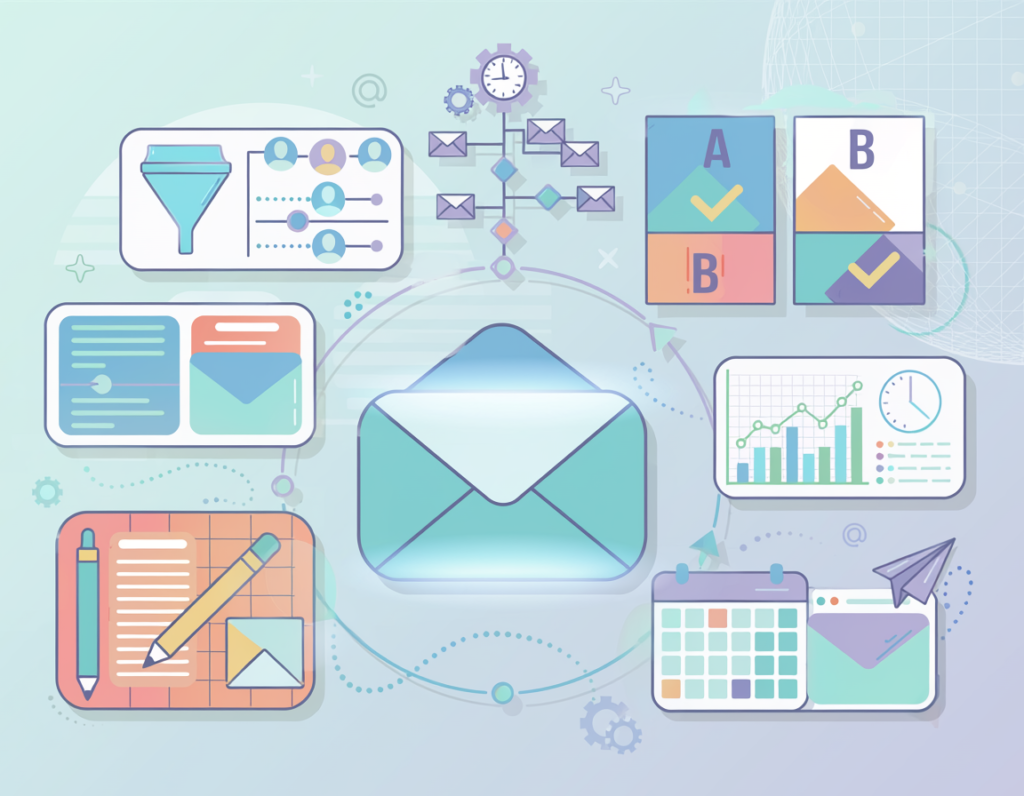
Concept 1: The Content Creation Bottleneck
The single biggest reason small business email lists go dormant isn’t lack of strategy. It’s lack of content — specifically, the time and mental energy required to produce it consistently.
Consider Sarah, a freelance brand designer in Portland with eight active clients. She knows her newsletter should go out every two weeks. She has opinions worth sharing. But sitting down to draft a 400-word email, write a subject line worth opening, and format it for mobile while managing client deadlines is a task that keeps sliding to Friday, then the following Monday, then indefinitely.
AI writing assistance inside MailerLite changes this dynamic by collapsing a 90-minute drafting session into a 20-minute editing session. Sarah provides the core idea and tone direction; the AI produces a structured draft. She edits, personalizes, and sends. The bottleneck — the blank page — disappears. Sarah’s estimate: 2.5 hours saved per week, or roughly 130 hours per year returned to client work.
For advanced content generation strategies and workflow examples specific to email marketing, explore MailerLite AI in detail.
Concept 2: The Sequence Design Tax
Building an email automation sequence — a welcome flow, a post-purchase series, a re-engagement campaign — is not a one-time cost. It requires planning the logic, writing each email, configuring triggers, testing the flow, and iterating on performance. For a solo operator without a marketing background, this represents a steep learning curve on top of an already heavy workload.
Research from the University of California, Irvine, found that it takes an average of 23 minutes to regain full concentration after an interruption. When building an automation sequence requires switching between the campaign editor, a doc with copy, a spreadsheet with subscriber segments, and a tutorial tab, the cognitive overhead multiplies fast.
Marcus, a solo management consultant in Chicago, tracked this explicitly. Before using AI-assisted automation tools, he spent roughly 5 hours per month on email-related tasks: drafting newsletters, setting up sequences for new lead magnet subscribers, and reviewing campaign analytics. After implementing MailerLite’s AI-driven workflow suggestions and AI writing assistant, that dropped to 2 hours. He now uses the recovered 3 hours per month — 36 hours per year — to develop a new service offering he had been postponing for two years.
Concept 3: The Optimization Feedback Loop
Most small business email programs suffer from a silent problem: campaigns go out without clear understanding of why performance is what it is. Testing hypotheses manually requires patience, statistical literacy, and time — resources in short supply for the solo operator.
AI-assisted analysis closes this loop by identifying patterns across campaigns quickly. Elena, an e-commerce owner in Austin, spent approximately 4 hours per month manually reviewing campaign metrics and trying to apply lessons to the next send. AI-powered campaign analysis in MailerLite surfaces actionable insights automatically: subject line patterns correlated with higher open rates, optimal send times based on historical data, and subscriber segments showing disengagement before they fully churn.
As detailed in MailerLite’s breakdown of MCP server automation use cases, connecting an AI assistant directly to your MailerLite account allows it to analyze actual campaign data and suggest improvements based on real performance — not generic best practices. Elena reclaimed roughly 4 hours monthly and redirected it into product development.
How MailerLite AI Helps Efficiency

Feature 1: Built-in AI Writing Assistant
MailerLite’s AI writing assistant is embedded directly in the drag-and-drop email editor — accessible mid-campaign without leaving the platform or opening a separate tab. It generates subject lines, body copy, CTAs, and preheader text based on short prompts. It also improves pre-written copy: tightening wordy paragraphs, adjusting tone between natural, catchy, professional, and persuasive, and flagging spam-trigger words that hurt deliverability.
For a freelancer sending one campaign per week with an average of 90 minutes of writing time, shifting to AI-assisted drafting at 25–30 minutes of editing time yields approximately 52 hours saved annually. At $75–100 per hour, that’s $3,900–5,200 in recovered billable capacity per year.
The assistant also generates subject line variations on demand — a capability that removes one of the most time-consuming micro-decisions in email marketing. Rather than spending 20 minutes deliberating between three subject line options, you review five AI-generated variants and pick the strongest one in two minutes.
Feature 2: Behavior-Based Automation Workflows
MailerLite’s automation builder creates sophisticated trigger-based sequences without code: welcome sequences, re-engagement flows triggered by inactivity thresholds, post-purchase nurture sequences, and content delivery automations for lead magnets.
The time value is asymmetric. Building a five-email welcome sequence takes approximately 3–4 hours once — then runs indefinitely for every new subscriber. For a business adding 50 new subscribers per month, a properly configured welcome sequence eliminates what would otherwise be 50 manual follow-up tasks per month.
AI assists in the setup phase: MailerLite’s MCP server connection allows an AI assistant to analyze your existing automations, identify drop-off points, and suggest specific improvements based on real engagement data from your account.
Feature 3: AI-Powered Campaign Analysis and Subject Line Optimization
Consistent email marketing improvement requires feedback loops. MailerLite’s AI-enhanced analytics surface actionable insights automatically — subject line patterns that correlate with higher open rates, optimal send times based on historical data, subscriber segments showing early disengagement. As described in MailerLite’s own guide to using the AI writing assistant effectively, detailed prompts produce substantially better output than generic ones — a principle that applies equally to campaign optimization requests.
The MCP server integration goes further: you can ask an AI assistant connected to your MailerLite account to analyze your last 10 campaigns, identify your highest-performing subject line structures, and draft subject line options for your next send — in under two minutes.
Annual time saved: approximately 35 hours for a business reviewing campaigns monthly.
Ready to automate your email marketing without hiring a marketing team? Try MailerLite AI free and run your first automation this week. Start Free at mailerlite.com | No credit card required
Best Practices for Implementing AI Email Automation

1. Start with One Automation, Not Five
The most common mistake is trying to build everything at once. Welcome sequence, abandoned cart, re-engagement flow, birthday campaign — all at once, none of them right.
Start with the single highest-value automation for your business model. For most small businesses, that’s the welcome sequence. Build it, test it for 60 days, optimize it. Add the next automation once the first one runs reliably.
2. Keep Human Oversight on Voice
AI-generated email copy is a first draft, not a final product. Read every AI-generated email out loud before sending. Does it sound like you? A 15-minute edit pass that restores your voice is worth far more than a perfectly formatted email that feels corporate.
3. Consolidate Tools Before Adding New Ones
A common pattern among small business owners is accumulating email tools: one for list management, one for landing pages, one for popups, one for AI writing. The average fragmented stack costs $129–175 per month and creates data-sync headaches that consume more time than the tools save.
MailerLite consolidates email campaigns, automation, landing pages, popup forms, and AI writing into one platform. Before adding any new tool, check whether MailerLite already does it.
Limitations and Considerations

AI email marketing automation performs best on structured, repeatable tasks — and falls short when nuanced brand judgment, legal accuracy, or genuine human relationship is what the situation requires.
High-Stakes Brand Voice Writing. If your email list is built on a distinctive personal voice — humor, vulnerability, contrarian opinions — AI drafts will frequently flatten it into something generically competent. For newsletters where voice IS the product, budget more editing time than you expect.
Legal and Compliance Messaging. Do not use AI to draft emails that carry legal weight: terms of service updates, privacy notifications, refund policy communications. Hallucination risk alone makes this inadvisable; these messages require human review with relevant domain knowledge.
Personal Relationship Management. Automation is powerful for broad segments; it’s wrong for individual relationship maintenance. If an important client or longtime subscriber replies to a campaign, respond personally. Automated replies to direct messages are detectable and damage trust.
Key Risks to Manage. AI writing assistants occasionally generate confident-sounding but factually incorrect claims — verify any statistics or product claims before publishing. Review MailerLite’s data handling terms before automating workflows that include sensitive customer data. And maintain the habit of writing some content without AI assistance; over-reliance can atrophy your own skills over time.
Used with appropriate oversight, AI email automation is transformative. Used as a replacement for editorial judgment, it produces emails that subscribers can feel aren’t quite right.
Frequently Asked Questions
What is AI email marketing automation for small business?
AI email marketing automation for small businesses refers to using AI-powered tools to streamline the creation, delivery, and optimization of email campaigns — including drafting copy, building behavior-triggered sequences, analyzing performance, and maintaining list health. For solo operators and small teams, it converts what would be 5–10 hours of weekly email work into 1–2 hours of oversight and editing.
Can AI replace email marketing admin work entirely?
Not entirely, and the goal shouldn’t be full replacement. AI can eliminate the most time-consuming mechanical tasks — drafting, sequencing, segmenting, and analyzing — but human judgment remains essential for brand voice, strategic decisions, and relationship-sensitive communications. Think 70–80% reduction in time-on-task for routine work, not 100% automation.
How do freelancers use AI to save time on email campaigns?
The most common high-value workflow for freelancers is AI-assisted drafting combined with pre-built automation sequences. A freelancer provides a topic and tone direction; the AI produces a structured draft in minutes. Pre-built welcome, nurture, and re-engagement sequences handle new subscriber onboarding automatically. Together, these two capabilities eliminate the two biggest time sinks in freelancer email marketing: content creation and follow-up consistency.
Conclusion

The case for AI email marketing automation in 2026 is no longer theoretical — it’s arithmetic. For US freelancers and small business owners billing $75–150 per hour, recovering 5 hours per week from email overhead at a $100 rate is $26,000 in annual capacity, available to redirect toward client work, product development, or rest.
MailerLite AI delivers this through four integrated capabilities: an AI writing assistant that eliminates the blank page, behavior-based automation that runs nurture sequences without human intervention, AI-driven campaign analysis that closes the performance feedback loop, and MCP server integration that connects the platform to external AI tools for deep account-level insights.
The goal throughout is augmentation, not replacement. Your relationship with your subscribers — the trust you’ve built, the voice they recognize, the value you provide — remains human. AI handles the operational layer underneath that relationship so you can show up more consistently, not less personally.
For US small businesses, the ROI on AI email marketing automation is clear: a $20–50 monthly platform investment replacing $150–300 in equivalent freelance marketing assistance, with 5–10x the consistency. Over a year, that compounds into audience growth, pipeline development, and revenue that manual, intermittent email marketing cannot produce.
The question isn’t “Should I use AI for email marketing automation?” It’s “Can I afford to keep doing this manually?”
Try MailerLite AI free and run your first automation this week. Start Free at mailerlite.com | No credit card required
Leave a Reply