
The right ai app builder for business turns operational bottlenecks into working internal tools — no developer, no waiting, no six-figure budget required.
In 2026, American founders and small team operators face a specific operational trap. The business is growing. Customers are happy. Revenue is climbing. But behind the scenes, everything runs on a patchwork of spreadsheets, Slack threads, and manual processes that eat 10–15 hours a week in coordination overhead.
The tools that would solve this — custom CRMs, client portals, inventory trackers, internal dashboards — used to require a developer. And hiring a developer in the US typically runs $75–$150 per hour. A modest internal tool could cost $3,000–$10,000 to build and even more to maintain.
That equation has fundamentally changed.
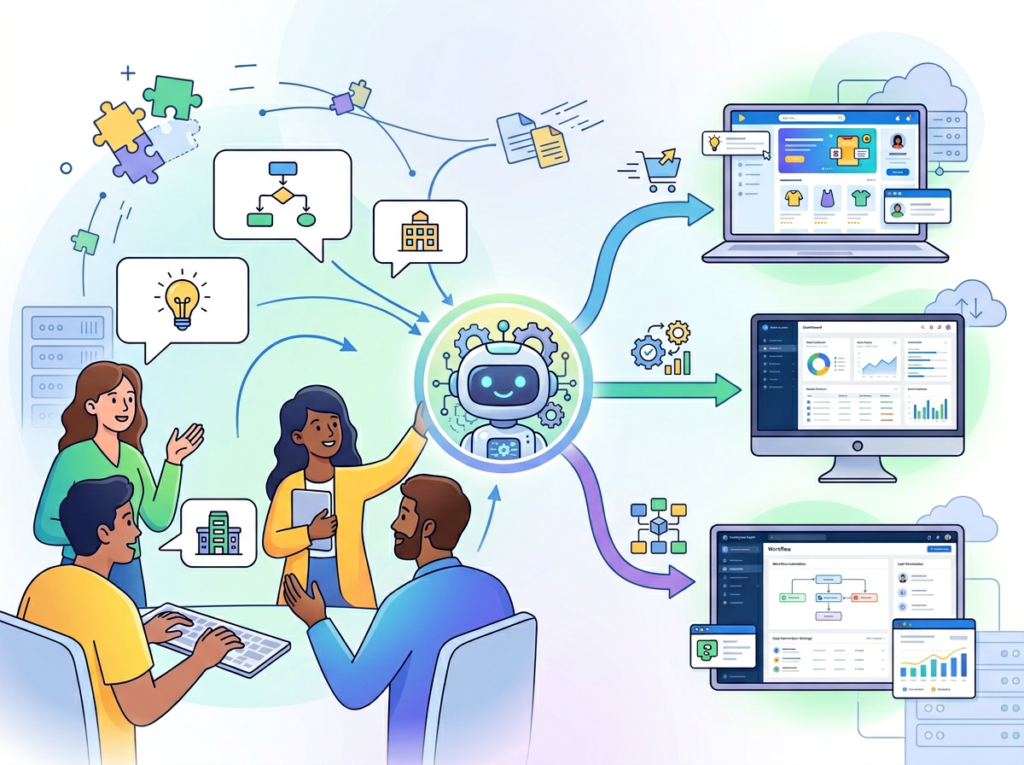
Base44 is an AI-powered no-code app builder that lets founders, operators, and small teams build fully functional internal tools in minutes using plain language. No code. No developer. No waiting. You describe what you need, and Base44 generates a working app — complete with a database, user authentication, forms, dashboards, and integrations with tools like Gmail, Slack, and Stripe.
For US-based teams billing at $75–$150 per hour, every hour spent manually moving data between spreadsheets or chasing down approvals is direct money lost. Base44 converts that overhead into automated workflow infrastructure — the kind that used to require a dedicated engineering hire.
This article covers four specific use cases for building internal tools with AI, three concrete automation workflows to implement this week, and an honest look at where Base44 excels — and where it doesn’t.
Try Base44 free and eliminate your most painful manual workflow today. Start Free | No credit card required
Key Concepts: What It Means to Build Internal Tools with AI

Concept 1: The Developer Dependency Gap
Most small businesses don’t need a full-time developer. They need a CRM that matches their specific sales process. They need a client onboarding portal that reflects their actual workflow. They need an internal request tracker that fits how their team communicates.
Generic SaaS tools approximate these needs but rarely fit precisely. Custom development fits precisely but costs too much. This gap — between “close enough” and “exactly right” — is where most operational inefficiency lives.
Consider Marcus, who runs a six-person marketing agency in Denver. His team was managing client deliverables across a combination of Asana, a shared Google Sheet, and a folder structure on Google Drive that nobody could agree on. It worked well enough until client count crossed 20. At that point, the system broke weekly. Hiring a developer to build something custom was quoted at $8,500. Instead, Marcus described his ideal workflow to Base44 in plain language and had a working client project tracker — with role-based access and automated status updates — in under two hours.
The developer dependency gap is closing. AI app builder for business platforms like Base44 are the reason.
Concept 2: Operational Debt
Every manual process a small team runs creates what engineers call “technical debt” — the hidden cost of doing things the slow way. For non-technical founders, this is better understood as operational debt: the accumulated friction of workflows that were never properly systematized.
Research from productivity studies consistently shows that knowledge workers switch tasks an average of every few minutes in reactive work environments, and that recovering full focus after an interruption takes upward of 20 minutes. For a team of five people each losing an hour a day to manual coordination tasks, that’s 25 person-hours per week — roughly $1,875–$3,750 in billable-equivalent time, every single week.
Explore Base44 in detail to understand how the platform’s approach to app templates and AI-driven customization can eliminate specific operational debt patterns common to service businesses, e-commerce operators, and SaaS teams.
Operational debt compounds. A process that costs one hour per week today will cost three hours per week in six months as the business grows around it. Building the right internal tool now is not a productivity optimization — it’s risk mitigation.
Concept 3: Composable Workflow Architecture
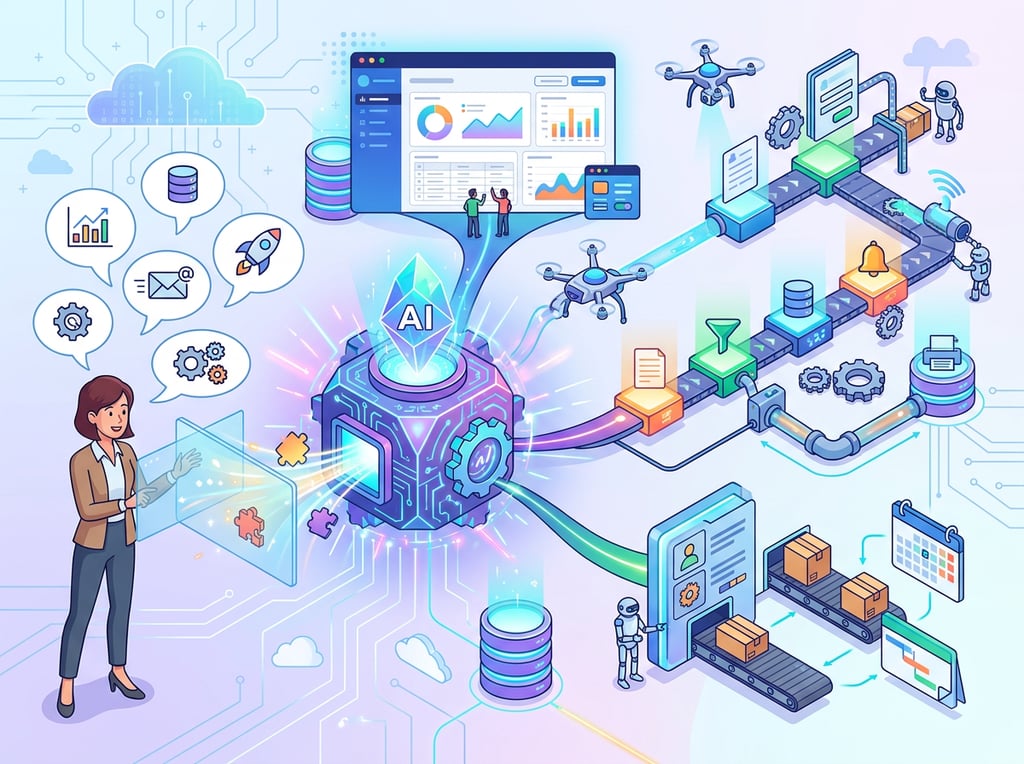
The most powerful shift that no code ai app builder platforms enable isn’t just “faster tool building.” It’s composable workflow architecture — the ability to build a stack of small, specific internal tools that each solve one job precisely, and then connect them together as the business scales.
Traditional software thinking requires buying a platform and fitting your business around its structure. Composable workflow thinking requires identifying your most painful friction points and building targeted tools that fit your actual process.
Elena runs a Shopify store in Phoenix with three employees. Rather than buying an all-in-one operations suite, she built four small Base44 apps: a supplier communication tracker, a product photography request queue, a return processing dashboard, and a team task log. Each took under two hours to build. Together, they eliminated approximately 12 hours of weekly coordination overhead across her team — saving an estimated $900–$1,800 per week at standard operational labor rates.
How Base44 Helps Small Teams Build and Automate

Capability 1: Natural Language App Generation
The core mechanism of Base44 is simple: you type what you want to build, and the platform builds it. As outlined in Base44’s official quick-start documentation, the AI handles design, database structure, user flows, permissions, and hosting automatically — you focus on describing the problem.
The difference between a useful app and a generic one comes down to prompt specificity. Instead of “Build me a CRM,” a prompt like “Build a CRM for a six-person marketing agency with contact management, deal tracking by stage, and a dashboard showing monthly revenue per client” produces something immediately usable.
Annual time saved: Teams that previously relied on consultant-built or developer-built internal tools report saving 40–80 hours per year in development cycle time alone, before accounting for operational efficiency gains. At $100/hour equivalent, that’s $4,000–$8,000 in reclaimed capacity.
Capability 2: Native Integrations (Gmail, Slack, Stripe, Google Calendar)
Base44 includes built-in connections to Gmail, Slack, Stripe, and Google Calendar without requiring API configuration. This means an internal tool can send a Slack notification when a form is submitted, trigger a Gmail confirmation when a client onboards, or update a payment status when Stripe processes a transaction — all described in plain language, with no webhook setup required.
For operations-heavy teams, this integration layer is where Base44 generates the most automation value. The manual work of copying information between systems, sending status update emails, and notifying teammates about task changes can be fully replaced by trigger-based automations built directly into your internal apps.
Annual time saved: 60–120 hours per year for teams running three or more manual cross-tool workflows, representing $6,000–$18,000 in reclaimed capacity.
See our full Base44 review for a detailed breakdown of available integrations, pricing tiers, and platform limitations relevant to US small businesses.
Capability 4: AI Chat for Continuous Iteration
Unlike traditional no-code platforms where customization requires learning a visual editor, Base44’s AI chat lets you modify your app conversationally. Change a color, add a new data field, adjust permissions, create a new page — all by typing what you want.
Base44 also supports a “Discuss mode” for brainstorming changes without consuming credits, which is valuable for teams in the planning phase of a new internal tool. As noted in Base44’s app performance documentation, the platform also includes tools for checking and optimizing app speed — an important consideration for client-facing portals built on the platform.
Annual time saved: 20–40 hours per year compared to traditional no-code platforms where modifications require navigating complex visual editors.
Combined ROI estimate: A small team investing $240–$480 per year in Base44 and reclaiming 150–290 hours of operational time annually generates a return of 30x to 120x on the platform investment — before accounting for the revenue capacity freed up by those reclaimed hours.
Ready to build your first internal tool in under two hours? Try Base44 free and eliminate your most painful manual workflow today. Start Free | No credit card required
Best Practices for Implementing No-Code AI App Building

1. Start with Your Most Painful Single Workflow
Resist the impulse to build everything at once. The teams that succeed with Base44 fastest identify the single workflow that costs the most time per week, build a tool for that one problem, use it for two weeks, and then expand. Starting too broad — trying to replace three systems simultaneously — creates confusion and slows adoption.
A practical rule: if you’re spending more than 3 hours per week on a manual coordination task, it’s a viable Base44 candidate. Start there.
2. Write Specific Prompts — Then Refine in AI Chat
The quality of your initial Base44 app is directly proportional to the specificity of your first prompt. Include: who will use the app, what data it needs to track, what outputs it should generate, and what existing tools it needs to connect with. A 150-word prompt produces a significantly more useful first build than a 20-word prompt.
After the initial build, use Base44’s AI chat to refine — add fields, adjust permissions, modify layouts. The iterative loop of build-test-refine is faster and cheaper than trying to get everything right in the first prompt.
3. Avoid Tool Proliferation by Consolidating on One Platform
A common trap for small teams is building one tool in Base44, another workflow in Zapier, a third database in Airtable, and a fourth dashboard in Notion — and then spending hours managing the connections between them. The operational overhead of a four-platform stack can easily exceed $200/month and 5 hours/week in maintenance.
Where possible, consolidate. If Base44 can handle the full workflow — data entry, storage, automation, notification, and reporting — building everything in one platform eliminates integration overhead and simplifies troubleshooting. The platform’s built-in database and native integrations make this consolidation realistic for most small business internal tool needs.
4. Track Time Before and After
Before building a Base44 tool for any workflow, log how many hours per week the current manual process requires. After deploying the tool, measure again after 30 days. This creates accountability, validates the ROI, and makes it easier to identify the next highest-value automation target.
Teams that track time savings consistently report identifying two to three additional automation opportunities they hadn’t considered, simply by quantifying where their hours are actually going.
Limitations and Considerations

Where Base44 Is Not Ideal
Complex customer-facing products: Base44’s strength is internal tools and lightweight client portals. If you’re building a customer-facing product that needs advanced UI customization, third-party API integrations beyond Base44’s supported connectors, or performance at thousands of concurrent users, you’ll likely outgrow the platform. It’s a tool for operational efficiency, not for building a scalable SaaS product.
Highly regulated data environments: Healthcare, legal, and financial services companies operating under HIPAA, attorney-client privilege, or SEC data handling requirements should evaluate Base44’s architecture carefully before processing regulated data. The platform offers standard security features — Cloudflare CDN and user authentication — but is not specifically certified for regulated industry compliance.
Workflows requiring complex conditional logic: Base44 handles states and conditions well for standard use cases — role-based access, form validation, notification triggers. But highly complex branching logic (multi-tier approval workflows with dynamic routing, real-time data processing) may require custom code supplements.
Key risks to manage:
- Vendor dependency: Your internal tools live on Base44’s platform. Export your project to GitHub (available on Builder plan and above) to maintain a backup and avoid complete vendor lock-in.
- AI hallucination in app logic: Review AI-generated workflows before deployment. Test edge cases — what happens when a form is submitted twice, when a required field is empty, when an integration fails.
- Skill atrophy: Teams that replace every manual process with automation lose the muscle memory of understanding how their operations actually work. Keep human oversight on any workflow that involves external financial transactions, client commitments, or compliance reporting.
Frequently Asked Questions
What is an AI app builder for business?
An AI app builder for business is a platform that converts natural language descriptions of software requirements into functional applications — including database structure, user interface, authentication, and integrations — without requiring code. Base44 is one of the leading platforms in this category, enabling small teams to build internal tools, client portals, and operational dashboards in hours rather than weeks.
Can Base44 replace my existing project management or CRM tool?
For many small teams, yes — particularly if your current tool doesn’t fit your exact workflow. Base44 can build a custom CRM or project tracker shaped precisely around how your team operates, rather than requiring you to adapt your process to a generic tool. However, if you’re heavily invested in an existing platform and its integrations, the switching cost may not justify the transition.
Do I need technical skills to use Base44?
No. Base44 is specifically designed for users without coding or technical backgrounds. The platform handles design, database structure, authentication, hosting, and integrations automatically based on your natural language prompts. Some familiarity with how software works — understanding concepts like user roles, form fields, and data tables — is helpful for writing effective prompts, but no coding knowledge is required at any point.
Conclusion
In 2026, the operational gap between small teams that have systemized their workflows and those still running on manual processes is widening. Teams that build their own internal tools — custom to their process, connected to their tools, deployed without a developer — compound their operational advantage every quarter.
Base44 puts the ai app builder for business capability directly in the hands of founders and operators. The ROI case is clear: at $16–$50 per month for the platform, a small team reclaiming 10 hours per week in operational efficiency at $75/hour equivalent generates a 375x annual return on the platform investment.
AI in this context is infrastructure, not a replacement for human judgment. The decisions, relationships, and strategic work that drive business growth still require people. But coordination overhead, manual data entry, repetitive status updates, and spreadsheet gymnastics? Those are Base44’s domain.
Start with your most painful manual workflow. Describe it in plain language. Deploy in an afternoon. Then do it again.
The question isn’t “Should I build internal tools with AI?” — it’s “How many hours this week can I afford NOT to?”
Try Base44 free and eliminate your most painful manual workflow today. Start Free | No credit card required
Leave a Reply