
AI video editing tools have quietly become the difference between brands that scale social media and those that stall — CapCut AI is where that shift starts.
In 2026, American freelancers, content creators, and small business owners face an uncomfortable paradox: the platforms that drive the most customer attention — TikTok, Instagram Reels, YouTube Shorts — demand a relentless volume of short-form video content, while the hours available to produce it haven’t changed at all.
The content calendar is falling behind. The raw footage folder from last month is still untouched. And every hour trimming clips, syncing captions, and hunting for the right transition is an hour not spent on client work, product development, or revenue generation.
For US freelancers and small business owners billing $50–$150 per hour, this math is brutal. Ten hours of manual video editing per week isn’t just exhausting — it’s $500–$1,500 in weekly opportunity cost.
That’s the problem CapCut AI was built to solve. Unlike traditional editing software that asks you to master timelines, keyframes, and layer stacking, CapCut AI approaches video creation as an automation problem first. It uses AI to handle the mechanical work — auto-cutting, captioning, background removal, script-to-video generation, music syncing — so that creators and business owners spend their time on strategy and creativity instead of execution.
This article breaks down exactly how CapCut AI delivers on that promise, with four specific workflows you can implement this week. Each one is designed to save 2–8 hours on your current content production process, validated through real small business scenarios grounded in the US market.
The question isn’t whether short-form video matters for your business in 2026. It does. The question is whether you can produce it without burning out — and that’s where AI video editing tools change the equation permanently.
To see these features mapped to specific workflow templates and real publishing cadences, see our full CapCut AI review on AI Plaza.
Key Concepts of AI Efficiency
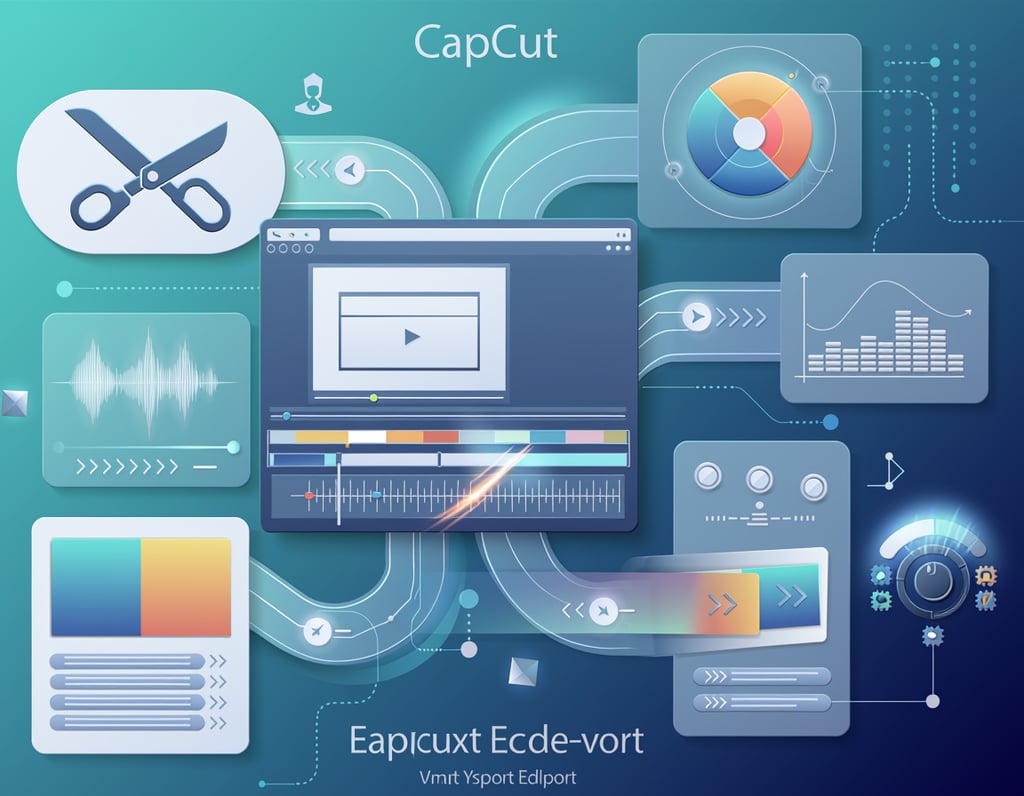
Concept 1: Cognitive Offloading in Video Production
Cognitive offloading is the practice of moving routine mental tasks onto an external system — in this case, AI — so that the human operator can preserve mental bandwidth for higher-order decisions.
In video editing, cognitive offloading looks like this: instead of manually reviewing 45 minutes of raw footage to find the usable 90-second clip, an AI auto-cuts system does the first pass automatically. Instead of typing captions word by word, auto-captioning generates them in seconds. Instead of manually syncing music beats to transitions, AI beat detection handles the alignment.
Consider Sarah, a freelance brand content creator in Seattle who manages video production for eight small business clients. Before adopting AI tools, her workflow consumed approximately 12 hours per week in post-production alone — cutting, captioning, exporting in multiple aspect ratios, and reformatting for each platform. After integrating AI-assisted editing into her pipeline, that number dropped to under 5 hours. The 7 hours she recovered went directly into client strategy calls and content planning — work that commands her full $85/hour rate. That’s a weekly gain of $595 in billable capacity.
Explore CapCut AI in detail to see how cognitive offloading translates into specific editing features that work across TikTok, Instagram, and YouTube Shorts.
Concept 2: Context Switching Cost
Research consistently shows that the average knowledge worker loses approximately 23 minutes of focused productivity every time they switch between tasks. For video creators, context switching is constant: move from scripting to filming, then to editing software, then to caption review, then back to reformatting for a different platform aspect ratio. Each transition carries a cognitive penalty.
Marcus, a solo marketing consultant in Atlanta who produces weekly video content for his LinkedIn and Instagram audiences, tracked his video workflow for one month before and after implementing AI editing tools. He found that the number of distinct task-switching moments in a typical editing session dropped from 34 to 11 — because AI handled entire phases of the workflow rather than individual steps. His weekly video production time fell from 9 hours to 4 hours, recovering 260 hours annually that he now reinvests into client-facing consulting work.
Concept 3: Workflow Orchestration
The most powerful application of AI efficiency in video production isn’t any single feature — it’s the ability to chain multiple AI functions into a single coherent workflow. This is what distinguishes a genuinely efficient AI-assisted pipeline from a collection of disconnected tools.
Workflow orchestration means: raw footage goes in, and a platform-ready short-form video comes out, with captions, background music, proper aspect ratio, and basic color correction — without the creator touching a timeline. Elena, a Shopify store owner in Denver who produces product demonstration videos, reduced her video production cycle from 6 hours to 1.5 hours per video by implementing a template-based AI workflow. Over a year, that represents more than 180 hours recovered — the equivalent of over four full work weeks returned to product sourcing, customer service, and paid advertising management.
How CapCut AI Helps Efficiency

Feature 1: AI Auto-Cut and Smart Highlight Detection
CapCut AI’s auto-cut feature analyzes raw footage and automatically identifies the most relevant segments based on motion, face detection, audio clarity, and pacing. For small business owners who shoot product demos, tutorials, or talking-head content, this eliminates the single most time-consuming editing task: the first-pass review and selection process.
A typical 20-minute raw recording session produces approximately 2 minutes of usable short-form content. Manually identifying those 2 minutes takes an average of 45–60 minutes with traditional editing software. AI auto-cut reduces that to under 5 minutes, including review time.
Annual time saved: Approximately 52 hours for a creator producing two short-form videos per week. Annual ROI at $75/hour average rate: $3,900.
Feature 2: Auto-Captioning and Subtitle Styling
Captions are no longer optional for short-form video. Approximately 85% of social media videos are watched without sound, making accurate captions a direct driver of viewer retention and conversion. CapCut AI generates captions automatically from audio, with accuracy rates that rival dedicated transcription services — and delivers them in stylized, platform-native formats that are ready to publish.
Beyond time savings, AI-generated captions reduce a common bottleneck for non-native English speakers and business owners who lack confidence in their writing: the fear that manual captioning will introduce errors or slow down their publishing cadence.
Annual time saved: Approximately 40 hours for a creator publishing three videos per week. Annual ROI at $75/hour average rate: $3,000.
Feature 3: Template-Based Workflow Automation
CapCut AI’s template library — combined with its AI-powered style matching — allows users to apply consistent visual branding across multiple videos in a single session. For small businesses running recurring content series (weekly product spotlights, customer testimonials, tutorial episodes), this means the formatting decisions made once propagate automatically across future productions. As noted in this breakdown of CapCut’s AI capabilities, the platform’s AI effects and template systems are designed to dramatically reduce per-video production time.
Annual time saved: Approximately 60 hours for a business producing a recurring weekly content series. Annual ROI at $75/hour average rate: $4,500.
To see these features mapped to specific workflow templates and real publishing cadences, see our full CapCut AI review on AI Plaza.
Best Practices for Implementing AI Efficiency

1. Start with One Workflow, Not the Entire Pipeline
The most common mistake when adopting AI video tools is attempting to automate everything at once — the result is an overwhelming setup phase, inconsistent outputs, and abandoned tools within 30 days.
Choose the single task in your current workflow that consumes the most time relative to its creative value. For most small business owners, that’s caption creation or multi-platform export. Automate that one step first, measure the time saved, and expand from there.
2. Maintain a Human Review Step
AI-generated captions, auto-cuts, and voiceovers are impressive but not infallible. Auto-captions can mishear industry-specific terminology. Auto-cuts can clip an important sentence. Build a 5–10 minute quality review into every AI-assisted workflow. This human-in-the-loop approach preserves brand credibility while still capturing the majority of time savings.
3. Avoid Tool Bloat
A typical fragmented video stack might include a dedicated captioning tool ($29/month), a background removal service ($19/month), a music licensing platform ($15/month), and an export tool ($25/month) — totaling $88/month for functions that CapCut AI consolidates into one interface. Before adding any new tool, audit what CapCut AI already handles.
4. Track Time Before and After
Before implementing CapCut AI, spend one week tracking time on each step of your production process. After implementing AI, track the same steps. The concrete before/after comparison reveals which features deliver real value — and gives you quantified ROI to justify further investment.
Limitations and Considerations

Where CapCut AI Is NOT Ideal
High-Stakes Brand Storytelling AI-generated templates and auto-cuts produce competent, clean short-form videos. They do not produce emotionally resonant brand narratives. If your business’s competitive advantage lives in the personality and authenticity of your founder story, a heavily AI-automated video will flatten that voice. Use AI for the mechanical layers, but keep the script, the delivery, and the editorial judgment human.
Legal, Medical, or Compliance-Sensitive Content Auto-captioning is accurate enough for most casual content, but not for industries where specific wording carries legal significance — healthcare, financial services, legal services, and regulated products. In these contexts, every caption must be human-reviewed for accuracy, and AI-generated voiceovers should be avoided entirely unless approved by a compliance team.
Content Requiring Deep Cultural Nuance AI tools trained on broad data sets can miss the cultural specificity that makes content resonate with a particular community or demographic. If your audience is highly culturally specific — a regional community, a niche subculture, or a non-English-speaking demographic — AI-generated content elements may feel generic or off-tone.
Frequently Asked Questions

How do freelancers and solo creators use AI to save time on videos?
The most common AI efficiency gains for solo creators are in four areas: auto-captioning (eliminating 30–60 minutes of manual caption work per video), AI auto-cut (reducing first-pass footage review from hours to minutes), template-based formatting (applying consistent branding across multiple videos in one session), and multi-platform export (generating TikTok, Reels, and Shorts versions simultaneously instead of manually reformatting each one).
What’s the best AI video editing tool for small businesses?
The right tool depends on publishing platform, budget, and content type. CapCut AI is particularly well-suited for businesses publishing primarily to TikTok, Instagram Reels, and YouTube Shorts because its feature set — auto-cut, AI captions, beat-sync templates, and multi-platform export — maps directly to short-form content workflows. It also offers a robust free tier that allows small businesses to validate the workflow before committing to a paid plan.
Do I need technical skills to use CapCut AI for business?
No. CapCut AI is explicitly designed for non-technical users. The interface uses drag-and-drop video import, one-click template application, and automatic caption generation without requiring any knowledge of traditional editing software. Most small business owners report being able to produce their first publishable AI-assisted video within 30–60 minutes of opening the platform for the first time.
Conclusion

The core argument of this article is simple: in 2026, AI video editing tools are not a competitive advantage reserved for large brands with dedicated content teams. They are a practical efficiency tool for solo operators, freelancers, and small business owners who need to show up consistently on short-form video platforms without sacrificing the hours that should be going into their actual business.
CapCut AI delivers on that promise through four specific workflow improvements — AI auto-cut, automatic captioning, template-based batch production, and multi-platform export — that together can recover 150–400 hours of production time annually for a typical small business creator. At US freelance rates of $50–$150 per hour, that represents $7,500–$60,000 in recovered economic capacity.
The philosophy here is augmentation, not replacement. Your creative vision, your brand voice, and your relationship with your audience still require human judgment. What CapCut AI removes is the mechanical friction between having an idea and publishing it — the part of video production that burns out creators and stalls content calendars.
The recommended approach is phased. This week, pick one task: caption generation or multi-platform export. Automate it. Measure the time saved. Next week, add one more step. Within 30 days, you will have rebuilt your video workflow around AI efficiency — and the output difference will be measurable.
The question is no longer “Should I use AI for video production?” The question is: “Can you afford to keep doing it without AI?”
To see these features mapped to specific workflow templates and real publishing cadences, see our full CapCut AI review on AI Plaza.
Leave a Reply