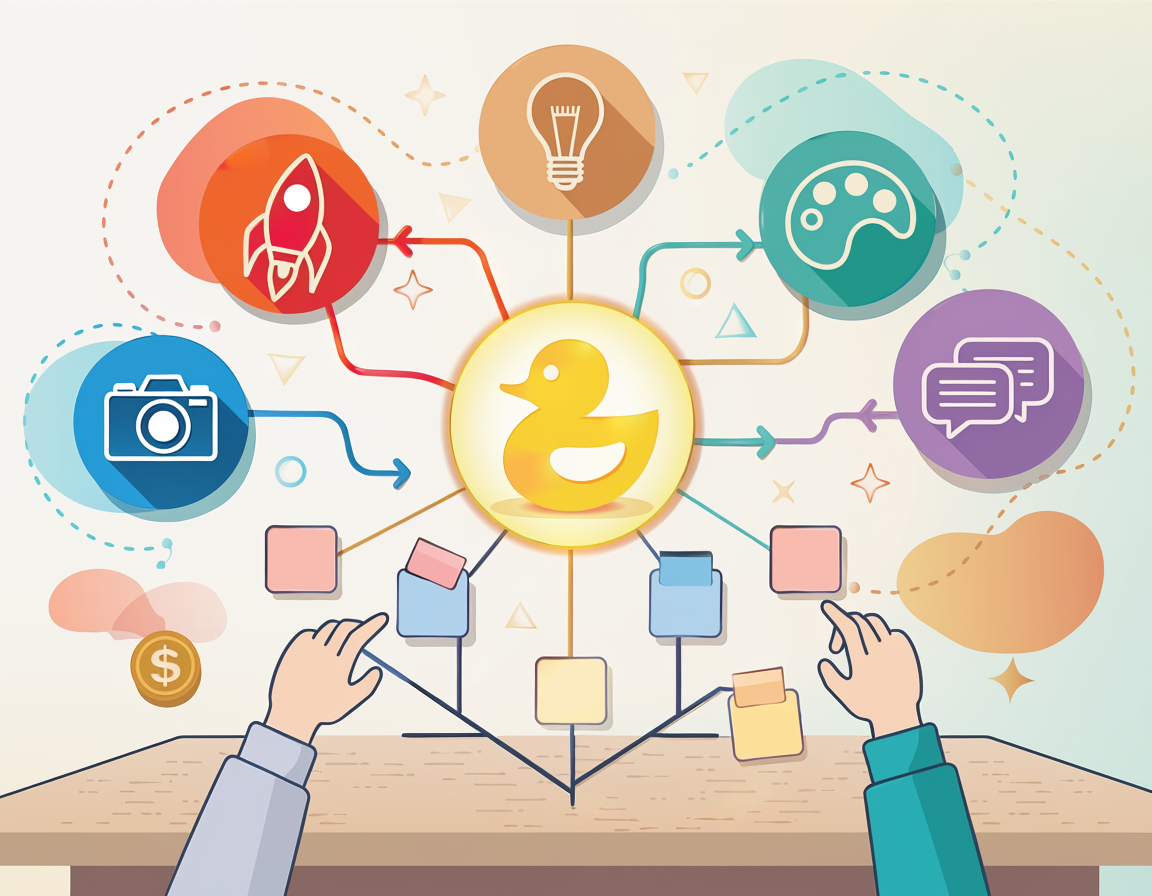
The best AI idea generation tools don’t just hand you answers — they rewire how you think, and Minduck is built around exactly that gap.
In 2026, American freelancers, solo entrepreneurs, and independent creators face a productivity paradox that no amount of hustle can solve. The ideas are there — half-formed, scattered, buried under a backlog of client emails, half-finished Notion pages, and voice memos you never transcribed. You’re not short on inspiration. You’re drowning in it, with no clean system for turning raw thinking into usable output.
This is the creative overhead nobody talks about. The cognitive drag of having to hold ten half-baked ideas in your head while simultaneously managing deadlines, client expectations, and the next product launch. For US-based creators billing $75–150 an hour, every hour spent organizing half-thoughts instead of executing them is real money left on the table — and real mental energy spent on something AI can now handle.
That’s where Minduck enters. Unlike conventional AI brainstorming tools that generate a flat list of suggestions and leave you to sort through the chaos, Minduck is built on a fundamentally different premise: your ideas have a structure, and AI should reflect that structure back to you visually.
This article shows you four specific workflows — for designers, consultants, content creators, and SaaS founders — that you can implement this week, each designed to reduce creative overhead and turn scattered thoughts into organized, actionable concepts.
To see detailed walkthroughs of Minduck’s creation and discovery features for freelancers, see our full Minduck review on AI Plaza.
Key Concepts of AI Idea Generation

Concept 1: Externalized Thinking
The human brain is not a storage device. It’s a processing device. When you try to hold multiple undeveloped ideas in working memory simultaneously — a content strategy, a new product angle, a client proposal — you degrade your ability to evaluate any one of them clearly. Cognitive science refers to this as working memory overload, and it’s the silent killer of creative momentum for solo operators.
AI idea generation tools address this by giving ideas somewhere to live outside your head. The moment a concept is externalized — typed, mapped, or voice-noted — it stops consuming working memory and becomes something you can actually interact with. For a freelance brand designer like Sarah in Portland managing eight active clients, that shift alone represents roughly 2.5 hours of recovered mental bandwidth every week. Instead of mentally juggling client briefs, Sarah can build a mind map branch for each project, let Minduck expand the conceptual threads, and return to a structured thinking environment rather than a blank page.
Concept 2: The Idea Fragmentation Problem
Most entrepreneurs don’t have an idea shortage. They have an idea fragmentation problem. A great concept surfaces in the shower, another emerges during a client call, a third gets half-written in a notes app at 11pm. None of them connect. None of them develop. They sit in isolation until the window closes and the moment passes.
This is the invisible tax on creative work that most productivity frameworks ignore. Context switching between fragmented ideas — especially in different formats and locations — costs an estimated 23 minutes of refocusing time per switch, according to widely cited attention research. For Marcus, an independent management consultant in Chicago billing at $120/hour, that fragmentation cost translates to over five recoverable hours per week. Structured AI brainstorming that connects related idea threads in a single visual workspace closes that gap meaningfully.
As explored in Minduck’s own analysis of AI productivity positioning, the distinction between tools that find information and tools that help you organize and retain it is the fundamental difference between surface-level AI use and genuine cognitive leverage.
Concept 3: Structured Generation vs. Flat Brainstorming
Most AI tools generate ideas the same way: a list. You ask for ten content ideas, you get ten content ideas, and then you’re on your own to figure out which ones are connected, which ones are viable, and how they fit into a larger strategy. The output is wide but shallow.
Structured AI idea generation works differently. Rather than producing a flat list, it maps relationships — showing how one concept branches into sub-concepts, how two ideas share a common premise, how a half-formed thought connects to a proven framework you already use. This is the difference between AI as a vending machine and AI as a thinking partner.
For Elena, a Shopify store owner in Austin running seasonal campaigns, the structured approach reclaims roughly four hours per month that would otherwise go toward manually organizing scattered campaign ideas into a coherent content calendar. For solo operators, that’s four hours redirected toward execution.
To understand how Minduck’s visual brainstorming framework applies to your specific creative workflow, explore Minduck in detail on AI Plaza.
How Minduck Helps with Idea Generation and Creative Thinking

Minduck helps creators and entrepreneurs generate ideas faster by combining AI-powered content generation with an interactive mind map interface — so thinking happens in a structured visual space rather than a blank text box.
Minduck’s core insight is deceptively simple: the problem with most AI brainstorming tools isn’t the AI. It’s the interface. A chat window treats every idea like a standalone message. A document treats every idea like a paragraph. Neither reflects how human thinking actually works — which is associatively, visually, and in branching structures rather than linear sequences.
Minduck’s interface starts with a visual mind map canvas. You place your central idea — a product concept, a content theme, a business problem — at the center, and the AI expands outward from there, generating branches, sub-branches, and connective tissue between related concepts. Every idea has a relationship to every other idea, and you can see those relationships at a glance.
Feature 1: AI-Powered Mind Map Generation
The core mechanic of Minduck’s Discovery mode is that it transforms any question or prompt into an interactive visual map. You’re not typing into a void and receiving a wall of text. You’re building a living idea structure that you can navigate, expand, and reorganize. For a freelance copywriter developing a content strategy for a SaaS client, that means going from a single brief to a fully branched content universe — pillar topics, supporting angles, counterintuitive hooks, and distribution formats — in under ten minutes instead of two hours. Annual time recovered: approximately 45 hours, or $3,375–$6,750 at standard US freelance rates.
Feature 2: Insight Book for Deep-Dive Development
Not every idea needs the same depth. Minduck’s Insight Book feature lets users toggle from the high-level mind map view into a detailed, source-backed exploration of any specific branch. As noted in this Tech Company News breakdown of Minduck Discovery, the Insight Book provides traceable, curated content that lets users go deeper on any node without losing the structural overview. For an entrepreneur researching a new market, this means moving fluidly between strategic overview and tactical depth — without context-switching between five different tabs. Annual time recovered: approximately 30 hours, or $2,250–$4,500.
Feature 3: Concept Structuring and Branch Reorganization
Once ideas are generated, the real work begins: prioritizing, connecting, and pruning. Minduck’s canvas allows users to drag, rearrange, and restructure their mind maps as their thinking evolves. This is particularly powerful for business planning, content strategy, and product development — any domain where the relationship between ideas matters as much as the ideas themselves. For a solo founder developing a go-to-market strategy, the ability to reorganize a 30-branch map in two minutes versus rewriting a 15-page document recovers roughly 20 hours per quarter. Annual time recovered: approximately 80 hours, or $6,000–$12,000.
Feature 4: Creation Mode for Output Generation
Minduck’s Creation mode translates the structured mind map directly into content output — drafts, outlines, structured frameworks — without losing the relational context the map was built on. For content creators, this bridges the gap between ideation and production in a single workflow. You don’t have to manually translate your mind map into an outline before writing. The structure carries forward. Annual time recovered: approximately 60 hours, or $4,500–$9,000.
Combined efficiency ROI across all four features: 215 hours annually at $75–$150/hour = $16,125–$32,250 — representing a substantial return relative to Minduck’s subscription cost.
Ready to turn scattered ideas into structured output? Try Minduck free and experience AI-powered brainstorming built around how you actually think. Start Free at Minduck | No credit card required
To see detailed walkthroughs of Minduck’s creation and discovery features for freelancers, see our full Minduck review on AI Plaza.
Best Practices for Implementing AI Brainstorming Tools

1. Start with One Thinking Context
The biggest mistake solo operators make with new AI tools is trying to use them everywhere at once. Pick one recurring creative challenge — weekly content planning, client discovery, product roadmap — and build your Minduck workflow around that single context for the first two weeks. Master the habit before expanding. A focused 30-minute Minduck session once per week delivers more sustainable value than an unfocused attempt to use it for everything at once.
2. Own the Editorial Layer
AI generates, but you direct. Minduck’s mind maps are starting points, not final answers. The branches it generates will sometimes be generic, off-strategy, or disconnected from your specific context. Your role is to prune aggressively, redirect when the map drifts, and inject the specificity that only you can provide — your audience’s actual language, your brand’s specific positioning, your product’s real differentiators. The AI handles volume; you handle judgment.
3. Consolidate Before You Add
Tool fragmentation is the silent budget and attention killer for solo operators. Before adding Minduck to your stack, audit what you’re already using for brainstorming and idea capture — Notion, Miro, Roam, voice memos, ChatGPT threads. If Minduck can replace two or three of those tools, it’s a consolidation win. The goal is one structured thinking environment, not another parallel system competing for your attention. A consolidated $20/month tool that you actually use beats a $129/month stack you context-switch between constantly.
Limitations and Considerations
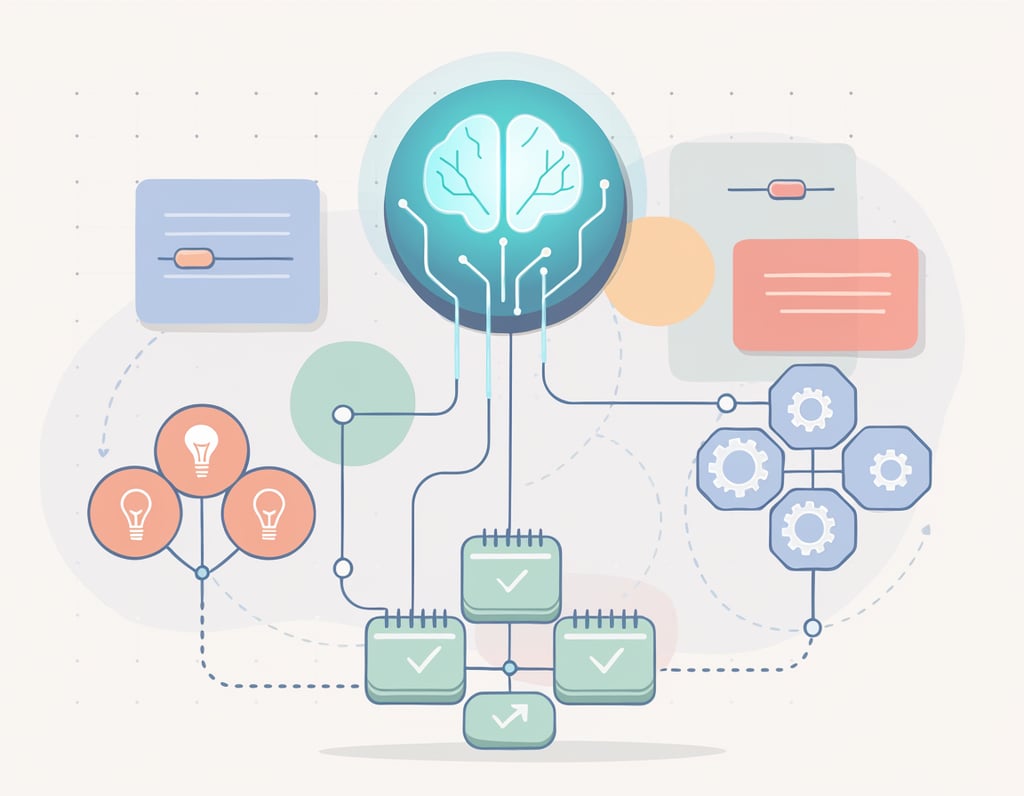
Where Minduck Is Not the Right Tool
Truly original positioning work. Minduck excels at expanding and connecting ideas you bring to it. It’s less reliable at generating genuinely novel market positioning or brand concepts from scratch. If your differentiation depends on an insight that doesn’t already exist in the AI’s training data, the tool will trend toward familiar patterns. Use it to develop and stress-test your positioning, not to originate it.
Legal, contractual, or compliance documents. No AI brainstorming tool should be in the loop for documents with legal standing. Minduck is a thinking environment, not a legal or regulatory advisor. Any outputs that inform contracts, terms of service, or compliance frameworks require expert human review before use.
High-stakes sensitive client interactions. The relational nuance of a difficult client conversation, a negotiation, or a sensitive feedback session cannot be scripted by AI and executed mechanically. Use Minduck to prepare your thinking — organize your points, anticipate objections, map the conversation structure — but the execution requires human judgment and emotional intelligence that no current AI tool replicates reliably.
Key risks to manage. Hallucination remains a real issue with AI-generated content; Minduck’s Insight Book mitigates this with source transparency, but verify any factual claims before using them in client deliverables. Privacy is a consideration for any cloud-based AI tool — avoid putting sensitive client data into mind maps until you’ve reviewed Minduck’s data handling policies. And over-reliance on AI-structured thinking can gradually erode the independent analytical muscle that makes your creative and strategic work distinctive. Use Minduck as a scaffold, not a substitute.
Frequently Asked Questions

What is AI idea generation for entrepreneurs and creators?
AI idea generation means using artificial intelligence to help surface, expand, and structure concepts faster than manual brainstorming allows. For entrepreneurs and creators, it specifically refers to tools that reduce the cognitive overhead of moving from a vague concept to an organized, actionable idea. The best AI brainstorming tools don’t replace your thinking — they give it more surface area to develop on.
Can AI replace the creative process entirely?
No, and tools like Minduck are designed around that reality. AI excels at expanding on starting points, connecting related concepts, and generating volume. It consistently underperforms at genuine originality, judgment-intensive strategy, and work where the value comes from lived expertise or relational nuance. The productive framing is AI as a thinking partner — one that handles the generative volume so you can focus on the editorial judgment.
How do freelancers use AI to generate ideas faster?
The most effective freelancer workflows use AI brainstorming tools at the beginning of a project — before a blank-page stall can set in — to generate a structured idea map from the brief. From there, the freelancer edits, redirects, and builds on the map rather than generating from zero. This typically cuts discovery and concept development time by 40–60% for creative professionals who implement it consistently.
Conclusion

The gap between having ideas and doing something useful with them is the most underacknowledged productivity problem for solo creators in 2026. It’s not a creativity problem. It’s a structure problem — and AI idea generation tools are increasingly good at solving it.
Minduck occupies a distinct position in that landscape. Rather than layering AI onto a text box, it builds AI into a visual thinking environment that reflects how creative and entrepreneurial minds actually work: associatively, spatially, and in branching structures rather than linear lists. For US-based creators billing $75–150/hour, the efficiency return is concrete — 200+ hours annually in reduced creative overhead, redirected toward execution, client relationships, and new revenue streams.
The adoption approach matters as much as the tool. Start with one recurring creative challenge. Own the editorial judgment layer. Measure output quality, not just time saved. Use Minduck to consolidate your thinking environment, not expand it.
AI idea generation isn’t about replacing the creative process. It’s about removing the friction that prevents your best thinking from becoming your best work. The question for solo creators and entrepreneurs in 2026 isn’t whether AI brainstorming tools are worth using. It’s how much creative overhead you can afford to keep paying without them.
To see detailed walkthroughs of Minduck’s creation and discovery features for freelancers, see our full Minduck review on AI Plaza.
Leave a Reply