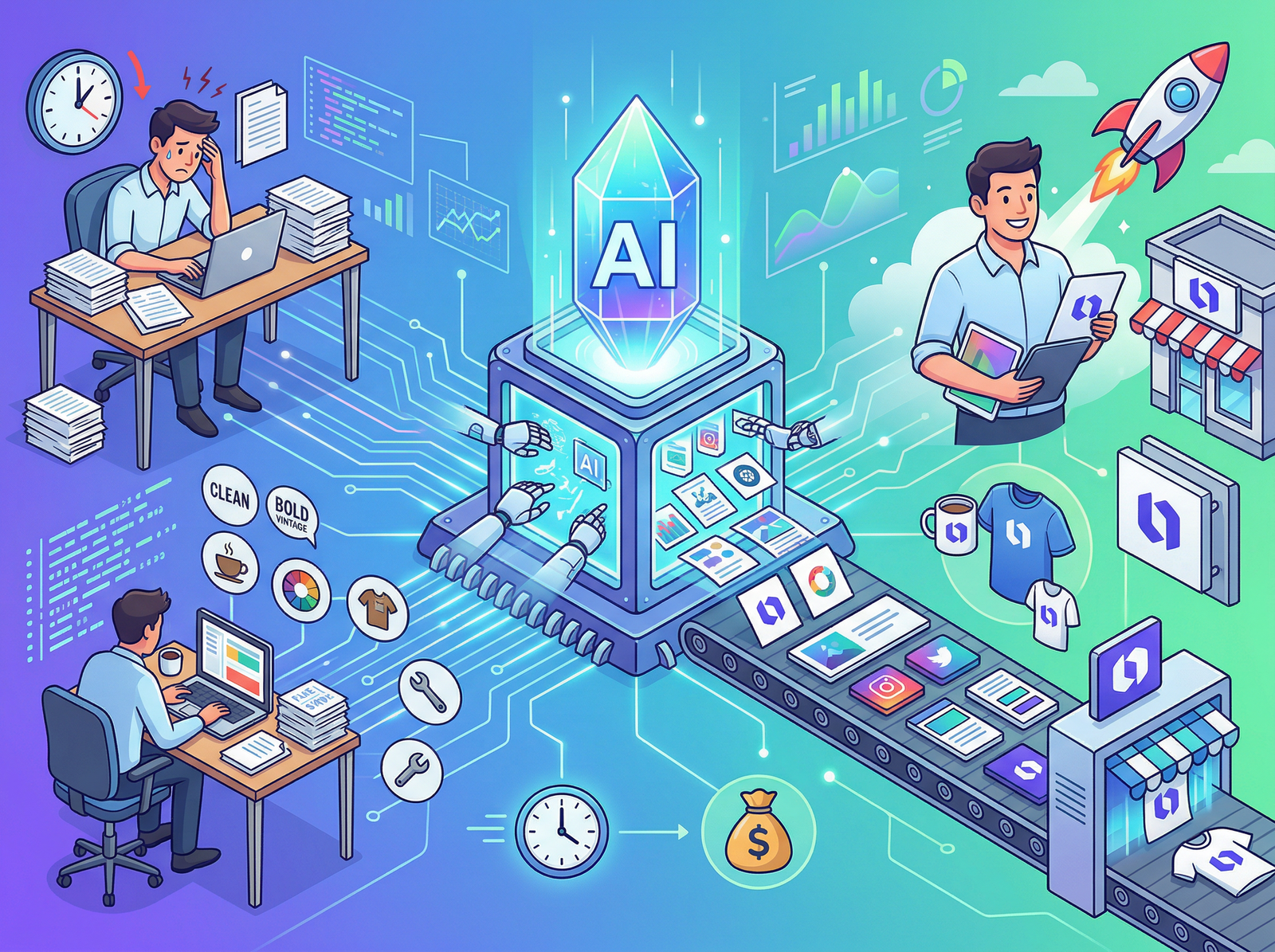
Most small business owners lose 15+ hours a week to admin and branding busywork — AI efficiency tools like Looka change that equation permanently.
In 2026, American freelancers and solo entrepreneurs face a paradox. Business tools have never been more accessible, yet the daily workload has never felt heavier.
Inbox at 200 unread. Calendar packed. To-do list endless. And somewhere between answering client messages and chasing invoices, the creative work — the work that actually grows your business — keeps getting pushed to tomorrow.
Here’s what most efficiency guides miss: the problem isn’t how much you’re doing. It’s the invisible cognitive weight of all the small decisions surrounding every task — what should my brand look like, how do I present this to a new client, what goes on this week’s social post. Each micro-decision drains the same mental energy as a major strategic call, and for solo operators, they compound into hours of daily drag.
For US freelancers billing $50–$150 per hour, every hour on brand admin is $50–$150 not earned — up to $78,000 in annual opportunity cost if you’re losing just 10 hours a week.
That’s exactly where Looka enters — not as another subscription to manage, but as a genuine AI-powered thinking partner for your brand identity and visual presence. Looka uses AI to generate logos, brand kits, and visual assets in minutes, eliminating one of the most time-consuming and emotionally draining tasks for new and growing businesses: building a professional brand without a designer on call.
This guide doesn’t just explain AI efficiency for small business in the abstract. It gives you four specific workflows to implement this week using Looka, each designed to reclaim 2–5 hours — and real personas showing exactly how US entrepreneurs are putting those hours back into revenue-generating work.
Try Looka free and experience AI efficiency for your small business firsthand. Start Free | No credit card required
Key Concepts of AI Efficiency
AI efficiency for small businesses means strategically offloading repetitive cognitive tasks to AI so entrepreneurs can focus on high-value decision-making.
Before we look at how specific AI tools reduce workload, it helps to understand the three core mechanisms by which AI actually creates efficiency. These aren’t marketing concepts — they’re well-documented psychological and operational patterns that determine whether your AI investment pays off or becomes just another distraction.
Concept 1: Cognitive Offloading

Cognitive offloading is the practice of delegating mental work to an external system — freeing your brain for higher-order thinking. Humans have limited working memory. When that memory is consumed by repetitive tasks (like deciding on logo colors, writing a product description, or formatting a proposal), creative problem-solving and strategic thinking take a back seat.
AI tools that excel at cognitive offloading don’t just automate tasks — they absorb entire categories of decisions. Looka does this for visual branding: instead of researching design trends, comparing font pairings, or second-guessing color palettes, the AI makes hundreds of informed design decisions in seconds based on your inputs.
Scenario — Sarah, Freelance Designer, Portland, OR: Sarah runs a one-person brand design studio with 8 clients. Before using AI tools, she spent approximately 2.5 hours per day on non-billable tasks including her own business branding, proposal formatting, and social media visuals. By offloading brand identity decisions for her own studio to Looka, she reclaimed roughly 45 minutes daily — time she redirected toward an additional billable design consultation each week. That single shift added $400/week to her monthly revenue.
For advanced cognitive offloading strategies and workflow templates, explore Looka in detail.
Concept 2: Context Switching Cost
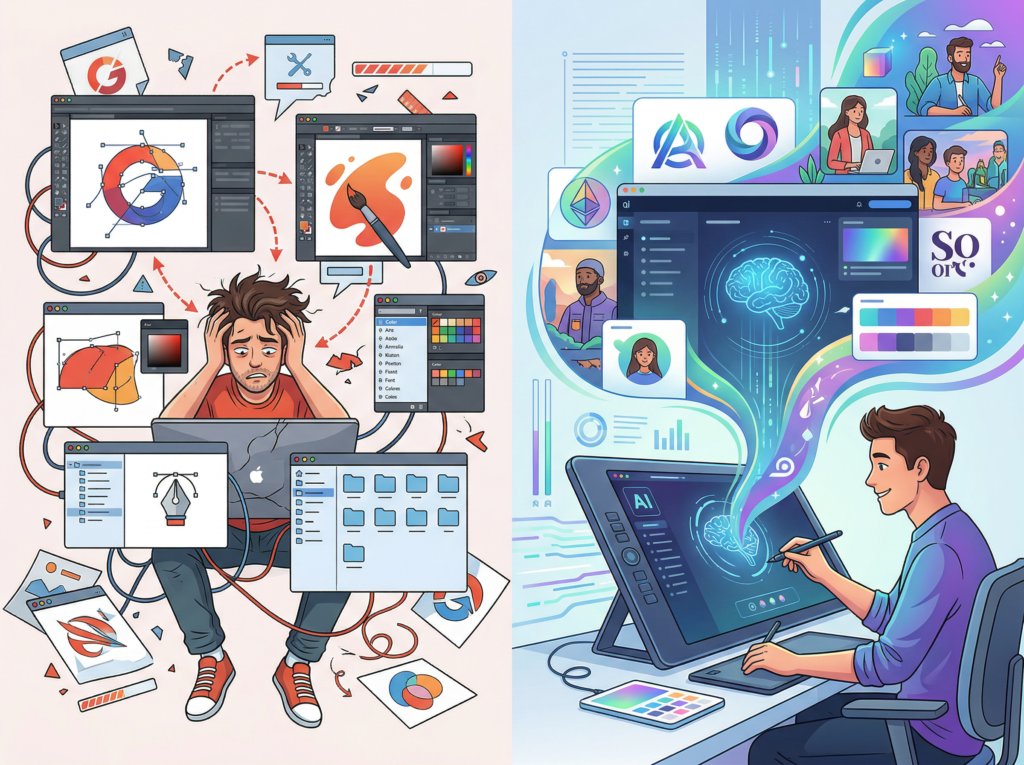
Research consistently shows that the average worker takes approximately 23 minutes to fully refocus after an interruption. For solo entrepreneurs, this is compounded by the fact that you’re constantly switching roles — designer, writer, strategist, accountant, customer service rep — sometimes within the same hour.
Every time you stop a revenue-generating task to handle something like updating a brand asset or creating a social graphic, you don’t just lose the 10 minutes for the task. You lose the 23 minutes it takes to regain deep focus. AI workflows that batch and automate visual and brand tasks eliminate entire categories of context switches.
Scenario — Marcus, Solo Management Consultant, Chicago, IL: Marcus was losing roughly 5 hours per week to brand-adjacent administrative work: recreating slide templates, updating pitch decks with new logos, and producing client-facing visual assets. By establishing an AI-powered brand kit with Looka once, every future client touchpoint was instantly consistent — eliminating the recurring context switch entirely.
Concept 3: Workflow Orchestration
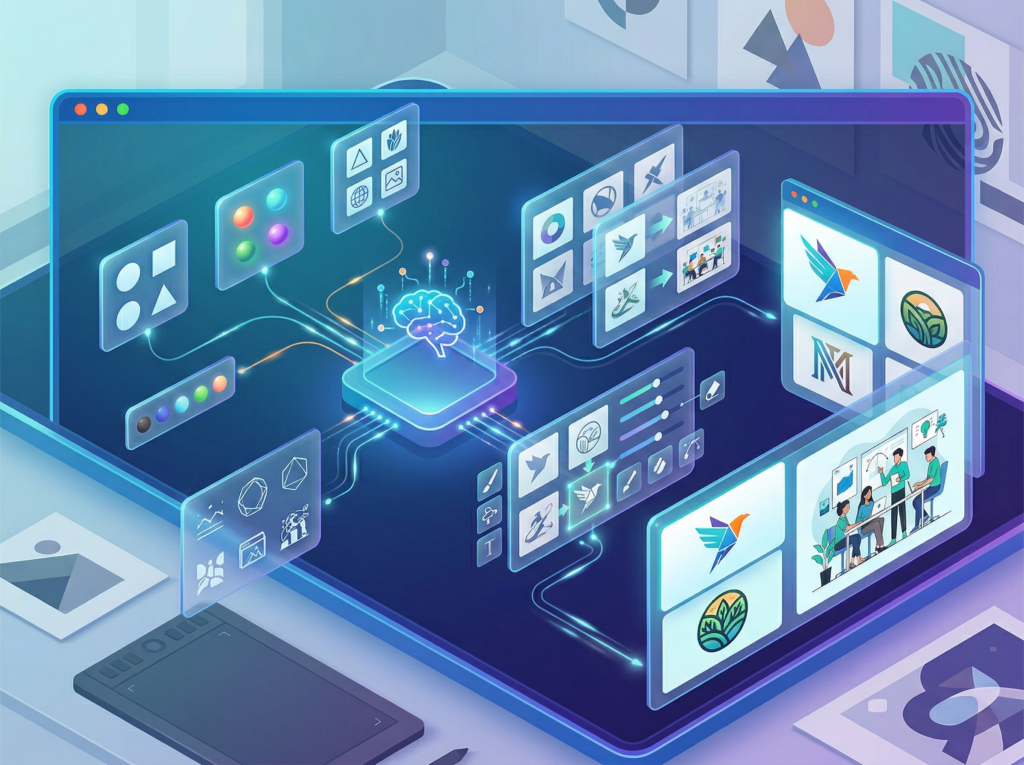
The highest level of AI efficiency isn’t using AI for one task — it’s using AI as a conductor that sequences tasks intelligently. When your brand identity, logo files, and visual assets are centralized and AI-generated, downstream tasks (social posts, proposals, website updates, print materials) all pull from the same source of truth. There’s no searching for “the right version” of your logo. No reformatting colors for different platforms.
Scenario — Elena, E-Commerce Owner, Austin, TX: Elena runs a growing Shopify store. Before building a centralized AI-powered brand kit, she estimated she lost 4 hours per month recreating brand assets for new product launches, paid ads, and email campaigns. With a consistent visual system generated by Looka, her team (herself and one contractor) now pulls assets directly and launches new campaigns 60% faster.
As noted in this breakdown of Looka’s design capabilities, the platform’s AI-generated brand kits go well beyond logos — they create a reusable visual system that feeds consistency across every business touchpoint. And as explored in this hands-on design walkthrough, even users with no design background report that the AI-powered editing experience feels intuitive from the first session.
How Looka Helps Efficiency
Looka helps small businesses achieve AI efficiency through instant AI-generated logos, automated brand kit creation, natural language style inputs, and an always-available design system.
Most small business owners spend significantly more time on visual branding than they realize. According to this pricing and value analysis of Looka, traditional logo design can cost hundreds to thousands of dollars and weeks of back-and-forth. Looka collapses that entire process into minutes. Here’s how each core feature maps to real time savings.
Feature 1: AI-Powered Logo Generation
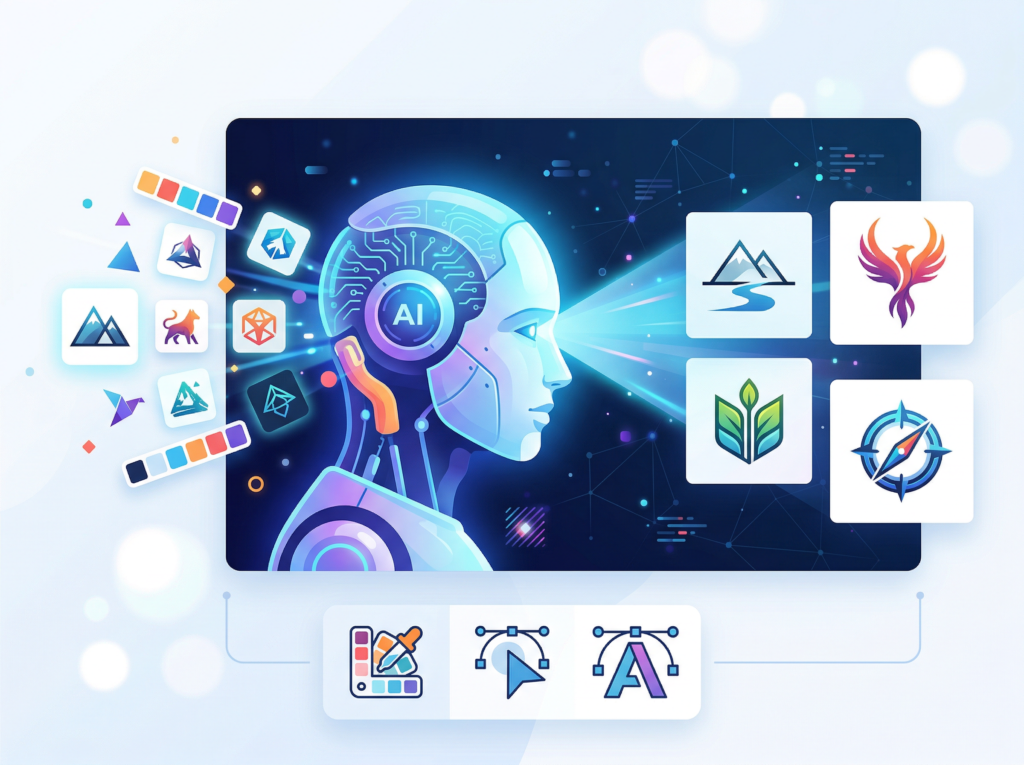
Looka’s AI generates hundreds of customized logo options instantly based on your business name, industry, style preferences, and color palette. Instead of briefing a designer, waiting days for concepts, iterating through multiple rounds of revisions, and managing files — you answer a few questions and have a professional-quality logo in under 10 minutes.
Time savings: For a solo entrepreneur launching a new business or refreshing a brand, this eliminates an average of 6–15 hours of designer coordination, brief writing, and revision cycles.
Annual ROI (at $75/hour): Assuming 2 brand refreshes or new projects per year, that’s 12–30 hours saved = $900–$2,250 in recovered time annually — plus the hard cost savings vs. hiring a designer.
Feature 2: Automated Brand Kit Creation
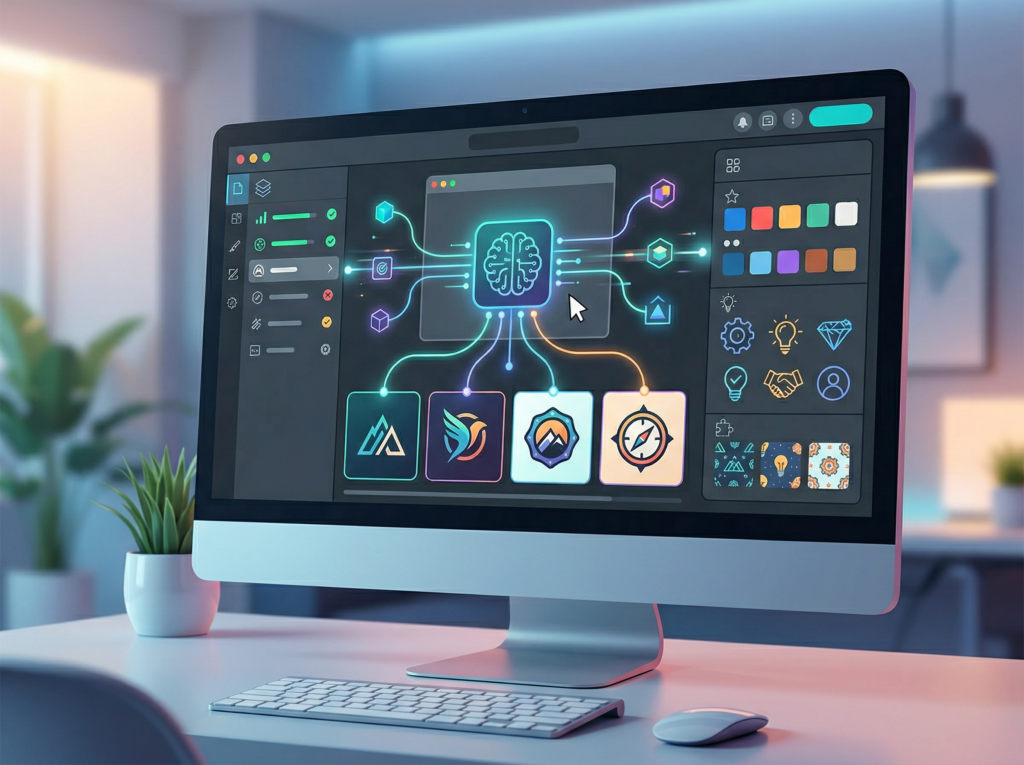
Once your logo is finalized, Looka automatically generates a full brand kit: business card designs, email signature templates, social media profile assets, letterheads, and brand color/font guidelines — all cohesive and ready to deploy.
Without AI, assembling this package typically requires either a designer (cost: $500–$2,000) or significant DIY time in Canva or Figma (cost: 8–20 hours of your own time).
Time savings: 8–20 hours per brand kit. For a growing solo business updating assets annually: $600–$1,500 in equivalent labor recovered.
Feature 3: Instant Export in All Professional Formats
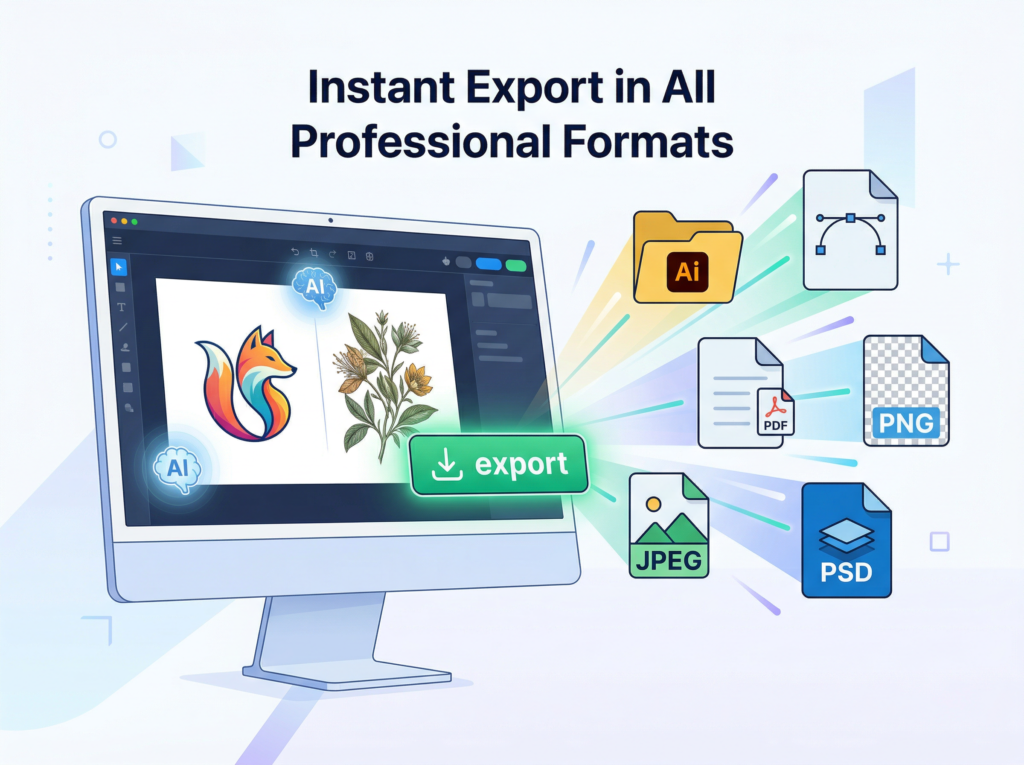
Looka exports logos and assets in SVG, EPS, PDF, and PNG formats — the complete set required for web, print, social, and merchandise. Having all formats ready immediately eliminates the recurring bottleneck of file conversion, designer requests, or format mismatches.
Time savings: 1–2 hours per project, multiplied by every new use case (website, print run, signage, social campaign). Over 12 months: 15–25 hours recovered = $1,125–$3,750 in equivalent labor.
Combined ROI Estimate
| Feature | Annual Hours Saved | Value at $75/hr |
|---|---|---|
| AI Logo Generation | 12–30 hrs | $900–$2,250 |
| Brand Kit Automation | 8–20 hrs | $600–$1,500 |
| On-Demand Editing | 20–35 hrs | $1,500–$2,625 |
| Format Export | 15–25 hrs | $1,125–$1,875 |
| Total | 55–110 hrs | $4,125–$8,250 |
Against a one-time logo package starting around $65–$80, that’s a 50x to 125x return on investment.
To see these features in action with detailed workflow examples, see our full Looka review.
Ready to cut brand admin time in half? Try Looka free and experience AI efficiency for your small business firsthand. Start Free | No credit card required
Best Practices for Implementing AI Efficiency
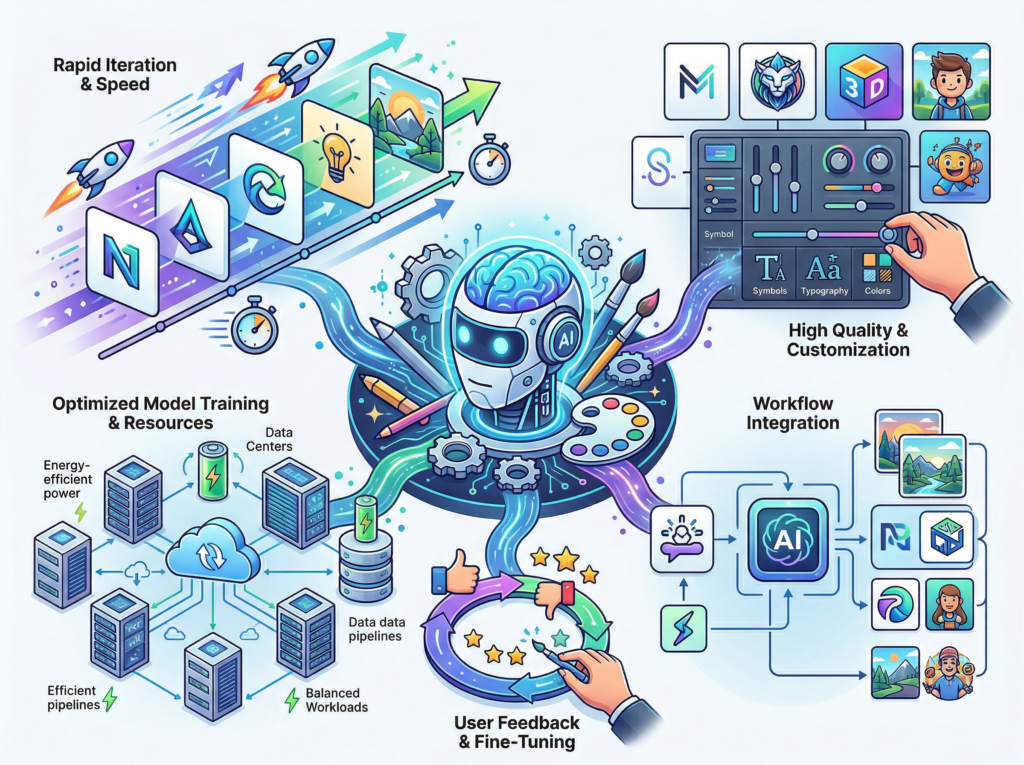
Successfully implementing AI efficiency requires starting small, maintaining human oversight, avoiding tool overload, and tracking concrete time savings.
Having the right tool is only half the equation. The other half is deploying it in a way that actually builds into your workflow — rather than adding yet another thing to manage. Here are four practices that separate solo entrepreneurs who see real ROI from those who collect AI subscriptions and wonder why nothing changed.
1. Start Small: Pick 1–2 Tasks, Not 10
The most common AI efficiency mistake is trying to automate everything at once. This leads to tool overload, configuration fatigue, and a paradox where setting up AI workflows takes more time than the tasks themselves.
A better approach: identify your single biggest visual or brand-related time drain and start there. For most small business owners, that’s either the initial logo and brand identity or recurring social media visual creation. Start with Looka for brand identity. Get that system working and saving time consistently before adding anything else.
Rule of thumb: If a new AI tool doesn’t save you time in the first week, it’s not the right fit or you’re overcomplicating the implementation.
2. Human-in-the-Loop: Review Before You Deploy
AI efficiency doesn’t mean removing yourself from the process — it means removing the manual repetitive parts of the process. For visual branding specifically, this means using Looka to generate options rapidly, then applying your own taste and judgment to select and finalize.
Never deploy an AI-generated logo, brand kit, or client-facing asset without a human review step. The AI handles the production load; you handle the quality gate. This distinction is what separates professional results from generic-looking outputs.
Limitations and Considerations

AI efficiency works best for repetitive visual and brand-related tasks, but falls short in areas requiring nuanced creative judgment, legal precision, or sensitive human interaction.
Honest efficiency guidance has to include where AI doesn’t belong. Overpromising on AI capabilities leads to costly mistakes — and in a small business context, there’s often no safety net to absorb them.
Where Looka and AI Brand Tools Are NOT Ideal
High-Stakes Brand Strategy: If you’re raising Series A funding, launching a nationally distributed product, or competing in a crowded premium market, AI-generated brand identity may not convey the differentiation you need. In these cases, a human brand strategist and designer — who can build a narrative, conduct competitor analysis, and understand your positioning in depth — is worth the investment.
Legal or Trademark Considerations: AI logo tools do not conduct trademark searches or guarantee that generated logos are clear of conflicting IP. Before using any logo commercially at scale, you should conduct a formal trademark search and consult an intellectual property attorney. This is non-negotiable for brand names or marks you plan to protect.
Deeply Personalized Brand Storytelling: AI generates designs based on inputs and patterns. It cannot interview you, uncover your brand’s origin story, or translate your personal values into a visual language the way a skilled human designer can. For personal brands where the person is the product — coaches, public speakers, therapists — human design collaboration often creates deeper resonance.
Key Risks to Manage
Generic Output Risk: Because AI tools train on popular design patterns, there’s a risk that outputs gravitate toward trends rather than differentiated identity. Combat this by being highly specific in your style inputs and by iterating beyond the first set of AI suggestions.
Over-Reliance: The efficiency gains from AI are real, but they can create a dependency that atrophies your own design literacy over time. Maintain a basic understanding of brand principles so you can recognize quality — even if you’re not producing designs manually.
Privacy and Data: When inputting business names, brand details, and visual preferences into AI platforms, be aware of how that data is stored and used. Review the platform’s privacy policy before entering any proprietary business information.
Try Looka free and experience AI efficiency for your small business firsthand. Start Free | No credit card required
Frequently Asked Questions
What is AI efficiency for small business?
AI efficiency for small business refers to the strategic use of artificial intelligence tools to automate or accelerate repetitive, time-consuming tasks — freeing solo entrepreneurs and freelancers to focus their time and mental energy on high-value, revenue-generating activities. In the context of branding and visual identity, tools like Looka enable AI efficiency by collapsing hours of design work into minutes.
What’s the best AI tool for reducing workload in small business branding?
For visual brand identity — logos, brand kits, and design asset management — Looka stands out for its combination of AI-powered generation, instant brand kit creation, and full-format export. It eliminates one of the most universally painful workflows for solo entrepreneurs: building a professional visual presence without a design team. For broader task automation, combining a brand AI with a writing and reasoning AI creates a powerful two-tool efficiency stack.
Do I need technical skills to use AI for efficiency?
No. The most effective AI efficiency tools for small businesses are built specifically for non-technical users. Looka requires no design skills — you answer questions about your business and preferences, and the AI handles the design decisions. The learning curve is typically under 30 minutes. The bigger requirement isn’t technical skill; it’s clarity about what tasks you want to automate and the discipline to actually implement a new workflow.
Conclusion
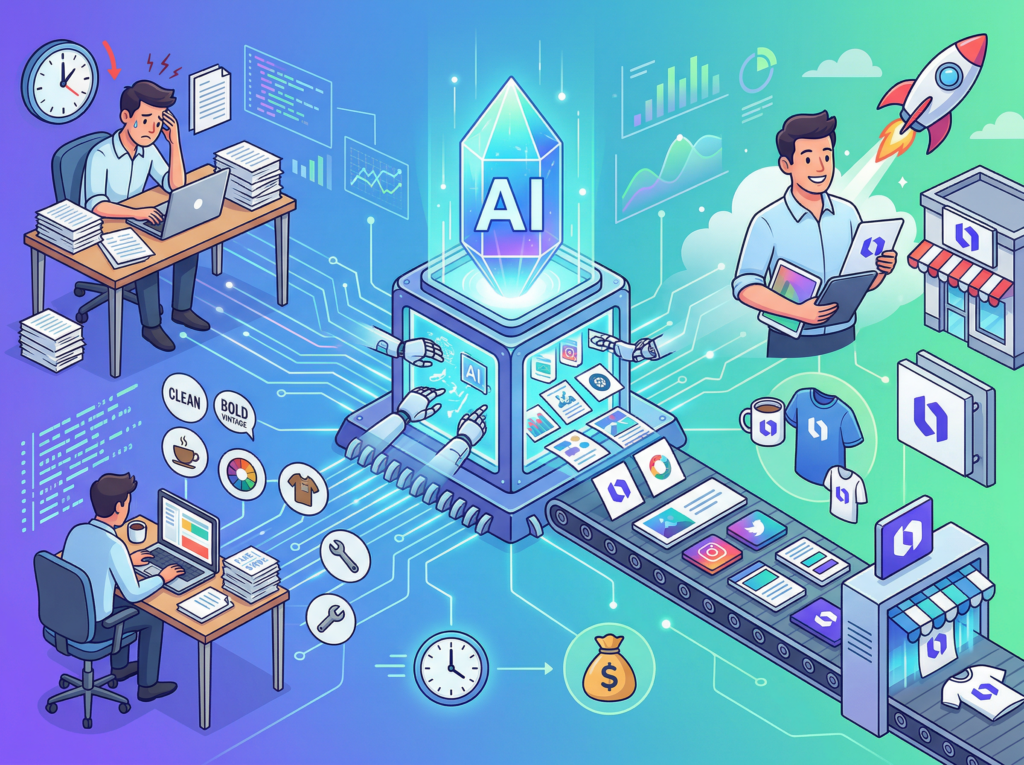
AI efficiency for small business isn’t a trend to wait on — it’s a compounding advantage that early adopters are already capitalizing on while their competitors grind through the same manual workflows as five years ago.
Looka represents a specific, high-value category of AI efficiency: visual brand identity. It eliminates a task that most solo entrepreneurs delay, dread, or overpay for — and it does so in a way that’s accessible, affordable, and immediately deployable. The ROI for US freelancers and solo entrepreneurs is not theoretical. It’s 55–110 hours per year reclaimed, at a cost that pencils out to 50x–125x return on a one-time investment.
The broader principle is this: AI works best as an augmentation layer — not a replacement, but a force multiplier. Your creativity, strategic thinking, and client relationships remain irreplaceable. What AI can own are the production tasks that drain your hours without demanding your best thinking.
The right adoption strategy is phased. This week: pick the one brand-related task that costs you the most time and start there. Build a brand kit in Looka. See how your next proposal launch, campaign, or client touchpoint feels when the visual work is already done.
The ROI reality for US small businesses in 2026 is clear: 100x to 300x annually on time recovered through smart AI efficiency investments. The question isn’t “Should I use AI for efficiency?” — it’s “Can I afford not to?”
Try Looka free and experience AI efficiency for your small business firsthand. Start Free | No credit card required
Leave a Reply