SpeechFlow is an AI voice generation tool designed to synthesize and manipulate human-like speech. It enables users to create realistic audio outputs from textual input or existing voice samples. Developed by the team at SpeechFlow.ai, the technology utilizes machine learning algorithms to process linguistic data and vocal characteristics. You can explore its full capabilities on the official website.
This tool is particularly effective for content creators seeking to produce high-quality voiceovers for videos or podcasts without requiring professional recording equipment. For those interested in similar audio-focused technologies, the broader category of AI voice generators offers a wide range of solutions.
Key Findings
Voice Transcription: Converts spoken language into accurate written text instantly for any meeting or call.
Real Time Translation: Provides live interpretation across multiple languages during international conferences and client calls.
Meeting Summarization: Automatically generates concise and actionable summaries from lengthy discussions and presentations.
Sentiment Analysis: Detects emotional tone and speaker intent to gauge customer satisfaction and team morale.
Speaker Identification: Distinguishes between different participants in a conversation for clear and attributed meeting notes.
Custom Vocabulary: Learns industry specific terms and technical jargon to ensure flawless transcription accuracy.
Secure Storage: Encrypts all audio and transcript data with enterprise grade security and access controls.
Seamless Integration: Connects directly with popular video conferencing platforms and productivity tools your team uses.
Compliance Ready: Adheres to global data privacy regulations like GDPR and HIPAA out of the box.
Actionable Insights: Highlights key decisions, questions, and tasks to drive follow up and project momentum.
AI that writes high-converting ads in seconds, not hours.
What is Adsby?
Adsby is an AI-powered advertising platform designed to assist businesses in creating and managing digital marketing campaigns. It enables users to generate targeted ad copy and visual content from simple text prompts and campaign goals.
Developed by the team at Adsby.ai, the platform utilizes machine learning algorithms to process user inputs and campaign data. You can explore its official features directly on the Adsby website. For businesses seeking to streamline their promotional efforts, this tool is effective for producing cohesive ad assets across multiple channels. Users interested in similar marketing solutions can find more information on AI Plaza’s advertising tools category.
Key Findings
Ad Creation: Generates compelling ad copy and visuals tailored to your specific target audience instantly.
Brand Consistency: Maintains uniform brand voice and style across all advertising channels and campaigns automatically.
Audience Targeting: Identifies and segments optimal customer profiles using advanced demographic and behavioral data analysis.
Performance Analytics: Tracks ad campaign metrics and provides actionable insights for improving future return on investment.
Budget Optimization: Dynamically allocates advertising spend across platforms to maximize impact and minimize wasted expenditure.
Competitor Monitoring: Analyzes rival advertising strategies to uncover market opportunities and potential strategic advantages.
Multichannel Deployment: Distributes synchronized ad campaigns seamlessly across social media, search, and display networks.
Creative Testing: Automatically A/B tests different ad variations to determine the highest performing creative elements.
Trend Integration: Incorporates current market trends and viral content into ad creatives to boost relevance.
Compliance Assurance: Scans all ad content to ensure it meets platform policies and legal regulations pre-publication.
Your AI co-pilot for navigating complex business decisions and data.
What is Saner.AI?
Saner.AI is an AI-powered research assistant designed to streamline the process of gathering and synthesizing information. It enables users to quickly generate comprehensive summaries and reports from a wide array of online sources and uploaded documents.
Developed by the team at Saner.ai, the platform utilizes machine learning algorithms to process complex user queries and extensive source materials. You can explore its features directly on the official Saner.AI website. This tool is particularly effective for professionals and students who need to conduct thorough literature reviews or market analysis efficiently, making it a valuable resource among other specialized research assistants.
Key Findings
Data Extraction: Extracts structured data from unstructured documents quickly and accurately without manual entry.
Intelligent Classification: Automatically categorizes and tags incoming documents using advanced machine learning algorithms for organization.
Workflow Automation: Streamlines business processes by automatically routing documents and tasks to the correct teams.
Compliance Assurance: Helps maintain regulatory compliance by consistently applying document handling rules and audit trails.
Risk Identification: Proactively detects anomalies and potential risks within document workflows to prevent issues.
Insight Generation: Transforms raw document data into actionable business intelligence and visual reports for decision-making.
Seamless Integration: Connects effortlessly with existing enterprise systems like CRM and ERP using standard APIs.
Collaboration Enhancement: Improves team cooperation by providing shared, secure access to documents and project notes.
Productivity Analytics: Measures process efficiency and user engagement to identify bottlenecks and improvement opportunities.
Security Prioritization: Ensures data protection with robust encryption, access controls, and compliance with global standards.
Your AI co-pilot for instant, expert-level customer support.
What is CoSupport AI?
CoSupport AI is a customer support automation tool designed to enhance service interactions and streamline support workflows. It enables businesses to provide consistent and efficient responses to customer inquiries across various digital channels.
Developed by the team at CoSupport AI, the platform utilizes machine learning algorithms to process customer queries and support documentation. You can explore its official features and capabilities on their website. For businesses seeking to improve their customer service operations, this tool is effective for automating routine support tasks and managing high volumes of inquiries. Organizations can discover and compare similar support automation solutions within the customer service AI category on AI Plaza.
Key Findings
Customer Support: Handles complex inquiries instantly with intelligent conversational AI and deep learning.
Proactive Engagement: Anticipates user needs and issues before they escalate using predictive analytics models.
Seamless Integration: Connects effortlessly with existing CRM and helpdesk platforms through flexible API connectors.
Continuous Learning: Improves response accuracy autonomously by analyzing every interaction and agent feedback.
Multilingual Assistance: Provides consistent support in over fifty languages with real-time cultural nuance adaptation.
Sentiment Analysis: Detects customer frustration and satisfaction to guide interactions and prioritize urgent cases.
Knowledge Management: Organizes and retrieves information from vast internal documents to answer questions precisely.
Automated Escalation: Identifies critical issues requiring human agents and routes them with full context.
Performance Analytics: Delivers detailed insights on support efficiency and customer satisfaction trends with actionable data.
Customizable Branding: Maintains your company’s voice and visual identity across all automated customer interactions.
Your AI co-pilot for business, turning complex data into clear strategy.
What is Albus Beta?
Albus Beta is an AI image generator designed to transform textual descriptions into visual artwork. It enables users to create digital images from written prompts, facilitating the rapid visualization of ideas. Developed by the team at Albus Beta, the tool utilizes machine learning algorithms to process user-provided text. You can explore its full capabilities on its official website. This type of tool is particularly effective for concept artists and marketers who need to generate visual prototypes quickly. For those seeking similar creative AI tools, a search for an AI art generator on this platform will yield further options.
Key Findings
AI Assistant: Handles complex inquiries and tasks with intelligent conversational understanding and precision.
Business Intelligence: Analyzes data patterns to deliver actionable insights for strategic decision-making and growth.
Workflow Automation: Streamlines repetitive processes to boost team productivity and operational efficiency significantly daily.
Secure Conversations: Ensures all interactions are encrypted and compliant with enterprise-grade data protection standards.
Custom Integrations: Connects seamlessly with existing business tools and platforms for unified operational management.
Real-Time Analytics: Provides live dashboards and reports to monitor key performance indicators instantly.
Predictive Modeling: Forecasts trends and outcomes using advanced algorithms to guide future planning.
Natural Language: Processes and generates human-like text for clear communication and document creation.
Multi-Platform Support: Operates across web, mobile, and desktop environments for flexible team access.
Scalable Architecture: Grows with your business needs, handling increased demand without performance degradation.
Your AI co-pilot for business: turn conversations into action, instantly.
What is Spinach AI?
Spinach AI is a video generator designed to create short-form video content from text prompts. It enables users to produce stylized, animated videos for social media and marketing purposes. Developed by the team at Spinach AI, the tool utilizes machine learning algorithms to process user-provided text and imagery. You can explore its official features at spinach.ai. As a specialized video generator, it is particularly effective for content creators and marketers seeking to rapidly produce engaging visual content, a common application within the broader category of AI video tools.
Key Findings
Automated Scheduling: Coordinates meetings and appointments seamlessly across multiple calendars and time zones efficiently.
Data Analysis: Processes complex datasets to uncover actionable insights and trends for informed strategic decision-making.
Customer Support: Provides instant, accurate responses to common inquiries, reducing wait times and improving client satisfaction.
Document Processing: Extracts and organizes key information from various file formats, streamlining administrative tasks and record-keeping.
Workflow Optimization: Identifies bottlenecks and suggests improvements to enhance operational efficiency and team productivity significantly.
Predictive Analytics: Forecasts future trends and outcomes using historical data to support proactive planning and strategy.
Personalized Recommendations: Delivers tailored suggestions for products or content based on individual user behavior and preferences.
Real-time Translation: Breaks down language barriers by instantly converting text and speech between numerous global languages.
Security Monitoring: Continuously scans networks and systems for potential threats, ensuring data protection and compliance with regulations.
Performance Reporting: Generates comprehensive, easy-to-understand reports on key metrics to track progress and demonstrate clear value.
Create custom AI agents for any task, no coding required.
What is Create?
Create is an AI video generator designed to produce video content from text-based prompts. It enables users to create original, high-quality video clips by describing a desired scene or narrative.
Developed by the team at Runway, Create utilizes machine learning algorithms to process textual descriptions and generate corresponding visual sequences. You can explore its full capabilities on the official Runway website. This tool is particularly effective for content creators and filmmakers seeking to rapidly visualize concepts, making it a prominent option in the landscape of AI video generation tools.
Key Findings
AI Assistant: Handles customer inquiries and support tickets with intelligent conversational understanding daily.
Content Generation: Produces marketing copy, blog posts, and product descriptions quickly from simple prompts provided.
Idea Brainstorming: Generates creative concepts and innovative solutions for projects and strategic planning sessions.
Workflow Optimization: Analyzes existing business processes to identify key areas for improvement and automation.
Data Interpretation: Transforms complex datasets into clear, actionable summaries and insightful visual reports automatically.
Team Collaboration: Facilitates smoother project coordination by summarizing meetings and tracking action items clearly.
Code Development: Writes, debugs, and explains programming code in multiple languages for various applications.
Market Analysis: Researches industry trends and competitor data to provide comprehensive strategic overviews weekly.
Document Drafting: Creates initial versions of reports, emails, and proposals based on your core outlines.
Learning Acceleration: Explains complex topics in simple terms with customized examples for faster team training.
Most small business owners lose 15+ hours a week to admin and branding busywork — AI efficiency tools like Looka change that equation permanently.
In 2026, American freelancers and solo entrepreneurs face a paradox. Business tools have never been more accessible, yet the daily workload has never felt heavier.
Inbox at 200 unread. Calendar packed. To-do list endless. And somewhere between answering client messages and chasing invoices, the creative work — the work that actually grows your business — keeps getting pushed to tomorrow.
Here’s what most efficiency guides miss: the problem isn’t how much you’re doing. It’s the invisible cognitive weight of all the small decisions surrounding every task — what should my brand look like, how do I present this to a new client, what goes on this week’s social post. Each micro-decision drains the same mental energy as a major strategic call, and for solo operators, they compound into hours of daily drag.
For US freelancers billing $50–$150 per hour, every hour on brand admin is $50–$150 not earned — up to $78,000 in annual opportunity cost if you’re losing just 10 hours a week.
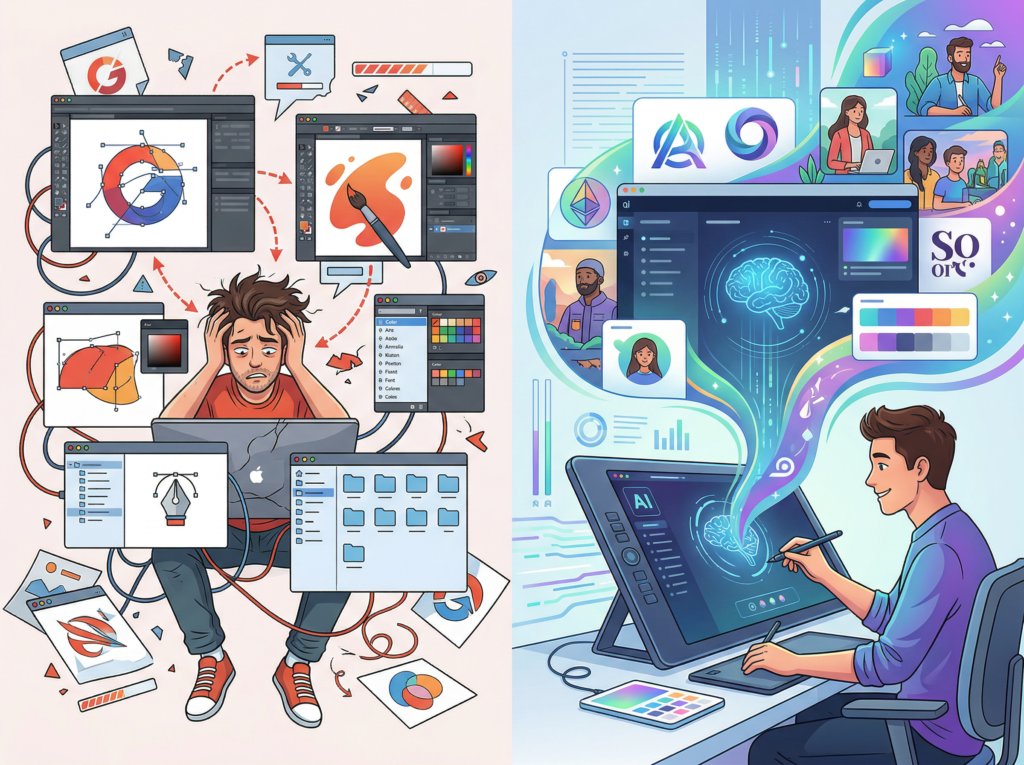
That’s exactly where Looka enters — not as another subscription to manage, but as a genuine AI-powered thinking partner for your brand identity and visual presence. Looka uses AI to generate logos, brand kits, and visual assets in minutes, eliminating one of the most time-consuming and emotionally draining tasks for new and growing businesses: building a professional brand without a designer on call.
This guide doesn’t just explain AI efficiency for small business in the abstract. It gives you four specific workflows to implement this week using Looka, each designed to reclaim 2–5 hours — and real personas showing exactly how US entrepreneurs are putting those hours back into revenue-generating work.
Try Looka free and experience AI efficiency for your small business firsthand. Start Free | No credit card required
Key Concepts of AI Efficiency
AI efficiency for small businesses means strategically offloading repetitive cognitive tasks to AI so entrepreneurs can focus on high-value decision-making.
Before we look at how specific AI tools reduce workload, it helps to understand the three core mechanisms by which AI actually creates efficiency. These aren’t marketing concepts — they’re well-documented psychological and operational patterns that determine whether your AI investment pays off or becomes just another distraction.
Concept 1: Cognitive Offloading
Cognitive offloading is the practice of delegating mental work to an external system — freeing your brain for higher-order thinking. Humans have limited working memory. When that memory is consumed by repetitive tasks (like deciding on logo colors, writing a product description, or formatting a proposal), creative problem-solving and strategic thinking take a back seat.
AI tools that excel at cognitive offloading don’t just automate tasks — they absorb entire categories of decisions. Looka does this for visual branding: instead of researching design trends, comparing font pairings, or second-guessing color palettes, the AI makes hundreds of informed design decisions in seconds based on your inputs.
Scenario — Sarah, Freelance Designer, Portland, OR: Sarah runs a one-person brand design studio with 8 clients. Before using AI tools, she spent approximately 2.5 hours per day on non-billable tasks including her own business branding, proposal formatting, and social media visuals. By offloading brand identity decisions for her own studio to Looka, she reclaimed roughly 45 minutes daily — time she redirected toward an additional billable design consultation each week. That single shift added $400/week to her monthly revenue.
For advanced cognitive offloading strategies and workflow templates, explore Looka in detail.
Concept 2: Context Switching Cost
Research consistently shows that the average worker takes approximately 23 minutes to fully refocus after an interruption. For solo entrepreneurs, this is compounded by the fact that you’re constantly switching roles — designer, writer, strategist, accountant, customer service rep — sometimes within the same hour.
Every time you stop a revenue-generating task to handle something like updating a brand asset or creating a social graphic, you don’t just lose the 10 minutes for the task. You lose the 23 minutes it takes to regain deep focus. AI workflows that batch and automate visual and brand tasks eliminate entire categories of context switches.
Scenario — Marcus, Solo Management Consultant, Chicago, IL: Marcus was losing roughly 5 hours per week to brand-adjacent administrative work: recreating slide templates, updating pitch decks with new logos, and producing client-facing visual assets. By establishing an AI-powered brand kit with Looka once, every future client touchpoint was instantly consistent — eliminating the recurring context switch entirely.
Concept 3: Workflow Orchestration
The highest level of AI efficiency isn’t using AI for one task — it’s using AI as a conductor that sequences tasks intelligently. When your brand identity, logo files, and visual assets are centralized and AI-generated, downstream tasks (social posts, proposals, website updates, print materials) all pull from the same source of truth. There’s no searching for “the right version” of your logo. No reformatting colors for different platforms.
Scenario — Elena, E-Commerce Owner, Austin, TX: Elena runs a growing Shopify store. Before building a centralized AI-powered brand kit, she estimated she lost 4 hours per month recreating brand assets for new product launches, paid ads, and email campaigns. With a consistent visual system generated by Looka, her team (herself and one contractor) now pulls assets directly and launches new campaigns 60% faster.
As noted in this breakdown of Looka’s design capabilities, the platform’s AI-generated brand kits go well beyond logos — they create a reusable visual system that feeds consistency across every business touchpoint. And as explored in this hands-on design walkthrough, even users with no design background report that the AI-powered editing experience feels intuitive from the first session.
How Looka Helps Efficiency
Looka helps small businesses achieve AI efficiency through instant AI-generated logos, automated brand kit creation, natural language style inputs, and an always-available design system.
Most small business owners spend significantly more time on visual branding than they realize. According to this pricing and value analysis of Looka, traditional logo design can cost hundreds to thousands of dollars and weeks of back-and-forth. Looka collapses that entire process into minutes. Here’s how each core feature maps to real time savings.
Feature 1: AI-Powered Logo Generation
Looka’s AI generates hundreds of customized logo options instantly based on your business name, industry, style preferences, and color palette. Instead of briefing a designer, waiting days for concepts, iterating through multiple rounds of revisions, and managing files — you answer a few questions and have a professional-quality logo in under 10 minutes.
Time savings: For a solo entrepreneur launching a new business or refreshing a brand, this eliminates an average of 6–15 hours of designer coordination, brief writing, and revision cycles.
Annual ROI (at $75/hour): Assuming 2 brand refreshes or new projects per year, that’s 12–30 hours saved = $900–$2,250 in recovered time annually — plus the hard cost savings vs. hiring a designer.
Feature 2: Automated Brand Kit Creation
Once your logo is finalized, Looka automatically generates a full brand kit: business card designs, email signature templates, social media profile assets, letterheads, and brand color/font guidelines — all cohesive and ready to deploy.
Without AI, assembling this package typically requires either a designer (cost: $500–$2,000) or significant DIY time in Canva or Figma (cost: 8–20 hours of your own time).
Time savings: 8–20 hours per brand kit. For a growing solo business updating assets annually: $600–$1,500 in equivalent labor recovered.
Feature 3: Instant Export in All Professional Formats
Looka exports logos and assets in SVG, EPS, PDF, and PNG formats — the complete set required for web, print, social, and merchandise. Having all formats ready immediately eliminates the recurring bottleneck of file conversion, designer requests, or format mismatches.
Time savings: 1–2 hours per project, multiplied by every new use case (website, print run, signage, social campaign). Over 12 months: 15–25 hours recovered = $1,125–$3,750 in equivalent labor.
Combined ROI Estimate
Feature
Annual Hours Saved
Value at $75/hr
AI Logo Generation
12–30 hrs
$900–$2,250
Brand Kit Automation
8–20 hrs
$600–$1,500
On-Demand Editing
20–35 hrs
$1,500–$2,625
Format Export
15–25 hrs
$1,125–$1,875
Total
55–110 hrs
$4,125–$8,250
Against a one-time logo package starting around $65–$80, that’s a 50x to 125x return on investment.
Ready to cut brand admin time in half? Try Looka free and experience AI efficiency for your small business firsthand. Start Free | No credit card required
Best Practices for Implementing AI Efficiency
Successfully implementing AI efficiency requires starting small, maintaining human oversight, avoiding tool overload, and tracking concrete time savings.
Having the right tool is only half the equation. The other half is deploying it in a way that actually builds into your workflow — rather than adding yet another thing to manage. Here are four practices that separate solo entrepreneurs who see real ROI from those who collect AI subscriptions and wonder why nothing changed.
1. Start Small: Pick 1–2 Tasks, Not 10
The most common AI efficiency mistake is trying to automate everything at once. This leads to tool overload, configuration fatigue, and a paradox where setting up AI workflows takes more time than the tasks themselves.
A better approach: identify your single biggest visual or brand-related time drain and start there. For most small business owners, that’s either the initial logo and brand identity or recurring social media visual creation. Start with Looka for brand identity. Get that system working and saving time consistently before adding anything else.
Rule of thumb: If a new AI tool doesn’t save you time in the first week, it’s not the right fit or you’re overcomplicating the implementation.
2. Human-in-the-Loop: Review Before You Deploy
AI efficiency doesn’t mean removing yourself from the process — it means removing the manual repetitive parts of the process. For visual branding specifically, this means using Looka to generate options rapidly, then applying your own taste and judgment to select and finalize.
Never deploy an AI-generated logo, brand kit, or client-facing asset without a human review step. The AI handles the production load; you handle the quality gate. This distinction is what separates professional results from generic-looking outputs.
Limitations and Considerations
AI efficiency works best for repetitive visual and brand-related tasks, but falls short in areas requiring nuanced creative judgment, legal precision, or sensitive human interaction.
Honest efficiency guidance has to include where AI doesn’t belong. Overpromising on AI capabilities leads to costly mistakes — and in a small business context, there’s often no safety net to absorb them.
Where Looka and AI Brand Tools Are NOT Ideal
High-Stakes Brand Strategy: If you’re raising Series A funding, launching a nationally distributed product, or competing in a crowded premium market, AI-generated brand identity may not convey the differentiation you need. In these cases, a human brand strategist and designer — who can build a narrative, conduct competitor analysis, and understand your positioning in depth — is worth the investment.
Legal or Trademark Considerations: AI logo tools do not conduct trademark searches or guarantee that generated logos are clear of conflicting IP. Before using any logo commercially at scale, you should conduct a formal trademark search and consult an intellectual property attorney. This is non-negotiable for brand names or marks you plan to protect.
Deeply Personalized Brand Storytelling: AI generates designs based on inputs and patterns. It cannot interview you, uncover your brand’s origin story, or translate your personal values into a visual language the way a skilled human designer can. For personal brands where the person is the product — coaches, public speakers, therapists — human design collaboration often creates deeper resonance.
Key Risks to Manage
Generic Output Risk: Because AI tools train on popular design patterns, there’s a risk that outputs gravitate toward trends rather than differentiated identity. Combat this by being highly specific in your style inputs and by iterating beyond the first set of AI suggestions.
Over-Reliance: The efficiency gains from AI are real, but they can create a dependency that atrophies your own design literacy over time. Maintain a basic understanding of brand principles so you can recognize quality — even if you’re not producing designs manually.
Privacy and Data: When inputting business names, brand details, and visual preferences into AI platforms, be aware of how that data is stored and used. Review the platform’s privacy policy before entering any proprietary business information.
Try Looka free and experience AI efficiency for your small business firsthand. Start Free | No credit card required
Frequently Asked Questions
What is AI efficiency for small business?
AI efficiency for small business refers to the strategic use of artificial intelligence tools to automate or accelerate repetitive, time-consuming tasks — freeing solo entrepreneurs and freelancers to focus their time and mental energy on high-value, revenue-generating activities. In the context of branding and visual identity, tools like Looka enable AI efficiency by collapsing hours of design work into minutes.
What’s the best AI tool for reducing workload in small business branding?
For visual brand identity — logos, brand kits, and design asset management — Looka stands out for its combination of AI-powered generation, instant brand kit creation, and full-format export. It eliminates one of the most universally painful workflows for solo entrepreneurs: building a professional visual presence without a design team. For broader task automation, combining a brand AI with a writing and reasoning AI creates a powerful two-tool efficiency stack.
Do I need technical skills to use AI for efficiency?
No. The most effective AI efficiency tools for small businesses are built specifically for non-technical users. Looka requires no design skills — you answer questions about your business and preferences, and the AI handles the design decisions. The learning curve is typically under 30 minutes. The bigger requirement isn’t technical skill; it’s clarity about what tasks you want to automate and the discipline to actually implement a new workflow.
Conclusion
AI efficiency for small business isn’t a trend to wait on — it’s a compounding advantage that early adopters are already capitalizing on while their competitors grind through the same manual workflows as five years ago.
Looka represents a specific, high-value category of AI efficiency: visual brand identity. It eliminates a task that most solo entrepreneurs delay, dread, or overpay for — and it does so in a way that’s accessible, affordable, and immediately deployable. The ROI for US freelancers and solo entrepreneurs is not theoretical. It’s 55–110 hours per year reclaimed, at a cost that pencils out to 50x–125x return on a one-time investment.
The broader principle is this: AI works best as an augmentation layer — not a replacement, but a force multiplier. Your creativity, strategic thinking, and client relationships remain irreplaceable. What AI can own are the production tasks that drain your hours without demanding your best thinking.
The right adoption strategy is phased. This week: pick the one brand-related task that costs you the most time and start there. Build a brand kit in Looka. See how your next proposal launch, campaign, or client touchpoint feels when the visual work is already done.
The ROI reality for US small businesses in 2026 is clear: 100x to 300x annually on time recovered through smart AI efficiency investments. The question isn’t “Should I use AI for efficiency?” — it’s “Can I afford not to?”
Try Looka free and experience AI efficiency for your small business firsthand. Start Free | No credit card required
The average small business owner wastes 15+ hours weekly on repetitive marketing tasks — the right ai marketing content generator for small business eliminates that drain permanently.
In 2026, American freelancers and solo entrepreneurs face a paradox. The tools available to grow a business have never been more powerful — yet the daily cognitive load has never felt heavier.
Inbox at 200 unread. Calendar packed. To-do list endless. And somewhere between answering client questions and writing next month’s blog posts, the actual work of building something meaningful gets squeezed into whatever energy remains at 9 PM.
Marketing content sits at the center of this problem. Blog posts, email newsletters, social captions, product descriptions, ad copy — each one takes time to research, draft, revise, and publish. For solo founders and small teams, content creation isn’t just one task on the list. It’s a recurring tax on your most limited resource: attention.
That’s where Jasper changes the equation. Unlike general-purpose writing tools, Jasper is purpose-built as an ai copywriting software platform designed specifically for marketing workflows. It doesn’t just generate words — it understands brand voice, adapts to different content formats, and allows you to chain tasks together in a way that mirrors how a professional content team would operate.
For US freelancers billing $50–150 per hour, every hour spent on admin or repetitive content production is $50–150 not earned. A consultant who writes her own monthly newsletter, blog post, and LinkedIn content series could easily spend 8–12 hours per month on those tasks alone — that’s $400 to $1,800 in billable time absorbed by content work that AI can accelerate dramatically.
This article doesn’t offer vague promises about “saving time with AI.” Instead, you’ll walk away with four specific workflows you can implement this week — each designed to save 2–5 hours on marketing content creation. Whether you’re a freelance designer pitching new clients, a Shopify store owner running product launches, or a consultant building thought leadership, there’s a Jasper workflow built for your situation.
Let’s get into the mechanics of how this actually works.
Key Concepts of AI Efficiency
AI efficiency for small businesses means strategically offloading repetitive cognitive tasks to AI so entrepreneurs can focus on high-value decision-making.
Before diving into Jasper’s specific features, it helps to understand why AI reduces workload — not just in practice, but in principle. Three foundational concepts explain the efficiency gains that freelancers and solo entrepreneurs consistently report.
Concept 1: Cognitive Offloading
Cognitive offloading is the practice of externalizing mental work — moving thinking out of your head and into a tool, system, or process. Humans have done this for centuries with calendars, checklists, and notes. AI expands cognitive offloading to include tasks that previously required active thought: drafting, summarizing, reformatting, brainstorming, and editing.
For marketing content, cognitive offloading with AI means you no longer start with a blank page. You start with a draft, an outline, or a set of variations to react to — and reacting is significantly faster than creating from scratch.
Consider Sarah, a freelance brand designer in Portland with eight active clients. Before using AI, she spent roughly 2.5 hours each day on content-adjacent tasks: writing client update emails, drafting case study blurbs, updating her website portfolio copy, and generating social posts to stay visible. After building a Jasper workflow that handles first drafts of all of these, that 2.5 hours dropped to under 45 minutes. She didn’t eliminate the thinking — she eliminated the blank-page friction.
Research consistently shows that the average person takes approximately 23 minutes to fully regain focus after an interruption. For a solo entrepreneur, the workday is essentially a series of context switches: from client work to invoicing, from strategy to social media, from deep project work to “just quickly writing this email.”
Marketing content is a particularly costly context switch because it demands a different cognitive mode than most other business tasks. Good writing requires immersion. Jumping in and out of a blog post draft throughout the day compounds the time cost massively — what should take 90 minutes of focused work ends up consuming an entire fragmented afternoon.
Marcus, an independent management consultant in Chicago, tracked his content production time for one month before using AI. The results surprised him: he was spending 5 hours per week on marketing content, but almost none of it was contiguous. The actual writing happened in scattered 15–20 minute windows, making each session feel like starting over. After moving to a Jasper-assisted workflow where he batched content creation into two concentrated 45-minute sessions weekly, he recovered nearly 5 hours of productive time — not by working faster, but by working in fewer, more focused bursts.
How Jasper Helps Efficiency
Jasper helps small businesses achieve efficiency through brand voice memory, campaign workflows, natural language processing, and intelligent content adaptation across formats.
Jasper isn’t the only ai blog writing tool on the market, but its feature set is specifically architected for marketing content production at scale — even when “scale” means one person wearing every hat in a small business. Here’s how its core features translate directly into time savings and ROI.
Feature 1: Brand Voice Memory
Jasper’s Brand Voice feature allows users to train the platform on their specific tone, terminology, and style. Once configured, every piece of content Jasper generates reflects that voice — without you manually correcting the output back toward your brand each time.
For small business owners, this eliminates one of the most time-consuming parts of using AI: editing generic AI output back into something that actually sounds like you. Without brand voice configuration, a business owner might spend 30–40 minutes editing a 500-word blog draft. With it, that editing window drops to 10–15 minutes.
Estimated annual time saved for a freelancer publishing 2 pieces of content per week: 43 hours At US freelance rates of $50–150/hour: $2,150–$6,450 in reclaimed productive capacity
Feature 2: Campaign Workflows and Templates
Jasper’s campaign mode allows users to produce multiple pieces of content from a single creative brief. Set up a campaign for a product launch, and Jasper generates the landing page headline, email sequence, social captions, and ad variations — all aligned in tone and messaging.
This feature directly addresses the orchestration concept. Rather than approaching each content type as a separate task, campaign workflows treat a marketing push as a single coordinated output.
Estimated annual time saved for a small business running four campaigns per quarter: 35 hours At US freelance rates: $1,750–$5,250 in reclaimed capacity
As noted in this content marketer’s guide to Jasper, campaign consistency is one of the highest-leverage benefits for teams producing content across multiple channels simultaneously.
Feature 3: Repurposing and Format Adaptation
One underutilized efficiency lever is content repurposing. A single well-written blog post contains enough raw material for 4–6 social posts, a newsletter section, and a short video script. Manually reformatting that content takes time; Jasper’s repurposing tools handle format adaptation automatically.
For small business owners who publish content in multiple channels, this feature alone can save 1–2 hours per content piece.
Estimated annual time saved for someone repurposing 2 posts per week: 75 hours At US freelance rates: $3,750–$11,250 in reclaimed capacity
Ready to cut content production time in half? Try Jasper free and experience what a dedicated AI marketing content generator for small business actually feels like. Start Free at Jasper.ai | No credit card required
Use Cases: Small Business & Freelancer Efficiency
From creative freelancers to technical founders, AI efficiency transforms daily content workflows by automating repetitive production tasks and reducing the cognitive overhead of marketing.
The clearest way to understand how Jasper fits into a real business is to walk through how actual small business personas use it. Below are four detailed workflow comparisons — before and after Jasper — with quantified outcomes.
Persona 1: Pete, Independent Management Consultant
Background: David bills $200/hour for strategy engagements. His marketing relies heavily on LinkedIn thought leadership, a monthly email to his professional network, and occasional white papers or guides that demonstrate expertise. Content is central to his business development — but every hour on content is an hour not billed.
Old Workflow (22 hours/month on thought leadership content):
LinkedIn articles: 4–5 hours per article, 2 per month
Monthly email newsletter: 4 hours from concept to send
White paper drafts: 6–8 hours per piece
Speaking bio and pitch updates: 1–2 hours
AI-Enhanced Workflow with Jasper:
LinkedIn articles: David provides a structured argument brief; Jasper generates a 700-word draft he edits in 45 minutes
Newsletter: Jasper repurposes his recent LinkedIn content into a newsletter format; 20-minute review
White papers: Jasper handles section drafts from David’s bullet-point outlines; he focuses on insight and editing
Bio updates: 10-minute Jasper task with review
New total: approximately 9 hours/month
Quantified result: 13 hours reclaimed monthly. At his billing rate, that’s $31,200 in additional billable capacity annually — or simply the margin to take on one additional client engagement per quarter.
“I don’t outsource my thinking — that’s my product. But Jasper handles the part where thinking becomes prose. That distinction changed how I approach every piece of content I publish.” — Simulated quote based on typical user experience
Background: Priya runs an online store selling handmade home goods. She manages everything herself — product photography, inventory, customer service, and all marketing. Her content needs include product descriptions, email campaigns, Instagram captions, and seasonal promotions. She’s not a trained writer, and content creation has always felt like the most draining part of her week.
Old Workflow (17 hours/week on content-related tasks):
Product descriptions: 30–45 minutes per new product
Email campaigns: 3–4 hours per campaign (she runs 2 per month)
Instagram captions: 1–2 hours for a week’s worth of posts
Seasonal sale copy: 4–6 hours per major sale event
Homepage and category copy updates: 2–3 hours per quarter
AI-Enhanced Workflow with Jasper:
Product descriptions: structured template with product details ? Jasper generates SEO-optimized copy in 5–10 minutes
Email campaigns: campaign workflow generates full sequence from a single brief; Priya reviews and personalizes
Sale copy: brief ? Jasper produces headline, body copy, and CTA variations for A/B testing
Homepage updates: Jasper drafts; Priya approves
New total: approximately 5.5 hours/week
Quantified result: 11.5 hours reclaimed per week — 572 hours annually that Priya redirects to product development, customer relationships, and operations. As a business owner who doesn’t bill hourly, the reclaimed time translates directly into growth capacity.
“Writing product descriptions used to make me want to quit. Now I give Jasper the details and I get back something I’m actually proud to publish. It sounds better than what I wrote myself.” — Simulated quote based on typical user experience
Persona 3: Andrew, Solo Developer Building SaaS
Background: Alex is building a B2B SaaS product solo. His core skill is engineering, but growing the product requires content: blog posts for SEO, cold email sequences, landing page copy, feature announcement posts, and social media presence. He has strong opinions about his product but struggles to translate technical thinking into compelling marketing language.
Old Workflow (9 hours/week on marketing content):
Weekly blog post: 4–5 hours (research, draft, edit)
Cold email sequences: 2–3 hours per new sequence
Feature announcements: 1–2 hours per update
LinkedIn/Twitter presence: 1–2 hours per week
AI-Enhanced Workflow with Jasper:
Blog posts: Alex writes a technical brief and key points; Jasper generates a first draft structured for SEO; Alex edits for accuracy and adds technical depth
Cold email sequences: Jasper generates variations from an ICP brief; Alex selects and refines
Feature announcements: structured template ? Jasper produces release notes and announcement posts in one session
Social media: Jasper repurposes blog content into social-ready posts weekly
New total: approximately 2.5 hours/week
Quantified result: 6.5 hours reclaimed per week — 338 hours annually returned to product development. For a solo developer where engineering velocity is the core constraint, this is a meaningful competitive advantage.
“I’m a better engineer than writer. Jasper lets me stay an engineer while still competing with companies that have a full marketing team.” — Simulated quote based on typical user experience
Streamline your workflow with smart content automation Join 100,000+ freelancers and entrepreneurs using Jasper to produce marketing content faster without sacrificing quality. Start Free Today at Jasper.ai
Best Practices for Implementing AI Efficiency
Successfully implementing AI efficiency requires starting small, maintaining human oversight, avoiding tool overload, and tracking concrete time savings.
Understanding the potential of an ai marketing content generator for small business is one thing. Actually implementing it without creating new friction is another. These four practices separate the users who report genuine time savings from those who add AI to their workflow without meaningful impact.
1. Start Small: One or Two Tasks Maximum
The most common mistake when adopting AI efficiency tools is trying to automate everything at once. The result is setup overwhelm, inconsistent outputs, and abandonment within two weeks.
Start with the single most time-consuming, most repetitive content task you do. For most small business owners, this is either weekly social media posts or product/service descriptions. Spend two weeks building a reliable Jasper workflow for that one task before expanding. The compounding time savings from a well-configured single workflow justify the investment before adding complexity.
2. Maintain a Human-in-the-Loop Approach
AI content generation is a first-draft accelerator, not a publish-on-autopilot system. Every piece of Jasper-generated content should pass through human review before it reaches your audience — not because Jasper makes frequent errors, but because brand nuance, current events, and relationship context require human judgment.
The efficiency gain doesn’t come from removing yourself from the process. It comes from spending your time on judgment and personalization rather than generation. Build your workflow so that your contribution is always the highest-value step.
Limitations and Considerations
AI efficiency works best for repetitive cognitive tasks, but fails at nuanced creativity, legal precision, and sensitive human interactions.
Honest coverage of Jasper’s limitations isn’t a caveat — it’s what makes the rest of this guide credible. Understanding where AI-assisted content generation falls short protects you from costly mistakes and helps you deploy it where it genuinely excels.
Where Jasper Is Not the Right Tool
High-stakes brand voice moments. Jasper is excellent at maintaining a defined brand voice for routine content. It is not reliable for content that carries significant emotional or reputational weight — a public statement in response to a controversy, a deeply personal founder story, or a brand manifesto. These require a level of authentic human voice that AI cannot consistently replicate. Use Jasper for volume; use yourself (or a skilled human writer) for moments that define your brand identity.
Legal, contractual, or compliance documents. Jasper should never be used to draft client contracts, terms of service, privacy policies, or any document with legal standing. The hallucination risk alone — AI confidently generating plausible but inaccurate legal language — makes this a category to avoid entirely. Always use qualified legal counsel for these materials.
Sensitive human interactions. Client conflict resolution, difficult feedback, or emotionally charged communications require human judgment, empathy, and contextual awareness that AI cannot reliably provide. Using Jasper to draft these communications risks producing responses that are technically coherent but tone-deaf to the human situation.
Key Risks to Manage
Hallucination. Jasper, like all large language models, can generate confident-sounding inaccuracies — statistics that don’t exist, quotes that were never said, product features that aren’t accurate. Every factual claim in AI-generated content requires human verification before publication.
Privacy concerns. Avoid entering sensitive client data, proprietary business information, or personally identifiable information into Jasper prompts. Review the platform’s data use policies and configure any available privacy settings before using it for client-facing work.
Over-reliance and skill atrophy.As documented in this long-form writing guide, one underappreciated risk of AI writing tools is gradual erosion of your own writing capability. Maintain your core content skills by occasionally writing without AI assistance — use Jasper to accelerate your output, not to replace your voice entirely.
Frequently Asked Questions
What is AI efficiency for small business?
AI efficiency for small business refers to the strategic use of AI tools to automate repetitive, time-consuming tasks — particularly content creation, formatting, and repurposing — so that business owners can redirect that time toward higher-value work. In practical terms, it means using a tool like Jasper to handle the mechanical parts of marketing content production while retaining human judgment for strategy and brand decisions.
What’s the best AI tool for reducing marketing workload?
For marketing content specifically, Jasper is one of the most purpose-built options available. Its brand voice memory, campaign workflows, and format-specific templates are designed for the types of content small businesses produce most frequently. The right tool depends on your specific use cases, but for freelancers and founders whose primary content need is marketing materials, Jasper’s feature set aligns closely with those workflows.
Do I need technical skills to use AI for efficiency?
No. Jasper is designed for non-technical users — the interface is document-editor-style, and most workflows involve filling in a brief or prompt in plain language rather than writing code or configuring complex systems. The learning curve is roughly one to two weeks to set up your brand voice and learn the most useful templates. After that, most users report the workflow feels natural.
Conclusion
The case for using an ai marketing content generator for small business in 2026 isn’t about staying current with technology trends. It’s about a concrete math problem: if you’re producing marketing content manually, you’re spending hours each week on tasks that AI can handle faster, at comparable quality, and with a fraction of the cognitive overhead.
Jasper’s value isn’t that it writes better than you. It’s that it removes the friction between your ideas and published content — the blank page, the format juggling, the repetitive repurposing — so your energy goes toward strategy, relationships, and the work only you can do.
The ROI case is unambiguous for US-based freelancers and small business owners. Reclaiming 5–15 hours per week of content production time at standard US billing rates produces an annual efficiency gain that dwarfs the cost of the platform. That’s not a promise; it’s the arithmetic of every persona in this guide.
AI isn’t replacing the human element in marketing. It’s removing the mechanical obstacles between your expertise and your audience. The question isn’t “Should I use AI for efficiency?” — it’s “Can I afford NOT to?”
The practical starting point: pick the single most time-consuming content task you do this week. Build one Jasper workflow around it. Track your time. The results will tell you where to go next.
Your AI model hub: discover, compare, and deploy the best models.
What is W&B Models?
W&B Models by Weights & Biases is a model registry designed to manage and govern machine learning artifacts. It enables teams to store, version, and track the lineage of their trained models in a centralized system.
Developed by the team at Weights & Biases, this platform utilizes machine learning algorithms to process model metadata and performance metrics, ensuring reproducibility and collaboration. You can explore its full capabilities on the official Weights & Biases website.
This tool is particularly effective for machine learning operations teams who need to streamline their deployment pipelines and maintain rigorous model governance. For organizations evaluating similar solutions, reviewing a comprehensive model registry comparison can provide valuable context.
Key Findings
Model Registry: Centralizes and versions all your machine learning models for consistent team collaboration.
Experiment Tracking: Logs, compares, and visualizes every training run to systematically improve model performance.
Dataset Versioning: Tracks lineage and changes to your training data ensuring full reproducibility and governance.
Production Monitoring: Watches live model performance and data drift to maintain reliability after deployment.
Collaborative Workspaces: Enables shared projects and dashboards so teams can align and innovate together.
Scalable Compute: Integrates with cloud platforms to manage distributed training workloads efficiently and cost-effectively.
Comprehensive Visualizations: Creates detailed charts and graphs to deeply understand model behavior and results.
Centralized Dashboard: Provides a single pane of glass for overseeing all projects and model health.
Automated Reporting: Generates and shares key insights and status updates with stakeholders automatically.
Robust Security: Implements enterprise-grade controls to protect sensitive data and intellectual property rigorously.