
Most marketers pick the wrong AI video tool not because they lack options — but because they’re comparing features instead of outcomes.
If you’re a small business owner or solo marketer who needs to go from a rough idea to a polished, publish-ready marketing video in under an hour — with no video editing background — InVideo AI is likely your best starting point. Its text-to-video engine, AI voiceovers, and prompt-driven workflow mean you can produce social ads, explainer clips, and product promos without touching a timeline.
VEED AI pulls ahead when: you already have footage (screen recordings, talking-head clips, interviews) and need to polish it fast — adding captions, removing silences, cleaning up audio, or repurposing content across formats. It’s the stronger choice for teams that record first and edit second.
Neither is ideal if: you need broadcast-quality production, advanced motion graphics, or footage-heavy storytelling. Both tools accelerate content volume, not cinematic craft.
Your decision hinges less on which tool has more features and more on whether your workflow is create from scratch or edit what you’ve already recorded. That single distinction resolves most of the invideo ai vs veed ai for video marketing debate before you read another word.
Why This Comparison Matters in 2026

In 2026, there are 80+ AI-powered video tools vying for your marketing budget. Most comparison articles make the same mistake: they line up feature checklists — “both support captions, both have templates, both offer AI voiceover” — without answering the question that actually matters: which one saves you the most time given how you actually work?
The invideo ai vs veed ai for video marketing question isn’t really about features. It’s about fit. Your production workflow, your team’s skill level, and what you’re trying to accomplish in the next 30 days matter far more than which tool has more template categories.
This matters especially for US small businesses and solo marketers because video content has become non-negotiable. Social video ads now drive higher click-through rates than static images across Facebook, Instagram, TikTok, and YouTube Shorts. But hiring a video editor in the US runs $40–80/hour. A full-time video specialist can cost $55,000–$85,000/year. AI video tools promise to close that gap — and for many use cases, they deliver. But only if you choose the right one.
Most marketers in 2026 are grappling with specific pain points: producing more content with the same headcount, repurposing long-form content into short clips for multiple platforms, or creating promotional videos without a production background. InVideo AI and VEED AI solve different versions of these problems.
The real risk isn’t choosing the “wrong” tool — it’s choosing one that doesn’t match your workflow and abandoning AI video altogether after a frustrating first week. This comparison is built to prevent that outcome by helping you match tool to situation, not just tool to feature list.
See more details about InVideo AI or VEED AI.
Who This Comparison Is Best For
This comparison is written for specific business situations, not job titles. Here are the four profiles that will get the most value from it.
Situation 1: Solo Founder or Marketer Creating Content from Scratch

You have a product, a message, and a vague idea for a video — but no footage, no editor, and maybe no on-camera confidence. Your pain is that video content takes far too long relative to the business value you’re getting from it. You need an ai video generator that converts your ideas directly into watchable content. Your biggest mistake is expecting the first output to be final-cut ready; both tools require iteration, and that iteration time needs to fit your schedule.
Situation 2: Small Business Owner Repurposing Existing Content
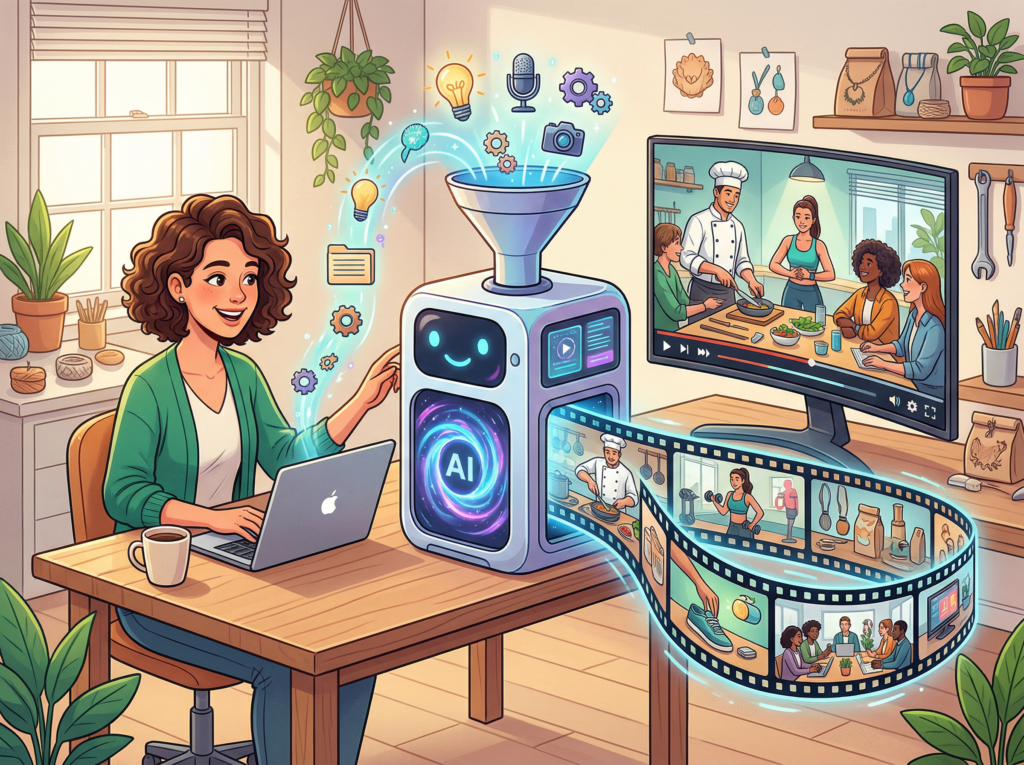
You already have recordings — Zoom calls, webinar clips, product demos, selfie-style social posts — and the problem is transforming raw footage into polished, branded clips efficiently. You spend hours manually cutting silences, adding subtitles, and reformatting for different platforms. You need an online video editor with AI that handles the mechanical work so you can focus on message and strategy.
Situation 3: Marketing Agency or Freelancer Managing Client Videos

You produce videos for multiple clients with different brand guidelines, asset libraries, and output requirements. Speed matters, but so does consistency. You need to deliver volume without sacrificing brand quality. Your mistake is often over-engineering the workflow — choosing tools with too steep a learning curve for the output volume you need.
Real-world example: Jenna runs a 4-person skincare brand in Denver. She needs two to three product videos per week for her Meta ad campaigns but can’t justify a $4,000/month video production retainer. She needs to go from product brief to published ad in under two hours. That’s a specific problem requiring a specific kind of tool — and the choice between InVideo AI and VEED AI for her situation is clear once you understand what each does best.
Who this comparison is NOT for: Enterprise marketing teams with dedicated video production staff, professional videographers choosing personal tools for advanced post-production, or brands requiring 3D animation, complex motion graphics, or film-quality production values. Neither InVideo AI nor VEED AI replaces professional post-production for high-stakes brand campaigns.
Why Each AI Fits Different Needs
InVideo AI: Strengths and Best-Fit Scenarios

InVideo AI is fundamentally a text-to-video platform — you describe what you want, and it builds a video. That core mechanic defines everything about who it’s for and what it does well.
Generative Power: InVideo AI’s primary strength is converting a text prompt, script, or even a URL into a complete video with stock footage, voiceover, captions, and music. You can type “create a 60-second ad for a cold brew coffee subscription targeting millennials” and receive a structured, watchable video in minutes. For marketers running best ai video tool 2026 searches with a “create from nothing” use case, InVideo AI is consistently near the top of the results for good reason.
Speed to First Output: Most users produce their first usable video in under 30 minutes on the free tier, with no prior video editing experience required. The workflow is conversational — you can give follow-up instructions like “make the pacing faster” or “change the voiceover tone to be more upbeat” and see results immediately.
Stock Library Depth: InVideo AI integrates with a massive licensed stock footage and music library. For marketers who don’t have original footage, this is a significant advantage. You’re not sourcing clips manually — the AI selects and assembles them contextually.
Platform-Specific Output: The tool is optimized for social-first content — Instagram Reels, TikTok, YouTube Shorts, Facebook Ads. Aspect ratios, duration limits, and caption styles are all built around platform requirements.
Limitations: Output quality is tied to prompt quality. Vague inputs produce generic results. For brands with specific visual identities, maintaining consistency across AI-generated videos requires careful prompt engineering. And while iteration is fast, you’re still working within the constraints of available stock footage.
You can explore InVideo AI in detail to see a full breakdown of its current feature set, pricing tiers, and platform integrations.
Real-World Business Result: DTC brands using InVideo AI for ad creative testing report producing 5–10 ad variants in the time it previously took to create one, significantly accelerating their paid social testing cycles.
VEED AI: Strengths and Best-Fit Scenarios
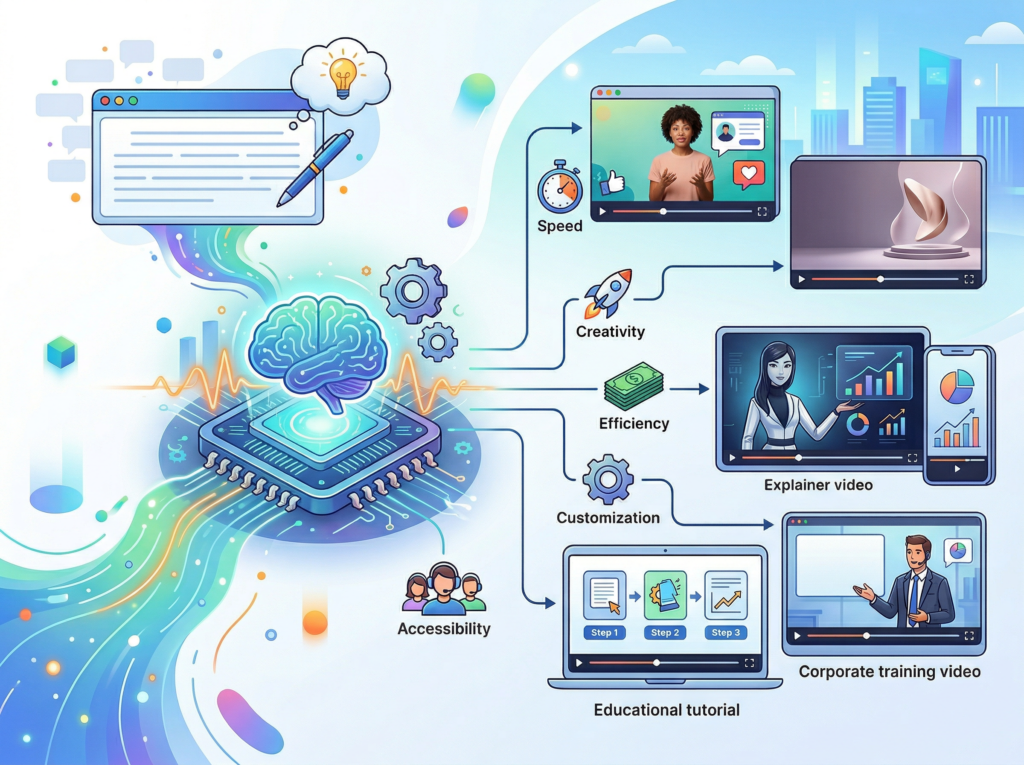
VEED AI is fundamentally a browser-based video editor with AI capabilities layered on top — you bring the footage, it handles the production work.
AI-Powered Editing: VEED’s AI features shine in post-production tasks: automatic subtitle generation (supporting 100+ languages), background noise removal, silence cutting, eye contact correction for talking-head videos, and auto-translation. These aren’t gimmicks — for marketers recording their own content, these features eliminate hours of manual work per week.
Talking-Head and Presenter Content: If your marketing strategy involves founder videos, testimonials, tutorials, or any format where a person speaks on camera, VEED AI has a meaningful edge. Its AI avatar and text-to-speech features also allow you to create presenter-style videos without being on camera yourself.
Collaboration and Brand Consistency: VEED offers team workspaces, brand kits (logo, fonts, color palettes), and shared asset libraries. For agencies and small teams managing multiple brands, this infrastructure matters. As noted in this comparison by Speechify, VEED’s editing experience is considered more polished for users who already have recorded footage to work with.
Screen Recording and Tutorial Content: VEED has a built-in screen recorder, making it a natural fit for SaaS demos, how-to content, and onboarding videos — formats that InVideo AI doesn’t support natively.
Limitations: VEED’s AI video generation from text prompts is less developed than InVideo AI’s. If you’re starting from zero footage, the output is more limited. The platform’s strength is editing and enhancing existing content, not creating from scratch.
See our full VEED AI review for a complete assessment of its AI editing suite, pricing, and team collaboration features.
Real-World Business Result: Marketing teams using VEED AI for subtitle generation and content repurposing report cutting post-production time by 60–70% on talking-head and tutorial-style videos.
Comparative Summary
InVideo AI generates; VEED AI enhances. InVideo AI is faster for marketers starting from a blank page. VEED AI is faster for marketers starting from recorded footage. Your choice depends on whether your primary bottleneck is creation or production.
Who Should Choose Another AI Entirely

Before committing to either tool, it’s worth being direct about the situations where neither InVideo AI nor VEED AI is the right answer.
Need 1: High-Production Brand Campaigns
Both tools produce content that works well for social media, ads, and informational video. Neither is suited for broadcast commercials, brand films, or any production requiring original cinematography, complex motion graphics, or director-level creative vision. For those projects, a professional production agency or a dedicated tool like Adobe Premiere Pro with a skilled editor is the appropriate investment.
Need 2: Real-Time or Live Video
Neither platform supports live streaming, real-time video production, or live event capture. If your marketing strategy includes live commerce, real-time webinars with complex production, or live social content, these are the wrong tools.
As this analysis from Vertu points out, both InVideo AI and VEED AI occupy a “prosumer” tier — more capable than consumer apps like CapCut, but not replacements for professional post-production workflows.
The honest bottom line: InVideo AI and VEED AI are excellent for the 80% of marketing video content that needs to be fast, consistent, and cost-effective. They are not the right tools for the 20% of content where production quality is a strategic differentiator.
Use Cases by Business Goal
Productivity: Scaling Content Output Without Adding Headcount

Use Case: A solo content marketer needs to produce 10–15 short-form videos per month across Instagram, TikTok, and YouTube Shorts without hiring a video editor.
InVideo AI Approach: The marketer maintains a library of brand prompts (tone, visual style, target audience) and uses InVideo AI’s batch creation workflow to generate multiple video variations from a single content brief. A product launch that previously required 3–4 hours of editing can be executed in 45–60 minutes. The AI selects relevant stock footage, applies branded captions, and outputs platform-specific formats automatically.
Time to value: First publishable video in under an hour. Monthly time savings: 8–15 hours compared to manual editing.
VEED AI Approach: The marketer records a single talking-head video and uses VEED AI to auto-transcribe, generate captions in multiple languages, remove filler words, and cut silences — then exports three different length versions for different platforms. One recording session yields four to five publishable clips.
Time to value: 20–40 minutes of post-production per recording. Monthly time savings: 6–12 hours for content repurposers.
Decision Criteria: Choose InVideo AI if you’re generating content volume from briefs and scripts. Choose VEED AI if you’re maximizing output from recorded footage. For more automation strategies that go beyond video, discover AI efficiency strategies that compound these time savings across your entire workflow.
Revenue & Marketing: Paid Ad Creative at Scale

Use Case: An e-commerce brand needs to test 8–10 video ad variations per product launch across Meta and TikTok, previously constrained by the cost and time of professional video production.
InVideo AI Approach: The brand creates a master prompt template per product category (hero shot style, benefit messaging, CTA variations) and generates multiple ad scripts and video outputs rapidly. Each variation takes 15–25 minutes to produce. A/B testing cycles that previously required a week’s production lead time can now happen in a single afternoon. Potential business impact: 2–3x increase in ad creative velocity, directly accelerating paid social optimization.
VEED AI Approach: The brand records a single product demonstration video and uses VEED AI to create multiple cut-downs: a 15-second hook version, a 30-second benefit-focused version, a 60-second full-feature version. The AI adds dynamic captions, adjusts pacing, and adapts aspect ratios per platform. Business impact: higher production value from existing footage, with better brand consistency across variations.
Decision Criteria: Choose InVideo AI if you’re production-constrained and need volume fast from minimal source material. Choose VEED AI if you already have product footage and need professional polish and multi-format distribution. To explore more revenue-focused AI strategies, check out AI revenue growth tactics for a broader playbook on using AI across your marketing funnel.
Systemization & Workflows: Repeatable Video Production at Scale

Use Case: A digital marketing agency needs a standardized, repeatable video production workflow that can be delegated to junior team members and executed consistently across multiple clients.
InVideo AI Approach: The agency builds a prompt library for each client (brand voice, visual style guidelines encoded in prompts, approved messaging frameworks) and creates a templated workflow: brief prompt AI draft human review publish. Junior marketers can execute the AI generation steps; senior staff review and approve. This workflow scales without proportional headcount increases.
Stability consideration: InVideo AI’s prompt-based workflow is relatively stable, but stock footage availability and AI output quality can vary. Build in a human review step for brand-sensitive clients.
VEED AI Approach: The agency standardizes on VEED’s brand kit feature to enforce visual consistency across clients. Footage recording guidelines are documented, and VEED’s AI handles the mechanical post-production (captions, cleanup, reformatting) while human editors handle narrative structure and client-specific customization. This approach produces more consistently professional output but requires more recorded content to work from.
Decision Criteria: Choose InVideo AI for agencies whose clients lack existing video assets and need creation-first workflows. Choose VEED AI for agencies whose clients produce regular recorded content (webinars, demos, interviews) that needs systematic repurposing.
For building scalable team processes around AI tools, learn more about InVideo AI and explore Solo DX workflow strategies for systematizing your operations.
Side-by-Side Comparison Table
| Comparison Axis | InVideo AI | VEED AI |
|---|---|---|
| Core Strength | Text-to-video generation | AI-assisted editing of existing footage |
| Best For | Creating marketing videos from scratch | Polishing, captioning, repurposing recordings |
| Ease of Use | Very beginner-friendly; prompt-driven | Moderate; requires basic editing familiarity |
| Speed to First Video | 15–45 minutes from text prompt | 20–40 minutes from uploaded footage |
| AI Video Generation | Excellent; core feature | Limited; secondary feature |
| Captions & Subtitles | Good; auto-generated | Excellent; industry-leading accuracy |
| Stock Footage Library | Extensive integrated library | Limited; relies on user uploads |
| Team Collaboration | Basic | Strong; shared brand kits, workspaces |
| Screen Recording | Not native | Built-in |
| AI Avatar / Presenter | Available | Available; strong text-to-speech |
| Background Noise Removal | Basic | Excellent |
| Multi-Platform Export | Excellent; social-first formats | Good; flexible export options |
| Pricing (US Market) | Free tier available; paid from ~$25/month | Free tier available; paid from ~$24/month |
| Best Use Case | Ad creative, social content, product promos | Tutorials, talking-head, repurposing long-form |
| Main Limitation | Limited for footage-heavy workflows | Limited for zero-footage creation |
After-Table Analysis
Your choice ultimately comes down to business maturity and content workflow stage.
Early-Stage / High Volume Testing (0–12 months): Prioritize creation speed and iteration. InVideo AI typically wins for businesses in test-and-learn mode, running paid social experiments and needing to produce content fast without significant existing video assets. The ability to go from brief to published content in under an hour is a real competitive advantage at this stage.
Growth / Brand Building (12–24 months): As your brand visual identity solidifies and you start recording more original content (founder videos, customer testimonials, product demos), VEED AI’s editing and brand consistency features become more valuable. One broken customer testimonial that looks unprofessional costs more than producing it carefully with the right tool.
Established / Optimizing (24+ months): Use both strategically — InVideo AI for rapid ad creative iteration and campaign content, VEED AI for polished brand content, long-form repurposing, and team-collaborative production. At this stage, $50/month for both tools is a fraction of the time savings they deliver. See our full VEED AI review for a detailed breakdown of its team-tier features.
Cost Consideration (US Market): Both tools are priced at approximately $24–$25/month on paid tiers, or roughly $288–$300/year. If AI video tools save just 4 hours per month at a US freelance rate of $50/hour, the ROI is $2,400/year in recovered time against a $300 investment. For most US small businesses and freelancers, both tools pay for themselves within the first month of active use.
See more details for comparison about InVideo AI or VEED AI.
How to Choose the Right AI for Your Business
Checkpoint 1: What’s Your Starting Point?

Ask yourself: when you sit down to make a video, do you have footage to work with, or are you starting from a blank page? If blank page ? InVideo AI. If existing footage ? VEED AI. This single question resolves the majority of best ai video tool 2026 decisions.
Reality check: If you’re not sure which situation describes you, try both free tiers for one week with a real project. The workflow that feels less like fighting the tool is the right one.
Checkpoint 2: Team Size and Collaboration Needs
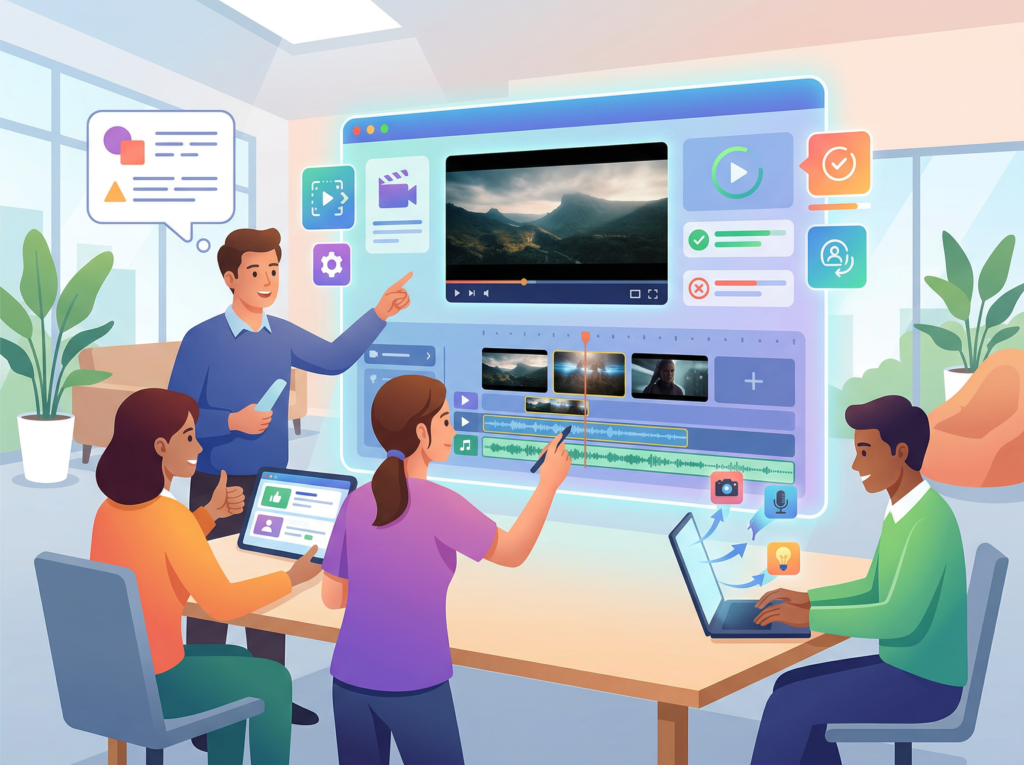
If you’re a solo operator, both tools work equally well for individual use. If you’re managing a team of 2–5 people with shared assets and brand guidelines, VEED AI’s collaboration infrastructure is meaningfully better. Building a consistent review and approval workflow inside VEED takes less setup than trying to replicate that structure in InVideo AI.
Reality check: Team features matter only if you’ll actually use them. Solo operators often over-invest in collaboration tools they don’t need.
Checkpoint 3: Content Mix

If 80%+ of your content is social ads, product promos, and campaign videos generated from scripts and briefs — InVideo AI is the better core tool. If 80%+ of your content involves recorded footage (demos, tutorials, interviews, webinars) — VEED AI is the better core tool. Mixed content workflows can often benefit from both tools in tandem.
Common Mistakes to Avoid
Mistake 1: Choosing Based on Feature Count — The tool with more listed features is rarely the right choice. The right choice is the tool whose core workflow matches yours. Test both with your actual content before committing.
Mistake 2: Treating AI Output as Final — Both tools produce drafts, not finished products. Human review for messaging accuracy, brand alignment, and legal compliance is non-negotiable before publishing.
Mistake 3: Ignoring the Learning Curve Math — If a tool saves you 3 hours per month but takes 20 hours to learn, it takes nearly 7 months to break even on the learning investment. Factor learning time into your ROI calculation.
For advanced integration strategies and automation workflows that extend the value of your AI video stack, explore our AI workflow guides.
Frequently Asked Questions

Is InVideo AI better than VEED AI for video marketing?
Neither is universally better — the right choice depends on your content workflow. InVideo AI excels if you’re generating marketing videos from text prompts, scripts, or briefs with no existing footage. VEED AI is stronger if you have recorded footage to polish, need advanced captioning and transcription, or require team collaboration features. For most US small businesses running paid social campaigns, InVideo AI’s text-to-video generation is faster to value. For content teams repurposing webinars, tutorials, and talking-head recordings, VEED AI saves more time.
Can I use these tools without any video editing experience?
Yes, both are designed for non-editors. InVideo AI’s prompt-driven interface means you describe what you want in plain English and iterate conversationally. VEED AI’s editing interface is more traditional but is notably simpler than desktop editors like Premiere Pro. However, both tools still require you to make editorial judgments — which clip to use, whether the pacing feels right, whether the message lands. AI handles the mechanical work; human judgment still guides the creative decisions.
How much can AI video tools realistically save in production time?
For small business owners and solo marketers handling their own video production: expect 50–70% time reduction on tasks these tools are designed for. A social ad that previously took 3–4 hours (scripting, sourcing footage, editing, captioning, exporting) can take 45–90 minutes with InVideo AI. A 45-minute webinar that previously took 3–4 hours to cut into clips and add captions can take 60–90 minutes in VEED AI. The efficiency gains are real, but they compound with practice — your first month will be slower than your third.
See more details about InVideo AI or VEED AI.
Leave a Reply