
The best ai business plan generator for startups doesn’t replace your thinking — it structures it so your team moves faster and funders take you seriously.
In 2026, American startup founders face a planning paradox. They know they need a solid business plan and financial forecast to attract investors, secure SBA loans, or simply make smarter decisions. But between managing a growing team, serving customers, and putting out daily fires, there’s never a clean moment to sit down and build one properly.
The result is predictable: financial projections live in disconnected spreadsheets, business narratives are buried in old pitch decks, and cash flow surprises derail growth plans every quarter. For US founders managing teams of two to ten people, this operational gap costs more than just time — it costs opportunities.
Traditional business planning hasn’t helped. Hiring a consultant to produce a bank-ready plan runs $5,000–$15,000 in US labor costs. Working with a CPA to build three-year forecasts can add another $3,000–$8,000 before you’ve pitched a single investor. And generic templates downloaded from the internet deliver polished formatting without the financial rigor lenders actually need.
LivePlan AI takes a different approach. Built by Palo Alto Software — with over 30 years of small business planning expertise — it combines an AI-powered writing assistant with automated financial modeling, performance dashboards, and 550+ industry-specific sample plans. The result is startup business planning software that bridges the gap between founder ambition and investor-ready execution.
This guide is written for US-based founders and small startup teams who want to create professional business plans and financial forecasts without hiring consultants or becoming spreadsheet experts. You’ll see exactly how LivePlan AI works, which team roles benefit most, and what outcomes real American small businesses can expect in 2026.
Unlike general productivity tools, LivePlan AI is purpose-built for planning and performance tracking — which means it fits directly into the Solo DX model: small-scale digital transformation led by founders who need enterprise-quality outputs without enterprise overhead.
What is Solo DX?

Solo DX stands for small-scale digital transformation — the process by which US founders and lean startup teams build the systems, workflows, and strategic infrastructure that larger companies have entire departments for.
This isn’t about buying a stack of apps. Solo DX is about systematically replacing founder-dependent chaos with documented, repeatable processes that your team can follow, your investors can evaluate, and your business can scale on.
| Category | What It Means | Best For |
|---|---|---|
| Solo DX | Building systems for planning, forecasting, and operations | Founders scaling from idea to team |
| AI Efficiency | Automating repetitive tasks to save time | Teams optimizing existing workflows |
| AI Revenue Boost | Using AI to increase sales and marketing output | Teams focused on growth and acquisition |
| AI Workflows | Connecting tools and automating multi-step processes | Operations-heavy teams with complex pipelines |
Most corporate planning methods fail for US small businesses because they were designed for organizations with dedicated finance teams, planning departments, and six-month runway for strategic reviews. A three-person startup in Austin doesn’t have that luxury. They need a plan that’s fundable this month and a forecast that updates as the business evolves — not a static document that goes stale before the ink dries.
Consider a real example: a three-person design studio in Austin recently needed to pitch a regional bank for a $75,000 expansion loan. Their founder had the vision. She knew her market, her pricing, and her growth trajectory. But she lacked the financial statements the bank required — a formatted P&L, a three-year cash flow projection, a balance sheet that matched lending expectations.
Building those from scratch would have taken weeks and $4,000–$6,000 in CPA fees. Instead, she used AI-powered planning software to go from raw business inputs to lender-ready documents in under a week — and walked into the bank with professional projections her banker recognized immediately.
That’s Solo DX in practice: using accessible AI tools to produce professional-grade planning outputs that were previously gated behind expensive consultants or specialized finance expertise.
You can explore LivePlan AI’s features to see how the platform supports each stage of this transformation — from first draft to investor meeting.
The Solo DX approach works because it treats planning as a system, not an event. Instead of building a business plan once and filing it away, founders who adopt Solo DX use planning tools to run monthly reviews, track actuals against forecast, and make real-time adjustments before small variances become expensive problems.
Why AI is Key for Mini-Team Systemization
Challenge 1: Financial complexity exceeds founder expertise

Most US startup founders are domain experts, not financial modelers. They understand their product, their customer, and their market. But producing a three-year P&L that accounts for staffing costs, seasonal cash flow, COGS, operating leverage, and SBA lending requirements requires specialized knowledge most founders don’t have — and can’t justify paying $150/hour to acquire.
AI-powered financial forecasting tools solve this by asking founders plain-language questions about their business model, then auto-generating the formatted financial statements lenders and investors require. What previously cost $3,000–$8,000 in CPA time now takes hours.
Challenge 2: Planning is treated as an event, not a system

US labor turnover averaged 47% in recent years across small business sectors, according to Bureau of Labor Statistics data. Every time a key team member leaves, strategic context walks out the door with them. Business plans that exist only in a founder’s head — or in a PDF drafted two years ago — cannot protect against this kind of knowledge loss.
Real systemization means building living plans: documents connected to actual financial data, updated monthly, and accessible to the entire team. This is the difference between a plan you wrote to get a loan and a plan that actively guides your business decisions. As noted in this breakdown of LivePlan’s planning approach, companies that conduct regular plan reviews make faster, better-informed decisions than those treating planning as a one-time task.
Challenge 3: Scaling requires credibility your current documents can’t provide

Whether you’re applying for an SBA loan, pitching an angel investor, or bringing on a strategic partner, the quality of your business plan and financial forecast signals the quality of your leadership. Formatted in Word and projected in Excel, most small-team plans immediately communicate “early stage with limited infrastructure.” Professionally formatted, benchmark-verified documents communicate something different entirely.
The Cost Reality for US Teams
| Approach | Time Required | Cost Estimate |
|---|---|---|
| Hiring a business plan consultant | 3–6 weeks | $5,000–$15,000 |
| Working with a CPA on forecasts | 2–4 weeks | $3,000–$8,000 |
| AI-assisted planning software | 1–2 weeks | $144–$288/year |
For small US teams operating on lean budgets, the math is straightforward. AI tools for entrepreneurs don’t just save money — they compress the timeline from idea to fundable plan from months to weeks. In a competitive market where timing matters, that speed advantage is a genuine strategic asset. This comprehensive overview of LivePlan’s capabilities covers how the login and onboarding experience is designed to get new users into productive planning workflows quickly.
How LivePlan AI Enables Solo DX
1. AI-Powered Business Plan Builder
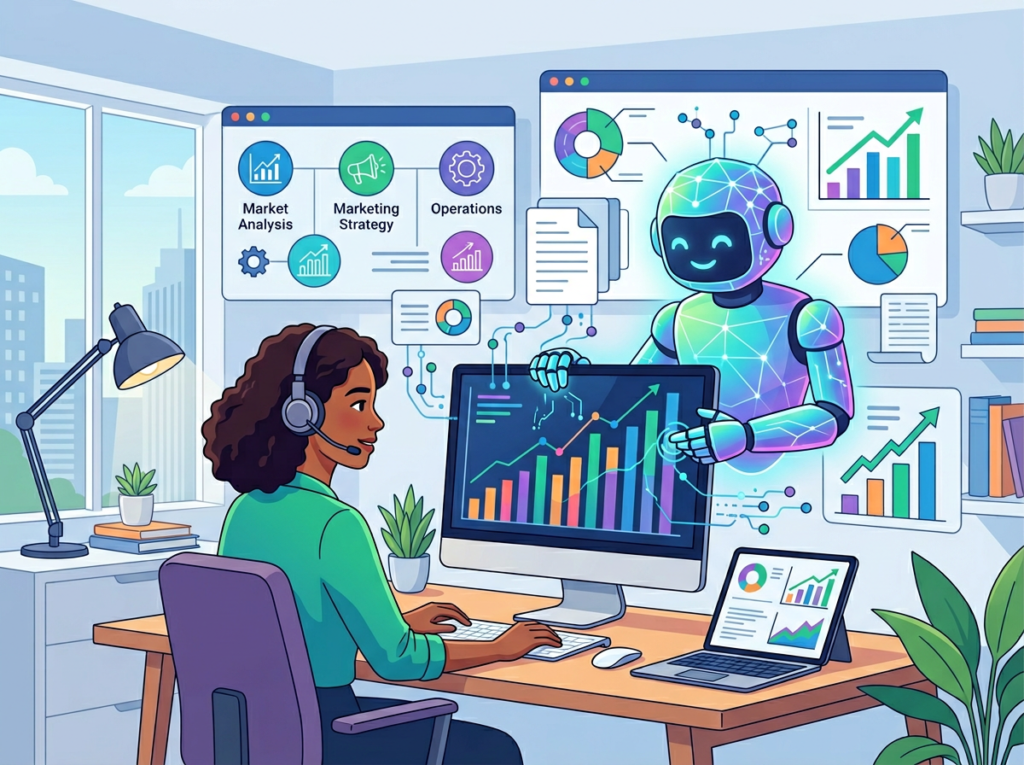
LivePlan’s AI assistant — trained on thousands of successful business plans and 30+ years of planning expertise — guides founders through each section of their business plan by asking targeted questions and drafting professional content from the answers.
This is not generic AI output. The system understands what lenders want in an executive summary, what investors look for in a market analysis, and what level of detail a competitive analysis needs to be credible. It flags gaps, suggests improvements, and helps founders articulate their business model in language that communicates clearly to external audiences.
ROI impact: US founders who previously spent $2,000–$5,000 on business plan consultants report completing comparable quality plans internally in 8–15 hours. For a solo founder billing $100/hour elsewhere, that’s a $800–$1,500 savings on time alone — plus the $2,000–$5,000 in consulting fees avoided.
2. Automated Financial Forecasting

Enter your pricing, projected volume, and cost structure. LivePlan auto-builds a complete three-year P&L, balance sheet, and cash flow statement in the exact formats banks and SBA lenders require. No financial modeling background needed. No complex formulas to maintain.
The financial forecasting with AI capability is particularly valuable for multi-revenue-stream businesses — a common structure for US founders combining services, products, and recurring subscriptions. Set up separate revenue lines, apply different growth assumptions, and compare scenarios before committing to a strategy.
ROI impact: Replacing CPA-built financial projections with AI-automated models saves US teams $3,000–$8,000 per funding cycle. For teams that revise forecasts quarterly, the annual savings compound to $12,000–$24,000 in avoided professional services costs.
3. Scenario Planning and What-If Modeling
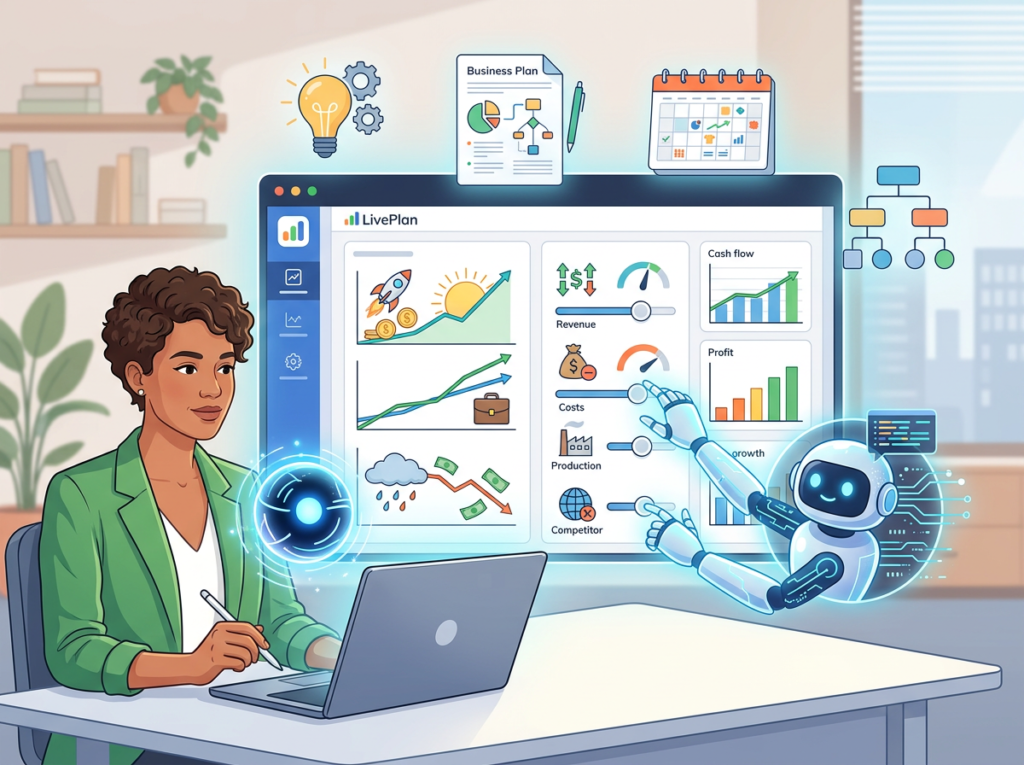
What happens to your cash position if your top client pauses for 60 days? What does a 20% pricing increase do to your customer acquisition curve? LivePlan’s scenario planning lets you model these questions before they become crises.
For US startup teams making hiring decisions, pricing adjustments, or market expansion moves, this small business planning automation capability removes the guesswork. You make decisions informed by modeled outcomes rather than gut instinct and spreadsheet math.
ROI impact: A single avoided bad hire ($15,000–$50,000 in US labor costs for recruiting, onboarding, and severance) covers years of LivePlan subscription fees. One pricing optimization informed by scenario modeling can increase annual revenue by $20,000–$100,000 for a growing service business.
Ready to build a fundable business plan without hiring a consultant? Try LivePlan AI Free | 35-day money-back guarantee | Trusted by 1 million+ entrepreneurs
See how LivePlan AI works with a full feature walkthrough before you commit.
Use Cases by Team Role
Maria Chen — Startup Founder

Background: Maria runs a 6-person SaaS startup in San Francisco. She’s preparing for a seed round and needs a polished business plan and three-year financial model to present to angel investors.
Old workflow: Maria spent three weekends trying to build financial projections in Excel, using a template she found online. The model kept breaking when she changed assumptions. She eventually hired a consultant for $7,500 to produce investor-ready financials — but the consultant didn’t understand her unit economics well enough to capture her business model accurately.
AI-powered workflow with LivePlan: Maria entered her pricing tiers, customer acquisition assumptions, and cost structure directly into LivePlan. The AI assistant helped her draft her market analysis and competitive positioning. Within ten days, she had a complete business plan, three-year P&L, and a pitch deck formatted for investor presentation.
Quantified results: $7,500 in consulting fees eliminated. 60+ hours of internal time saved. Investor meeting scheduled within two weeks of completing the plan.
“I went into my first investor meeting with a level of financial detail I couldn’t have built myself. LivePlan basically gave me a CFO-quality document at a subscription price.” — Maria, SaaS Founder, San Francisco
James Thompson — Operations Director

Background: James manages operations for an 8-person professional services firm in Miami. The company is growing fast and needs to hire three more people in the next six months — but the owner wants to see a workforce plan tied to financial projections before approving headcount.
Old workflow: James built hiring scenarios manually in Excel, disconnected from the company’s actual P&L. Every time revenue assumptions changed, he had to manually update four different spreadsheets. The process took two weeks and was immediately out of date.
AI-powered workflow with LivePlan: James connected LivePlan to the company’s QuickBooks account and built a hiring scenario model tied to actual revenue data. He created three growth scenarios — conservative, base, and optimistic — with corresponding headcount and cash flow implications for each.
Quantified results: Workforce planning cycle reduced from two weeks to three days. Owner approved hiring plan in the first review meeting. $4,200 in CPA time saved by producing financial models internally.
“The QuickBooks integration meant I wasn’t starting from scratch every time. Actuals flowed in automatically and my scenarios updated in real time.” — James, Operations Director, Miami
Aisha Robinson — Marketing Lead

Background: Aisha runs marketing for a 5-person e-commerce startup in Denver. She’s been asked to build a marketing budget tied to revenue projections — and present it to the CEO alongside ROI benchmarks for each channel.
Old workflow: Aisha pulled industry benchmarks from scattered blog posts, built a budget in Google Sheets, and manually formatted a presentation. The process took a full week and the CEO still asked follow-up questions about how the numbers were validated.
AI-powered workflow with LivePlan: Aisha used LivePlan’s industry data feature — which includes benchmarks from 550+ business categories — to validate her channel ROI assumptions against real industry averages. She built her marketing budget as a scenario within the company’s broader financial model, so the CEO could see exactly how each dollar of marketing spend connected to projected revenue.
Quantified results: Budget presentation time cut from one week to two days. CEO approved marketing budget in the same meeting with no follow-up questions. Industry benchmark data added credibility that internal projections alone couldn’t provide.
“Having real industry benchmarks baked into my presentation changed the whole conversation. It wasn’t my opinion anymore — it was our numbers against what the industry actually does.” — Aisha, Marketing Lead, Denver
Robert Kim — Finance Manager

Background: Robert manages financial reporting for a 10-person consulting firm in Chicago. The firm’s partners want monthly performance reports comparing actuals to the annual plan — but Robert has been building these manually from QuickBooks exports, a process that takes two full days each month.
Old workflow: Robert exported QuickBooks data to Excel, manually matched actuals to budget line items, built charts in PowerPoint, and emailed a static PDF to partners. Two days of work. Immediately out of date.
AI-powered workflow with LivePlan: Robert connected LivePlan directly to QuickBooks. Now actuals update automatically, the performance dashboard shows real-time variances, and monthly reports are generated in under an hour. Partners can log in and check performance themselves without waiting for Robert’s manual export.
Quantified results: Monthly reporting cycle cut from two days to under an hour — saving $3,200/month at Robert’s billing rate. Partners now access live dashboards instead of waiting for static PDFs. Year-over-year reporting consistency improved with no manual data entry errors.
“I used to dread the first week of every month. Now the report basically builds itself. I just review it and add commentary.” — Robert, Finance Manager, Chicago
See a detailed breakdown of LivePlan AI including the dashboard features Robert’s team uses for monthly reporting.
Join 1 million+ entrepreneurs using LivePlan AI to build better business plans and forecasts. Get Started Today | Used by teams from Silicon Valley to Chicago
Common Pitfalls & How to Avoid Them
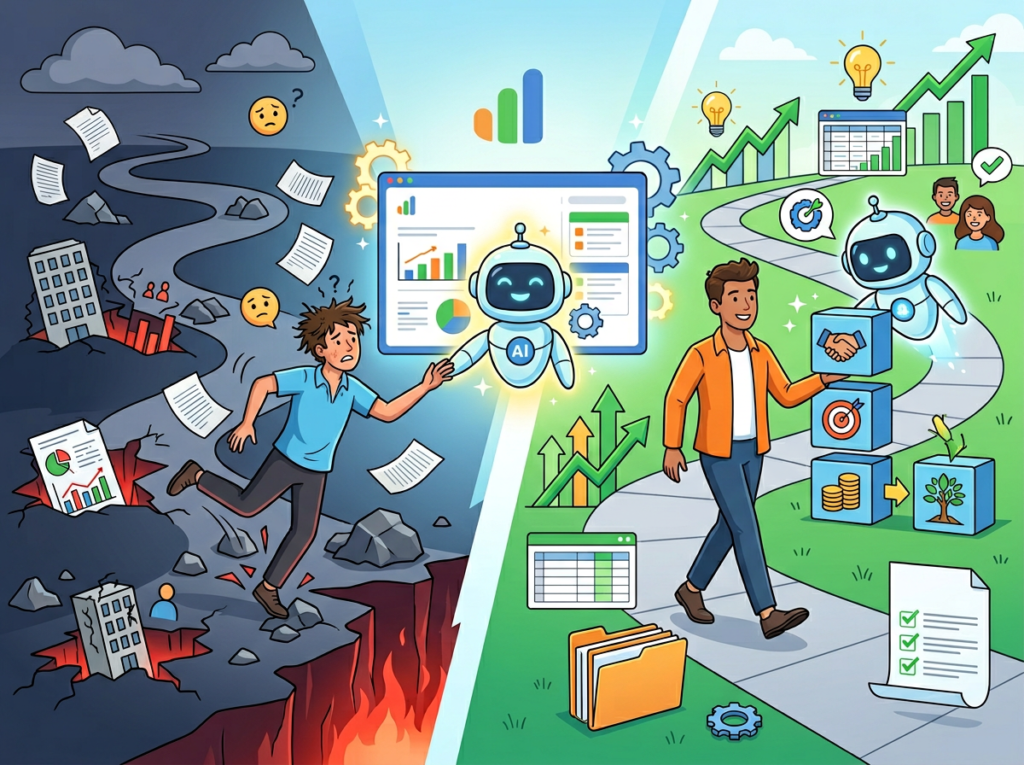
Pitfall 1: Treating the business plan as a one-time document
The most expensive planning mistake US founders make is building a business plan to get funding and then never updating it. Your plan should function as a living management tool — reviewed monthly, updated quarterly, and connected to actual financial performance. LivePlan’s dashboard and performance tracking features exist specifically to prevent this. If you’re not running monthly plan-vs-actual reviews, you’re using 20% of the tool’s value.
Pitfall 2: Entering optimistic assumptions without benchmark validation
AI tools for entrepreneurs can generate compelling financial models — but they’re only as accurate as your inputs. US founders consistently overestimate revenue growth and underestimate operating costs, particularly in the first two years. LivePlan’s industry benchmark data exists to pressure-test your assumptions against what comparable businesses actually achieve. Use it before you present projections to any external audience.
Pitfall 3: Skipping the scenario planning features
According to this analysis of LivePlan’s planning methodology, businesses that test multiple growth scenarios before committing to a plan make better decisions about hiring, pricing, and market expansion. US founders who skip scenario modeling are essentially betting their cash flow on a single set of assumptions. Build at least three scenarios — conservative, base, and optimistic — before presenting any forecast to investors or lenders.
Discover LivePlan AI’s full scenario and forecasting toolkit to see how US teams avoid these pitfalls in practice.
FAQs

What is Solo DX, and does my startup need it?
Solo DX is small-scale digital transformation — the process of building planning systems, financial workflows, and strategic infrastructure without a dedicated operations team. If you’re a US founder managing a team of two to ten people and making strategic decisions without documented financial models or a current business plan, you’re already practicing informal Solo DX. Formalizing it with a tool like LivePlan AI makes your planning process faster, more credible, and less dependent on institutional knowledge that walks out the door when team members leave.
Can small startup teams actually afford business planning software in 2026?
LivePlan’s Standard plan runs approximately $144/year — less than one hour of CPA time at US rates. For any startup team pursuing external funding, planning for a hire, or managing quarterly cash flow, the ROI is straightforward. The 35-day money-back guarantee means you can fully test the platform before committing.
Is LivePlan AI hard to set up for a non-technical founding team?
LivePlan is designed for founders, not finance specialists. The interface walks you through each section of your business plan with plain-language questions and guided prompts. Financial models build automatically from the assumptions you enter — no formula maintenance required. Most US founding teams complete a first draft of their business plan within their first two weeks of use. The QuickBooks/Xero integration for Premium users is a one-time connection that takes under 30 minutes to configure.
Conclusion

In 2026, American startup teams don’t need enterprise budgets to produce enterprise-quality business plans and financial forecasts. The gap between “founder with a vision” and “founder with an investor-ready plan” has narrowed dramatically — and ai business plan generator for startups tools like LivePlan AI are the primary reason why.
The data is straightforward: companies that plan regularly and track actuals against forecast grow 30% faster than those that don’t. US founders who use LivePlan AI reduce business planning costs by $5,000–$15,000 per funding cycle, compress their planning timeline from weeks to days, and walk into lender and investor meetings with documents that communicate professional credibility.
The Solo DX approach isn’t about replacing strategic thinking — it’s about eliminating the operational friction that prevents founders from doing it. When your financial models build themselves, your dashboards update automatically, and your business plan stays connected to live performance data, strategic planning stops being an overwhelming project and becomes a regular business practice.
Start with one process: build your three-year financial forecast this week. Connect it to your actuals. Run your first plan-vs-actual review next month. The founders who treat planning as a system — not an event — are the ones who scale without surprises.
Get the full LivePlan AI review and see exactly how US startup teams use it to move from vision to fundable plan in under two weeks.
Leave a Reply