
LinkedIn has become the most valuable lead generation channel for US small businesses in 2026 — but for most founders and small teams, it’s also one of the most time-consuming. If you’re running a team of two to ten people, you already know what this looks like: someone remembers to post on Monday, nothing goes up Tuesday through Thursday, and by Friday the algorithm has forgotten you exist.
The problem isn’t motivation. It’s bandwidth.
US-based small teams are stretched across sales, delivery, and client work simultaneously. The average founder spends roughly 6.5 hours per week on LinkedIn-related tasks — writing posts, responding to comments, monitoring competitors, and trying to stay relevant in a feed that moves at lightning speed. At $100/hour in opportunity cost, that’s over $33,000 per year directed at a channel most teams never fully optimize.
What’s changed in 2026 is that AI linkedin automation tools have matured enough to handle the repetitive, high-volume side of content production without sacrificing the personal tone that makes LinkedIn work. The platforms that do this best don’t just generate generic posts — they learn your voice, study what’s working in your niche, and help you maintain a consistent presence even during your busiest client weeks.
Taplio sits at the center of this shift. Built specifically for LinkedIn, it combines AI content generation, scheduling, engagement tracking, and lead relationship management into a single platform designed for founders, marketers, and small teams who need to grow on LinkedIn without adding headcount.
This article breaks down exactly how Taplio works for US small teams in 2026 — what it enables, where it saves real money, and how teams across industries are using it to generate leads and build authority without burning out their people.
What is Solo DX?

Solo DX — short for Solo Digital Transformation — describes the process of using AI and automation tools to build scalable, repeatable systems without a dedicated operations team. It’s the approach US founders take when they’ve outgrown “winging it” but aren’t yet in a position to hire a VP of Marketing or a full-time content strategist.
Unlike enterprise digital transformation, which relies on six-figure consultants and multi-year roadmaps, Solo DX is lean by design. It’s what happens when a three-person agency in Austin decides that instead of hiring a social media manager, they’ll use an AI linkedin automation tool to run their LinkedIn presence with 90 minutes of input per week instead of 8.
How Solo DX compares to other categories:
| Category | Scale | Focus | Budget |
|---|---|---|---|
| Solo DX | 2–10 person teams | Systems + automation | $50–$500/month |
| AI Efficiency | Individual operators | Speed + output | $20–$100/month |
| AI Revenue Boost | Growth-stage teams | Leads + pipeline | $200–$2,000/month |
| Enterprise AI | 50+ employees | Cross-dept integration | $5,000+/month |
The reason corporate SOP methods fail for US SMBs is structural. A Fortune 500 company can assign a team to audit content workflows for six weeks. A six-person consulting firm in Denver can’t. They need tools that are opinionated, fast to set up, and immediately useful — not platforms that require a 40-hour onboarding process before you see your first post.
Consider a three-person design studio in Austin. Before using an AI-driven LinkedIn workflow, the founder — who had the strongest voice and deepest client relationships — was the only person who could write the studio’s LinkedIn content. When she was on deadline, posting stopped. When posting stopped, inbound inquiries dropped. Within 30 days of switching to a structured AI-assisted content system, she was able to hand off 70% of post creation to a junior team member working from AI-generated drafts, while still maintaining her distinctive voice.
Explore Taplio’s features to see how it supports this kind of workflow hand-off for small creative and professional services teams.
Solo DX is the framework that makes this possible at scale — and LinkedIn content automation is one of its most immediate, measurable applications.
Try Taplio Free | No credit card required | Trusted by 10,000+ US teams
Why AI is Key for LinkedIn Content Automation

Problem 1: The Founder Bottleneck
In most small businesses, the founder has the strongest personal brand, the deepest industry knowledge, and the least available time. Content that should live on LinkedIn sits in their drafts folder for three weeks before being abandoned. When they do post, it performs well — but the inconsistency kills momentum.
The AI solution here isn’t to replace the founder’s voice. It’s to build a system that extracts their perspective efficiently. Tools that analyze past posts, identify writing patterns, and generate new drafts in that style reduce the time investment from 45 minutes per post to under 10 minutes of review and editing. Across a five-post-per-week cadence, that’s a recovery of 2.5+ hours weekly — roughly $13,000 annually at US consulting rates.
Problem 2: Team-Level Content Consistency
US labor turnover in marketing-adjacent roles runs close to 47% annually. Every time a content hire leaves, the LinkedIn voice shifts. Followers notice. Engagement drops. The algorithm penalizes inconsistency.
AI linkedin automation tools solve this by making content strategy a system rather than a person. When the guidelines, tone settings, and content templates live in the platform rather than in an employee’s head, transitions become smoother. New team members can produce on-brand content from week one instead of week six.
Problem 3: The ROI Visibility Gap
Most US small teams know LinkedIn is important — they just can’t prove it. Without clear attribution between content activity and pipeline outcomes, LinkedIn content gets deprioritized when things get busy. This creates a feast-or-famine posting pattern that undermines long-term growth.
Analytics-driven scheduling tools close this gap by tracking which content formats, topics, and posting times drive the most profile visits, connection requests, and inbound messages. When a team can see that their Wednesday morning thought leadership posts drive 3x more inbound leads than their Friday product updates, they can optimize with data rather than guessing.
The Cost Reality
Building a manual LinkedIn content operation for a small US team typically costs between $4,000 and $8,000 monthly when you factor in a part-time content strategist ($3,000–$5,000), a social media coordinator ($1,500–$2,500), and tool subscriptions. An AI-assisted approach using a platform like Taplio brings that same output to under $100/month in subscription fees, with 3–5 hours of weekly team input rather than 20+.
How Taplio Enables LinkedIn Content Automation

1. AI-Powered Post Generation
Taplio’s AI content engine analyzes your existing LinkedIn posts, identifies your writing patterns and preferred topics, and generates new post drafts that match your voice. For a marketing lead at a SaaS startup in San Francisco, this means producing a week’s worth of content in under an hour — instead of blocking out half a day.
The system can generate full posts from a short prompt, expand bullet points into narrative posts, rewrite underperforming content, and adapt a single idea into multiple formats (short insight posts, story-led posts, carousel outlines). For teams where one person is responsible for both their own and their company’s LinkedIn presence, this multiplies output without multiplying time.
Estimated ROI: Saving 4+ hours weekly at $75/hour US rate = $15,600 annually per content-responsible team member.
2. Viral Post Library and Inspiration Engine
One of the most consistent problems small teams face is ideation fatigue — running out of things to say before running out of audience. Taplio solves this with a library of high-performing LinkedIn posts, filterable by industry, format, engagement level, and topic. As noted in this breakdown of how AI supports LinkedIn growth, maintaining a reliable inspiration pipeline is foundational to consistent posting.
For US teams in B2B services — consulting, marketing agencies, tech startups — the ability to see what’s resonating in your specific niche and then adapt those structures to your own perspective compresses the ideation phase from hours to minutes.
Estimated ROI: Eliminating 3 hours/week of research and ideation at $85/hour = $13,260 annually.
3. Engagement and Lead Relationship Tracking
Taplio’s CRM-lite functionality tracks who’s engaging with your content — which prospects are consistently liking and commenting, which connections haven’t been contacted in 90 days, and which relationships are warming toward a conversation. For US founders and sales-led teams, this turns passive content activity into an active lead pipeline.
Rather than manually reviewing LinkedIn notifications and trying to remember which leads have been nurtured, teams can see a prioritized list of people to engage with each morning, with full context on their interaction history.
Estimated ROI: Identifying 2 additional qualified conversations per month at a 20% close rate = $24,000+ annually at an average US B2B deal size of $5,000.
See how Taplio works across all four of these functions before committing to a plan.
Ready to automate your LinkedIn content and generate leads on autopilot? Try Taplio Free | No credit card required | Trusted by 10,000+ US teams
Use Cases by Team Role
Operations Leader

James manages operations for a 12-person consulting firm in Miami. His job includes handling the firm’s LinkedIn company page, which had gone dark for six months before he took ownership of it.
Old workflow: James would brief a freelance writer monthly, receive a batch of posts, spend 2 hours editing them for accuracy and tone, and then manage the scheduling manually. Total time investment: 6–8 hours monthly, $800–$1,200 in freelancer fees.
AI-powered workflow: James uses Taplio to generate company page content from internal meeting notes and client case study summaries. He pastes a rough summary of a recent client win, the AI formats it into a structured LinkedIn post, and he approves or edits within five minutes.
Quantified results: Monthly content spend dropped from $1,000 to $99 (Taplio subscription). Time investment fell from 8 hours to 90 minutes monthly. Company page followers increased from 340 to 1,100 in four months. Two partnership inquiries came through LinkedIn that quarter.
“We went from a dead company page to one that actually represents what we do. It took less effort than I expected.” — James (composite)
Marketing Leader

Aisha is the sole marketing hire at a 7-person fintech startup in Austin. She manages the CEO’s personal LinkedIn, the company page, and her own professional brand simultaneously. Before Taplio, she was producing about 3 posts per week across all three accounts. The goal was 15.
Old workflow: Aisha maintained separate content calendars for each account in Notion, wrote every post from scratch, and spent 12–15 hours per week on LinkedIn alone. She was burning out and the accounts still weren’t hitting their targets.
AI-powered workflow: Aisha now manages all three accounts from a single Taplio workspace. Each account has its own tone profile. She generates drafts for all three in a single two-hour session on Mondays, reviews and schedules everything, and uses the remaining time for engagement and response management.
Quantified results: Weekly post volume went from 3 to 16 across the three accounts. Time on LinkedIn dropped from 15 hours to 4.5 hours weekly — a savings of 10.5 hours at her $65/hour equivalent rate, or $35,490 annually. The CEO’s profile views tripled. As this analysis of AI-assisted LinkedIn strategy notes, the combination of AI generation and human editing is what keeps content feeling authentic rather than automated.
“Managing three LinkedIn accounts used to feel impossible. Now it’s just part of Monday morning.” — Aisha (composite)
Business Development Director

Robert leads BD for a professional services firm in Chicago. He has 14,000 LinkedIn connections built over 20 years and rarely posts — despite his connections representing the firm’s single most valuable network asset.
Old workflow: Robert would occasionally share industry articles with a sentence of commentary, averaging one post per month. His network was largely dormant from a content engagement standpoint.
AI-powered workflow: Robert now uses Taplio to convert his weekly team briefing notes and client conversations into three LinkedIn posts per week. The AI drafts; Robert adds one or two personal observations in his own words; the post goes out. He also uses Taplio’s relationship tracking to identify connections who haven’t been contacted in over six months and re-engages them proactively.
Quantified results: Posts per month went from 1 to 12. Engagement rate from existing connections: 4.2% average (industry benchmark: 1.8%). Three former clients re-engaged within 90 days of Robert resuming consistent posting. Estimated referral pipeline attributed to LinkedIn reactivation: $60,000 in the first quarter.
“I didn’t think I had time to post. Turns out I just didn’t have a system. Now the system runs on maybe 20 minutes a day.” — Robert (composite)
Discover Taplio and see which use case maps most closely to your team’s current LinkedIn challenges.
Join 10,000+ US small teams using Taplio to grow on LinkedIn without the manual grind. See How It Works | Used by teams from Silicon Valley to Chicago
Common Pitfalls and How to Avoid Them
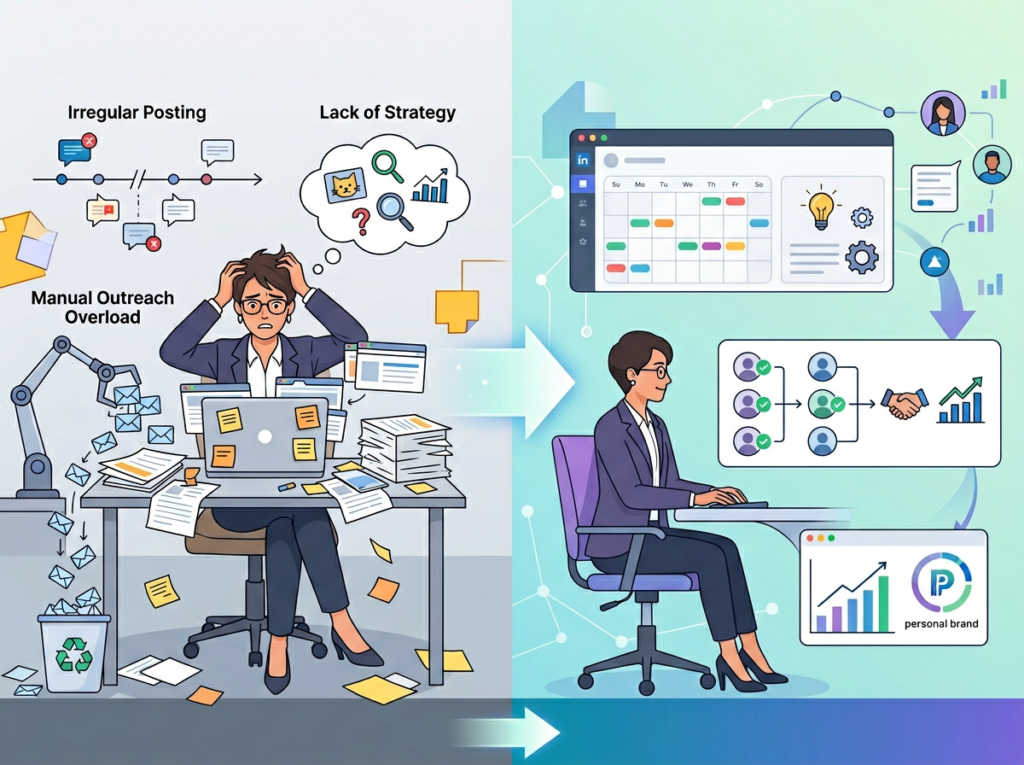
Pitfall 1: Treating AI Output as Final Copy
The most common mistake teams make is publishing AI-generated posts without editing them. Even the best AI content tools produce drafts, not finished posts. LinkedIn’s algorithm rewards authentic, conversational content — and readers can tell the difference between a post that came from a real perspective and one that was generated and published without a human pass.
The fix is simple: build a 5-minute editing step into every post. Add one specific detail — a client name (anonymized if needed), a number from your actual experience, a specific city or context. That level of personalization is what separates content that drives connections from content that gets scrolled past. You can find a detailed breakdown of Taplio including how its editing interface supports this review workflow.
Pitfall 2: Using LinkedIn Automation Without a Content Strategy
Posting consistently is necessary but not sufficient. US teams that automate posting without first defining their content pillars, target audience, and conversion goals end up with high post volume and low business impact. Before automating, spend two hours defining three to four content themes that map directly to your services and the questions your best clients ask most often.
Pitfall 3: Neglecting Multiple Accounts
For teams with both a company page and active personal brands (which is the high-leverage approach for most US B2B businesses), managing LinkedIn across multiple accounts manually creates coordination chaos. Centralized tools solve this — but only if the team commits to using them consistently rather than reverting to ad hoc posting from individual devices. This practical overview of how teams use Taplio for productivity illustrates how multi-account coordination benefits real practitioners.
FAQs

What’s the difference between AI Efficiency and Solo DX?
AI Efficiency refers to tools that make individual tasks faster — writing faster, summarizing faster, responding faster. Solo DX is about using AI to build systems that don’t depend on any one person. An individual using a writing tool to draft posts faster is AI Efficiency. A three-person team with a defined LinkedIn content system that runs consistently regardless of who’s available that week — that’s Solo DX.
Can small US teams afford LinkedIn automation tools?
Taplio’s entry-level plan is under $50/month. For US small teams spending $75–$150/hour on skilled labor, the tool pays for itself if it saves even 30–45 minutes per week. Most teams report saving 4–8 hours weekly once the system is set up — making the ROI not just positive but substantial.
Is Taplio hard to set up for a non-technical team?
No. Taplio is a browser-based application with no technical installation required. Most teams are generating their first AI-drafted posts within 20 minutes of signing up. The learning curve for the scheduling and analytics features is measured in hours, not weeks.
Try Taplio Free | No credit card required | Trusted by 10,000+ US teams
Conclusion

In 2026, American small businesses don’t need enterprise budgets to build enterprise-level LinkedIn presence. The tools that once required dedicated social media teams, expensive agencies, and five-figure monthly retainers are now accessible to a four-person startup in Denver or a solo consultant in Charlotte for under $100/month.
Taplio sits at the intersection of where that shift is most practical. It doesn’t try to replace human judgment — it removes the parts of LinkedIn content production that don’t require human judgment: the blank-page problem, the scheduling logistics, the tracking of which relationships need attention. What’s left is a more strategic, higher-leverage use of your team’s time.
The ai linkedin automation tool category has matured. The question for US small teams in 2026 isn’t whether to automate LinkedIn content — it’s which system to use and how to implement it in a way that feels authentic rather than mechanical.
Start with one account. Define three content pillars. Run the system for 30 days before evaluating results. The teams that commit to consistency — even at lower post volumes — consistently outperform those who burst-post for two weeks and then go silent.
Learn more about Taplio and see the full feature set before your next content planning session.
Start your free trial at Taplio — no credit card required.
Leave a Reply