
Small teams that master AI video production now outpace larger competitors — and Wan 2.6 is the ai video generator for marketing that makes that possible.
Running a small marketing team in 2026 means being asked to do more with less — more content, more channels, more consistency, all without the budget for a full video production crew. For US-based founders, marketers, and indie teams, video is no longer optional. It’s the primary driver of engagement across LinkedIn, Instagram, YouTube, and paid ad platforms. Yet the cost of traditional video production — $3,000 to $15,000 per professional video — puts high-quality content out of reach for most small businesses.
The result? Teams either skip video altogether, or they produce low-quality content that hurts the brand they’re trying to build.
This is exactly the problem that ai video creation software was built to solve. In 2026, AI video tools have matured to the point where a two-person marketing team can produce broadcast-quality short-form videos, product demos, and social ads in hours — not weeks. No video crew. No expensive post-production pipeline. No waiting.
Wan 2.6 has emerged as one of the most capable ai video generators for marketing teams that need speed, consistency, and professional output. Built by Alibaba’s AI research division and accessible globally through its web platform at wan.video, it supports text-to-video, image-to-video, and reference-to-video generation — giving small teams the same production capabilities that used to require a studio.
Unlike traditional content marketing with ai video tools that focus on simple templates or slide-based animations, Wan 2.6 generates cinematic, motion-rich video from text prompts and static images. For US small teams managing content across multiple channels, that’s a fundamental shift in what’s operationally possible.
This guide breaks down exactly how Wan 2.6 works, who it’s built for, and how American small teams are using it to cut video production costs by 70% or more while scaling output to meet modern content demands.
Discover Wan 2.6 and see the full feature breakdown, pricing details, and comparison against alternative AI video tools on AI Plaza.
What is Solo DX?
Solo DX — short for Solo Digital Transformation — describes a specific kind of operational challenge facing US small business founders in 2026. It’s the moment when a solo operator or micro-team realizes that the informal, memory-based systems that worked for one person are actively breaking down as the team grows.
For content-focused businesses, Solo DX typically looks like this: video production knowledge lives in one person’s head. There’s no repeatable workflow for creating a brand-consistent video. Every new hire or contractor has to be trained from scratch. And the founder ends up in every decision loop because nothing is documented or automated.
Corporate SOP methodologies — the kinds enterprise teams use — don’t translate well to US SMBs. They’re too rigid, too time-consuming to build, and assume dedicated operations staff that small teams don’t have. What Solo DX calls for instead is a lightweight, AI-assisted approach to systemizing the most chaotic workflows first.
Video production is one of the most chaotic workflows in any content-driven small business. It involves creative direction, scripting, motion, editing, branding, and distribution — all requiring coordination that breaks down without a clear system.
Consider a real example: A three-person design studio in Austin was producing client explainer videos using a combination of Canva, iMovie, and contractor relationships managed entirely via email threads. Every project started from scratch. Turnaround was two to three weeks. Client revision cycles added another week. The team was burning 12–15 hours per video project in coordination alone.
After adopting an AI-assisted production workflow centered on tools like Wan 2.6, that same studio reduced average project time to four days — with the AI handling motion generation and initial visual sequencing, freeing human creatives for direction and brand alignment.
That’s Solo DX in practice: not replacing the team, but building a repeatable, AI-powered system that makes the team dramatically more efficient.
If you want to understand where Wan 2.6 fits in this kind of workflow, the detailed breakdown of Wan 2.6 on AI Plaza walks through its full feature set and use case context.
| Category | Solo DX | AI Efficiency | Enterprise Ops |
|---|---|---|---|
| Team size | 2–10 people | 1 person | 50+ people |
| Focus | Systemizing workflows | Personal productivity | Process standardization |
| AI role | Workflow automation | Task acceleration | Integration at scale |
| Video need | Repeatable production | Fast output | Multi-team consistency |
Why AI is Key for Mini-Team Video Production
Problem 1: Video production knowledge lives in one person’s head.

Most small marketing teams have one person who knows how to produce a video — the right aspect ratios for each platform, which transitions work, how to match brand guidelines in motion. When that person is unavailable or leaves, production stops. The institutional knowledge isn’t documented. It can’t be replicated.
AI video creation software changes this by converting creative intent — expressed through text prompts — into video output that any team member can generate. The “knowledge” lives in the prompt templates and brand guidelines you establish, not in an individual.
Problem 2: US labor costs make traditional video production economically unsustainable for small teams.
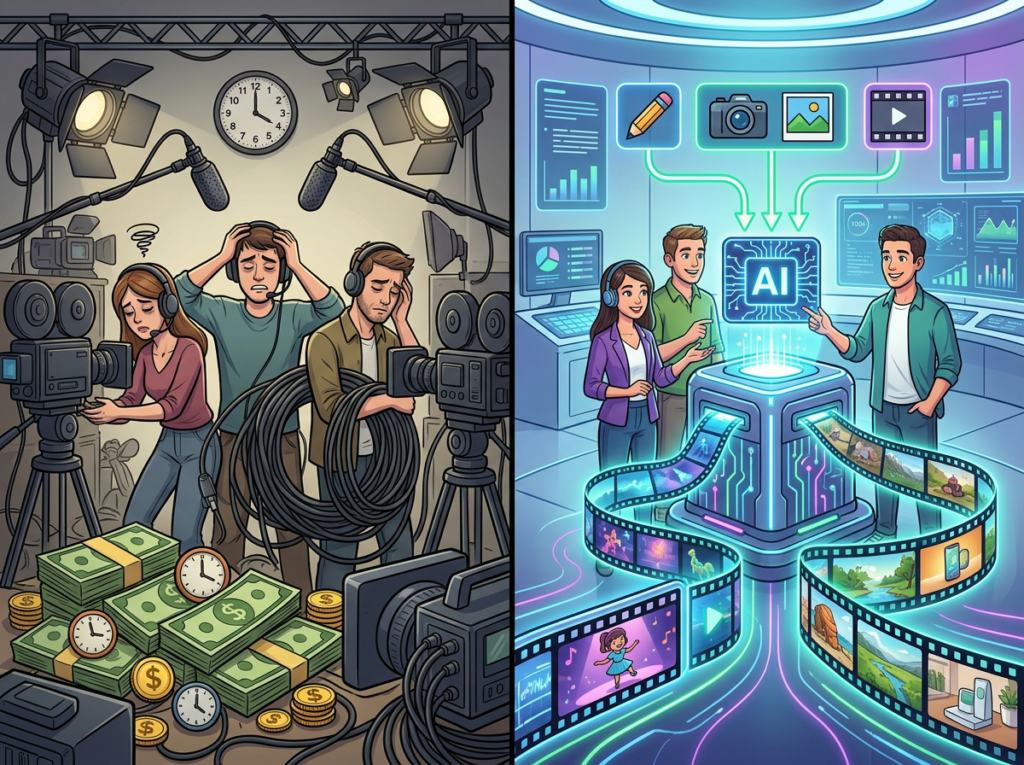
At $75–$150/hour for skilled video editors and motion designers, a single 60-second marketing video can consume $2,000–$5,000 in US labor. For a team producing four videos per month, that’s $8,000–$20,000 monthly — a budget most small businesses don’t have.
AI video production automation slashes that cost to near zero for the generation phase. Teams pay a subscription fee (typically $30–$100/month for tools like Wan 2.6) and produce unlimited video assets. The human creative role shifts to direction, review, and brand alignment — tasks that take 2–3 hours instead of 20.
Problem 3: Quality variance across team members creates inconsistent brand output.
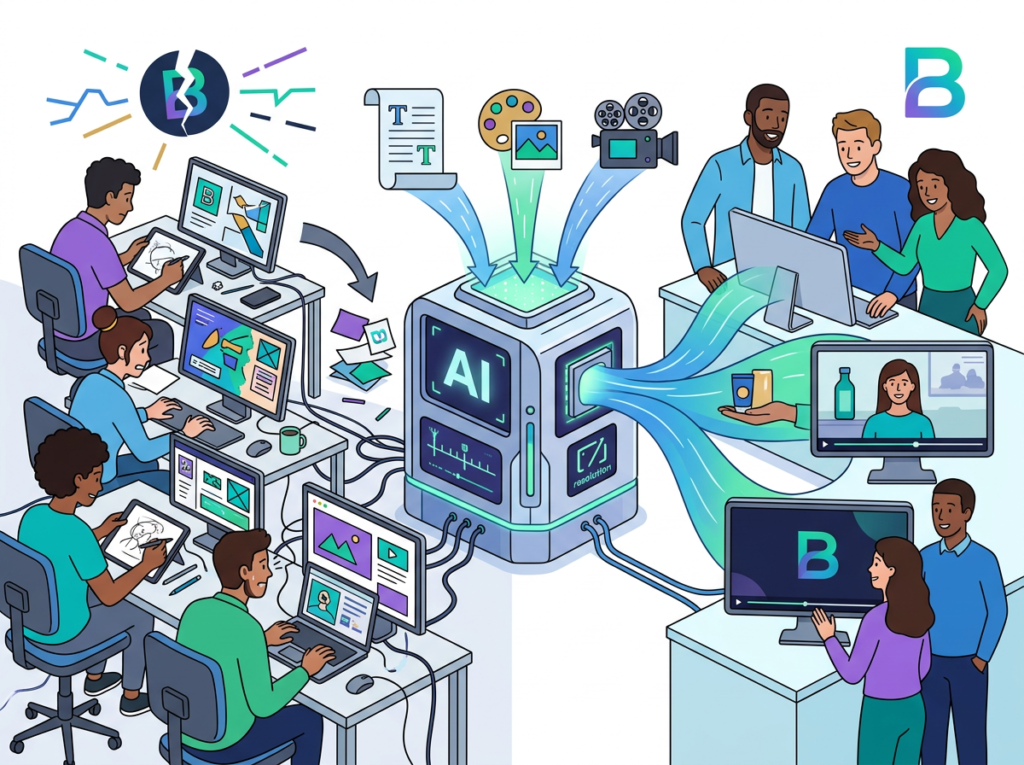
When different people on a small team produce video content without a shared system, quality varies wildly. One video looks polished; the next looks amateurish. Clients and audiences notice.
AI-generated video, when driven by well-crafted prompt templates and brand reference images, produces consistent visual output regardless of who runs the generation. Quality becomes a function of your prompting system, not individual skill.
The cost comparison:
| Method | Cost per video | Time | Team required |
|---|---|---|---|
| Traditional production | $3,000–$8,000 | 2–3 weeks | 3–5 people |
| Freelance editor | $800–$2,000 | 5–7 days | 1–2 people |
| AI video (Wan 2.6) | $5–$30 | 2–6 hours | 1 person |
For a US small team producing 8 videos per month, switching to an AI-first production workflow saves an estimated $15,000–$60,000 annually. That’s capital that goes back into distribution, paid media, or team growth.
Discover Wan 2.6 and see the full feature breakdown, pricing details, and comparison against alternative AI video tools on AI Plaza.
How Wan 2.6 Enables Solo DX
Text-to-Video: From Brief to Motion in Minutes

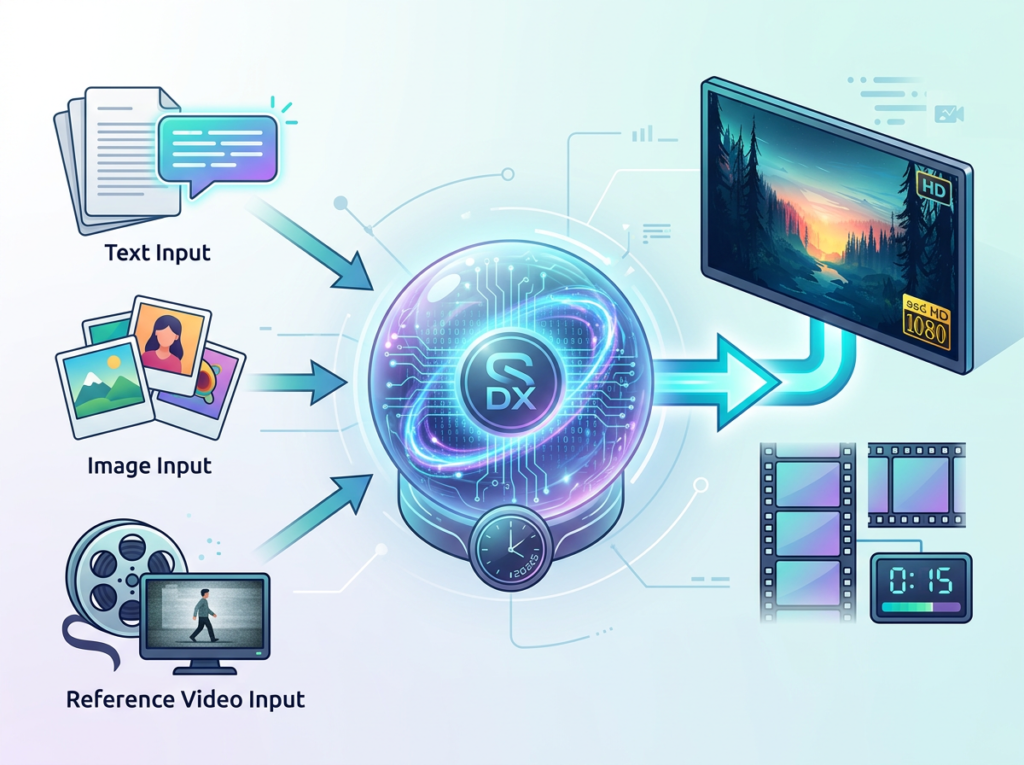
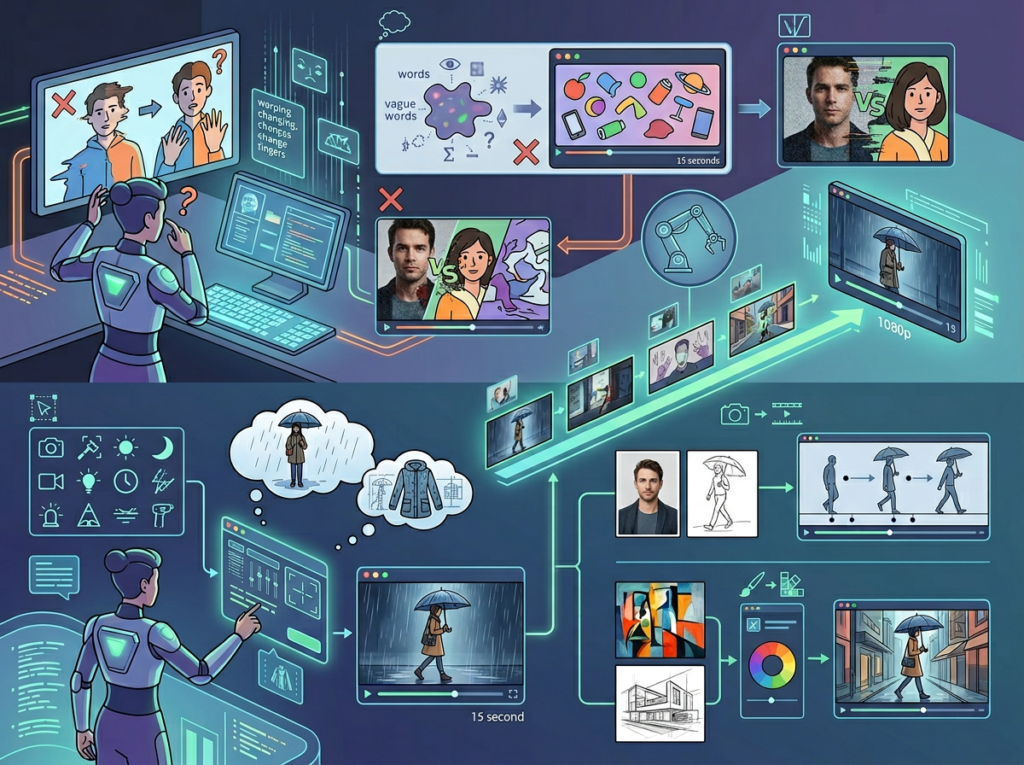
Wan 2.6’s text-to-video mode accepts detailed prompts up to 800 characters and generates video at resolutions up to 1080p, in durations of 5, 10, or 15 seconds. For small teams, this is the core workflow: write a clear, structured prompt, and get a usable video asset.
The key to consistent output is prompt structure. Wan 2.6 responds best to prompts that include a global style description followed by shot-level breakdowns with timing markers. A marketing team producing LinkedIn ads can develop a set of 8–10 prompt templates that produce brand-consistent video at scale.
Estimated savings: A team that previously spent $1,500/video on freelance motion designers and produces 6 videos per month saves approximately $9,000/month — or $108,000 annually — by shifting to AI generation for the initial production pass.
Image-to-Video: Animate Your Existing Creative Assets

For small teams that already have a library of product photos, lifestyle images, or brand visuals, Wan 2.6’s image-to-video mode is transformative. Upload a static image, describe the motion you want (camera push, environmental animation, lighting shift), and Wan 2.6 produces a cinematic video from it.
This capability alone eliminates the need for video shoots for many standard marketing use cases — product showcases, seasonal promotions, social content. A team with 50 quality product photos can generate 50 distinct video assets in a single afternoon.
Estimated savings: Eliminating one product video shoot per month, which typically costs $2,500–$5,000 including crew and editing, saves $30,000–$60,000 annually.
Reference-to-Video: Brand Consistency at Scale

Wan 2.6’s reference-to-video mode maintains subject and style consistency across multiple video generations. For small teams managing a brand, this means you can generate multiple video variations of the same product, spokesperson, or visual style without losing consistency between outputs.
For content marketing teams running A/B tests on video ads, this capability is essential. Generate four variations of a product ad with different motion sequences, test them simultaneously, and scale the winner — all without additional production cost.
Multi-Shot Sequencing
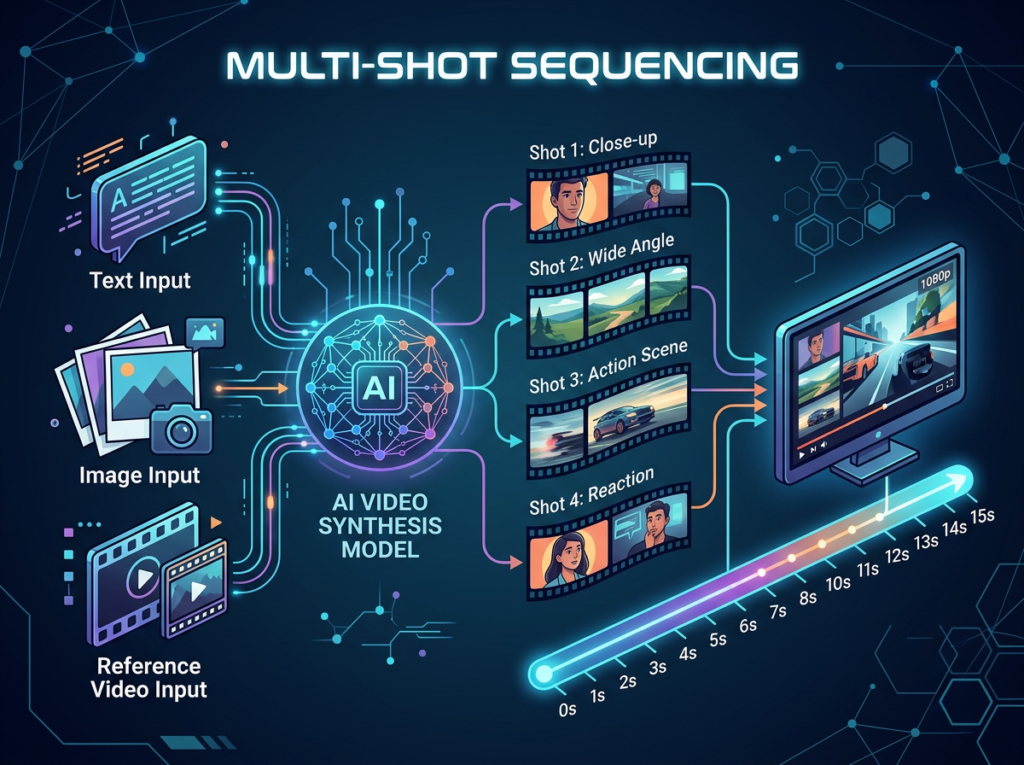
Wan 2.6 supports multi-shot video generation, allowing teams to produce structured, narrative video clips with multiple scene transitions in a single generation. As noted in this detailed prompt engineering breakdown, using timing brackets and specific camera action descriptors in prompts produces significantly more cinematic results than generic descriptions — a technique small teams can systematize once and use repeatedly.
ROI Summary by Feature
| Feature | Use Case | Annual Savings (US Teams) |
|---|---|---|
| Text-to-video | Ad creative, social content | $12,000–$24,000 |
| Image-to-video | Product showcases, promos | $15,000–$30,000 |
| Reference-to-video | Brand consistency, A/B testing | $8,000–$18,000 |
| Multi-shot sequencing | Narrative content, demos | $6,000–$12,000 |
See how Wan 2.6 works across all three generation modes with full technical specifications on AI Plaza.
Ready to cut your video production costs by 70% this quarter? Try Wan 2.6 Free | No credit card required | Trusted by growing US marketing teams
Use Cases by Team Role
Persona 1: Maria — Startup Founder Juggling Marketing, Sales, and Product (San Francisco, CA)

Background: Maria runs a 6-person B2B SaaS startup in San Francisco. She handles marketing strategy herself because they can’t yet afford a full marketing hire. Video content for LinkedIn and YouTube has been on her to-do list for six months — she knows it converts, but the production barrier has kept her from starting.
Old workflow: Maria would brief a freelance video editor, wait 5–7 days for a draft, go through two revision cycles, and publish — total time: 2–3 weeks, total cost: $1,200–$1,800 per video. She was producing two videos per quarter.
AI-powered workflow with Wan 2.6: Maria writes a structured text prompt based on a template her team developed. She uploads a product screenshot for image-to-video generation, specifies brand-aligned motion (clean camera push, minimal transitions), and generates a 15-second product demo in under an hour. She reviews, approves, and queues for publishing — same day.
Quantified results: Production time reduced from 2–3 weeks to 3–4 hours. Cost per video: from $1,500 to under $20. Maria now produces 8–10 videos per month instead of 2 per quarter — a 5x increase in content output without adding headcount.
“I spent six months avoiding video because the production process was too heavy. Now I produce more video content in a week than I used to in a quarter.” — Maria T., SaaS Founder, SF
Persona 2: James — Executive Assistant Onboarding Remote Staff (Miami, FL)

Background: James supports a 12-person consulting firm in Miami with a fully remote team spread across five states. Onboarding new contractors requires walking them through the firm’s methodology, tools, and client communication standards — a process that previously relied on 90-minute Zoom sessions that James had to run personally.
Old workflow: Every new hire got a live Zoom walkthrough, a shared Google Drive folder of PDFs, and a follow-up call. James spent 6–8 hours per new hire on onboarding content delivery. With 2–3 new hires per month, that was 15+ hours monthly on repetitive explanation.
AI-powered workflow with Wan 2.6: James used Wan 2.6 to convert the firm’s core methodology documents into a series of short explainer videos — text-to-video generations from structured prompts based on each onboarding module. New hires now watch a five-part video series (total: 40 minutes) before their first call.
Quantified results: James reclaimed 12–15 hours per month previously spent on live onboarding delivery. At an EA billing rate of $45/hour, that’s $6,480–$8,100 in recovered capacity annually. New hire ramp time dropped from 3 weeks to 10 days.
“The videos answer the questions I used to answer live. New people come to their first call actually prepared.” — James R., Executive Assistant, Miami
Persona 3: Robert — Content Trainer Documenting Internal Knowledge (Chicago, IL)

Background: Robert leads content training at a 20-person e-commerce brand in Chicago. The company’s content strategy — voice guidelines, visual standards, platform-specific formats — lives in Robert’s head and in an aging 80-page Google Doc that no one reads. New content team members take 4–6 weeks to produce on-brand content independently.
Old workflow: Robert would run weekly 2-hour training sessions for the first month of every new content hire’s tenure. He’d review every piece of content personally for the first six weeks. The bottleneck was real: Robert’s calendar was consistently 70% consumed by training overhead.
AI-powered workflow with Wan 2.6: Robert converted each section of the content guidelines into a short video module using Wan 2.6’s text-to-video generation — visual demonstrations of tone, format, and style standards that were nearly impossible to convey in text alone. As covered in this analysis of AI video generation techniques, Wan 2.6’s style range and prompt comprehension make it well-suited for producing training content that adapts to different visual styles and brand aesthetics.
New content hires complete a 90-minute self-directed video training before their first content review session. Robert reviews their first three submissions instead of twelve.
Quantified results: Robert’s training overhead dropped from 70% of calendar to under 20%. New hire time-to-independence: from 6 weeks to 3 weeks. Robert now has capacity to manage two additional content contractors — effectively doubling the team’s output without new FTE costs.
“I built the training system once. It runs itself now. Every new person gets the same foundation.” — Robert K., Content Trainer, Chicago
Explore Wan 2.6’s features and see how it fits into each of these production workflows with detailed technical specs and pricing comparison.
Join small teams across the US using Wan 2.6 to produce professional video content at a fraction of traditional cost. See How It Works | Used by marketing teams from Silicon Valley to New York
Common Pitfalls & How to Avoid Them
Pitfall 1: Using too many disconnected tools.
Many small teams try to assemble an AI video workflow from five or six separate tools — one for scripting, one for image generation, one for video, one for editing, one for publishing. The result is a workflow so fragmented it’s slower than what it replaced.
Fix: Start with Wan 2.6’s native capabilities (text-to-video, image-to-video, reference-to-video) and build outward only when there’s a clear gap. Depth in fewer tools outperforms breadth across many.
Pitfall 2: Generating video without a prompt system.
Teams that approach every video generation as a fresh creative exercise never build repeatable output. The quality is inconsistent and the time savings evaporate.
Fix: Develop a library of 10–15 prompt templates organized by content type — product demo, social ad, onboarding module, client report. Treat prompt templates like brand assets. Learn more about Wan 2.6 and how its multi-shot prompt structure supports this kind of systemization.
Pitfall 3: Failing to review AI output before publishing.
AI video generation produces impressive output, but it’s not infallible. Motion artifacts, off-brand visual elements, and pacing inconsistencies appear — especially in early generation passes.
Fix: Build a one-pass human review step into every production workflow. This takes 10–20 minutes and catches the 5–10% of outputs that need regeneration before they become brand problems.
Pitfall 4: Treating AI video as a replacement for creative strategy.
The biggest mistake US small teams make is assuming that AI video generation eliminates the need for clear creative direction. The opposite is true — AI amplifies whatever creative strategy (or lack of one) you bring to it.
Fix: Invest time upfront in brand guidelines, content strategy, and audience definition. The ROI on AI video production is only realized when the inputs are strategically sound. Teams that combine strong creative strategy with ai video production automation consistently outperform teams that use AI as a shortcut around strategic thinking.
Discover Wan 2.6 and see the full feature breakdown, pricing details, and comparison against alternative AI video tools on AI Plaza.
FAQs

What is Solo DX?
Solo DX refers to small-scale digital transformation led by US founders and micro-teams without dedicated operations staff. It focuses on building lightweight, AI-assisted systems that make growing teams more consistent and efficient — without enterprise-level complexity.
How can AI write or generate my marketing videos?
Tools like Wan 2.6 accept text prompts describing your video content — scene descriptions, camera movement, style, mood — and generate video output directly from those descriptions. You can also provide static images and animate them, or use reference images to maintain brand consistency across multiple generations. No video editing skills required.
What’s the difference between AI Efficiency and Solo DX in content production?
AI Efficiency tools focus on making an individual faster — autocomplete, single-task automation, personal productivity. Solo DX applies AI at the workflow level, building repeatable production systems that an entire team can use consistently. The distinction matters because Solo DX tools like Wan 2.6 are designed for output that scales across team members, not just individual use.
Can small teams actually afford AI video tools?
Yes. Wan 2.6 is accessible through wan.video with no enterprise pricing requirement. The monthly cost for most small teams is in the range of $30–$100 — compared to $3,000–$8,000 per traditionally produced video. For a team producing 4–8 videos per month, AI video tools pay for themselves on the first project.
Is Wan 2.6 hard to set up for a non-technical marketing team?
No. Wan 2.6 is accessed through a web interface at wan.video — no installation, no API configuration required for standard use. Marketing teams are typically producing their first video within an hour of creating an account. The learning curve is in prompt refinement, not technical setup.
Discover Wan 2.6 and see the full feature breakdown, pricing details, and comparison against alternative AI video tools on AI Plaza.
Conclusion

In 2026, American small businesses don’t need enterprise budgets to produce enterprise-quality video content. The gap between what a two-person marketing team and a full production agency can produce has narrowed dramatically — and AI video generation is the reason.
Wan 2.6 gives US small teams a complete ai video generator for marketing that covers text-to-video, image-to-video, and reference-to-video generation in a single platform. The production economics are transformative: what used to cost $3,000–$8,000 and two to three weeks now costs under $30 and takes a few hours.
The teams that win in content marketing with ai video aren’t the ones with the biggest budgets. They’re the ones that build the best production systems — clear prompt templates, consistent brand inputs, a disciplined one-pass review workflow — and execute them consistently.
Start with one process. Pick the video type your team produces most often — a social ad, a product demo, a client report summary — and build a Wan 2.6 prompt template for it this week. Systemize that one workflow. Then expand.
Discover Wan 2.6 and see the full feature breakdown, pricing details, and comparison against alternative AI video tools on AI Plaza.
Leave a Reply