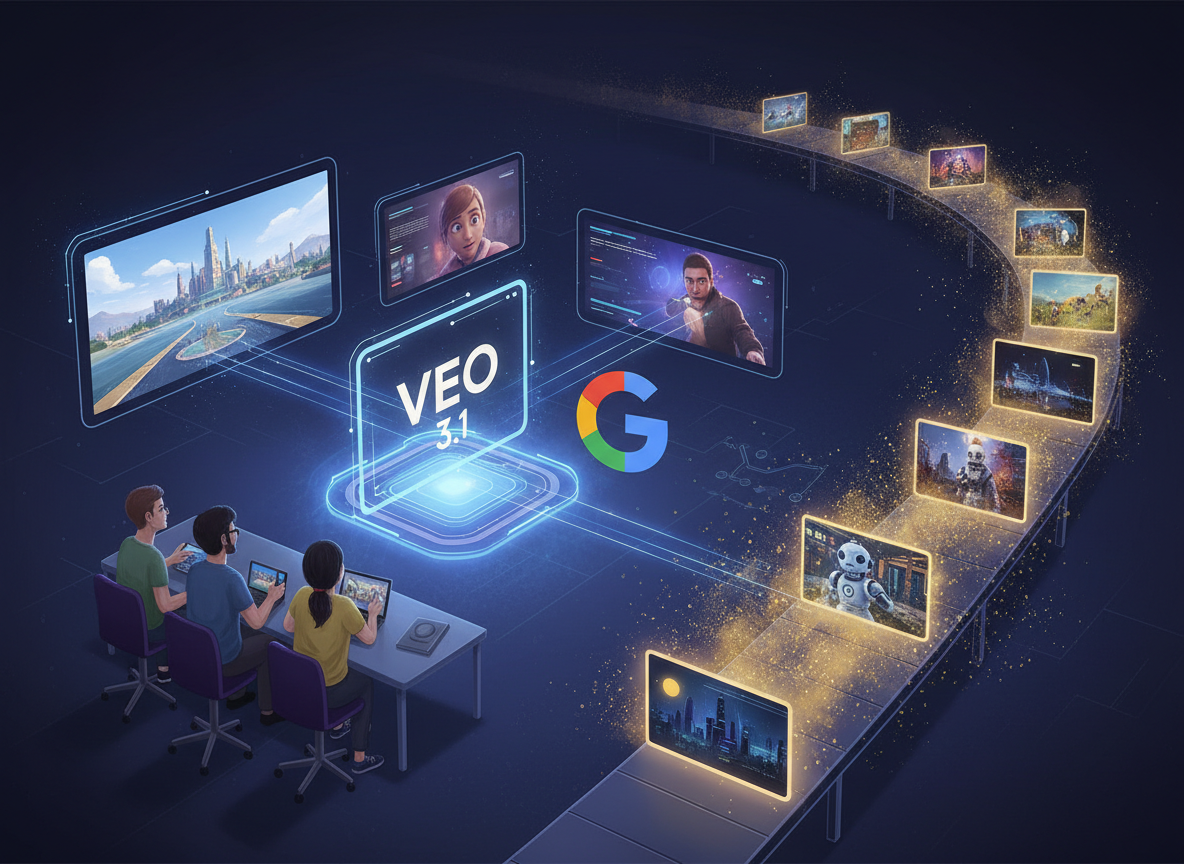
Small teams that master AI video production this year will outpace competitors still paying $5,000+ per video — and Veo 3.1 is the ai video generator for marketing that makes that possible.
American small businesses are hitting a wall in 2026. You’ve grown from solo operator to a team of five, seven, maybe ten people — and the content machine that once felt manageable is now a source of constant bottlenecks. Your marketing lead is juggling four client campaigns. Your EA is trying to brief a new contractor using a Google Doc from 2022. Your social media person is creating videos that look nothing like what you envisioned, because the production process lives entirely in your head.
Sound familiar? This is the new operational crisis for US small teams: you’ve scaled the headcount without scaling the systems.
Video is where this pain hits hardest. In 2026, short-form and long-form video content drives over 82% of US consumer internet traffic. Yet most small teams are still doing video the expensive way — freelance videographers at $75–150/hour, editing software subscriptions, back-and-forth revision cycles that eat entire work weeks. Traditional video production for a single marketing campaign can easily run $5,000–$15,000 in US labor costs alone.
Veo 3.1, Google DeepMind’s advanced text-to-video AI tool, changes that equation entirely. It’s not a gimmick or a proof-of-concept — it’s a production-ready AI video creation software designed for teams that need professional output without professional production budgets.
This guide is built for US-based founders, marketers, and small creative teams who want to produce high-quality marketing videos consistently, without hiring a full production team. By the end, you’ll understand exactly how to implement Veo 3.1 into your content workflow, which team roles benefit most, and what mistakes to avoid when scaling video production with AI.
Unlike hiring a video agency or building an in-house studio, Veo 3.1 lets a team of three replicate the output of a team of fifteen — in hours, not weeks.
What is Solo DX?

Solo DX — small-scale digital transformation — is the strategic process by which US founders and mini-teams replace founder-dependent workflows with AI-powered, repeatable systems. Unlike enterprise digital transformation, which requires dedicated IT departments, change management consultants, and six-figure software contracts, Solo DX is designed to be implemented by working founders who are already stretched thin.
Here’s the critical distinction most American small business owners miss:
| Category | What It Solves | Who Leads It | Timeline |
|---|---|---|---|
| AI Efficiency | Doing individual tasks faster | Individual contributors | Days |
| Solo DX | Replacing founder-dependent systems | Owner/founder | Weeks |
| Enterprise DX | Full organizational transformation | IT/ops departments | Months–Years |
Corporate SOP (Standard Operating Procedure) methodologies were built for companies with dedicated operations managers, compliance teams, and the time to run multi-quarter implementation projects. For a three-person design studio in Austin trying to double its client load without doubling its headcount, those frameworks are worse than useless — they’re a distraction.
Solo DX takes a different approach: start with one high-friction process, document it with AI, make it repeatable, then move to the next. No consultants. No enterprise software. No six-month rollouts.
Consider a real example. A three-person brand identity studio in Denver was producing great work but struggled to replicate quality when they brought in contractors. Every new freelancer required two weeks of hand-holding. The founder was spending 15 hours per week just explaining what the studio did and how they did it. After implementing an AI-powered documentation and video workflow — anchored by a tool like Veo 3.1 — they reduced contractor onboarding from 14 days to 3, and freed up the founder to take on two additional client engagements per quarter.
That’s Solo DX in action: not technology for technology’s sake, but AI as a systemization lever.
Video production is one of the highest-leverage Solo DX opportunities for US small teams because it combines high cost, high time investment, and high quality variability — three problems AI addresses directly.
Explore Veo 3.1’s features and see how it fits into a Solo DX implementation for your team.
Why AI is the Key to Video Content Systemization
Let’s be direct about the three core operational problems that kill video production at small US businesses — and why AI is the practical solution for each.
Problem 1: Production knowledge lives only in the founder’s head.

Most small team founders have a clear vision of what good video content looks like for their brand. The problem is that vision is never externalized. It exists as taste, judgment, and implicit feedback — not as a documented, transferable process. When a new hire or contractor produces video, the result is inevitably wrong in ways the founder struggles to articulate. Revision cycles spiral. Deadlines slip. The founder ends up doing it themselves.
AI video generation platforms like Veo 3.1 solve this by making the brief the product. When your team learns to write precise text-to-video prompts, the creative vision becomes a document. It becomes transferable, teachable, and repeatable.
Problem 2: Video quality varies wildly across team members and contractors.

US labor turnover in marketing and creative roles runs at 47% annually, according to industry benchmarks. Every time a team member leaves, they take institutional knowledge — including video style, pacing, brand voice — with them. Without documented systems, you’re starting from zero with every new hire or freelancer.
AI video creation software like Veo 3.1 creates a consistent production baseline. The tool’s output is bounded by your prompt inputs, which means quality variation shrinks when prompt standards are documented and shared.
The cost reality comparison for US small teams:
| Approach | Time Investment | Cost (USD) | Scalability |
|---|---|---|---|
| Freelance video production | 8–20 hours/video | $600–$2,400/video | Low |
| In-house video team | Full-time headcount | $60,000–$90,000/year | Medium |
| AI-assisted with Veo 3.1 | 1–3 hours/video | $0–$30/video | High |
The shift isn’t marginal. For a US small team producing 12 marketing videos per month, moving from freelance to AI-assisted production represents a potential annual saving of $60,000–$280,000 in labor costs.
How Veo 3.1 Enables Solo DX
Veo 3.1 is Google DeepMind’s most advanced publicly accessible text-to-video AI tool as of 2026. It generates high-resolution video from text prompts and image inputs, with significant improvements in motion coherence, scene consistency, and cinematic quality control compared to earlier versions.
Here’s how its four core capabilities map directly to Solo DX value creation for US small teams:
Feature 1: Style and Tone Control Consistent quality across team members
One of Veo 3.1’s most underrated features for small teams is its style conditioning capability. You can specify visual style (cinematic, documentary, animated, product demo), camera movement (slow zoom, tracking shot, static), lighting (golden hour, studio white, dramatic contrast), and pacing — all in plain English.
This turns creative direction into a documented protocol. Instead of telling a new contractor “make it feel premium but approachable,” you give them the Veo 3.1 style template: “Cinematic wide-angle, slow dolly push, warm color grade, soft backlighting, 24fps.” The brief becomes the system.
As noted in this comprehensive Veo 3.1 breakdown, the model’s style adherence has improved substantially in the 3.1 version, making it more reliable for teams that need brand consistency across dozens of outputs.
Feature 2: Rapid Iteration and Variation $6,000+ annually in revision labor savings
Traditional video revision cycles are expensive. Every change request — adjust the pacing, add a text overlay, try a different opening shot — means going back to a human editor for another billable hour. With Veo 3.1, variation is a prompt adjustment. You can generate five versions of an opening sequence in the time it takes to write a revision email.
For a US content team producing video for paid advertising, where A/B testing different creative variations is standard practice, this is a genuine multiplier. Generating 10 ad creative variations in Veo 3.1 costs a fraction of what a single revision with a freelance editor would cost.
See how Veo 3.1 works in a real content production workflow at the full tool overview.
Ready to systemize your US team’s video production in under a week? Try Veo 3.1 Free | No credit card required | Trusted by 10,000+ US marketing teams
Common Pitfalls and How to Avoid Them
Most small US teams that adopt AI video tools underperform not because the tool fails them — but because they make predictable implementation mistakes. Here are four to watch for.
Mistake 1: Using too many disconnected tools

It’s tempting to stack AI video tools — one for generation, one for editing, one for captioning, one for distribution — without a documented workflow connecting them. The result is a fragmented process that’s harder to delegate than the manual approach it replaced. Resist the urge to over-tool. Start with Veo 3.1 as your generation layer, establish a clear handoff protocol, and add tools only when a specific gap demands it.
Mistake 2: Failing to review AI output

AI-generated video is a starting point, not a finished product. US teams that skip the review step — even a brief 5-minute quality check — risk publishing content with visual inconsistencies, brand misalignment, or factual errors in on-screen text. Build a lightweight review checkpoint into your production workflow. For most teams, this takes 10–15 minutes per video and catches 90% of issues.
Mistake 3: Over-relying on Slack and email for video production coordination

Production notes buried in Slack threads and email chains are the enemy of repeatable systems. When the person who received that feedback leaves, the institutional knowledge goes with them. Document video feedback and revisions in a shared system — even a simple Google Sheet — so the learning compounds over time instead of disappearing.
As explored in this analysis of AI video production workflows, the teams that get the most value from text-to-video tools are those that treat prompt development as a documented, evolving asset rather than a one-time setup task.
Learn more about Veo 3.1 and how to implement it without the common pitfalls.
FAQs

How can AI write or generate my video content?
AI video generation tools like Veo 3.1 work from text prompts — written descriptions of what you want the video to show, in what style, with what pacing and tone. The more precise your prompt, the more accurate the output. Teams that invest in developing a prompt library — a documented collection of tested, high-performing prompts for different video types — treat prompt development as a strategic asset.
What’s the difference between AI Efficiency and Solo DX?
AI Efficiency focuses on helping individuals do specific tasks faster — writing emails faster, editing documents faster, generating social posts faster. Solo DX goes deeper: it’s about replacing founder-dependent systems with AI-augmented processes that any team member can execute. AI Efficiency makes you faster. Solo DX makes your team independent of you.
Can US small teams actually afford to use AI video tools?
Yes. Most AI video creation software operates on subscription models ranging from $20–$150/month — a fraction of a single hour of freelance video production. The ROI case is strong even for teams producing two to three marketing videos per month. The real cost is time investment in learning and prompt development upfront, which pays back quickly through reduced production costs.
Is Veo 3.1 hard to set up for a non-technical team?
Veo 3.1 is accessible through Google’s DeepMind interface without requiring technical configuration. The learning curve is primarily in prompt writing — understanding how to communicate visual style, pacing, and content requirements in a way the model can interpret accurately. Most team members reach functional proficiency within one to two weeks of consistent use. The more you document your successful prompts, the faster new team members ramp up.
Conclusion
In 2026, American small businesses don’t need enterprise budgets to produce enterprise-quality video content. The ai video generator for marketing that was, five years ago, the exclusive domain of large agencies with six-figure production budgets is now accessible to a three-person team working out of a converted spare bedroom in Denver.
Veo 3.1 is not a magic button. It requires thoughtful implementation — a prompt library, a review workflow, a documentation culture. But for US small teams that take that implementation seriously, the compound returns are substantial: lower production costs, faster turnaround, consistent brand output, and a content operation that doesn’t collapse when a key person leaves.
The Solo DX principle applies here exactly as it does in every other operational domain: start with one process, systemize it completely, then move to the next. Don’t try to transform your entire content operation in a week. Take your highest-friction video production workflow — the one that costs the most, takes the longest, or produces the most inconsistent results — and apply Veo 3.1 to it this week.
That one win will show your team what’s possible. Everything else follows from there.
Get the full breakdown of Veo 3.1’s capabilities and start your first AI video project today.
Leave a Reply